To avoid these ads, REGISTER NOW!

Lug Nut / Stud Torque

_brian_

Well-known member
Joined
Jun 23, 2019
Messages
360
Location
Wisconsin, USA
I was enjoying some reasoning on torque sticks in the forums here and opted for a new thread vs reviving those over a year old.

What really happens if I over torque a lug nut? For example, say spec is ~100 and I torque to ~140. I know the standard I hear is I will "warp the rotor". However, I also hear that the pulsating from brakes is a result of warped rotors, however, the rotors are not actually warped, they have uneven wearing of brake material on them. It would seem to me the same here, as long as the tire is on the rotor which is on the hub all straight and no dirty or other in between, the mating surfaces are flat and thus not "warped". Aside from potential wheel damage, lug nut/bolt and other part damage and difficulty of the next removal, is there anything that is really at risk?
 
  • Like
Reactions: LSU
To avoid these ads, REGISTER NOW!

Ole Slewfoot

Well-known member
Joined
Feb 22, 2016
Messages
5,098
Location
Freedom, CA
It would seem to me the same here, as long as the tire is on the rotor which is on the hub all straight and no dirty or other in between, the mating surfaces are flat and thus not "warped". Aside from potential wheel damage, lug nut/bolt and other part damage and difficulty of the next removal, is there anything that is really at risk?
Once you ruled out part and roval damage, that pretty much leaves crash damage and reinstallation difficulty.
 

2ndGearRubber

Well-known member
Joined
Mar 24, 2014
Messages
14,185
Location
Pittsburgh
I don't even want to touch the "warped rotor" wormhole.

So long as a fastener is not plastically deformed, no harm no foul. Lugs and studs are typically m12 to m14. These fasteners, with the metals used, are capable of a fairly large range.


People lose their minds about lug nuts, but I have never been questioned about timing belt tensioner or cam caps.
 
OP
B

_brian_

Well-known member
Joined
Jun 23, 2019
Messages
360
Location
Wisconsin, USA
In the past I will admit that I just impacted lug nuts on. Once I learned, I stopped doing that. However, I have never experienced a problem with over tightening, but I have with under. If not tight enough, it can loosen and fall off, causing an obvious risk.

I guess in my experience, I would rather have a 100 spec tightened to 140 than 80, or even 90. It seems to me that the risk is more under tightening, as even a little is a lot when compared to over.

I am considering a reasonable smart person here though, if I were to over tighten to the point that I start to stress the nut/bolt hardware, all logic is out the window. I assume the same sense that has a person not tighten a 8 mm head bolt to 150 pound feet, to keep things in order, I need to assume some core sense.
 

cannuck

Well-known member
Joined
Nov 30, 2021
Messages
4,594
Location
Rural SK
If a rotor is trapped between wheel and hub, I can't see how it could distort from wheel fastener tension, Ditto the hub, and I realize that assaults a lot of common wisdom.

What you DO risk, as pointed out in post #3 is finding the plastic deformation limit of the fastener. While the stretched bolt or stud may still be in tact, you are diving very deeply into its fatique life and most likely have opened surface micro cracks that invite stress corrosion cracking to occur somewhere down the road (wheels live in a horribly corrosive environment in snow country). I would actually replace any fastener that is known to have been overtightened by 40% or more.
 

Steve_P

Well-known member
Joined
Sep 15, 2010
Messages
5,181
Torque specs for reusable fasteners are derived by assuming a tension of about 70% of the bolts yield strength. So, in theory, you can overshoot by about 40% and still be ok. This assumes that the friction is exactly what is assumed when calculating the spec, so YMMV, but based on the 70%, there is a lot of room for error in overtightening. I've "torque audited" myself and found that I typically overtighten by at least 20% when going by feel.
 

u2slow

Well-known member
Joined
Nov 20, 2011
Messages
3,583
Location
BC
Overtorque can possibly cause the stud to snap. It may happen days/weeks/miles after the original torquing; when you hit a hard bump, or on loosening the next time. You don't know the history on that fastener either, unless it's brand new.

I don't want to ride that edge. Rather go for the low end of the torque range and re-torque again later.
 

2ndGearRubber

Well-known member
Joined
Mar 24, 2014
Messages
14,185
Location
Pittsburgh
If a rotor is trapped between wheel and hub, I can't see how it could distort from wheel fastener tension, Ditto the hub, and I realize that assaults a lot of common wisdom.

What you DO risk, as pointed out in post #3 is finding the plastic deformation limit of the fastener. While the stretched bolt or stud may still be in tact, you are diving very deeply into its fatique life and most likely have opened surface micro cracks that invite stress corrosion cracking to occur somewhere down the road (wheels live in a horribly corrosive environment in snow country). I would actually replace any fastener that is known to have been overtightened by 40% or more.

Wormhole activated:

With varying clamping load around the surface, the rotor will deform slightly. It's academic, but it exists. The big one is rust jacking behind the hub, making the rotor sit crooked. At least "the big one" in terms of mounting related issues. Eventually the hub is so rotten you can't buff/grind it clean anymore and have it still be flat. I get the rust and scale off and call it acceptable. It's not like the rotor is actually true and flat to begin with.

Armchair engineers lose their minds about "warped" rotors. Whatever, irregular or excessive runout. That's what it is. Warp is the the colloquial term for a friction surface with runout issues, whatever the root cause may be.
 

39CAMC

Well-known member
Joined
Feb 26, 2019
Messages
468
Location
St. Louis, MO
So long as a fastener is not plastically deformed, no harm no foul. Lugs and studs are typically m12 to m14. These fasteners, with the metals used, are capable of a fairly large range.


People lose their minds about lug nuts, but I have never been questioned about timing belt tensioner or cam caps.
Yeah, this. The most immediate risk of over torquing them is not being able to get them back off. 2ndgear deals with way more rusty stuff than I do, but if its supposed to go to 100 and someone does 180 and then add in 2 years of corrosion and heat/colling and all the sudden the nut (or especially the bolt) literally can't hold enough torque and strips and then you have an issue. THe numbers are different for different cars, Honda S2000 and Subaru, which seem to make studs from used wet toilet paper, are the worst. Over torqued strips the threads, so the next guy removing it finds the lug locked to the stud, which then strips the splines and it spins in the hub. Very fun.

IMO, the biggest reason to hand torque stuff is to ensure that a) they are somewhere in a reasonable range of the spec and b) so that you don't forget one.

DaveW
 

cannuck

Well-known member
Joined
Nov 30, 2021
Messages
4,594
Location
Rural SK
Wormhole activated:

The big one is rust jacking behind the hub, making the rotor sit crooked. At least "the big one" in terms of mounting related issues. Eventually the hub is so rotten you can't buff/grind it clean anymore and have it still be flat. I get the rust and scale off and call it acceptable.
We change our wheels 2 x a year so to avoid this exact problem on the hub/rotor interface as well as the rotor/wheel one I clean the surface off with wire brush (if corroded, I like to start doing this when near new and still protected with original finish) then spray a coating of zinc rich paint. Works like a damn.
 

Treeman

Well-known member
Joined
Jan 4, 2008
Messages
545
Location
Michigan
Wormhole activated:

With varying clamping load around the surface, the rotor will deform slightly. It's academic, but it exists. The big one is rust jacking behind the hub, making the rotor sit crooked. At least "the big one" in terms of mounting related issues. Eventually the hub is so rotten you can't buff/grind it clean anymore and have it still be flat. I get the rust and scale off and call it acceptable. It's not like the rotor is actually true and flat to begin with.

Armchair engineers lose their minds about "warped" rotors. Whatever, irregular or excessive runout. That's what it is. Warp is the the colloquial term for a friction surface with runout issues, whatever the root cause may be.
Yes! I detest the idea invoked when a brake job is referred to as a "pad slap", especially in the salt belt. Pad slap seems to imply that you simply throw in new pads and neglect the rest of a complete brake job: clean hub/rotor mating surfaces, all lubed areas cleaned and re-lubed, fluid exchanged, etc..

In line with your mention of run out, just a few years ago I started using a clamp-on dial gauge to check run out during routine brake jobs. I've read that brake pulsation/warp sometime develops after new rotors with excessive run out are used for several thousand miles. The initial run out might be from rusty/dirty hub surfaces or again, present in new rotors out of the box . Sometimes you can change the position (index) of the rotor on the hub to achieve acceptable standards.

For the very occasional DIYer, the Harbor Freight clamp on dial gauge works just fine.
 

2ndGearRubber

Well-known member
Joined
Mar 24, 2014
Messages
14,185
Location
Pittsburgh
Yes! I detest the idea invoked when a brake job is referred to as a "pad slap", especially in the salt belt. Pad slap seems to imply that you simply throw in new pads and neglect the rest of a complete brake job: clean hub/rotor mating surfaces, all lubed areas cleaned and re-lubed, fluid exchanged, etc..

In line with your mention of run out, just a few years ago I started using a clamp-on dial gauge to check run out during routine brake jobs. I've read that brake pulsation/warp sometime develops after new rotors with excessive run out are used for several thousand miles. The initial run out might be from rusty/dirty hub surfaces or again, present in new rotors out of the box . Sometimes you can change the position (index) of the rotor on the hub to achieve acceptable standards.

For the very occasional DIYer, the Harbor Freight clamp on dial gauge works just fine.

In my world pad-slap just means no rotors.

Still need to pull the brackets off, grind them to clean metal, new hardware, pins moving freely, etc. Most of the brake pads I remove require a hammer to knock them out of the bracket. It simply isn't possible to hammer a set of pads in, clean nothing, and survive with no comebacks. It sure would be nice to be able to, but you gotta get it clean.
 

F-22

Well-known member
Joined
Jan 23, 2022
Messages
1,830
I guess in my experience, I would rather have a 100 spec tightened to 140 than 80, or even 90. It seems to me that the risk is more under tightening, as even a little is a lot when compared to over.
I doubt that little of a change makes much of a difference, there's bound to be a decent safety factor on the specified value for lug nuts. Main thing is to have them tightened equally, but for most cars ~100-120Nm will be fine, and for trucks a bit more...
 

MJK

Well-known member
Joined
May 21, 2018
Messages
729
Location
Tucson, AZ
I've always been told even was more important than exactly to spec, but owned a torque wrench long before electric impacts were a thing. I assume that at extreme loads (e.g. track days or heavy mountain roads with 10k trailers) that the rotors get pretty darn hot and need some room to expand within the tensile strength of the stud and/or the elastic deformation range of the rotor. I've boiled fresh ATE, glazed pads and even had to replace piston seals, but never warped rotors. Maybe I have just been lucky - but it's amazing how often that happens with a little extra care (and ducting).

I don't understand why people feel the need to exceed spec. Maybe it's just me, but when have you ever seen a lug fall off? VS need to get a breaker bar after a visit to your local tire shop? That can't help the life of the studs.

You guys up north have my sympathies. I used to live in the salt belt. That was a whole different bowl of turds. Never again.
 
OP
B

_brian_

Well-known member
Joined
Jun 23, 2019
Messages
360
Location
Wisconsin, USA
Wow! I appreciate the opinions, and the addition of brakes to the discussion. I live in the salting area, SE Wisconsin. Not as bad as other places, but still in it. Once the surfaces are cleaned and assembled, it should not matter. Now I speak from what I do, I use anti-seize, corrosion inhibitor (like Fluid Film), I use abrasive wheels to clean the hub and inside of wheels, etc.

Again though, what really happens? If I over tighten ANY bolt, it is prone to fail. This should not be a wheel nut/bolt specific topic. We have nothing more than a 12mm, 14mm, etc stud (or bolt) that we fasten. I can find numerous torque specs that do not even consider the make/model of car, but just list the spec based on the bolt size. I believe those who do not get this... it is user and employer error. I just wonder... what are the real and true risks of those errors.
 
OP
B

_brian_

Well-known member
Joined
Jun 23, 2019
Messages
360
Location
Wisconsin, USA
I don't even want to touch the "warped rotor" wormhole.
My friend, I see your point. I would love to have that topic discussed, but this is not the query to do it in. If you have interest, I wonder if the mods can branch it out, or I can make a new thread if there is any interest.
 

rancherbill

Well-known member
Joined
Oct 18, 2007
Messages
5,332
Location
Foothills County, Alberta, Canada
Right from day one there was a torque for the bolts. The problem in the field was not very many home mechanics had a torque wrench. Tight was good enough.

Today many many people have torque wrenches and the info is on the net. It's called doing a quality job nowadays.
 

F-22

Well-known member
Joined
Jan 23, 2022
Messages
1,830
I can find numerous torque specs that do not even consider the make/model of car, but just list the spec based on the bolt size.
Bolt material is equally important, I think most lug nuts are at least 10.9 metric grade...
 
To avoid these ads, REGISTER NOW!

Ole Slewfoot

Well-known member
Joined
Feb 22, 2016
Messages
5,098
Location
Freedom, CA
Nobody else ever ran across a fullsize truck that had been overtightened so much the conic part of the nut mushroomed in, the impact hammered all the way, and all 32 nuts either came off smoking, or snapped the stud?
 

2ndGearRubber

Well-known member
Joined
Mar 24, 2014
Messages
14,185
Location
Pittsburgh
Nobody else ever ran across a fullsize truck that had been overtightened so much the conic part of the nut mushroomed in, the impact hammered all the way, and all 32 nuts either came off smoking, or snapped the stud?

I've seen that on plenty of steel wheels on cars. Often the lugs are too soft to begin with. GM lugs for steel wheels in the 90s/00s come to mind. They're just made of cheese.

It's a viscious cycle. Prior to complete failure, the warning signs are obvious. The front desk/customer doesn't want to hear it, so they get rammed back on. That, and a lack of accountability. If such work is leaving the shop, that's probably not the first time. If we want to bee seen as professionals, we need to act like it. Training and management managing come to mind.
 

dchawk81

Well-known member
Joined
Jul 31, 2014
Messages
14,345
Nobody else ever ran across a fullsize truck that had been overtightened so much the conic part of the nut mushroomed in, the impact hammered all the way, and all 32 nuts either came off smoking, or snapped the stud?
Or worse....start spinning it loose and it freewheels because some jack wagon cross threaded it and ran it down with a 1" gun.

Now you're in for 40-60 new studs because you can't trust that ******* at all.
 

BlakeTheCarGuy

ALLIANCE MEMBER
Joined
Oct 10, 2018
Messages
9,318
Location
Roanoke Virginia
It can put too much pressure on the rotor personally I’ve never seen that happen though where it actually damages the rotor. In school we were taught that torque was based on wheel type and it was 80 for steel and 100 for aluminum because aluminum flexes more. Since i started in the industry I’ve realized it’s more of based on stud material in fact everyone at my dealership thought I was crazy for saying it was based on wheel type lol. I’ve used torque sticks before but you have to know how to use them and know to double check the lugs at the end. Personally I’ve never torqued wheels on my personal vehicles lol. Tight is tight for me and I’ve found most people don’t. Every customer car I touch though the wheels get torqued to spec. I’m a Subaru/ Toyota tech and Toyota specs 76 for all their wheels and Subaru 89 for all of theirs. I do 90 because it’s easier on the Subaru but one foot pound isn’t going to make a difference. One of our loober goobers snapped off a Toyota Tundra wheel stud torquing it to 130 at 5:53pm when we were getting ready to close I was so mad lol.
 

Aileron

Well-known member
Joined
Apr 15, 2019
Messages
457
Location
outside
I never bought the warped rotor theory either. Most are hats sandwiched between the wheel and hub. Your not pulling it ,your sqeezing it.
 

alwaysFlOoReD

Well-known member
Joined
Sep 24, 2013
Messages
2,384
Location
Airdrie, Alberta, Canada
Nobody else ever ran across a fullsize truck that had been overtightened so much the conic part of the nut mushroomed in, the impact hammered all the way, and all 32 nuts either came off smoking, or snapped the stud?
I found a 22.5" aluminum rim and wheel in the ditch. There was a few broken studs with nuts attached still in the holes...
I have pics somewhere but not easily accessible.
 

Garcky

Well-known member
Joined
Sep 10, 2022
Messages
3,434
Location
Twin Cities Metro Area, Minnesota
The thing is that it's pretty easy to torque those things. Takes just a few minutes. It's doing the job right. Why wouldn't someone do it? That's what I've never understood. Even if you're working in a flat rate shop, torqueing lug nuts isn't all that time-consuming.

Do the job right. It's good for the customer and, in the end, good for you, too.
 

dnschmidt

Well-known member
Joined
Oct 3, 2014
Messages
7,264
Location
Phoenix, AZ
Slightly off topic. One of the most interesting findings of the Torque Test Channel was that torque sticks seemingly work well with air impact wrenches and not very well with Cordless or Electric impact wrenches. The reason seems to be the frequency of hit being much slower for the air impact versus the electric. The slower hit of the air impact gives the spring time to do it's spring thing whereas the rapid hit of the cordless doesn't give the torque stick time to recover. I have an I-R 231 which I use exclusively for torque sticks that seems to make them work just right. Naturally, being a torque wrench kind of a guy I follow this lower value torque stick up to actually spec using a torque wrench but the fact that the impact itself had so much bearing on whether the torque stick was accurate or not was surprising.
 

corn chip

Well-known member
Joined
Jul 15, 2021
Messages
672
Torque specs for reusable fasteners are derived by assuming a tension of about 70% of the bolts yield strength. So, in theory, you can overshoot by about 40% and still be ok. This assumes that the friction is exactly what is assumed when calculating the spec, so YMMV, but based on the 70%, there is a lot of room for error in overtightening. I've "torque audited" myself and found that I typically overtighten by at least 20% when going by feel.

theres a good amount of over shoot left. thats why grease , antiseize or any other lube can be used on the threads and still not go beyond the plastic limit. but lets not get that heated argument fired up again
 

BigLeagueSmoes

Well-known member
Joined
Feb 10, 2022
Messages
314
Location
Central IL
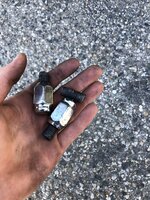
Story time! Okay so I can't say that I know EXACTLY what happened during this story but I have a strong suspicion. To answer your question, as some others have stated, if you over torque a fastener you can plastically deform it causing it to become brittle and ultimately break under stress/load.

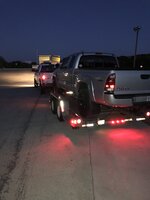
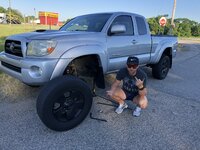
I bought this truck (still have it, still love it) outside of Cincinnati and drove it back home to central Illinois. When I bought the truck the seller said that just two days before I bought it he had the front pads replaced. He did have a receipt for the work which was done at a local shop. Everything seemed to check out fine when I looked it over and test drove it. So I buy this truck and am driving it back home, it was a beautiful early June evening and I was excited to have a new truck! The sun was shining, windows down because it was a perfect 80 degree evening. As I make my way around Indianapolis and back towards Illinois I notice on the 465/74 west interchange I notice some pretty strong steering wheel shaking as I made the turn, but it went away when the road straightened back out. I thought, hmmm that's a little odd... :headscrat I took mental note of it but it wasn't massively alarming and since it went away I didn't get worked up about it. I figured, hey, if it doesn't cause any problems on the way back I'll check things out when I get home. Because the interstate from Indianapolis back home is almost a straight shot there are virtually no turns in the road, I didn't really notice any shaking again. There was only one more time I noticed the shaking as I went around a big swooping curve, a little more subtle this time. Hmmm.. odd. Well I decided to fill up on gas right before I hit the Illinois/Indiana border because I was getting low and it was cheaper there than back home. As I exit the interstate and go through the curves of the off ramp I hear an aggressive clunking/thumping noise that was very loud and very alarming. The steering wheel started shaking so violently I almost lost my grip on it. The noise got louder. I'm braking hard at this point so I can pull off the road. I have no idea immediate indication of what's broken or breaking on me. I'm fast approaching the stop sign at the end of the exit ramp and decide to turn the corner onto the street because the shoulder was much bigger there than on the exit ramp and it seemed mildly safer (slower traffic and just a lot more room to get off the road). As I make the turn I hear SNAP! POP! BANG! :rocketwho like what the heck is going on here!?! I stop on the shoulder, the noise had stopped. I idle the engine for a second and everything sounds good, engine purring like a kitten. I shut it off and hop out. Immediately I see one, two, three shiny pieces of metal glistening in the road. I walk over and pick them up, three lug studs and lug nuts, laying in a line right there in the middle of the road where I turned the corner. I look back at my truck. Front driver side missing one, two, three lug nuts. The wheel was sitting a little cockeyed on the hub. Very interesting... I called my brother and told him the news and had him bring a car hauler trailer. I jacked the truck up to investigate to make sure nothing else looked broken in the suspension/steering. I took the wheel off to look at the hub. The third stud, in the 5 o'clock position was actually cracked too, and bent, it just hadn't broken completely off yet. Everything else looked fine. I put the wheel back on and gently tighten the two good lug nuts remaining, just enough to allow it to roll up on the trailer. Back home it went, on a trailer. But the story doesn't end there! There is a happy ending to my troubles. The previous owner was one of the nicest guys in the world. He had texted me to see if I made it home safely and how the truck drove on my way home, in which I responded and said "I made it about 3/4 of the way home before the the wheel fell off!" and sent him the pictures (not the one of the middle finger :lol: ). He felt so bad that he 1) paid for the trailer rental 2) paid for the new wheel hub 3) paid me extra money for the time it would take me to do the repair myself. I mean WOW what a guy! I was very fortunate for that and fortunate that it didn't happen in a worse place like the 465 interchange around Indy.

There are two theories here. What I suspect happened is that the shop that put new brake pads had some guy that wasn't paying attention or some shop boy helper that just rammed the lugs on with an impact for way too long and massively over torqued them or didn't torque them down at all. Option A After being over torqued the lugs became stretched, hardened, and brittle. Over time the load of the vehicle on the studs combined with lateral forced encountered during turns, slowly stressed the studs to a point where they cracked enough to not securely hold the wheel anymore but not enough to completely break in two. Then, as I was driving, as I went around turns the wheel would be sloppy against the hub/rotor because it didn't have 6 lugs securely holding the rim on. While driving straight the wheel actually would "balance out" and rotate down the road normally. Then they actually fractured off like a complete fatigue failure when I subjected the vehicle's wheel to a rather high lateral force when I turned sharply coming off the off ramp. The rim essentially pushed the stud outwards and the stud couldn't resist the tension it was put under. What's interesting is that one of the broken lugs was missing the the lug nut which almost suggests that one wasn't tightened down enough and the lug nut worked its way off (I found it in the street) while the others were overtightened. The other possible situation, Option B is that the lug nuts were not tightened down enough. After driving it for a couple hundred miles they slowly started backing themselves off, allowing a little wiggle room for the rim to move back and forth between the lug nut and the face of the hub/brake rotor. As I was making turns the rim slapped back and forth causing the shaking and clunking. And again as I drove straight the wheel normalized and rotated fine. Then, upon the sharp turn the force was so great that the tension from the slapping completely broke the lugs.

Either way, moral of the story, make sure your lug nuts are properly torqued! Not too tight, not too loose.
IMG-7416.JPG61369465455--2B8AC668-D48A-4955-9075-BD193311B338.JPGIMG-7427.JPGIMG-6350.jpgIMG-7430.JPGIMG-7433.JPG
 

richfinn

Well-known member
Joined
Jan 29, 2011
Messages
4,809
Location
Leeds, Yorkshire, England
I've been an auto mechanic for 35 plus years, this is what I know.

1. Undertightening is the worst scenario they will come loose & break the studs or the bolts will fall out, it will destroy the wheel and possibly kill somebody (use a torque wrench)

2. Overtightening will stretch the bolts/studs and they may break and cause a similar disaster (use a torque wrench)

3. Don't use anti-seize the heat from the brakes will dry it out and and mess up the threads in short (use a torque wrench/dry threads)

4. Vehicle Manufacturers don't supply torque wrenches in vehicle tool kits, the supplied tool is the appropriate length for temporarily tightening the nuts/bolts to close enough!!!

The actual torque cannot therefore be that critical, use a torque wrench though and you will be in the right ballpark.

I don't believe the majority of warped rotors have anything to do with torque, it's poor preparation/**** quality rotors/pads or excessive heat caused by worn calipers.

Use a torque wrench though it's good practice not to guess, thats why owners handbooks recommend torque to spec ASAP after a spare wheel is installed.
 

dchawk81

Well-known member
Joined
Jul 31, 2014
Messages
14,345
The thing is that it's pretty easy to torque those things. Takes just a few minutes. It's doing the job right. Why wouldn't someone do it? That's what I've never understood. Even if you're working in a flat rate shop, torqueing lug nuts isn't all that time-consuming.

Do the job right. It's good for the customer and, in the end, good for you, too.
Well the proper torque wrench is about 5 feet long and kind of awkward.

A 1" impact is in your hands and a matter of squeezing a trigger.

I have both so I can see the appeal of not torquing properly. It's actually a PITA.
 

ybnormal

Well-known member
Joined
Jan 3, 2016
Messages
5,002
We change our wheels 2 x a year so to avoid this exact problem on the hub/rotor interface as well as the rotor/wheel one I clean the surface off with wire brush (if corroded, I like to start doing this when near new and still protected with original finish) then spray a coating of zinc rich paint. Works like a damn.
there was a thread on this recently and the one of the posters was like "I'm not paid to clean the rust off!" . my thought was "then you're being paid too much because you're not qualified to do the job right"
 

cherrybomb

Well-known member
Joined
Oct 18, 2016
Messages
887
Location
Near Madison Wi.
Also a good rule of thumb is recheck the torque after brake,tire work on your vehicle. I also own a infrared temperature device from Napa,I after a reasonable length trip,after tire or brake work check the temps of tires,brakes,hub for any possible problems.Little tips I have learned
 

dchawk81

Well-known member
Joined
Jul 31, 2014
Messages
14,345
Also a good rule of thumb is recheck the torque after brake,tire work on your vehicle. I also own a infrared temperature device from Napa,I after a reasonable length trip,after tire or brake work check the temps of tires,brakes,hub for any possible problems.Little tips I have learned
Not me I go by smell.
 

2ndGearRubber

Well-known member
Joined
Mar 24, 2014
Messages
14,185
Location
Pittsburgh
Also a good rule of thumb is recheck the torque after brake,tire work on your vehicle. I also own a infrared temperature device from Napa,I after a reasonable length trip,after tire or brake work check the temps of tires,brakes,hub for any possible problems.Little tips I have learned

Use a thermal imager and you can see the pulsation spots on the rotors. Don't even need to pull wheels.
 

Steve_P

Well-known member
Joined
Sep 15, 2010
Messages
5,181
theres a good amount of over shoot left. thats why grease , antiseize or any other lube can be used on the threads and still not go beyond the plastic limit. but lets not get that heated argument fired up again

Yes, in theory there is ~40% "overshoot" until you reach plastic deformation- as I said.

And since you brought it up :LOL: nickel antiseize reduced thread friction by ~15%. So you should reduce torque by this much. I use antiseize on just about everything, including wheel studs, and just tighten to spec and have never had an issue.
 

yellowbox

Well-known member
Joined
Dec 9, 2008
Messages
4,683
I don't even want to touch the "warped rotor" wormhole.

So long as a fastener is not plastically deformed, no harm no foul. Lugs and studs are typically m12 to m14. These fasteners, with the metals used, are capable of a fairly large range.


People lose their minds about lug nuts, but I have never been questioned about timing belt tensioner or cam caps.
So true,,,,the lugnuts could practically be hand tight and be OK
 
To avoid these ads, REGISTER NOW!
Top Bottom