To avoid these ads, REGISTER NOW!

Lug Nut / Stud Torque

F-22

Well-known member
Joined
Jan 23, 2022
Messages
1,830
3. Don't use anti-seize the heat from the brakes will dry it out and and mess up the threads in short (use a torque wrench/dry threads)
I always used copper anti seize and it does not dry up (since it's made for use in heat like for exhaust stuff). I lower the torque slightly, around 100Nm, and never had an issue. Should be about the same as ~120-130Nm dry.

Makes it so easy to pop the wheels off in future. I swap them two times per year (for winter wheels...). Never used an impact gun on the lug nuts, even for untightening, and they're still like new (they're chromed...). Impact guns ruin eve the chrome sockets, yet some people will say they don't damage a lug nut (which is far from being tool steel and typically has only decorative chrome coating, not a thick protective coat like tools).
 
To avoid these ads, REGISTER NOW!

dchawk81

Well-known member
Joined
Jul 31, 2014
Messages
14,345
Intersections around here are littered with broken lug studs with nuts attached.
I had to help a neighbor change a flat and their Chrysler minivan lug nuts were torqued to over 300 ft-lbs. They had just had a brake job done.
How did you measure this 300 ft-lbs? 🤔

Using a torque wrench for removal is not recommended.
 

richfinn

Well-known member
Joined
Jan 29, 2011
Messages
4,809
Location
Leeds, Yorkshire, England
I too am curious how you can kill 2400 degrees anti seize when the grease in the hub is done at 300
The solvent/liquid base will evaporate over time and leave behind a disgusting metallic gunge which causes galling to the threads, when fresh it will also change the applied torque (they don't apply it in the factory or recommend it during service)

I've never come across an untreated lug nut/bolt I was unable to remove with leverage, it's not required, use it on the wheel spigot if you must (I don't bother, I just clean)

Better still, remove the wheels from the vehicle annually/clean and retorque the fasteners when your done (problem solved)

For me personally antiseize is best used on fasteners that are replaced with new hardware each time they are removed (like every decade or so).

Serviceable parts that come apart regularly should not seize, and yes I live in a place which is notorious for rust and uses road salt 🙂
 

seber

Well-known member
Joined
May 31, 2016
Messages
4,193
Location
Deep East Tx.
I had a flat repaired on my dually while on a road trip. Four hundred miles later the wheel fell off just as I came to a stop at a rest area. Half of each stud was still in the hub. Obviously over tightened. The rotor was fine. Wheel and hub were destroyed.
 

cannuck

Well-known member
Joined
Nov 30, 2021
Messages
4,595
Location
Rural SK
There was a comment earlier in the thread that wheel fastener torque can be based solely on fastener diameter. Nothing could be further from the truth. Torque spec must take into consideration fastener dia, fastener material, thread pitch, seat design (ball, taper or flat), nut configuration (as per seat but for flat solid or composite) wheel material, thread condition (dry, clean, lubed, etc.), LENGTH of the fastener between anchor and seat, plus a few other factors I am too lazy to think about. This is why you go to the gas cap, door jamb, owners or workshop manual for a genuine OEM spec and follow it.
 

F-22

Well-known member
Joined
Jan 23, 2022
Messages
1,830
The solvent/liquid base will evaporate over time and leave behind a disgusting metallic gunge which causes galling to the threads
If you'd ask me, the purpose of anti seize is exactly to avoid this.


Yes with anti-seize you can lower the torque by about 15-20%. But if you apply anti-seize, the torque will actually be more consistent - dry torque is a vague recommendation at best. Over time, wear and dirt come onto the threads anyway.

Tightening torque is not the value engineers are after when they prescribe it. It's the value that mechanics can use to achieve what the engineers wanted. You want a certain force to pull the wheel onto the hub, and that force is distributed among the lug nuts and is the internal force that's pulling every stud apart. To achieve it, the engineer calculates how much tightening torque is needed - and that value depends on a few factors. Most are constants, some are not - the most notable would be friction on the threads and operator error (which is standardized based on what tool is used - hand tightening, torque wrench, ultrasonic stud internal force measuring devices...).

Anyway, if there is no friction, there would be no torque, the nut would spin freely without resistance until the stud snapped off. What counteracts the free spinning is solely friction. The more force there is in the stud, the more the nut pushes on the threads, and the more friction it creates between the threads (and the surface where the nut pushes on the washer/material too).

Even for dry friction, there are standardized tables specifying the friction between e.g. zinc plated fasteners, chromed fasteners, blued fasteners, various combinations... If they are very precise, they might even do their own tests on the actual parts that are used.


However, that only applies for the first time it is tightened down. Do it a couple times and whatever plating they use is worn away. People swap out lug nuts too, and the materials get even more mixed (zinc electroplating, zinc hot dip coating, chrome, stainless steel...).

But anyway, this is never the issue because lug nuts have a massive safety factor. They must not fail. Sure an impact gun or a long breaker bar will snap them easily enough, but those are not meant to be used by unqualified people that'd do that sort of stuff - with the typical wrench included in the car tool kit, I don't think you can overtighten it without using a cheater pipe or maybe stepping on it.

Sorry for going a bit theoretical there :)
 

rooster59

Well-known member
Joined
Nov 16, 2014
Messages
936
Location
Land of the Pines
Embarrassed to admit, I tightened the lug nuts on my 1999 F-150 when it was pretty new to 150 ft lbs with a torque wrench. Put a skinny waist on 4-5 studs and snapped one clean off. No damage to wheels. Were easy to replace, didn’t have to drive the truck . Now I do everything by hand feel with a T-wrench, never a problem.
 

2ndGearRubber

Well-known member
Joined
Mar 24, 2014
Messages
14,185
Location
Pittsburgh
There was a comment earlier in the thread that wheel fastener torque can be based solely on fastener diameter. Nothing could be further from the truth. Torque spec must take into consideration fastener dia, fastener material, thread pitch, seat design (ball, taper or flat), nut configuration (as per seat but for flat solid or composite) wheel material, thread condition (dry, clean, lubed, etc.), LENGTH of the fastener between anchor and seat, plus a few other factors I am too lazy to think about. This is why you go to the gas cap, door jamb, owners or workshop manual for a genuine OEM spec and follow it.

That's true for random fasteners.

An m12 wheel stud is either 1.25 or 1.5pitch and will have a torque on any vehicle between 75 and 100ft/lbs.
 

Wakefield

Well-known member
Joined
Aug 26, 2010
Messages
5,132
Location
Arlington VA (but would like to get out to country
Story time! Okay so I can't say that I know EXACTLY what happened during this story but I have a strong suspicion. To answer your question, as some others have stated, if you over torque a fastener you can plastically deform it causing it to become brittle and ultimately break under stress/load.

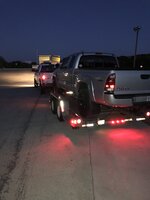
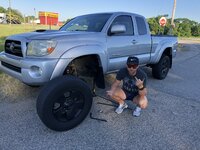
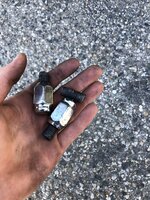
I bought this truck (still have it, still love it) outside of Cincinnati and drove it back home to central Illinois. When I bought the truck the seller said that just two days before I bought it he had the front pads replaced. He did have a receipt for the work which was done at a local shop. Everything seemed to check out fine when I looked it over and test drove it. So I buy this truck and am driving it back home, it was a beautiful early June evening and I was excited to have a new truck! The sun was shining, windows down because it was a perfect 80 degree evening. As I make my way around Indianapolis and back towards Illinois I notice on the 465/74 west interchange I notice some pretty strong steering wheel shaking as I made the turn, but it went away when the road straightened back out. I thought, hmmm that's a little odd... :headscrat I took mental note of it but it wasn't massively alarming and since it went away I didn't get worked up about it. I figured, hey, if it doesn't cause any problems on the way back I'll check things out when I get home. Because the interstate from Indianapolis back home is almost a straight shot there are virtually no turns in the road, I didn't really notice any shaking again. There was only one more time I noticed the shaking as I went around a big swooping curve, a little more subtle this time. Hmmm.. odd. Well I decided to fill up on gas right before I hit the Illinois/Indiana border because I was getting low and it was cheaper there than back home. As I exit the interstate and go through the curves of the off ramp I hear an aggressive clunking/thumping noise that was very loud and very alarming. The steering wheel started shaking so violently I almost lost my grip on it. The noise got louder. I'm braking hard at this point so I can pull off the road. I have no idea immediate indication of what's broken or breaking on me. I'm fast approaching the stop sign at the end of the exit ramp and decide to turn the corner onto the street because the shoulder was much bigger there than on the exit ramp and it seemed mildly safer (slower traffic and just a lot more room to get off the road). As I make the turn I hear SNAP! POP! BANG! :rocketwho like what the heck is going on here!?! I stop on the shoulder, the noise had stopped. I idle the engine for a second and everything sounds good, engine purring like a kitten. I shut it off and hop out. Immediately I see one, two, three shiny pieces of metal glistening in the road. I walk over and pick them up, three lug studs and lug nuts, laying in a line right there in the middle of the road where I turned the corner. I look back at my truck. Front driver side missing one, two, three lug nuts. The wheel was sitting a little cockeyed on the hub. Very interesting... I called my brother and told him the news and had him bring a car hauler trailer. I jacked the truck up to investigate to make sure nothing else looked broken in the suspension/steering. I took the wheel off to look at the hub. The third stud, in the 5 o'clock position was actually cracked too, and bent, it just hadn't broken completely off yet. Everything else looked fine. I put the wheel back on and gently tighten the two good lug nuts remaining, just enough to allow it to roll up on the trailer. Back home it went, on a trailer. But the story doesn't end there! There is a happy ending to my troubles. The previous owner was one of the nicest guys in the world. He had texted me to see if I made it home safely and how the truck drove on my way home, in which I responded and said "I made it about 3/4 of the way home before the the wheel fell off!" and sent him the pictures (not the one of the middle finger :lol: ). He felt so bad that he 1) paid for the trailer rental 2) paid for the new wheel hub 3) paid me extra money for the time it would take me to do the repair myself. I mean WOW what a guy! I was very fortunate for that and fortunate that it didn't happen in a worse place like the 465 interchange around Indy.

There are two theories here. What I suspect happened is that the shop that put new brake pads had some guy that wasn't paying attention or some shop boy helper that just rammed the lugs on with an impact for way too long and massively over torqued them or didn't torque them down at all. Option A After being over torqued the lugs became stretched, hardened, and brittle. Over time the load of the vehicle on the studs combined with lateral forced encountered during turns, slowly stressed the studs to a point where they cracked enough to not securely hold the wheel anymore but not enough to completely break in two. Then, as I was driving, as I went around turns the wheel would be sloppy against the hub/rotor because it didn't have 6 lugs securely holding the rim on. While driving straight the wheel actually would "balance out" and rotate down the road normally. Then they actually fractured off like a complete fatigue failure when I subjected the vehicle's wheel to a rather high lateral force when I turned sharply coming off the off ramp. The rim essentially pushed the stud outwards and the stud couldn't resist the tension it was put under. What's interesting is that one of the broken lugs was missing the the lug nut which almost suggests that one wasn't tightened down enough and the lug nut worked its way off (I found it in the street) while the others were overtightened. The other possible situation, Option B is that the lug nuts were not tightened down enough. After driving it for a couple hundred miles they slowly started backing themselves off, allowing a little wiggle room for the rim to move back and forth between the lug nut and the face of the hub/brake rotor. As I was making turns the rim slapped back and forth causing the shaking and clunking. And again as I drove straight the wheel normalized and rotated fine. Then, upon the sharp turn the force was so great that the tension from the slapping completely broke the lugs.

Either way, moral of the story, make sure your lug nuts are properly torqued! Not too tight, not too loose.
IMG-7416.JPG61369465455--2B8AC668-D48A-4955-9075-BD193311B338.JPGIMG-7427.JPGIMG-6350.jpgIMG-7430.JPGIMG-7433.JPG
If they failed because of having been too loose I would think they would have sheared more outboard (close to the nut)
I think gorilla wrenched with the air gun,at least on the ones that had a lot of stud sticking out of the nut
 

richfinn

Well-known member
Joined
Jan 29, 2011
Messages
4,809
Location
Leeds, Yorkshire, England
If you'd ask me, the purpose of anti seize is exactly to avoid this.


Yes with anti-seize you can lower the torque by about 15-20%. But if you apply anti-seize, the torque will actually be more consistent - dry torque is a vague recommendation at best. Over time, wear and dirt come onto the threads anyway.

Tightening torque is not the value engineers are after when they prescribe it. It's the value that mechanics can use to achieve what the engineers wanted. You want a certain force to pull the wheel onto the hub, and that force is distributed among the lug nuts and is the internal force that's pulling every stud apart. To achieve it, the engineer calculates how much tightening torque is needed - and that value depends on a few factors. Most are constants, some are not - the most notable would be friction on the threads and operator error (which is standardized based on what tool is used - hand tightening, torque wrench, ultrasonic stud internal force measuring devices...).

Anyway, if there is no friction, there would be no torque, the nut would spin freely without resistance until the stud snapped off. What counteracts the free spinning is solely friction. The more force there is in the stud, the more the nut pushes on the threads, and the more friction it creates between the threads (and the surface where the nut pushes on the washer/material too).

Even for dry friction, there are standardized tables specifying the friction between e.g. zinc plated fasteners, chromed fasteners, blued fasteners, various combinations... If they are very precise, they might even do their own tests on the actual parts that are used.


However, that only applies for the first time it is tightened down. Do it a couple times and whatever plating they use is worn away. People swap out lug nuts too, and the materials get even more mixed (zinc electroplating, zinc hot dip coating, chrome, stainless steel...).

But anyway, this is never the issue because lug nuts have a massive safety factor. They must not fail. Sure an impact gun or a long breaker bar will snap them easily enough, but those are not meant to be used by unqualified people that'd do that sort of stuff - with the typical wrench included in the car tool kit, I don't think you can overtighten it without using a cheater pipe or maybe stepping on it.

Sorry for going a bit theoretical there :)
Agreed the actual torque value itself is not that critical, ballpark figure is adequate (never seen a torque wrench in a vehicles tool kit)

Disagree with anti-seize slopped all over wheel hubs and brakes vehemently though, I hate that fricking filthy stuff and if the VMs don't recommend it that's enough excuse for me not to deal with it 🤣

I don't use it on spark plugs either 🙂
 

Blueshound_GJ

Well-known member
Joined
Feb 21, 2022
Messages
421
Embarrassed to admit, I tightened the lug nuts on my 1999 F-150 when it was pretty new to 150 ft lbs with a torque wrench. Put a skinny waist on 4-5 studs and snapped one clean off. No damage to wheels. Were easy to replace, didn’t have to drive the truck . Now I do everything by hand feel with a T-wrench, never a problem.
150ft lbs is the correct spec for lugnuts on a 2021 f150.
 

Attachments

  • Screenshot_20230106-135223.png
    Screenshot_20230106-135223.png
    475.9 KB · Views: 22

Garcky

Well-known member
Joined
Sep 10, 2022
Messages
3,434
Location
Twin Cities Metro Area, Minnesota
Well the proper torque wrench is about 5 feet long and kind of awkward.

A 1" impact is in your hands and a matter of squeezing a trigger.

I have both so I can see the appeal of not torquing properly. It's actually a PITA.
I'm talking about typical passenger vehicles, not large trucks. Nobody uses either a 5' long torque wrench or a 1" drive impact wrench on passenger vehicles. Obviously trucks have different needs, although their lugs need to be tightened to the proper torque as well.
 

cannuck

Well-known member
Joined
Nov 30, 2021
Messages
4,595
Location
Rural SK
. Nobody uses either a 5' long torque wrench or a 1" drive impact wrench on passenger vehicles.
Obviously written by someone who hasn't had to overcome and replace the 450 lb./ft. centerlock nuts on a pin drive Porsche.
 

joe_pinehill1

Well-known member
Joined
Feb 23, 2013
Messages
537
Location
Northern Virginia
I'm sure there are hundreds of thousands of cars on the road with over and under torqued lug nuts. But I have several torque wrenches and figure always better to follow the OEM torque specs. Also, unless the FSM calls for it, do not lubricate wheels lugs and nuts.
 
To avoid these ads, REGISTER NOW!

richfinn

Well-known member
Joined
Jan 29, 2011
Messages
4,809
Location
Leeds, Yorkshire, England
If they recommended it they'd have to pay for it, and $0.20/car adds up way to fast for them.

Many oe spark plugs have it electroplated on.
I worked in dealerships for the first 15 years of my career, we were forbidden from using it on wheel bolts as per VM instructions but we could smear some on the wheel spigots at the first service.

The VMs don't use it because it affects the torque.

Even so I've never struggled with "seized" wheel bolts/nuts, I've managed to remove even the very tight ones using leverage and never had one physically seized through corrosion.

I've had to hammer alloy wheels off the spigots regularly, but the seized lugs thing is a bit of a myth in my opinion.

Service the car regularly torque the fasteners and it won't be an issue.

I use antiseize occasionally on suspension parts that are left untouched for years/decades at a time so I don't run into an epic struggle in the future.

Wheels/spark plugs I just don't bother, too much mess for no gain (and yes spark plug manufacturers don't recommend it either for a few reasons like indexing plugs with a torque wrench on direct injection engines and heat transfer reasons, hence the plating), if you look at how keen they are to supply fasteners pre treated with loctite etc. It's definately a technical decision/not cost (and the mess it makes of everything it touches).
 

Ole Slewfoot

Well-known member
Joined
Feb 22, 2016
Messages
5,098
Location
Freedom, CA
I don't get to chose service intervals on cars that come in. I have an S shaped craftsman 3/4 slide bar that says lugs do seize.

On my rigs, a small dab (or you get the mess) on most fasteners that have no specific cal for dry or loctite keeps repeat services nice n easy.
 

ybnormal

Well-known member
Joined
Jan 3, 2016
Messages
5,002
Intersections around here are littered with broken lug studs with nuts attached.
I had to help a neighbor change a flat and their Chrysler minivan lug nuts were torqued to over 300 ft-lbs. They had just had a brake job done.
musta been one of the GJ members here who knows how to tighten it "just right" without using a torque wrench, because he knows what he doing. he is a per-fesh-inul
 

Radio Flyer

Well-known member
Joined
Mar 28, 2010
Messages
1,685
Location
Suburban Chicago
Well I decided to fill up on gas right before I hit the Illinois/Indiana border because I was getting low and it was cheaper there than back home. As I exit the interstate and go through the curves of the off ramp I hear an aggressive clunking/thumping noise that was very loud and very alarming. The steering wheel started shaking so violently I almost lost my grip on it. The noise got louder. I'm braking hard at this point so I can pull off the road. I have no idea immediate indication of what's broken or breaking on me. I'm fast approaching the stop sign at the end of the exit ramp and decide to turn the corner onto the street because the shoulder was much bigger there than on the exit ramp and it seemed mildly safer (slower traffic and just a lot more room to get off the road). As I make the turn I hear SNAP! POP! BANG! :rocketwho like what the heck is going on here!?! I stop on the shoulder, the noise had stopped. I idle the engine for a second and everything sounds good, engine purring like a kitten. I shut it off and hop out. Immediately I see one, two, three shiny pieces of metal glistening in the road. I walk over and pick them up, three lug studs and lug nuts, laying in a line right there in the middle of the road where I turned the corner. I look back at my truck. Front driver side missing one, two, three lug nuts. The wheel was sitting a little cockeyed on the hub. Very interesting... I called my brother and told him the news and had him bring a car hauler trailer. I jacked the truck up to investigate to make sure nothing else looked broken in the suspension/steering. I took the wheel off to look at the hub. The third stud, in the 5 o'clock position was actually cracked too, and bent, it just hadn't broken completely off yet. Everything else looked fine. I put the wheel back on and gently tighten the two good lug nuts remaining, just enough to allow it to roll up on the trailer. Back home it went, on a trailer. But the story doesn't end there! There is a happy ending to my troubles. The previous owner was one of the nicest guys in the world. He had texted me to see if I made it home safely and how the truck drove on my way home, in which I responded and said "I made it about 3/4 of the way home before the the wheel fell off!" and sent him the pictures (not the one of the middle finger :lol: ). He felt so bad that he 1) paid for the trailer rental 2) paid for the new wheel hub 3) paid me extra money for the time it would take me to do the repair myself. I mean WOW what a guy! I was very fortunate for that and fortunate that it didn't happen in a worse place like the 465 interchange around Indy.

There are two theories here. What I suspect happened is that the shop that put new brake pads had some guy that wasn't paying attention or some shop boy helper that just rammed the lugs on with an impact for way too long and massively over torqued them or didn't torque them down at all. Option A After being over torqued the lugs became stretched, hardened, and brittle. Over time the load of the vehicle on the studs combined with lateral forced encountered during turns, slowly stressed the studs to a point where they cracked enough to not securely hold the wheel anymore but not enough to completely break in two. Then, as I was driving, as I went around turns the wheel would be sloppy against the hub/rotor because it didn't have 6 lugs securely holding the rim on. While driving straight the wheel actually would "balance out" and rotate down the road normally. Then they actually fractured off like a complete fatigue failure when I subjected the vehicle's wheel to a rather high lateral force when I turned sharply coming off the off ramp. The rim essentially pushed the stud outwards and the stud couldn't resist the tension it was put under. What's interesting is that one of the broken lugs was missing the the lug nut which almost suggests that one wasn't tightened down enough and the lug nut worked its way off (I found it in the street) while the others were overtightened. The other possible situation, Option B is that the lug nuts were not tightened down enough. After driving it for a couple hundred miles they slowly started backing themselves off, allowing a little wiggle room for the rim to move back and forth between the lug nut and the face of the hub/brake rotor. As I was making turns the rim slapped back and forth causing the shaking and clunking. And again as I drove straight the wheel normalized and rotated fine. Then, upon the sharp turn the force was so great that the tension from the slapping completely broke the lugs.

Either way, moral of the story, make sure your lug nuts are properly torqued! Not too tight, not too loose.
IMG-7416.JPG61369465455--2B8AC668-D48A-4955-9075-BD193311B338.JPGIMG-7427.JPGIMG-6350.jpgIMG-7430.JPGIMG-7433.JPG
I loved that part of the story. Sometimes its what i like about traveling the most!
 

HalfTonTom

Well-known member
Joined
Nov 2, 2018
Messages
683
Location
Waterford, NY
Intersections around here are littered with broken lug studs with nuts attached.
I had to help a neighbor change a flat and their Chrysler minivan lug nuts were torqued to over 300 ft-lbs. They had just had a brake job done.
Question: how did you determine the lug nuts were torqued to over 300 pounds? Is there a way to determine the tightness of a lug nut?
 

corn chip

Well-known member
Joined
Jul 15, 2021
Messages
672
Question: how did you determine the lug nuts were torqued to over 300 pounds? Is there a way to determine the tightness of a lug nut?

its easy to measure the removel torq. im sure many wrenches can do it. stahlwilles can. what isnt so easy to measure is the clamp force. this is what confuses people. torq vs clamp force
 

Leaflessshadetree

Well-known member
Joined
Aug 1, 2013
Messages
7,146
Location
Don't ask.
I've been on the side of the road attempting to change a tire but couldn't get the nuts to break loose with the 4 way lug wrench. I ended up using the jack to lift up one side of the wrench while I jumped on the other end. Each one made a loud pop when they finally broke loose. I doubt the wrench that came with the truck would have survived. Fortunately the weather was fine and traffic wasn't too heavy.
The other 3 wheels were the same (fortunately I was in my shop and better equipped to deal with them).
 

Sugarfryz

Well-known member
Joined
Mar 13, 2016
Messages
452
Yeah, this. The most immediate risk of over torquing them is not being able to get them back off. 2ndgear deals with way more rusty stuff than I do, but if its supposed to go to 100 and someone does 180 and then add in 2 years of corrosion and heat/colling and all the sudden the nut (or especially the bolt) literally can't hold enough torque and strips and then you have an issue. THe numbers are different for different cars, Honda S2000 and Subaru, which seem to make studs from used wet toilet paper, are the worst. Over torqued strips the threads, so the next guy removing it finds the lug locked to the stud, which then strips the splines and it spins in the hub. Very fun.

IMO, the biggest reason to hand torque stuff is to ensure that a) they are somewhere in a reasonable range of the spec and b) so that you don't forget one.

DaveW
When I was younger and less experienced I would destroy Subaru studs, they break so easy. I would use the same torque stick as every other car and they’d break while torquing. It sucked
 

engineer2

Well-known member
Joined
Dec 13, 2009
Messages
11,795
Location
Chicago burbs
Question: how did you determine the lug nuts were torqued to over 300 pounds? Is there a way to determine the tightness of a lug nut?
I'm sort of guessing. The owner was ruining swollen Mopar lugnuts with an 18" bar. I put my Makita on medium and got them off without a problem.
 

Kscardsfan

Well-known member
Joined
Apr 28, 2020
Messages
1,650
Location
The Little Apple
Slightly off topic. One of the most interesting findings of the Torque Test Channel was that torque sticks seemingly work well with air impact wrenches and not very well with Cordless or Electric impact wrenches. The reason seems to be the frequency of hit being much slower for the air impact versus the electric. The slower hit of the air impact gives the spring time to do it's spring thing whereas the rapid hit of the cordless doesn't give the torque stick time to recover. I have an I-R 231 which I use exclusively for torque sticks that seems to make them work just right. Naturally, being a torque wrench kind of a guy I follow this lower value torque stick up to actually spec using a torque wrench but the fact that the impact itself had so much bearing on whether the torque stick was accurate or not was surprising.
That is interesting. And damned good to know since I use battery impacts almost exclusively now.
 
OP
B

_brian_

Well-known member
Joined
Jun 23, 2019
Messages
360
Location
Wisconsin, USA
I always used copper anti seize and it does not dry up (since it's made for use in heat like for exhaust stuff). I lower the torque slightly, around 100Nm, and never had an issue. Should be about the same as ~120-130Nm dry.
This is not recommended per manufacturer direction. Back in the day, I did this too, but no longer. I have experience as to why, accidentally getting this **** on a stud and it loosening.
 

2ndGearRubber

Well-known member
Joined
Mar 24, 2014
Messages
14,185
Location
Pittsburgh
I'm sort of guessing. The owner was ruining swollen Mopar lugnuts with an 18" bar. I put my Makita on medium and got them off without a problem.

Swollen lugs make torque transfer harder. Your socket is often not 100% engaged, and a lot of effort is going into crushing/twisting the case rather than the lug. Impacts hate this, often times a breaker bar will beat them in this scenario. Seating with a hammer is key.

Nothing like the cap spinning on a lug nut when you try to loosen it.
 

M635_Guy

Well-known member
Joined
Dec 5, 2019
Messages
4,333
Location
NC
I've been an auto mechanic for 35 plus years, this is what I know.

1. Undertightening is the worst scenario they will come loose & break the studs or the bolts will fall out, it will destroy the wheel and possibly kill somebody (use a torque wrench)

2. Overtightening will stretch the bolts/studs and they may break and cause a similar disaster (use a torque wrench)

3. Don't use anti-seize the heat from the brakes will dry it out and and mess up the threads in short (use a torque wrench/dry threads)

4. Vehicle Manufacturers don't supply torque wrenches in vehicle tool kits, the supplied tool is the appropriate length for temporarily tightening the nuts/bolts to close enough!!!

The actual torque cannot therefore be that critical, use a torque wrench though and you will be in the right ballpark.

I don't believe the majority of warped rotors have anything to do with torque, it's poor preparation/**** quality rotors/pads or excessive heat caused by worn calipers.

Use a torque wrench though it's good practice not to guess, thats why owners handbooks recommend torque to spec ASAP after a spare wheel is installed.
Agree with all this. The key phrase in #4 is "temporarily." In the old-BMW world, the joking phrase used for proper torque is "guten-tight" - meaning going by feel to be not too little and not too much torque. There are (very experienced) people I know who I'd trust for their feel, though I'd bet all of them pull out a torque wrench in certain situations. For me, I don't have that kind of experience, so I use the torque wrench on a lot of things.

The argument "against" torque wrenches is silly - anyone who thinks they know better than the designers is...wrong (to be nice).

Also a good rule of thumb is recheck the torque after brake,tire work on your vehicle. I also own a infrared temperature device from Napa,I after a reasonable length trip,after tire or brake work check the temps of tires,brakes,hub for any possible problems.Little tips I have learned
I recently got one of our cars back from a shop I trust, but was hearing a scrapy noise that matched wheel rotation on the drive home. It diminished or went away during turns or braking, so I checked both front wheels when I got home. The passenger side (where the noise was coming from) was hand-tight, and since Mazda doesn't use a set screw for rotors, the rotor was floating around a bit. Last nail in the coffin in moving to a full "trust but verify" mode... :cautious:
So true,,,,the lugnuts could practically be hand tight and be OK
No. I'm not sure what your definition of "hand tight" is, but gRCGXj.gif
 

dchawk81

Well-known member
Joined
Jul 31, 2014
Messages
14,345
I'm talking about typical passenger vehicles, not large trucks. Nobody uses either a 5' long torque wrench or a 1" drive impact wrench on passenger vehicles. Obviously trucks have different needs, although their lugs need to be tightened to the proper torque as well.
I thought you were responding to the post above yours about 22.5 inch wheels.
 

joecon

Well-known member
Joined
Oct 4, 2010
Messages
678
One thing about using Anti seize on lug nuts is if the lug nut covers the end of the lug, you won't get water on the end and rust can't form because the threads are sealed. In the days of steel wheels, the nuts were more exposed and would rust more. Also, if the wheels are not steel you can get galling between the wheel and the fastener, and it will be like they are welded together. I have had to use a breaker bar, with a cheater pipe and a torque multiplier to get the lugs off of an Audi.
 
To avoid these ads, REGISTER NOW!
Top Bottom