
You are using an out of date browser. It may not display this or other websites correctly.
You should upgrade or use an alternative browser.
You should upgrade or use an alternative browser.
Machining pure Tungsten?
- Thread starter no704
- Start date
mike93lx
ALLIANCE MEMBER
Did you chat with him about it?
No. They did a small test area to get an idea of the time required per area of burn out. I feel like if he was willing to cut the price he would have made me an offer. I don’t think that they are hungry for work. Pretty new shop. But the guy that started it up is the son of a guy that was pretty high up in the other sinker shop in town that is shutting down. Pretty specialized field and there is a ton of chip manufacturing around here. They are probably doing just fine without this job.Did you chat with him about it?
Most of the cost would probably be completely cleaning the machine and replacing the fluid. And disposal of the used. I don’t claim to know anything about actual EDM operation other than basic principles. But I do believe cutting this amount of tungsten would probably generate a lot of gallons of contaminated fluid to dispose of.
Any way. I have a couple of diamond lathe bits coming from McMaster in the am. I had pretty good luck facing with one just using way oil. After the cut I chuckled up one half in the lathe and zeroed out on the little broken off stub from the end of the band saw cut. Big mistake. Other side protruding about 0.100”. Sent the power cross feed. Made it about 0.125 in before busting the diamond tip and stopping the part in the 3 jaw Chuck! Bits are $100 per have two coming in the am. Might experiment with some different cutting fluids. I really hate to say that moly-Dee will probably be the GoTo. I really don’t want to be wearing that ****!
Hopefully they get the cooler fixed tomorrow it’s going to be 113.
Hopefully they get the cooler fixed tomorrow it’s going to be 113.
mike93lx
ALLIANCE MEMBER
Well on your way to spending 5k a bit at a timeAny way. I have a couple of diamond lathe bits coming from McMaster in the am. I had pretty good luck facing with one just using way oil. After the cut I chuckled up one half in the lathe and zeroed out on the little broken off stub from the end of the band saw cut. Big mistake. Other side protruding about 0.100”. Sent the power cross feed. Made it about 0.125 in before busting the diamond tip and stopping the part in the 3 jaw Chuck! Bits are $100 per have two coming in the am. Might experiment with some different cutting fluids. I really hate to say that moly-Dee will probably be the GoTo. I really don’t want to be wearing that ****!
Hopefully they get the cooler fixed tomorrow it’s going to be 113.
American Locomotive
Well-known member
Is it? Basic lathe or milling work typically bills out atleast $125-$150/hr. It's also not just one machine. Sink EDM requires custom made electrodes. So you're:Even if it did tie up a machine for a week and an operator to babysit it once in a while $6k is a little out of hand. I think.
- Designing the electrodes in CAD
- Programming the mill or lathe to make the electrodes
- Occupying CNC time that could be used for an already setup money making job
- Writing a program for the EDM
- Building a fixture to hold the part
- Occupying EDM time that could be used for an already setup money making job.
EDM machines use water. The swarf falls to the bottom of the reservoir to be scooped out. There are a few filters and resin bottles to clean and deionize the water. I would expect this job to blow through a set of filters which would be a few hundred dollars.Most of the cost would probably be completely cleaning the machine and replacing the fluid. And disposal of the used. I don’t claim to know anything about actual EDM operation other than basic principles. But I do believe cutting this amount of tungsten would probably generate a lot of gallons of contaminated fluid to dispose of.
They will probably clean the machine (if they have common sense) prior to the job, so they have clean tungsten scrap to sell.
Any way. I have a couple of diamond lathe bits coming from McMaster in the am. I had pretty good luck facing with one just using way oil. After the cut I chuckled up one half in the lathe and zeroed out on the little broken off stub from the end of the band saw cut. Big mistake. Other side protruding about 0.100”. Sent the power cross feed. Made it about 0.125 in before busting the diamond tip and stopping the part in the 3 jaw Chuck! Bits are $100 per have two coming in the am. Might experiment with some different cutting fluids. I really hate to say that moly-Dee will probably be the GoTo. I really don’t want to be wearing that ****!
Hopefully they get the cooler fixed tomorrow it’s going to be 113.
Yeah, I agree. It's called being "penny wise and pound foolish", or in maybe in more American terms "stepping over a dollar to pick up a dime".Well on your way to spending 5k a bit at a time
Your labor has value, the tooling that keeps breaking has value, the material you bought uas value, the time your machine is occupied doing this project instead of something else has value.
If the EDM shop said they could turn it around in a week, I doubt they are that busy. I would call them back and talk with them. Say your boss is balking at the cost, but maybe if it was broken down into engineering costs, machine time costs, etc... it could be justified.
Last edited:


scooby074
Well-known member
For shits and giggles did you try Xometry? I dont know if its even something they can handle however
Edit: they do sinker and exotic metals https://www.xometry.com/capabilities/sinker-edm/
Edit: they do sinker and exotic metals https://www.xometry.com/capabilities/sinker-edm/
Bet you that's a lot more than 6K...For shits and giggles did you try Xometry? I dont know if its even something they can handle however
Edit: they do sinker and exotic metals https://www.xometry.com/capabilities/sinker-edm/
For s&g I'll l have to see if I can run it through my account tomorrow
Blew it out with compressed air. Did get a few chunks out. Left it upside down submerged in water in the ultrasonic. I really doubt that will have any effect but didn’t seem like a terrible idea. My longest needle nose pliers could not reach it. Might try and make some kind of a tool to engage the drill flutes. I really don’t think it’s jammed in there too bad. Probably 1 to 1-1/2 inches of drill in the bottom of the 2.3” hole. I had like 0.010” to go when it snapped.
Might try and fish some brazing wire down the flutes and spin it out. Not much hope. Did submit a rfq to a different edm shop this am. I suppose 1.5”’of carbide might be easier than 2.3” of tungsten. I was really surprised at how relatively easy it did drill.
Well it’s moving with some brazing wires. Ordered some long reach hemostats. Fingers crossed this works. just to follow it up with a carbide end mill to get a flat bottom. I really hate this! Got a new 8” 3 jaw chuck to mount on my 9”’rotary table. Going to have to make a back plate for it. Can’t figure out a better way to Mount it.
American Locomotive
Well-known member
...so how much of your weekly salary and opportunity cost for other projects you could have been working on are you into this so far? I understand the determination, and you definitely will have a new skill set by the time you're finished - but sometimes it's just not worth plodding along on something for weeks that someone else can hammer out in a couple days.
I can not agree with this more!...so how much of your weekly salary and opportunity cost for other projects you could have been working on are you into this so far? I understand the determination, and you definitely will have a new skill set by the time you're finished - but sometimes it's just not worth plodding along on something for weeks that someone else can hammer out in a couple days.
...so how much of your weekly salary and opportunity cost for other projects you could have been working on are you into this so far? I understand the determination, and you definitely will have a new skill set by the time you're finished - but sometimes it's just not worth plodding along on something for weeks that someone else can hammer out in a couple days.
Makes you question the management/direction of the company
For 6k they can waste a couple weeks of my time. But I can’t agree more. But it will not be the first impossible thing that I have done. It’s some really boring work and I’d much prefer to be doing pretty much anything else other than chemistry.Makes you question the management/direction of the company
mike93lx
ALLIANCE MEMBER
Not absolutely everything has to be done in what looks like the most efficient way possible to some people. Learning by trying is a real thing.Makes you question the management/direction of the company
I mean, it is a research organization, not a lean manufacturing site
I've worked for and currently work with research groups.Not absolutely everything has to be done in what looks like the most efficient way possible to some people. Learning by trying is a real thing.
I mean, it is a research organization, not a lean manufacturing site
The research is supposed to be into the (hopefully) groundbreaking technology, not basic fabrication.
mike93lx
ALLIANCE MEMBER
I get that. But not every part of research is **** and like any business, not every decision looks ideal to everyone. I'm not saying he's hiding anything, but we are getting just a small piece of what's going on there.I've worked for and currently work with research groups.
The research is supposed to be into the (hopefully) groundbreaking technology, not basic fabrication.
American Locomotive
Well-known member
Yup. I worked for a decent sized manufacturing company that probably had around $75 million in mass-production type CNC equipment. They had separate dedicated "one-off" type machinists to support the factory. Really excellent machinists, too.I've worked for and currently work with research groups.
The research is supposed to be into the (hopefully) groundbreaking technology, not basic fabrication.
They had problems with a type of CNC that repeatedly broke a threaded adjustment rod. They designed a new rod out of super tough hardened steel, then sent it to the in-house guys to make. They were having a hard time getting a good part, as it was too long, spindly, and tough to thread traditionally. It took them like half a day just to make one.
But instead of occupying the machinist for a week or two trying to figure it out (he had many other important things to do), they sent the material to a local thread rolling company and recieved 12 rods back with beautiful rolled threads in a couple days.
It's not about whether the part of research is ****, it's about whether it's even relevant to the research.I get that. But not every part of research is **** and like any business, not every decision looks ideal to everyone. I'm not saying he's hiding anything, but we are getting just a small piece of what's going on there.
If an experimental chef for a boutique bakery is developing a new cookie recipe and just needs a new bowl for their commercial mixer, should they spend weeks having their in-house maintenance guy learn how to spin stainless steel sheet into a bowl to "save" money, or just buy one? On the other hand, if they're trying to develop a whole mass-production cookie system and scale-up, then learning how to make bowls in-house might be relevant and useful.
I give OP credit though, machining that much tungsten is not easy. I know of a major U.S. manufacturer (that has a massive on-site tool room shop to support the factory) that has a product line that uses tungsten electrodes for a welding process. They don't even machine the electrodes in house - they farm it out to my buddy's shop.
Received my 9”x3/4” round from McMaster today. As expected it was saw cut and a little thicker at about.810”. Amazing how square it was! Took about 0.030” off each side. Also drew up my hole pattern in SW today. Plate is mounted and zeroed out on the Bridgeport ready for some holes in the am. Swamp cooler was repaired today!
Should be good to Mount the new 8” three jaw on the RoTab tomorrow and begin some more “fun” tungsten cutting. Very curious to see how this **** likes to be milled. Will be conventional cutting. Depending on how that goes I might try to motorize the rotab.
Should be good to Mount the new 8” three jaw on the RoTab tomorrow and begin some more “fun” tungsten cutting. Very curious to see how this **** likes to be milled. Will be conventional cutting. Depending on how that goes I might try to motorize the rotab.
RoninB4
Well-known member
-Material chosen? Heat treating involved?Received my 9”x3/4” round from McMaster today.
-None of my business but do you plan to use dowel pins for the adaptor plate as well as the chuck to locate on the rotab? Instead of pins the center hole of the rotab could be used IF it's accurately bored (many are not) or you bore it and use a centering shaft for the chuck and adaptor plate. Locational pins/shaft is more work but sure beats dialing everything in again every time disassembly happens. Since you've already woke up the CAD demons the adaptor plate could also be made to accept a small-but-accurate vise (grinding type vise) or angle plate when wanted/needed. Your approach to designing the adaptor plate would be for it to quickly accept various work holding fixtures with locational accuracy, sort of a modular intent. Just a suggestion.Also drew up my hole pattern in SW today.
-Chuck been checked (if that's important) for concentricity?Should be good to Mount the new 8” three jaw on the RoTab tomorrow
-Almost all exotic materials I've machined don't "like" anything, they tolerate things until they don't.Very curious to see how this **** likes to be milled.
-Climb milling is NOT recommended, especially on rotabs of lesser quality than a Troyke or Moore. The excessive backlash in many will make for a poor surface finish as the cutter grabs/drags the rotational backlash or attempts to lift the table off the base. This also depends upon the build level and wear of THAT rotab more than brand name. The added height of the adaptor plate and chuck may also very well allow vibration to affect the milling, especially as the cutter dulls. Manual rotary tables are not, by nature, very stable. Rotabs for CNC machinery are, I presume, built differently and might be more stable but I've no recent experience with them.Will be conventional cutting.
-That will depend upon your cutters and the methods employed but I wouldn't expect milling, especially on an enhanced rotab, to be more fun than turning/facing on a lathe. Any particular reason you've chosen the mill over the lathe for this?Depending on how that goes
Last edited:
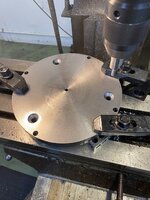
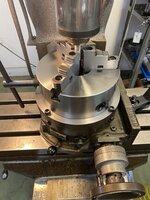
Nothing special just 3/4”’1045 I think. No heat treat. No dowls, just 3 10mm fhcs into the Chuck. Don’t expect runout to be an issue as it is tightened to the centered rotab being coaxial with the spindle. Haven’t tried milling but my experience on the lathe I could only take 0.005” passes and would have to sharpen the tool after 4 passes. It actually drilled better than expected (until it didn’t) hoping the multiple flutes on a mill will make slightly quicker progress. Don’t expect to be able to take much doc but we will see. Might come up with some way to motorize the rotab.-Material chosen? Heat treating involved?
-None of my business but do you plan to use dowel pins for the adaptor plate as well as the chuck to locate on the rotab? Instead of pins the center hole of the rotab could be used IF it's accurately bored (many are not) or you bore it and use a centering shaft for the chuck and adaptor plate. Locational pins/shaft is more work but sure beats dialing everything in again every time disassembly happens. Since you've already woke up the CAD demons the adaptor plate could also be made to accept a small-but-accurate vise (grinding type vise) or angle plate when wanted/needed. Your approach to designing the adaptor plate would be for it to quickly accept various work holding fixtures with locational accuracy, sort of a modular intent. Just a suggestion.
-Chuck been checked (if that's important) for concentricity?
-Almost all exotic materials I've machined don't "like" anything, they tolerate things until they don't.
-Climb milling is NOT recommended, especially on rotabs of lesser quality than a Troyke or Moore. The excessive backlash in many will make for a poor surface finish as the cutter grabs/drags the rotational backlash or attempts to lift the table off the base. This also depends upon the build level and wear of THAT rotab more than brand name. The added height of the adaptor plate and chuck may also very well allow vibration to affect the milling, especially as the cutter dulls. Manual rotary tables are not, by nature, very stable. Rotabs for CNC machinery are, I presume, built differently and might be more stable but I've no recent experience with them.
-That will depend upon your cutters and the methods employed but I wouldn't expect milling, especially on an enhanced rotab, to be more fun than turning/facing on a lathe. Any particular reason you've chosen the mill over the lathe for this?
RoninB4
Well-known member
-CR 1045 may warp after machining, depends upon amount/location/geometry of material removed because CR has a lot of internal stresses. HR 1045 has less internal stresses and is more stable you just have the mill scale to remove. Added bonus of 1045 is it can be heat treated if you wish to.Nothing special just 3/4”’1045 I think.
-Well of course you did, my suggestion was for the quick(er) change in the modular approach. If it doesn't seem worth the trouble then disregard it.Don’t expect runout to be an issue as it is tightened to the centered rotab being coaxial with the spindle.
-Sharpening the cutter? Was this HSS or something else?Haven’t tried milling but my experience on the lathe I could only take 0.005” passes and would have to sharpen the tool after 4 passes.
-I might have mentioned the wear at the corners of a spade drill in an earlier posting. Some materials machine better when taking a good sized DOC, smaller cuts either glaze the material or wear the cutter. It's rather unpredictable with unfamiliar material. Some materials like Ferro-Tic came with a speed/feed/DOC sheet when we ordered it. Machining was "acceptable" if you followed the instructions in the manufacturers sheet, any deviation from the recommended parameters would make bad things happen in stress, hardening, and/or cutters wearing out.It actually drilled better than expected (until it didn’t)
-You have far more experience in machining pure tungsten than I do so your estimations are what to run with. I only make suggestions, much like armchair quarterbacking. My suggestions are usually worth exactly how much you pay for them in this case.hoping the multiple flutes on a mill will make slightly quicker progress. Don’t expect to be able to take much doc but we will see.
-Should be fairly simple for proof of concept.Might come up with some way to motorize the rotab.
It is hot processed according to McMaster. I was very happy to find this off the shelf in a 9”diameter! Perimeter has rust/mill scale on it. It was obvious that it had been saw cut. Took off about 0.030” off each side in the big lathe to true it up. Ended up being with in 0.001” across the 9”.-CR 1045 may warp after machining, depends upon amount/location/geometry of material removed because CR has a lot of internal stresses. HR 1045 has less internal stresses and is more stable you just have the mill scale to remove. Added bonus of 1045 is it can be heat treated if you wish to.
-Well of course you did, my suggestion was for the quick(er) change in the modular approach. If it doesn't seem worth the trouble then disregard it.
-Sharpening the cutter? Was this HSS or something else?
-I might have mentioned the wear at the corners of a spade drill in an earlier posting. Some materials machine better when taking a good sized DOC, smaller cuts either glaze the material or wear the cutter. It's rather unpredictable with unfamiliar material. Some materials like Ferro-Tic came with a speed/feed/DOC sheet when we ordered it. Machining was "acceptable" if you followed the instructions in the manufacturers sheet, any deviation from the recommended parameters would make bad things happen in stress, hardening, and/or cutters wearing out.
-You have far more experience in machining pure tungsten than I do so your estimations are what to run with. I only make suggestions, much like armchair quarterbacking. My suggestions are usually worth exactly how much you pay for them in this case.
-Should be fairly simple for proof of concept.
I appreciate quick set up, but it doesn’t take long to clock in the rotab and just have a hunk of round stock in the quill and close the 3 jaw on it before snuggling the bolts to the rotab.
Was using brazed carbide tooling on the lathe. It was obvious when backing out of the cut it would cut more. Very easy to see the wear on the carbide.
Using carbide twist drills. Deep hole is only 3/8”dia. Hopefully I’ll run an end mill down this hole to achieve a flat bottom.
Still have to make a pocket 1/4” deep 2.5” diameter leaving a 1/4” lip.
I always appreciate your input. Will see how bad milling goes tomorrow!
This is all being done on manual machines. Kinda using feed it as fast and deep as you can until it doesn’t like it method. Witch in this case in not very! Have a stubby like 1/2” flute and a 3” flute 3/8” endmills. Going to start with shallow cuts.
Last edited:
I was very relieved to get this out. With a pretty small set of hemostats! I’m pretty nervous about chasing that hole with an end mill to make a flat bottom! 2.33”’deep. But that will be the first thing I do in the morning! Actually I’m going to try a much shallower hole in the top part first to see how this **** reaacts to a milling cutterVictory! I’ll take the small ones for now!
RoninB4
Well-known member
-Works well for 2nd ops but that's up to you.I appreciate quick set up, but it doesn’t take long to clock in the rotab and just have a hunk of round stock in the quill and close the 3 jaw on it before snuggling the bolts to the rotab.
-You already know my opinion about brazed carbide and sharpening on a green wheel, I've posted it often enough.Was using brazed carbide tooling on the lathe.
-The material has the same opinion of brazed carbide that I do.It was obvious when backing out of the cut it would cut more. Very easy to see the wear on the carbide.
-Hope you have some sort of center relief in the hole for the end mill. Even center cutting end mills aren't fond of making a flat bottomed hole without some small relief divot in the center of the hole bottom.Using carbide twist drills. Deep hole is only 3/8”dia. Hopefully I’ll run an end mill down this hole to achieve a flat bottom.
-Some materials (brass and copper for example) can have a tendency to close up and grab the drill or cutter when plunge cutting a deep hole. There is also the possibility that chips are getting evacuated from the hole and are being re-cut. You might want to try frequently raising the cutter out of the hole to:This is all being done on manual machines. Kinda using feed it as fast and deep as you can until it doesn’t like it method.
1) Allow cooling of cutter and hole
2) Clear out chips
3) To determine if there's any resistance to upward motion from the drill/cutter being seized in the hole. Fast feed can allow material to micro-weld itself to the drill/cutter. Material on the cutter/drill will now be rubbing on the same material in the hole. Tool failure to follow.
-Inspect drills/cutter (particularly the corners) under magnification (at least 10x) for accelerated wear characteristics.Witch in this case in not very! Have a stubby like 1/2” flute and a 3” flute 3/8” endmills. Going to start with shallow cuts.
RoninB4
Well-known member
-If you seen any signs of the coating being wiped off it could very well mean the cutter was binding in the hole, shattering when it fully seized up.I was very relieved to get this out.
-You should be a bit apprehensive. Wonder if the bottom of the hole has work-hardened?I’m pretty nervous about chasing that hole with an end mill to make a flat bottom! 2.33”’deep.
-That would be better.Actually I’m going to try a much shallower hole in the top part first to see how this **** reacts to a milling cutter
I don’t think it work hardens. But I like the thought. It was kinda binding on the sides as I would plunge in and out. I think hitting the tip of the 1/4” pilot hole might have caused it to catch.-If you seen any signs of the coating being wiped off it could very well mean the cutter was binding in the hole, shattering when it fully seized up.
-You should be a bit apprehensive. Wonder if the bottom of the hole has work-hardened?
-That would be better.
To get that deep I was peck cutting maybe 0.100” pecks and withdrawing the tool completely but the chips more of a dust would want to drip back down. More of a mixture of dust and cutting fluid. I ended up using a light air blast on the tool to clean it as it came out of the hole.
RoninB4
Well-known member
-Some sources feel it can. Perhaps this applies more to the tungsten alloys but more reading would be required. Copied this from another site:I don’t think it work hardens.
Machining Difficulties
Tungsten's unique properties can pose challenges during the CNC machining tungsten process.- High Hardness: Tungsten's exceptional hardness can cause rapid tool wear and require frequent tool changes during machining.
- High Elastic Modulus: Tungsten's high elastic modulus can lead to vibrations during machining, affecting part quality and surface finish.
- Work Hardening: Tungsten is prone to work hardening, which can make it more difficult to machine as the material becomes harder during the cutting process.
-I would take that "kinda binding" as a cautionary indicator of a developing situation.But I like the thought. It was kinda binding on the sides as I would plunge in and out.
-Entirely possible, that's another reason I like to use the quill stop when doing a plunge/peck operation. Yes it's more fiddly to do using your left hand to advance the stops (only one not both) but it provides a positive reference in "Z" for where the bottom is. No stop allows the cutter to possibly "grab" the material and attempt to auger itself in via the flute helix. Your call.I think hitting the tip of the 1/4” pilot hole might have caused it to catch.