Think I might get better life out of a larger diameter tool or more flutes? I’ll probably stick with the 4 flute 3/8 as I hope I’m almost done with this job and still have a couple spares.I imagine you are probably burning up end mills like crazy at the low feed rate. It seems counter intuitive, but cutting metal is just like digging in sun-drenched dry hard clay. The surface has been heated so it's rock hard. If you cut under it and dig in the material below then your tools cut better.
The question is whether a 3/8 end mill can handle the pressure of the higher feed rate. Sometimes it's balancing between burning them up and breaking them.

You are using an out of date browser. It may not display this or other websites correctly.
You should upgrade or use an alternative browser.
You should upgrade or use an alternative browser.
Machining pure Tungsten?
- Thread starter no704
- Start date
IndyGarage
Well-known member
I don't think the life of the tool would be any different once you have the parameters right.Think I might get better life out of a larger diameter tool or more flutes? I’ll probably stick with the 4 flute 3/8 as I hope I’m almost done with this job and still have a couple spares.
You could put more power through a heavier tool without risking breaking it so you could probably still double the feedrate and it might even cut better. Of course you have to adjust the RPM to a new diameter. And you can also increase your depth of cut too - up to the point where your machine still has power or your setup is strained. Be careful doing both at the same time.
The critical number for tool heat/wear is always the feedrate through the material.
A long time ago, when I was a young engineer I learned how to set up speeds and feeds for all kinds of materials in a large aerospace factory. I became the go to guy for the stuff that was really hard to cut. The funny thing is it was a union shop so I couldn't touch the machines. I always said when I retire I was going to have a machine shop. I'm still working but I have a couple machines that I play with. Most of my knowledge is pretty outdated now.
I can appreciate that. I’ve always been a manual machinist so I usually just go with what “feels “ right. On this project it’s so many passes on the rotab so I automated it bit. I was really struggling with this stuff on the lathe so I thought that was my best option.I don't think the life of the tool would be any different once you have the parameters right.
You could put more power through a heavier tool without risking breaking it so you could probably still double the feedrate and it might even cut better. Of course you have to adjust the RPM to a new diameter. And you can also increase your depth of cut too - up to the point where your machine still has power or your setup is strained. Be careful doing both at the same time.
The critical number for tool heat/wear is always the feedrate through the material.
A long time ago, when I was a young engineer I learned how to set up speeds and feeds for all kinds of materials in a large aerospace factory. I became the go to guy for the stuff that was really hard to cut. The funny thing is it was a union shop so I couldn't touch the machines. I always said when I retire I was going to have a machine shop. I'm still working but I have a couple machines that I play with. Most of my knowledge is pretty outdated now.
Only about another 0.100 to go on this cut, then a skim cut to even out the floor. Another piece needs a 1/4x 1/4 sholder on it.

American Locomotive
Well-known member
Hope you remembered to vacuum up all the tungsten dust. Scrap recyclers will take it.
Last company I worked for would sell their tungsten-carbide dust from tool grinding.
Last company I worked for would sell their tungsten-carbide dust from tool grinding.
Could have, but all is lost. Well most of it is in the shop vac. But with lots of other oil and swarf. I’m just happy that there is light at the end of this tunnel!Hope you remembered to vacuum up all the tungsten dust. Scrap recyclers will take it.
Last company I worked for would sell their tungsten-carbide dust from tool grinding.
The Tungsten machining is officially finished!
EDM would've avoided the rough finish and chipped edges
Yes it would have.EDM would've avoided the rough finish and chipped edges
mike93lx
ALLIANCE MEMBER
Lol.Bridgeport Milling Head Repair
$260 with shipping. H&W was almost $500. I really wanted to support them for the great videos but not $200 much.
Saving $200 on this project is pretty funny
mike93lx
ALLIANCE MEMBER
I'd make sure your boss knows that he should have approved the EDM. I'm feeling a 30 slide PowerPoint would do it
Ya! I’ll have to do a cost roll up! I never want to do this again! Thanks everyone for coming along for the ride!I'd make sure your boss knows that he should have approved the EDM. I'm feeling a 30 slide PowerPoint would do it
danski0224
Well-known member
That's no fun.
rlitman
Well-known member
That actually makes a lot of sense, since tungsten all starts out as powdered metal anyway. However, I would be concerned about the final density. I doubt a sintered part can match something produced under pressure.So, my partner/boss just returned from attending a conference. He met a company that can 3D print and sinter this stuff for less than we payed for blanks! Yeah I don’t have to do this again!
mike93lx
ALLIANCE MEMBER
I feel like a containment vessel probably doesn't need to be the strongest thing out there. Or is that not the case @no704 ?That actually makes a lot of sense, since tungsten all starts out as powdered metal anyway. However, I would be concerned about the final density. I doubt a sintered part can match something produced under pressure.
Doesn’t need to be the strongest, but also can not fail. I just only heard about this technique. Will be interesting to dive in deeper.I feel like a containment vessel probably doesn't need to be the strongest thing out there. Or is that not the case @no704 ?
rlitman
Well-known member
I wasn’t even thinking about strength. I was thinking that lower density means lower shielding. What it don’t know is how much a percent or so matters. Probably not a lot, but my “probably” doesn’t cut it.I feel like a containment vessel probably doesn't need to be the strongest thing out there. Or is that not the case @no704 ?
mike93lx
ALLIANCE MEMBER
Great point.I wasn’t even thinking about strength. I was thinking that lower density means lower shielding. What it don’t know is how much a percent or so matters. Probably not a lot, but my “probably” doesn’t cut it.

You are welcome to send them to me for disposal.Final death toll! I think most of these will still be useable, just not on Tungsten.
RoninB4
Well-known member
-Rough cutting edges produce rough wall finishes. That doesn't make them useless, just makes them a roughing cutter for clearance features. They're still of some use and wouldn't toss.Final death toll! I think most of these will still be useable, just not on Tungsten.
Still quite smooth edges, just lost the super sharp edge.-Rough cutting edges produce rough wall finishes. That doesn't make them useless, just makes them a roughing cutter for clearance features. They're still of some use and wouldn't toss.
You are welcome to send them to me for disposal.

RoninB4
Well-known member
-Might just be the photo looking like some chipped corners and the odd colored patches in the flutes that appears to be grinding marks. I'll take your word for it that the edges are still smooth enough and continuous. Not my cutters and not my call anyway.Still quite smooth edges, just lost the super sharp edge.
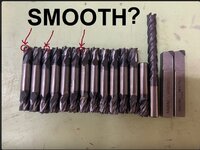
Some are chipped for sure. I was also marking them with a silver sharpie when they were used. The $100 cbn lathe tools are for sure junk!-Might just be the photo looking like some chipped corners and the odd colored patches in the flutes that appears to be grinding marks. I'll take your word for it that the edges are still smooth enough and continuous. Not my cutters and not my call anyway.