To avoid these ads, REGISTER NOW!

Main Panel for house install

OP
G

green.bubbly

Well-known member
Joined
Dec 14, 2008
Messages
2,156
Location
Lafayette, LA
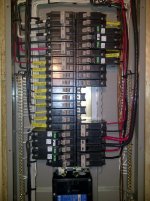
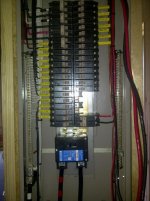
Just about finished up the panel. Need to pickup a breaker for the shop feed and one for the clothes dryer.

If I could start from scratch, I would no one thing different. One person mentioned doing all the grounds first, then the neutrals and then the hots. That was great advice being that I probably would have done each circuit one at a time. But what I should have done was to flip all the neutrals and hots over the top of the panel. This would have made it easier on me, being a rookie.

I did screw up. I wanted to put all the 220 circuits at the top of the panel like I did on the left. Sadly, I ate a big lunch and my eyes were getting heavy when I started the right side and forgot all about the 220 circuits on that side until it was too late.

:(


I will leave three extra breakers in the panel for any future use. I will also drop a two foot length of grey pvc into the panel to fish any wires down into the panel if I ever need to.
 

Attachments
  • main panel 3.jpg
    main panel 3.jpg
    95.5 KB · Views: 174
Last edited:
To avoid these ads, REGISTER NOW!

moserjj

Well-known member
Joined
Oct 17, 2010
Messages
155
Location
WI, USA
Looks very nice and tidy. You didn't have to use any afci breakers? My new home panel is full of them 18 I think. Only regular breakers are on circuits protected by gfci. It was damn expensive just for the breakers

Sent from my SPH-D710 using Tapatalk 2
 
OP
G

green.bubbly

Well-known member
Joined
Dec 14, 2008
Messages
2,156
Location
Lafayette, LA
Looks very nice and tidy. You didn't have to use any afci breakers? My new home panel is full of them 18 I think. Only regular breakers are on circuits protected by gfci. It was damn expensive just for the breakers

Sent from my SPH-D710 using Tapatalk 2


Thanks.

I have two Cutler Hammer afci breakers coming in for the bedrooms. Had to take a small 36 month loan to pay for them. :lol_hitti


They are not cheap!!! :mad:

You have almost $1,000 worth of afci breakers in your home.
 

moserjj

Well-known member
Joined
Oct 17, 2010
Messages
155
Location
WI, USA
Better be sure you don't need more than just the afci in bedrooms. My electrician buddy did mine and bitched the whole time about them. It was very costly for just the stupid breakers. He said something about needing them everywhere except kitchens, baths, laundry, garage and unfinished basements. Basically all places that usually get the equally expensive gfci.

Sent from my SPH-D710 using Tapatalk 2
 

BigJohn20

Well-known member
Joined
Sep 4, 2011
Messages
168
Better be sure you don't need more than just the afci in bedrooms. My electrician buddy did mine and bitched the whole time about them. It was very costly for just the stupid breakers. He said something about needing them everywhere except kitchens, baths, laundry, garage and unfinished basements. Basically all places that usually get the equally expensive gfci.

Sent from my SPH-D710 using Tapatalk 2

Completely depends on code cycle the AHJ is on.
 
OP
G

green.bubbly

Well-known member
Joined
Dec 14, 2008
Messages
2,156
Location
Lafayette, LA
Better be sure you don't need more than just the afci in bedrooms. My electrician buddy did mine and bitched the whole time about them. It was very costly for just the stupid breakers. He said something about needing them everywhere except kitchens, baths, laundry, garage and unfinished basements. Basically all places that usually get the equally expensive gfci.

Sent from my SPH-D710 using Tapatalk 2


I will double check with the inspector but I am fairly sure I only need them in the bedrooms. I sure hope so anyway.

I just looked up some info on the permits and codes for our parish and we are following the NEC 2008. From what I can see, just about every room will need them. :eyecrazy:

The electrical guy at Lowes is a semi-retired electrician and he and another guy told me I only needed it in the bedrooms. Guess i will be calling the inspector Monday morning...
 

moserjj

Well-known member
Joined
Oct 17, 2010
Messages
155
Location
WI, USA
Sorry to be the bearer of potential bad news and high costs...

And there isn't a pretty panel full of afci breakers. Hardly any room at all for the wires

Sent from my SPH-D710 using Tapatalk 2
 

Norcal

Well-known member
Joined
Mar 16, 2008
Messages
13,752
W/ 2008 & later NEC editions, pretty much everything that does not require GFCI's, is required to have AFCI's, AKA "Snake Oil".
 
OP
G

green.bubbly

Well-known member
Joined
Dec 14, 2008
Messages
2,156
Location
Lafayette, LA

matt151617

Well-known member
Joined
Dec 17, 2011
Messages
488
Location
New Jersey
I am actually building in St. Martin Parish but they follow the same codes. I did find some last night on Ebay for $27.00. He has over 5,000 reviews and a 100% positive rating.

You can always pull them out and resell them after the inspection. They don't work for **** anyways. Every time a vacuum turns on they trip.

Call the inspector and tell them your panel is done. See if they care about the AFCIs. I got lucky and mine hated them and "forgot" to verify they were there.
 

Norcal

Well-known member
Joined
Mar 16, 2008
Messages
13,752
Here is a copy and paste from the 2008 NEC 210.12.

210.12 Arc-Fault Circuit-Interrupter Protection.
(A) Definition: Arc-Fault Circuit Interrupter (AFCI). A
device intended to provide protection from the effects of
arc faults by recognizing characteristics unique to arcing
and by functioning to de-energize the circuit when an arc
fault is detected.
(B) Dwelling Units. All 120-volt, single phase, 15- and
20-ampere branch circuits supplying outlets installed in
dwelling unit family rooms, dining rooms, living rooms,
parlors, libraries, dens, bedrooms, sunrooms, recreation
rooms, closets, hallways, or similar rooms or areas
shall be
protected by a listed arc-fault circuit interrupter,
combination-type, installed to provide protection of the
branch circuit.

Bathrooms, kitchens,laundry/utility areas, garage outlets do not require AFCI's "outlets" do include lighting, smokes, receptacles.
 
Last edited:

PRH44

Well-known member
Joined
Dec 25, 2009
Messages
563
Location
Indiana
Here is a copy and paste from the 2008 NEC 210.12.

210.12 Arc-Fault Circuit-Interrupter Protection.
(A) Definition: Arc-Fault Circuit Interrupter (AFCI). A
device intended to provide protection from the effects of
arc faults by recognizing characteristics unique to arcing
and by functioning to de-energize the circuit when an arc
fault is detected.
(B) Dwelling Units. All 120-volt, single phase, 15- and
20-ampere branch circuits supplying outlets installed in
dwelling unit family rooms, dining rooms, living rooms,
parlors, libraries, dens, bedrooms, sunrooms, recreation
rooms, closets, hallways, or similar rooms or areas
shall be
protected by a listed arc-fault circuit interrupter,
combination-type, installed to provide protection of the
branch circuit.

Bathrooms, kitchens,laundry/utility areas, garage outlets do not require AFCI's "outlets" do include lighting, smokes, receptacles.

Norcal obviously we all survived without AFCIs for may years. I know there were fires and other issues that took place to drive the development of such devices. I Also know the NEC board has always been populated by manufactures and money talks.
The first generation of these breakers were very problematic.
Whats your personal opinion on this requirement?
 
OP
G

green.bubbly

Well-known member
Joined
Dec 14, 2008
Messages
2,156
Location
Lafayette, LA
Spoke with my inspector and yep, just about all non-gfci circuit require arc fault breakers. He does not agree with the rule but he has to enforce it now. Six months ago, he would have let it slide in just the bedrooms.

Now I get to make a mess of my panel. Some neutrals will now be too short. A few of the cicuits will be easy to rerun the line from the panel which I will do.


A few circuits would not be as easy. So, I am looking for opinions...

1. Re-run each line.
2. Extend 3 or 4 neutrals in the panel wire wire nuts.
3. I can install 3 or 4 junctions boxes in the attic above the main panel.

Completely my fault and which makes it **** even more.
 

moserjj

Well-known member
Joined
Oct 17, 2010
Messages
155
Location
WI, USA
Wire isn't cheap, I would extend them in the box with wire nuts. Once the cover is on, nobody will see it anyway
 

matt151617

Well-known member
Joined
Dec 17, 2011
Messages
488
Location
New Jersey
Extend them with wirenuts, buy the cheap ebay or even used afci breakers, and get it inspected. After it passes put it back the way it was and sell the stupid afci breakers.
 
OP
G

green.bubbly

Well-known member
Joined
Dec 14, 2008
Messages
2,156
Location
Lafayette, LA
Extend them with wirenuts, buy the cheap ebay or even used afci breakers, and get it inspected. After it passes put it back the way it was and sell the stupid afci breakers.

Seems like that would be a great excuse for the insurance company to deny a fire claim?
 

VHF

Well-known member
Joined
Oct 27, 2008
Messages
420
Location
NW Wisconsin
My personal opinion is that requiring AFCI breakers for new construction is silly, but that they might be valuable on older houses with with deteriorating insulation. If I had a pre-1950 house with original wiring I would certainly consider getting some AFCI breakers.

That does bring up the question: If AFCI breakers provide a measureable reduction in house fires, why aren't insurance companies offering a discount for existing houses retrofited with AFCI breakers?

And why isn't the industry marketing to those customers that would benefit the most--owners of older homes? Oh, wait, they don't need to market their product because the NEC does it for them! :willy_nil
 

BigJohn20

Well-known member
Joined
Sep 4, 2011
Messages
168
My personal opinion is that requiring AFCI breakers for new construction is silly, but that they might be valuable on older houses with with deteriorating insulation. If I had a pre-1950 house with original wiring I would certainly consider getting some AFCI breakers.

That does bring up the question: If AFCI breakers provide a measureable reduction in house fires, why aren't insurance companies offering a discount for existing houses retrofited with AFCI breakers?

And why isn't the industry marketing to those customers that would benefit the most--owners of older homes? Oh, wait, they don't need to market their product because the NEC does it for them! :willy_nil

Putting AFCIs on older circuits is a damn nightmare a lot of the time. If you retrofit your panel with AFCIs, I can guarantee you that you will be rerunning some circuits to stop a few from tripping.

And that's even if there is an AFCI breaker made at a reasonable cost for your panel.
 
To avoid these ads, REGISTER NOW!

Norcal

Well-known member
Joined
Mar 16, 2008
Messages
13,752
Norcal obviously we all survived without AFCIs for may years. I know there were fires and other issues that took place to drive the development of such devices. I Also know the NEC board has always been populated by manufactures and money talks.
The first generation of these breakers were very problematic.
Whats your personal opinion on this requirement?

The idea is good but they have not lived up to their promises, so I think they are snake oil, but code is code so they need to be installed.... :(

Pity the poor shmuck who bought a Dyson vacuum & live in a AFCI equipped dwelling.
 
OP
G

green.bubbly

Well-known member
Joined
Dec 14, 2008
Messages
2,156
Location
Lafayette, LA
Great, now my wife will have a legitimate excuse not to vacuum. :)


I have been reading a lot about the problems they cause. Several people including a couple here, suggested removing them after the inspection is complete.

Are they really that problematic? Does anyone know what the insurance company's stance would be on their removal? I hate the thought of fighting with breakers all the time but it would seem that if I removed them and the house burned down, my insurance company would be delighted to find out I pulled the code required breakers.
 

BigJohn20

Well-known member
Joined
Sep 4, 2011
Messages
168
Great, now my wife will have a legitimate excuse not to vacuum. :)


I have been reading a lot about the problems they cause. Several people including a couple here, suggested removing them after the inspection is complete.

Are they really that problematic? Does anyone know what the insurance company's stance would be on their removal? I hate the thought of fighting with breakers all the time but it would seem that if I removed them and the house burned down, my insurance company would be delighted to find out I pulled the code required breakers.

When they get their inspectors in there (and you better believe they will) and they determine the cause of the fire was something a CAFCI would have prevented, or at least made you aware of an issue with the circuit, you're SOL.
 
OP
G

green.bubbly

Well-known member
Joined
Dec 14, 2008
Messages
2,156
Location
Lafayette, LA
When they get their inspectors in there (and you better believe they will) and they determine the cause of the fire was something a CAFCI would have prevented, or at least made you aware of an issue with the circuit, you're SOL.

That is what I was thinking.
 

jbberns

Well-known member
Joined
Jan 1, 2012
Messages
105
Put them in. Better safe than sorry. I haven't had a problem with them after an install. If they do start tripping then change them out. Don't change them out because of what you hear about them.
My opinion of them is pricey overkill. But that doesn't matter to the NEC
 
OP
G

green.bubbly

Well-known member
Joined
Dec 14, 2008
Messages
2,156
Location
Lafayette, LA
I am a little confused. Reading online, it seems that many poco's do not want any ground conductors in the meter base. My poco, Slemco seems to require a ground in the meter base...


Meter Base grounding, minimum #6 soft drawn copper, in conduit from the meter base to the ground rod, furnished and installed by the customer. The meter base ground wire must be connected in the ground wire lug where provided, and not in the service neutral lug.


Why would one poco require a ground and another prohibit it?


And as an FYI, Cutler Hammer makes a CH panel with an inbound neutral bar. This allows the use of AFCI breakers without the neutral pigtail. The neutral part of the breaker actually attaches directly to the neutral bus. Would make for a cleaner installation.
 
OP
G

green.bubbly

Well-known member
Joined
Dec 14, 2008
Messages
2,156
Location
Lafayette, LA
If you're on 2008+, don't forget about the intersystem bonding/grounding bridge.

http://www.aifittings.com/products/spec-sheets/gb5.pdf


I had ordered the GBB5P with the conduit connector. It finally arrived today. It looked pretty cheesy online but this is a heavy duty little device. It was a nice surprise when you are expecting some cheap flimsy thing that will probably break in 3 months and you open the package to find a hefty solid assembly.
 

Tom in Seattle

Well-known member
Joined
Feb 8, 2012
Messages
45
Location
Sammamish, WA
I had ordered the GBB5P with the conduit connector. It finally arrived today. It looked pretty cheesy online but this is a heavy duty little device. It was a nice surprise when you are expecting some cheap flimsy thing that will probably break in 3 months and you open the package to find a hefty solid assembly.
I got mine from Amazon the other day also and as you say it's a nice, hefty unit. My panel and meter socket are back-to-back, connected with conduit on the outside garage wall. I am planning to run a stranded THHN ground cable from the main panel neutral bus, through the conduit into the meter socket, and then out the bottom through 1/2" PVC to the GBB5P, continuing on down to the grounds rods.

Sound OK? Is #6 the correct size or should I go larger?
 
OP
G

green.bubbly

Well-known member
Joined
Dec 14, 2008
Messages
2,156
Location
Lafayette, LA
I got mine from Amazon the other day also and as you say it's a nice, hefty unit. My panel and meter socket are back-to-back, connected with conduit on the outside garage wall. I am planning to run a stranded THHN ground cable from the main panel neutral bus, through the conduit into the meter socket, and then out the bottom through 1/2" PVC to the GBB5P, continuing on down to the grounds rods.

Sound OK? Is #6 the correct size or should I go larger?

For 200 amp service, my poco requires #4 copper.
 
OP
G

green.bubbly

Well-known member
Joined
Dec 14, 2008
Messages
2,156
Location
Lafayette, LA
I think I have it all wrapped up now. Installed six AFCIand two GFCI breakers. Also installed a 1" conduit in case I ever need to add a circuit down the road.

One GFCI circuits is for the master bath receptacles and two shower lights and the other is for the outside receptacles and sewer plant blower. The remaining circuits that require GFCI will get GFCI receptacles.

I was fortunate in that all the wires in the panel reached their new destinations. There was no need to pull any wire or extend any neutrals. :thumbup:
 

Attachments

  • panel complete.jpg
    panel complete.jpg
    133.5 KB · Views: 115
  • one inch conduit.jpg
    one inch conduit.jpg
    105.9 KB · Views: 87

jbberns

Well-known member
Joined
Jan 1, 2012
Messages
105
Good job. I work with some journeyman that couldn't do that good.
Poco's have different requirements. Some don't care and some are pretty picky. You have to meet their expectations and then the inspectors.
 
OP
G

green.bubbly

Well-known member
Joined
Dec 14, 2008
Messages
2,156
Location
Lafayette, LA
Good job. I work with some journeyman that couldn't do that good.
Poco's have different requirements. Some don't care and some are pretty picky. You have to meet their expectations and then the inspectors.


Thanks. It certainly makes me appreciated some of the professional work I occasionally see. It looks easy keeping everything neat and tidy but it is a lot of work and takes experience. I think I did an alright job but there are certainly a few things that could have been done better by an experienced professional.
 

MustangRick

Well-known member
Joined
Dec 26, 2006
Messages
308
Location
KC
Nice looking box. My neighbor is an electrician and your box looks similar to his, and he takes a lot of pride in his.

Did you draw up a map of where all the circuits are run to? That is the only thing I have over my neighbor, and that was only because I mapped it out before I moved in.
 
OP
G

green.bubbly

Well-known member
Joined
Dec 14, 2008
Messages
2,156
Location
Lafayette, LA
Nice looking box. My neighbor is an electrician and your box looks similar to his, and he takes a lot of pride in his.

Did you draw up a map of where all the circuits are run to? That is the only thing I have over my neighbor, and that was only because I mapped it out before I moved in.

I have a partial map. All the circuits are labeled and before I sheetrock the walls, I will draw out the circuits in case I need a reference later on.
 

Tom in Seattle

Well-known member
Joined
Feb 8, 2012
Messages
45
Location
Sammamish, WA
I'm not familiar with the inner workings of your brand of panel so I am curiuos why I don't see a bunch of "curlie-cue" pigtails coming from the AFCI and GFCI breakers. My QO AFCI and GFCI breakers both have coiled-up neutral wires. Did yours not have this type of neutral wire or were you able to straighten them during installation?

Question for others on AFCI installation: the QO panels do not come with separate ground bars, so I added one on each side. I am planning to run all the ground wires to these bars and all the neutrals to the main nuetral bus on either side at the top of the panel. Since the ground bars are in fact connected to the neutral via the case bonding screw, is it acceptable to connect AFCI or GFCI breakers to those bars? If I could do that it would make for a cleaner installation since I could position the breakers in a location where the pigtails could be much shorter and didn't have to stretch to reach the neutral bus.

Also, since I have some leftover #6 NM-B I was thinking of directly connecting the ground bars with the neutral bus with a short piece of the #6 stranded white wire as a back up to the case bonding screw. Good idea or not necessary?
 

moserjj

Well-known member
Joined
Oct 17, 2010
Messages
155
Location
WI, USA
One last tip, verify you've run a feed from the panel to each circuit. We just lit up my panel in a new construction and realized we/they forgot one. And we had already insulated, rocked, sprayed and painted everything. We got it fished without too much trouble but double checking would have been helpful.
 
OP
G

green.bubbly

Well-known member
Joined
Dec 14, 2008
Messages
2,156
Location
Lafayette, LA
I'm not familiar with the inner workings of your brand of panel so I am curiuos why I don't see a bunch of "curlie-cue" pigtails coming from the AFCI and GFCI breakers. My QO AFCI and GFCI breakers both have coiled-up neutral wires. Did yours not have this type of neutral wire or were you able to straighten them during installation?

Question for others on AFCI installation: the QO panels do not come with separate ground bars, so I added one on each side. I am planning to run all the ground wires to these bars and all the neutrals to the main nuetral bus on either side at the top of the panel. Since the ground bars are in fact connected to the neutral via the case bonding screw, is it acceptable to connect AFCI or GFCI breakers to those bars? If I could do that it would make for a cleaner installation since I could position the breakers in a location where the pigtails could be much shorter and didn't have to stretch to reach the neutral bus.

Also, since I have some leftover #6 NM-B I was thinking of directly connecting the ground bars with the neutral bus with a short piece of the #6 stranded white wire as a back up to the case bonding screw. Good idea or not necessary?


The curly-ques are there but tucked away. They are made out of stranded wire so it is a little harder getting them to hold a bend. I ran then behind the breaker out to the neutral/ground bars.

Cutler Hammer does make a panel with inboard neutral bars. With that, they make a special breaker without the curly-que wires. Instead of the wire, the special breaker has another snap contact that snaps on directly to the inboard neutral bars. Of course I did not know about this so I was stuck with what I had.

Look at the pic attached, I marked where the curly-que wires go.


The neutral bar and ground bar should be bonded so it does not matter is the neutrals and grounds are mixed on each bar. As far as using #6 wire for the bond, I don't know if that is accepted. Then again, take my advice for what it is, rookie advice. :p
 

Attachments

  • panel complete.JPG
    panel complete.JPG
    135.1 KB · Views: 61
OP
G

green.bubbly

Well-known member
Joined
Dec 14, 2008
Messages
2,156
Location
Lafayette, LA
One last tip, verify you've run a feed from the panel to each circuit. We just lit up my panel in a new construction and realized we/they forgot one. And we had already insulated, rocked, sprayed and painted everything. We got it fished without too much trouble but double checking would have been helpful.


I should not have this problem since I ran all my runs starting from the panel. That may be bassakwards but it is how I did it. :dunno:


I will of course install try and double check all the circuits before I sheet rock. Wish me luck.
 
To avoid these ads, REGISTER NOW!
Top Bottom