To avoid these ads, REGISTER NOW!

Main Panel to Sub panel to another sub panel?

sledzz

Well-known member
Joined
Jul 30, 2009
Messages
81
Location
Nebraska
Hi All,
I am planning on building a post frame building for storage and want to run electric just to run some trickle chargers and maybe a garage door opener and a couple lights, nothing much.
My main shop panel is a sub panel run from the house, can I run another sub panel to the storage building from my shop off a dedicated gfci breaker?
 
To avoid these ads, REGISTER NOW!

VHF

Well-known member
Joined
Oct 27, 2008
Messages
420
Location
NW Wisconsin
Sure.

Code gurus correct me if I'm wrong, but I belive if it is a single 20A circuit protected by a GFCI breaker you could run direct bury UF only buried 12" deep, and you do not need a ground rod at your storage building.
 

jktruck150

Well-known member
Joined
Oct 19, 2009
Messages
835
Location
Outskirts of Jackson, MS.
I am currently running power from my house, to my shop, and then to my horse barn from the panel in my shop. I have asked everyone, and nobody has said no, but I have not had it officially inspected yet (step one is just getting power to the shop). I am planning on each building having its own ground rod. The 30a breaker in the shop panel for the barn will run the 2 fans, 3 lights and 2 plugs. I have not hit any bumps in the road with that yet...
 

Rodger

Active member
Joined
Jul 24, 2006
Messages
25
It would be best to run a small 240v circuit (maybe 30A) to feed your subpanel. You will have too much voltage drop (dim lights, motors start and run slow, etc) in a long 110v run.

For a 30A circuit you will need 4 #10 conductors; 2 hot, 1 neutral, 1 ground. You can use either a 4/c direct burial cable or 4 single conductors in a Sch80 (minimum 1-1/4") PVC conduit. Direct burial must be buried a minimum of 24", 18" for PVC conduit.

At the subpanel, the ground wire from your feeder panel must be connected to a dedicated ground bus that is NOT jumpered to the neutral bus. (Although the neutrals and grounds share a common bus in your feeder panel, on a subpanel the grounds and neutrals must each have a separate bus.) You will need to drive a ground rod at your subpanel, connected to the ground bus with a bare (#6 minimum) conductor. (Check your local code, some require 2 ground rods a minimum of 6' apart.)

This is part of the National Electric Code basics (there is more pertaining to a subpanel), which is the minimum safe requirement. Local code requirements often exceed this.
 
OP
S

sledzz

Well-known member
Joined
Jul 30, 2009
Messages
81
Location
Nebraska
Thanks Rodger.. that 220 v makes sense. the total run from shop to storage bldg will be about 150 or more feet away. I'll plan on a small breaker box in the storage with a couple circuits. Just as well plan ahead for more in case I need more than a trickle charger and garage door opener on it.
Thanks
 

jarhead

Well-known member
Joined
Jul 9, 2006
Messages
705
Location
Colorado, near Morrison
It would be best to run a small 240v circuit (maybe 30A) to feed your subpanel. You will have too much voltage drop (dim lights, motors start and run slow, etc) in a long 110v run.

For a 30A circuit you will need 4 #10 conductors; 2 hot, 1 neutral, 1 ground. You can use either a 4/c direct burial cable or 4 single conductors in a Sch80 (minimum 1-1/4") PVC conduit. Direct burial must be buried a minimum of 24", 18" for PVC conduit.

At the subpanel, the ground wire from your feeder panel must be connected to a dedicated ground bus that is NOT jumpered to the neutral bus. (Although the neutrals and grounds share a common bus in your feeder panel, on a subpanel the grounds and neutrals must each have a separate bus.) You will need to drive a ground rod at your subpanel, connected to the ground bus with a bare (#6 minimum) conductor. (Check your local code, some require 2 ground rods a minimum of 6' apart.)

This is part of the National Electric Code basics (there is more pertaining to a subpanel), which is the minimum safe requirement. Local code requirements often exceed this.

NEC allows for a sub panel off a sub panel? I am curious because I need to do something similar.
 

jarhead

Well-known member
Joined
Jul 9, 2006
Messages
705
Location
Colorado, near Morrison
It would be best to run a small 240v circuit (maybe 30A) to feed your subpanel. You will have too much voltage drop (dim lights, motors start and run slow, etc) in a long 110v run.

For a 30A circuit you will need 4 #10 conductors; 2 hot, 1 neutral, 1 ground. You can use either a 4/c direct burial cable or 4 single conductors in a Sch80 (minimum 1-1/4") PVC conduit. Direct burial must be buried a minimum of 24", 18" for PVC conduit.

At the subpanel, the ground wire from your feeder panel must be connected to a dedicated ground bus that is NOT jumpered to the neutral bus. (Although the neutrals and grounds share a common bus in your feeder panel, on a subpanel the grounds and neutrals must each have a separate bus.) You will need to drive a ground rod at your subpanel, connected to the ground bus with a bare (#6 minimum) conductor. (Check your local code, some require 2 ground rods a minimum of 6' apart.)

This is part of the National Electric Code basics (there is more pertaining to a subpanel), which is the minimum safe requirement. Local code requirements often exceed this.

Never got a reply so I will bump with a question...

My garage subpanel which is 100 AMP has (3) #2 wires coming from the main panel (200 amp). The ground is at the subpanel and connected to the ground bus, it does not run from the main panel.

So did I do that wrong? It was inspected and passed so now I am worried.

Can I now by code run a 60 amp sub panel to my barn from this 100 amp sub panel using (3) #6 copper and ground at that sub panel in the barn?

Thanks
 
To avoid these ads, REGISTER NOW!

mrb

Well-known member
Joined
Dec 31, 2008
Messages
3,734
Never got a reply so I will bump with a question...

My garage subpanel which is 100 AMP has (3) #2 wires coming from the main panel (200 amp). The ground is at the subpanel and connected to the ground bus, it does not run from the main panel.

So did I do that wrong? It was inspected and passed so now I am worried.

Can I now by code run a 60 amp sub panel to my barn from this 100 amp sub panel using (3) #6 copper and ground at that sub panel in the barn?

Thanks

when was this installed? At the subpanel, is the neutral bus connected to the can or is it isolated?
 

jarhead

Well-known member
Joined
Jul 9, 2006
Messages
705
Location
Colorado, near Morrison
when was this installed? At the subpanel, is the neutral bus connected to the can or is it isolated?

It was installed about 12 years ago and inspected by the State. I did the work which is allowed by our county.

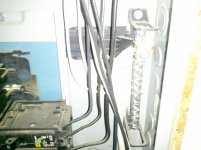
Neutral is isolated. I have attached a pic...
 

Attachments

  • sub-panel.jpg
    sub-panel.jpg
    136.5 KB · Views: 70
  • sub-panel2.jpg
    sub-panel2.jpg
    123.8 KB · Views: 56
Last edited:

mrb

Well-known member
Joined
Dec 31, 2008
Messages
3,734
It was installed about 12 years ago and inspected by the State. I did the work which is allowed by our county.

Neutral is isolated. I have attached a pic...

that is EXTREMELY dangerous and could kill someone. If there is a short circuit (hot touching ground) in a faulted power tool, cut extension cord, wire on the side of a receptacle touching a mud ring, or any other number of situations, there is no path back to the main panel for that fault current to flow which is what causes the circuit breaker to trip. This means under a fault condition everything that is 'grounded' will become energized.

I take it this is a detached structure, the N+G should be bonded in the subpanel in this installation. All new installations require 4 wires and the neutral and ground isolated in the subpanel.

Its been discussed before and ill say it again: a ground rod does nothing to provide a return path for fault current. Read this: http://www.mikeholt.com/technical.p...Does Not Assist in Clearing a Fault (01-25-2K)


"Note: Metal parts of the electrical system are grounded (connected to the earth) to prevent the destruction of electrical components from superimposed voltage from lightning and voltage transients and to help prevent the build-up of static charges on equipment and material."

Another thing worth noting: You cannot count on an inspector to make sure you did your work right. These guys do paperwork, not electrical work. It is up to whoever performs the work to make sure it is done in a safe and code compliant fashion.
 

Aceman

Well-known member
Joined
Jan 28, 2007
Messages
2,513
Location
Eastern Oregon
I agree with mrb, that's a death trap. I'd install a jumper, #8 minimum between your neutral and ground bars.

Can I now by code run a 60 amp sub panel to my barn from this 100 amp sub panel using (3) #6 copper and ground at that sub panel in the barn?

If your on the 05 NEC then it's still legal assuming there are no other metallic paths between this shed and your garage. That means water lines, clothes lines, coax, anything...

08 NEC requires 4 wires.
 
Last edited:

jarhead

Well-known member
Joined
Jul 9, 2006
Messages
705
Location
Colorado, near Morrison
Thanks to all that replied, I am amazed it passed. It scares me that nothing has happened up to this point. I made a bad assumption the inspector knew what he was doing, I didnt know any of this.

Yes it is in a detached garage

I will install the jumper

Edit, appears to be answered above: My garage to barn sub panel should be the same? or run a ground from the garage sub along with the (3) #6 ? There are no other pipes or anything mentioned in the path.

Can I find the code book on the WEB to educate myself?
 
Last edited:

Charles (in GA)

Well-known member
Joined
Jan 11, 2006
Messages
12,489
Location
50 mi south of Atlanta
Can I find the code book on the WEB to educate myself?

The code book on the web is not the latest version but I think right now, it is 2005 version. It is a read only, impossible to copy/paste or print from. You will quickly become discouraged trying to read it, as you need to be able to flip back and forth frequently.

Edit: I just looked and cannot find the free version any longer, they may have eliminated it altogether. It always was hard to find on the NFPA web site.

I highly suggest getting a paperback version of the complete NEC from Amazon. I also suggest a companion book, Illustrated Guide to the National Electric Code, by Charles Miller, as it is an excellent interpretation of the code, complete with references to the code you can find the sections and read the code for yourself.

The new 2011 version......

http://www.amazon.com/dp/0877659141/?tag=atomicindus08-20

The 2008 version.......

http://www.amazon.com/dp/0877657904/?tag=atomicindus08-20

The 2011 version of the Illustrated Guide to the NEC.....

http://www.amazon.com/dp/1435498135/?tag=atomicindus08-20

The 2008 version of the Illustrated Guide to the NEC.....

http://www.amazon.com/dp/1418050458/?tag=atomicindus08-20

Edit: You can purchase directly from the National Fire Protection Association, but its the same price as Amazon, and I'm sure Amazon is quicker.

Charles
 
Last edited:

mrb

Well-known member
Joined
Dec 31, 2008
Messages
3,734
Thanks to all that replied, I am amazed it passed. It scares me that nothing has happened up to this point. I made a bad assumption the inspector knew what he was doing, I didnt know any of this.

Yes it is in a detached garage

I will install the jumper

Edit, appears to be answered above: My garage to barn sub panel should be the same? or run a ground from the garage sub along with the (3) #6 ? There are no other pipes or anything mentioned in the path.

Can I find the code book on the WEB to educate myself?

colorado is under 2008 NEC now. Your subpanel you will be installing requires 4 wire, two hots, neutral, and ground. In this new subpanel you keep the neutral and ground seperate.

As far as counting on the inspector to make sure the work is done properly, thats not his job. Dont take this as a personal attack, its for the benefit of others that read here: If you didnt know something as basic as this, and counted on the inspector to make sure you did it right you had no business doing this work. I do commend you for getting a permit and having the work inspected, your intentions were good. Everyone seems to think 'its not rocket science, im not paying a licensed electrician i can do it myself', well it isnt rocket science, but there is alot to know that many DIYers do not and never realize the danger they created because it works ok.
 

jarhead

Well-known member
Joined
Jul 9, 2006
Messages
705
Location
Colorado, near Morrison
colorado is under 2008 NEC now. Your subpanel you will be installing requires 4 wire, two hots, neutral, and ground. In this new subpanel you keep the neutral and ground seperate.

As far as counting on the inspector to make sure the work is done properly, thats not his job. Dont take this as a personal attack, its for the benefit of others that read here: If you didnt know something as basic as this, and counted on the inspector to make sure you did it right you had no business doing this work. I do commend you for getting a permit and having the work inspected, your intentions were good. Everyone seems to think 'its not rocket science, im not paying a licensed electrician i can do it myself', well it isnt rocket science, but there is alot to know that many DIYers do not and never realize the danger they created because it works ok.

Thanks, I didn't/wont take it as a personal attack, just trying to learn.

When I did the wiring, I did research, asked a work electrician, and the inspector. At this point I have to think I didn't fully understand what I was told. I will fix it which is the important part and a learning experience.
 

Norcal

Well-known member
Joined
Mar 16, 2008
Messages
13,774
Sure.

Code gurus correct me if I'm wrong, but I belive if it is a single 20A circuit protected by a GFCI breaker you could run direct bury UF only buried 12" deep, and you do not need a ground rod at your storage building.

That post above only applies to residential & must be 120 volts only.
 
To avoid these ads, REGISTER NOW!
Top Bottom