To avoid these ads, REGISTER NOW!

Main panel with NO main shut off ??

CNGsaves

Well-known member
Joined
Sep 26, 2012
Messages
13,233
Location
KS and OK
Question(s) for sparky's - - - - friend's mom just had new house built in Joplin, MO after tornado. It's slab foundation with main electrical panel on back wall of attached 2 car garage.

However, more I look they really skimped on house build as just single light bulb fixture in 2 car garage, light switches outside of rooms or on wrong wall when entering room, largest breaker in panel was 30 amp, cheap screen doors with no latches, etc. This is disheartening as she had all-brick home prior to tornado which was very nice and in excellent neighborhood.

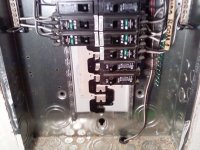
Biggest screaming problem(s) were when she told me 1 yr old house was having breakers trip during normal operation of house!! Also, the main electrical panel does NOT have a master shutoff (see pic below)!!

Living room (largest room in house at 14'x20') had ALL it's entire electrical outlets and lighting on one 15 amp AFCI breaker (see pic below of Eaton - - 4th from bottom on right that is turned off). Owner is 80+ yr old and has normal 3 or 4 lamps in room, approx 40" LCD TV, and can lights in ceiling (ie minimal load in my opinion, but unusual that 100% of largest room was on 1 breaker). That breaker had been tripping frequently according to homeowner, which darkened the whole front of house and killed the TV. Living room breaker tripped the day I was there so I upgraded breaker to 20 amp.

Kitchen has both a electric counter-top smooth surface burners, and a seperate electric oven. These are both on individual 30 amp double-pole 240v breakers. Counter-top burner has been tripping the breaker under normal operation - - - shouldn't that breaker be either a 40 or 50 amp?? What about the oven, I'm thinking it too should be bigger than 30 amp.

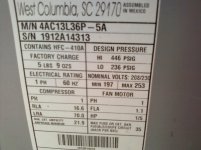
Furnace is natural gas and looks properly installed. Air handler in attic is insulated and also has insulated ducts in attic to individual rooms. A/C compressor on outside pad is Concord which my research shows is low-end Lennox brand (see pics below). The A/C only has 30 amp breaker but homeowner said it has not tripped breaker yet, but really hasn't fully loaded it since moderate temperatures.

QUESTIONS:
1) How can that main electrical panel be code without a single-throw shutoff??
2) What amp double-pole breaker should be installed for counter-top burners, oven, A/C, dryer (these now are all 30 amp double-pole 240v breakers)??
3) Any comments whether Concord air conditioner unit is any good (only 13 SEER)??
4) Any undue risk for 20 amp AFCI breaker I replaced for living room??
5) Should correction efforts be aimed at City inspection office, or start with the builder/electrician??
 

Attachments

  • Photo021_BreakerPanel_pic1.jpg
    Photo021_BreakerPanel_pic1.jpg
    108.3 KB · Views: 150
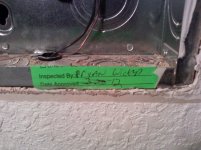
  • Photo024_BreakerPanel_inspection_sticker.jpg
    Photo024_BreakerPanel_inspection_sticker.jpg
    128.9 KB · Views: 129
  • Photo019_Eaton15ampBreaker2_LivingRm.jpg
    Photo019_Eaton15ampBreaker2_LivingRm.jpg
    144.4 KB · Views: 117
  • Photo022_BreakerPanel_pic2.jpg
    Photo022_BreakerPanel_pic2.jpg
    137.2 KB · Views: 169
  • Photo023_BreakerPanel_pic3.jpg
    Photo023_BreakerPanel_pic3.jpg
    138.5 KB · Views: 119
  • Photo025_Concord_AC_pic1.jpg
    Photo025_Concord_AC_pic1.jpg
    112.7 KB · Views: 102
  • Photo026_Concord_AC_pic2.jpg
    Photo026_Concord_AC_pic2.jpg
    133.3 KB · Views: 81
Last edited:
To avoid these ads, REGISTER NOW!

walrus

Well-known member
Joined
Nov 12, 2008
Messages
11,674
Location
Maine
You sure there isn't a main at the meter? Looks like 4 wires coming into this panel so its a sub

Sent from my XT901 using Tapatalk
 

kd3pc

Well-known member
Joined
Aug 10, 2013
Messages
3,630
Location
Northern Neck
1. This may be a subpanel to the meter base/master switch outside, where the service enters the building....check for a master disconnect there.

2. Each appliance/HVAC unit will have it's own requirements. You will need to look at each device or the manual. Electric ranges would require at least 20A/240, while HVAC may need 40A/240

3. NO experience with this brand.

4. may not have been safe to replace the breaker....the breaker protects the wiring...and if the wiring is not rated for 20A....then you need to put the 15 back in and start looking at breaking up the loads or replace the wiring.

5. All correction should go back to the builder/contractor/electrician, or if this is an insurance deal I would call my agent and explain that this needs to be corrected now! The city/county/AHJ will not even talk to you about this, they are there to do the admin inspection, nothing more. And that inspection could be as simple as opening the panel cover and looking at major items in the panel...neutrals and grounds and tape colors, etc. They have nothing to do with load calculation or things actually working.

Best of luck. These tend to be very time consuming and frustrating to no end. Might be cheaper to have the insurance company agree to pay a second electrician to do the job correctly.
 

shamrock12

Well-known member
Joined
Dec 26, 2007
Messages
958
Location
South Dakota
1) How can that main electrical panel be code without a single-throw shutoff??

Perhaps there is a disconnect outside that is downsteam of the electric meter?

2) What amp double-pole breaker should be installed for counter-top burners, oven, A/C, dryer (these now are all 30 amp double-pole 240v breakers)??
It depend on each appliance maximum load capacity. Some are smaller, some are larger. Normally the dryer would be on 30amp circuit, the range and oven usually are on 40A or 50A circuit; however, they could possibly be 30amp each if they are separate units and not as large as some others.

But more importantly, the circuit breakers are to PROTECT the conductors. So if for example there is an existing 10 gauge wires on a 30amp breaker, you cannot upsize the breaker to 40amp.
 

theoldwizard1

Well-known member
Joined
Feb 22, 2011
Messages
43,106
Location
SE MI
There has to be a customer accessible disconnect somewhere, likely at the meter.

Personally I think that is pretty stupid. If I was working on a load center, I would want the disconnect to be visible from where I was standing (code does allow a separate disconnect in the same building).

Minimum codes seem to be getting more minimum every year !
 

theoldwizard1

Well-known member
Joined
Feb 22, 2011
Messages
43,106
Location
SE MI
Living room (largest room in house at 14'x20') had ALL it's entire electrical outlets and lighting on one 15 amp AFCI breaker (see pic below of Eaton - - 4th from bottom on right that is turned off). Owner is 80+ yr old and has normal 3 or 4 lamps in room, approx 40" LCD TV, and can lights in ceiling (ie minimal load in my opinion, but unusual that 100% of largest room was on 1 breaker).
I'm sure it meets code, but it is not very logical. All ceiling lights are usually on 1 circuit per floor.

That breaker had been tripping frequently according to homeowner, which darkened the whole front of house and killed the TV. Living room breaker tripped the day I was there so I upgraded breaker to 20 amp.
NOT GOOD ! And I'll bet it does not solve the problem.

The trips are likely being cause by the Arc Fault breaker. The electrician may have installed the receptacle using back stabs (which is not "best practice") or it could be a bad breaker. You can argue with Eaton. but I will doubt that the give you another breaker. Personally, I would have installed a regular 15A breaker.
 
OP
C

CNGsaves

Well-known member
Joined
Sep 26, 2012
Messages
13,233
Location
KS and OK
I replaced the Eaton 15A AFCI breaker with exact same Eaton AFCI breaker but 20A. Best I could tell wiring for Living Room was 12 gauge so it should handle the 20A.

Eaton AFCI breaker has "quasi back stab" as you slide black and white wires into respective hole and screw down the set screw. Breaker has it's own coily white wire that connects to neutral bar.

My overall impression of electrical was bare bones . . . . . ie skimpy.

Garage door installer must have been numbskull as well as forgot to put in lightbulb for the GDO !!! Thus, her entire garage only had 1 light bulb that was only able to be turned on by GOING INSIDE THE HOUSE !!! No three-way switching for that single light bulb in garage. Thus, you come into back man door to garage, there is NO LIGHT SWITCH until you actually go into the house up near front of garage !! ****, cheap-*** in my opinion and likely took advantage of older tornado victim customer.
 

G_P

Well-known member
Joined
Jul 11, 2010
Messages
7,135
Location
Central CT
Sounds like she got a house built by a builder who does the bare minimum to meet code so they can get maximum profits.

Sadly its becoming more common these days.
 

Dick in Wisconsin

Well-known member
Joined
Mar 3, 2012
Messages
3,048
Location
Shawano, Wisconsin
Eaton AFCI breaker has "quasi back stab" as you slide black and white wires into respective hole and screw down the set screw.

Isn't that "back wire"? not "back stab".

I've read on the GJF that "back wire" is as good as putting a 180 degree loop around the screw on the side of the receptacle or switch. Much better than "back stabbing" which has limited contact area.

Minimum code was probably met. Bare minimum code. Great example that the customer paying the bill needs to clearly review the wiring plan with the electrician.

If I were building a house today ...

the kitchen counter outlets would be double box (4 outlets at each location), 20amp outlets, two 20amp circuits for the kitchen counter.

Outlets at a kitchen desk, either side of each bed, near where a TV would go, near where a computer desk would go ... all would be 20amp double box (4 outlets at each location). Yes ... four outlets on each side of the bed in the master bedroom ... 8 outlets total.

Each bathroom would have at least four outlets (20amps, each bath on a separate circuit).

Garage outlets would be on their own 20amp circuit, double box (4 outlets) at each location). Garage ceiling lights (at least one per car) would be three way switches ... one switch by door to house and one by door to outside, both lit when off. Outlet in garage in the area where one out put a bench at some point should be more than bench height off the floor. Outlets could be on two or three separate 20amp circuits.

Outside outlets ... 20amp either side of garage door(s), controlled by lighted switch in the garage by door to house. 20amp outlets by each downspout in case heat tapes are need to combat ice damming, switched in a utility room with pilot light.

GFIs and GFCIs as appropriate.
 
To avoid these ads, REGISTER NOW!

Gooch

Well-known member
Joined
May 30, 2009
Messages
676
Location
Petersberg, IA
Another reason things get done to minimum code is because people tend to ***** about the price when they get charged more, a lot of people seem to think they shouldn't have to pay more for more for the extra work. I'm not saying this is your mother, just that it's pretty damn common.
 

brewchief

Well-known member
Joined
Sep 20, 2008
Messages
2,370
Location
Michigan
Another reason things get done to minimum code is because people tend to ***** about the price when they get charged more, a lot of people seem to think they shouldn't have to pay more for more for the extra work. I'm not saying this is your mother, just that it's pretty damn common.

New construction is a price game, more often then not the lowest bidder gets the job, all the bids are normally based off the plans the builder supplies.
If you want more then the minimum then it should be brought up during the plan review process before it goes out to bid.

I have been in hundreds of houses that the people simply use the garage to park in, there will be one outlet that never gets used, most members on this site have far different power wants/needs then the average homeowner. A 100 amp subpanel might make sense for many members here but would be completely useless to the vast majority of homeowners.
 

Gooch

Well-known member
Joined
May 30, 2009
Messages
676
Location
Petersberg, IA
Isn't that "back wire"? not "back stab".

I've read on the GJF that "back wire" is as good as putting a 180 degree loop around the screw on the side of the receptacle or switch. Much better than "back stabbing" which has limited contact area.

Minimum code was probably met. Bare minimum code. Great example that the customer paying the bill needs to clearly review the wiring plan with the electrician.

If I were building a house today ...

the kitchen counter outlets would be double box (4 outlets at each location), 20amp outlets, two 20amp circuits for the kitchen counter.

Outlets at a kitchen desk, either side of each bed, near where a TV would go, near where a computer desk would go ... all would be 20amp double box (4 outlets at each location). Yes ... four outlets on each side of the bed in the master bedroom ... 8 outlets total.

Each bathroom would have at least four outlets (20amps, each bath on a separate circuit).

Garage outlets would be on their own 20amp circuit, double box (4 outlets) at each location). Garage ceiling lights (at least one per car) would be three way switches ... one switch by door to house and one by door to outside, both lit when off. Outlet in garage in the area where one out put a bench at some point should be more than bench height off the floor. Outlets could be on two or three separate 20amp circuits.

Outside outlets ... 20amp either side of garage door(s), controlled by lighted switch in the garage by door to house. 20amp outlets by each downspout in case heat tapes are need to combat ice damming, switched in a utility room with pilot light.

GFIs and GFCIs as appropriate.


Why would you put 20 amp recepts. In? What do you own with a 20 amp plug?
 
OP
C

CNGsaves

Well-known member
Joined
Sep 26, 2012
Messages
13,233
Location
KS and OK
House is on slab, just as previous all-brick house was . . . . due to soil conditions being all rock.

Homeowner is a friend's elderly mom (no relation to me), and she's widow of dead USA serviceman who raised 2 kids herself.

On outside, new house looks pretty good (ranch 3 BR 2 BA) with mostly half-brick front (ie not genuine brick), but lots of grout space between bricks that homeowner subsequently learned was builder tactic to save money. Neighboring houses are 2 story with partial foundation and likely costing 150K more than hers. Sides and back of house are clad in cheap vinyl siding all the way down to ground that is already getting broken from lawn mower impacts.

Thus, my overall feel is "replacement value" house that builders built is big drop in quality compared to 50's built all-brick house it replaced.

Smell test for builder NOT passed in my opinion when HO tells me builder changed her plans for kitchen (moved fridge to different place, left out electrical in island, put in cheap sliding door instead of french doors, etc) cause it was "easier for builder" and also because elderly woman wasn't on-site every day checking their work compared to drawings/plan. Countertop burners, fridge, oven & dishwasher were purchased outright by HO as she did discover the proposed builder appliances were so cheap she didn't want them. She bought Kenmore stuff herself from Sears.

Once 80+ yr old HO discovered the shortcuts builder was making in kitchen, she did stand her ground and got some price concessions.

With hundreds of houses being built in Joplin, this just smells of jipping the customer . . . . . "Trust me, I'll build you a nice house" is line that HO says the builder kept telling her !!

When elderly HO has to hire handyman to fix stuff on house less than yr old, something is definitely wrong. :( Stuff I'm seeing now is AFTER the builder did any fixes, AND handyman she hired did a bunch of stuff. It's a shame that widow of dead USA serviceman has been jipped like this.
 
Last edited:

Norcal

Well-known member
Joined
Mar 16, 2008
Messages
13,752
With the SER cable feeding the panel, it makes me think there is a main ahead of the panel, but assuming gets one into trouble. :D
 
OP
C

CNGsaves

Well-known member
Joined
Sep 26, 2012
Messages
13,233
Location
KS and OK
I've only been to house twice so I've got more checking to do next time I visit. Electrical service is buried and comes from back property line but I don't recall any shutoff near meter. However, first trip was just 10 minute walk-thru and 2nd trip was when she complained of tripping breaker and I was there for a few hours.

Getting pics was an adventure as used cell phone, then emailed back to my own email. Next trip I'll investigate the meter further and take more pics.

My friend is no help at all as "can't even turn a screwdriver" !! ;) That's why she was so appreciative when I noticed some of her build problems.

Forgot to mention earlier that 80+ yr old homeowner was sharp enough to demand that attic ladder be put in garage so there is at least proper access to HVAC equipment in attic !!! Builder also wanted to skimp and put no walkways up there, but she stood her ground and at least got attic ladder and runners nailed down on the roof joists, along with proper lighting and a light switch. Little section up there with plywood down so she has some attic storage.
 
Last edited:

Dick in Wisconsin

Well-known member
Joined
Mar 3, 2012
Messages
3,048
Location
Shawano, Wisconsin
Why would you put 20 amp recepts. In? What do you own with a 20 amp plug?

20 amp circuits. Have a party, lots of people, and you end up with all the cookers, roasters, crock pots, and other hi watt/hi amp appliances plugged in on the kitchen counter. Its not necessarily the plug ... but its the cumulative draw that needs the higher amp circuits.
 

Charles (in GA)

Well-known member
Joined
Jan 11, 2006
Messages
12,489
Location
50 mi south of Atlanta
Why would you put 20 amp recepts. In? What do you own with a 20 amp plug?

I don't think **** in Wisconsin really intends that you install 20 amp receptacles, I think he is implying that you need 20 amp circuits, which you do. Code does not require 20 amp receptacles on 20 amp circuits, unless there is only ONE receptacle on the circuit. I suspect he is using "receptacles" and "circuits" somewhat interchangeably.

Charles
 

Norcal

Well-known member
Joined
Mar 16, 2008
Messages
13,752
Tract homes are built as cheap as they can get away with, forget all the Holmes ******** as code plus is not happening unless willing to pay for it, & with the wrong contractor even if paying for it might not get it.
 

Gooch

Well-known member
Joined
May 30, 2009
Messages
676
Location
Petersberg, IA
20 amp circuits. Have a party, lots of people, and you end up with all the cookers, roasters, crock pots, and other hi watt/hi amp appliances plugged in on the kitchen counter. Its not necessarily the plug ... but its the cumulative draw that needs the higher amp circuits.

Ah. I thought you mwant recepts. Yes 20 am circuits in the kitchen, dinning room, and bathroom.
 

Greatbear

Well-known member
Joined
Jan 17, 2008
Messages
1,702
Location
Columbia/Fulton, MD
The AC unit looks like 30A is the required breaker. Since the cooktop and oven are separate rather than a range, the individual units tend to get 30A each, rather than 50A a typical range would get. Exceptions typically are the smooth ceramic cooktops, these sometimes need a 40 amp due to larger surface area burners, and ones with five or six cooking positions sometimes want a 50A. Typical electric water heater at 4500 watts gets a 30A as well.

The panel seems neatly wired for the most part, that's not sloppy workmanship. I would've preferred a main in the panel even if there's a main on the meter socket, but your installation probably meets local codes.

As for the rest, you got the bare minimum required by code, such as the single light in the garage, etc. It's also not required to have more than one branch feeding outlets in a room, but it's good to have at least two in a decent sized room, with lighting separate from them for all the reasons you've experienced. Again, someone cheaped out for bare minimum. Since the house was built as a replacement, many times insurance companies want to spec out the houses as cheaply as possible. Given it was also being built in a hurried manner most likely, some corners get cut, unfortunately. Building material costs go through the roof (no pun intended) after a natural disaster strikes a large area.

If you uprated a breaker from 15 to 20 amps, make sure all the wiring and not just that leaving the panel is 12 gauge. Sometimes a larger feed from a panel is put in especially if the panel is far from the load to keep voltage drops to a minimum, but once it hits the first receptacle or device, they might have switched to 14ga wire, especially in the lighting. If just one feed in that circuit is 14 gauge, you have to go back to a 15 amp breaker. You need to look inside every device box and fixture to make sure. Since all new Romex is color coded on the jacket with white=14ga, yellow=12ga, orange=10ga, I don't see any yellow peeking in from above. Not all Romex is color coded, the sparkie could be using older material. I do spy orange on the 30 amp branches though. With the costs of copper these days, some are installing 15 amp circuits everywhere, unfortunately.
 

Dick in Wisconsin

Well-known member
Joined
Mar 3, 2012
Messages
3,048
Location
Shawano, Wisconsin
I don't think **** in Wisconsin really intends that you install 20 amp receptacles, I think he is implying that you need 20 amp circuits, which you do. Code does not require 20 amp receptacles on 20 amp circuits, unless there is only ONE receptacle on the circuit. I suspect he is using "receptacles" and "circuits" somewhat interchangeably.

Charles

Yes ... 20amp circuits. Thank you!
 
To avoid these ads, REGISTER NOW!
Top Bottom