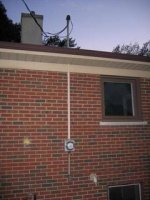
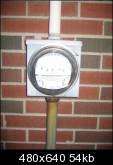
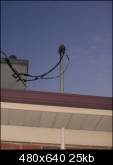
BTW, if I'm reading Pats post correctly, in my area they are very loose with building standards but residential double lugging at the meter is a big no no.
So very true. Most 320 and 400 amp meter sockets have dual lugs for this purpose. Most 200 amp meter sockets DO NOT.
This is why I suggested a combo meter socket/disconnect/panel which will give you a 200 A disconnect and a place to put a 100 amp breaker to supply the garage sub panel. Less than $110 at Lowes and Home Depot. For a new 200 amp panel in the house, you cannot go wrong with a full size GE or Siemens "contractor pack" which includes most of the breakers you will need and a full size panel. Biggest problem I find is that when upgrading panels, the wires never seem to reach, and you end up replacing the romex from the panel back to the first box or junction on many circuits. A very time consuming task. In addition, you will have to run new service entrance from the meter socket to the new breaker panelboard.
Here is the one I mentioned, cheaper here than anywhere on line I found it.
http://www.lowes.com/lowes/lkn?action=productDetail&productId=149739-76863-TSM420CSCU&lpage=none
Here are a couple of other similar products.
http://www.milbankmfg.com/Products/MeterMainBreaker/index.asp
http://www.geindustrial.com/cwc/Dispatcher?REQUEST=PRODUCTS&id=lc-msfp
The beauty of these is that you don't have to do any heavy wiring from a meter socket to a disconnect. All other setups, you take a meter socket, and connect it to a disconnect with a ******, offset or something similar and fight with huge stiff wires in a too small of a space, then you mount it on your house and it looks like ****. This is one box, looks professional.
I just used a 150 amp version of this (same price, same unit except for the main breaker) and mounted it on a pole next to one of our community wells. The old installation was rusted, corroded and generally in poor condition, and was ripped off the post by someone mowing who snagged one of the conduits on the bottom. I couldn't buy all the individual parts (meter socket, small breaker panel, ******, 100 amp breaker to backfeed for a main, and other small parts) for what this cost, and no assembly required! I'll be installing another one of these this fall on another well. That panel is plain dangerous, with most of the knockouts broken out, and no covers or fillers, and the wasps and dirt daubers have made a mess of it. Rusted, corroded, weathered, it will get replaced.
In the pic, the main breaker is obscured by the lid. You can however, make out the knockouts for the additional breakers.
By all means, check with your power company, to insure that they will accept and provide power to whatever you install.
Charles