To avoid these ads, REGISTER NOW!

Making a floorplate type 2 post lift more stable

Ironcrow

Well-known member
Joined
Sep 30, 2005
Messages
1,169
Location
Arizona
I think this underscores my hypothesis that the companies who design these lifts and actually test the real world forces on them are more concerned about the forward-to-aft tipping moments vs. anything else. That is the limiting factor and why we are cautioned to balance the load, use props/jacks, when pulling engines/heavy parts from vehicles, or why things like these outriggers are offered. ...Or maybe it points to the Greg Smith lifts being designed a little too close to the edge??? :)
Yes, this ^^^^^. I would add these features.
Even though my diagram looks childish, I like math and physics and figuring out things with some internet buddies rather than paying somebody to come into my digs and then wondering about the job they did.
I like this thought. Contrary to some opinions, I do not find the math particularly challenging, and I can calculate as well as whoever did the math for Greg Smith. Look, they tacked on extra metal to improve the strength of lift mounting, why can't we? Of course, I'm an engineer. So, if one is not comfortable with working out alterations, don't do it.
 
To avoid these ads, REGISTER NOW!

volaredon

Well-known member
Joined
Oct 7, 2012
Messages
1,630
Location
IL
Floor plate lifts as a rule seem to have a MUCH larger base plate than the ones with a top cross bar. (NOT the only example but a conveinient one here) I have a 9k Weaver symmetric floor plate style lift circa 1986 in my home garage. We have an ALM at work, a Ben Pearson (symmetrical, both 9K capacity) and an asymmetric Rotary that is much newer, (I think that one is a 10K cap.) all clearfloor versions and the baseplates are like 1/2 the size. so you lift the same car on mine here and any of them at work, that weight is concentrated on a much smaller footprint on them than my own here at home. I would think that the square inch size of the mounting bases would need to come into consideration here, as would finding out whether that concrete is reinforced with any kind of mesh or rebar, etc--- or not.
 
Last edited:

Strouty

Well-known member
Joined
Mar 21, 2010
Messages
38,216
Location
Southern Maine
I would be surprised if a lift were so poorly designed. A real engineer would have the lift strong enough to raise and support its rated capacity on the forward arms only or the rear arms only. If I found company literature that suggested your idea was true, I would question the judgement of the rest of the engineering and either not use this lift or suitably de-rate the whole thing, buying a 12,000 lb lift when I was only lifting 6,000 lb.

Here is a bit of reading for you.


https://www.eagleequip.com/blog/2013/11/04/car-lift-weights-9k-lift-doesnt-always-lift-9000-pounds/

http://www.bendpak.com/car-lifts/two-post-lifts/xpr-10a.aspx
 
OP
D

davejo

Well-known member
Joined
Oct 29, 2015
Messages
277
Location
(VA)
I looked at the bendpak site and saw this regarding their 12k floorplate model that has a 22 by 24 inch baseplate:

Lifting capacity*: 12,000 lbs. / 5,443 kg ◦*Max capacity / front axle: 6,000 lbs. / 2,722 kg
◦*Max capacity / rear axle: 6,000 lbs. / 2,722 kg

I need to find the axle weight bias and lift point recommendations for my trucks. Both are 7.3 powerstroke

98 f450 10 foot flatbed dump weighs 9000 empty
00 f250 8' supercab 4x4 stick weighs ? empty
 
OP
D

davejo

Well-known member
Joined
Oct 29, 2015
Messages
277
Location
(VA)
I looked into the possible side load limits of my polebarn. Found a cool wind load calculator here:

http://www.buildingsguide.com/calculators/structural/ASCE705W/

If my building was built to code (its a Lester building) it has to be able to withstand about 16 pounds per square foot wind pressure. Scratchpad calculations give a sideload of 1900 pounds on each 8x8 post

The gantry overhead would be a nice bonus so I went here for sizing ideas:

http://www.lkgoodwin.com/more_info/...d_adjustable_height_steel_gantry_cranes.shtml

The top plate on the lift is bolted on and suspends a pulley
 

lakeroadster

Well-known member
Joined
Jan 19, 2015
Messages
5,166
Location
Central Colorado
If my building was built to code

The drawings for your Lester building have the wind load specified on the front page. If you don't have a copy the county will, if the barn was built with a permit. The county will make you copies of the drawings for a minimal fee.
 
Last edited:

Ironcrow

Well-known member
Joined
Sep 30, 2005
Messages
1,169
Location
Arizona

Right. I did not foolishly say that your comment were wrong, only that I would be "surprised". And I am. It seems odd to me that lift manufacturers would pay the kind of attention to capacities that air compressor manufactures render to HP ratings.

Even if we assume a professional garage man has read the first link, how do you get it right? What is the actual use of a lift? I have never seen wheel scales used to find the cg before lift. In practical use the mechanical looks at crew cab truck, thinks to himself that it weighs about 7500 lbs, notes nothing is in the bed, and drives it onto a 10,000 lb lift, visually centering a speculated cg location. He lifts it up and tugs on the bumper to make sure it is steady.

If he does this (keep in mind we're talking the careful knowledgable tech) and understands he has a 5000 lb limit on each end, how does he know all is good? It would seem he has enough margin to hit less than 5000 lbs on each end with a 7500 lb truck. But, what if he has 6000 lbs on the rear and 1500 on the front? Looks good. Takes 700 lbs upward force on the front bumper to lift the truck off the front pads, so when he tugs and pushes it sees solid...

That said, in order to achieve an ALI sticker, the lift must lift 1.5 times its rated capacity. If marketing is hanging a 10,000 lb label on a ALI lift, the engineer has designed it to lift 15,000 lbs. I am curious about what the ALI standard says about how the tested lift is loaded and how pass/failure is determined. To that end I have ordered the ANSI standard and will report back.

We may find out an ALI lift may actually support its rated capacity on each end. If it doesn't, I still stand by my original assessment - it should. If it doesn't, the user should de-rate it themselves (which one of the links above suggests) or modify it to improve strength and stability as to OP and others are discussing.

Keep in mind lift testing is going to assume column anchors never pull out.

As an aside, I made my opinion of small-based free-standing lift columns known in post #4 here: http://www.garagejournal.com/forum/showthread.php?t=312017
 
Last edited:

WhiffySpark

Well-known member
Joined
Oct 22, 2009
Messages
6,252
I asked our installer at my last shop about the top braces. he said they really don't support anything beside the cable and hose. He said in theory you could remove the top piece and have no issue.

We had a lift that had a top bar bent up over a foot that our owner wouldn't replace, that's why I asked. lol

But if you look at most non cross bar designs they have a larger base plate. so I'm not sure.
 

Ironcrow

Well-known member
Joined
Sep 30, 2005
Messages
1,169
Location
Arizona
I asked our installer at my last shop about the top braces. he said they really don't support anything beside the cable and hose. He said in theory you could remove the top piece and have no issue.

We had a lift that had a top bar bent up over a foot that our owner wouldn't replace, that's why I asked. lol

But if you look at most non cross bar designs they have a larger base plate. so I'm not sure.
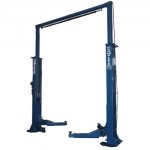
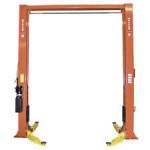
It depends. You kind of need to look at the lift design and speculate about the intent. If the columns are extended with a piece just scabbed on the top to carry the cables then it doesn't support primary load of columns tipping toward each other (image of blue lift). If the columns are full length then lift forces are restrained and the column bases can be sized with this in mind (orange lift). In some cases it may be indeterminate unless we were looking over the designer's shoulder. The column may be full height only to capture the height of the lift carriage/hydraulic cylinder with a cross bar that looks too thin to carry tipping loads without collapsing (image with large truck).
 

Attachments

  • l-2p-1-cl15000oh-12l0002-350px.jpg
    l-2p-1-cl15000oh-12l0002-350px.jpg
    51.3 KB · Views: 23
  • m5Jp4QH_6_WWOaZWg40xosA.jpg
    m5Jp4QH_6_WWOaZWg40xosA.jpg
    7.6 KB · Views: 23
  • TwoPost-MX-12C-Series.gif
    TwoPost-MX-12C-Series.gif
    20.2 KB · Views: 21

WNYflyer

Well-known member
Joined
Sep 13, 2009
Messages
2,120
Location
Lockport, NY
The initial sketch assumes the base of the post is fixed thus by tying off the post laterally (rods, cable, struts between) anywhere along its length the post analysis/reactions become indeterminate. Need a computer or some heavy lifting with a structures book to determine the correct loads/reactions.

Two post lift with a fixed base with no ties across anywhere will see no shear at the bases from vertical load. Add any ties/tie-off to the post then you will induce shears in the bases. Whether the anchors bolt themselves will see any of the shear is a function of the amount of shear relative to amount of vertical load and the friction between the base and concrete.

Assuming a fixed base as before, adding a cross bar/tie at the top (assumed pin connection with no slop) will not greatly reduce the amount of tension in the backside anchor bolts when the arms are loaded and say just above the base plates in elevation.

Then as already mentioned you still have the fore and aft forces/moments to worry about.
 

52wrench

Well-known member
Joined
Dec 20, 2015
Messages
69
Location
western NYS, land of taxes
"Assuming a fixed base as before, adding a cross bar/tie at the top (assumed pin connection with no slop) will not greatly reduce the amount of tension in the backside anchor bolts when the arms are loaded and say just above the base plates in elevation."

That's true because the moment arm between the load point on the arms and the base plate is at the minimum and as a result the tensile force applied to the anchors is the minimum. The moment arm is the greatest with the arms at the maximum height and extension and as a result the moment at the base plate is greatest and that's when the tensile force on the anchors is the greatest. The cross beam greatly reduces the maximum moment applied to the base plate when the arms are at maximum height.
 

brownbagg

Well-known member
Joined
Mar 20, 2006
Messages
5,208
i wonder why they dont make a two post with some extra post like four post. then you could lift like a two but not have it bolted down
 
OP
D

davejo

Well-known member
Joined
Oct 29, 2015
Messages
277
Location
(VA)
"Assuming a fixed base as before, adding a cross bar/tie at the top (assumed pin connection with no slop) will not greatly reduce the amount of tension in the backside anchor bolts when the arms are loaded and say just above the base plates in elevation."

That's true because the moment arm between the load point on the arms and the base plate is at the minimum and as a result the tensile force applied to the anchors is the minimum. The moment arm is the greatest with the arms at the maximum height and extension and as a result the moment at the base plate is greatest and that's when the tensile force on the anchors is the greatest. The cross beam greatly reduces the maximum moment applied to the base plate when the arms are at maximum height.

I don't think this is the case if the upright is actually plumb. The upright length only becomes a lever on the anchors if there is force applied in the x axis (sideways pull). Gravity is only pulling on the y axis.

Obviously, the mechanic will introduce x axis forces at times like pulling on a stuck wheel. This would indeed have more magnification the higher the lift is up in the air.

Strouty's vertical towers don't need to be tethered if there is no wind blowing:thumbup:
 
OP
D

davejo

Well-known member
Joined
Oct 29, 2015
Messages
277
Location
(VA)
That's really a nice lift and shop you have. Please don't do the cable tie into the structure thing, do it right with a cross beam that can be used for a hoisting beam also. It will cost more of course but it's the right way to do it. I can help you with the beam and post extension sizing. There's nothing like having a hoist, so much better than the cherry picker floor cranes.

Thanks

These guys are pretty close to me, I wonder if they would be stout enough for extending the uprights:

http://winchester.craigslist.org/for/5343219008.html

maybe too thin? I found the beamboy app to analyze beams, perhaps there is a pipeboy app somewhere:)
 

52wrench

Well-known member
Joined
Dec 20, 2015
Messages
69
Location
western NYS, land of taxes
" don't think this is the case if the upright is actually plumb. The upright length only becomes a lever on the anchors if there is force applied in the x axis (sideways pull). Gravity is only pulling on the y axis.

Obviously, the mechanic will introduce x axis forces at times like pulling on a stuck wheel. This would indeed have more magnification the higher the lift is up in the air."

The moment arm is the straight line distance between the load point and the pivot point, so here it's the distance from the pad on the arm to the inside edge of the base plate. But the only force that is considered acting on the moment arm is the component that is at a 90 deg angle to the moment arm. So here there is 6000 lbs force acting straight down. The part of that 6000 that is acting at a right angle to the moment arm has to be calc'd with trigonometry using the various angles involved. When that force is calc'd the moment acting on the base plate inside edge is simply the force times the moment arm distance, units are force-distance eg. ft-lbs. Once that is known the tensile force acting on the anchors can be calc'd knowing the distance between the inside edge and the anchors.
 

52wrench

Well-known member
Joined
Dec 20, 2015
Messages
69
Location
western NYS, land of taxes
These guys are pretty close to me, I wonder if they would be stout enough for extending the uprights:

http://winchester.craigslist.org/for/5343219008.html

maybe too thin? I found the beamboy app to analyze beams, perhaps there is a pipeboy app somewhere

It depends on how long they'd have to be to give you the height you need. 6.5" diameter is a pretty good, I bet they'd work but it has to be checked. I have to go out of town for a couple days, let me know the length you need and I can take a look at the hotel tonight.
 

Strouty

Well-known member
Joined
Mar 21, 2010
Messages
38,216
Location
Southern Maine
Davejo you brought up the towers so I would like restate what I said earlier. Steel is a hard form of rubber, if it doesn't bend it breaks. The towers I work on move a lot, some are designed to move multiple feet off center.

The posts are designed to have flex and I feel if you stop the post from flexing you may put that stress into another part of the lift. Maybe that other part counts on that flex to work properly, maybe not. It is obvious that the lift was used many times before yo I got it and it never failed. If your concern is the anchors pulling out then make the baseplate larger to spread out the load, leave the uprights alone or sell the lift and buy a four post.
 
To avoid these ads, REGISTER NOW!

Ironcrow

Well-known member
Joined
Sep 30, 2005
Messages
1,169
Location
Arizona
Steel is a hard form of rubber, if it doesn't bend it breaks.
Steel breaks if it is loaded beyond its strength, never because it "doesn't bend". Thoughtfully adding steel to a lift will increase the stiffness, strength, and rigidity of the lift. The challenge here is to have the judgement to tell thoughtful from don't know what I'm doing.
The posts are designed to have flex
No, they are not designed to have flex. The flex has no purpose to the operation of the lift. No engineer looked at this and said, gee it needs more flex here. Of course, some flex is easily tolerated.
If your concern is the anchors pulling out then make the baseplate larger to spread out the load, leave the uprights alone or sell the lift and buy a four post.
I have a two post that comes with ample column baseplates, so no problem there. The tops of the columns are attached to reinforced concrete wall (12 inch thick, two curtains of #5 rebar, on 8 inch centers) on one side and a W16x50 beam on the other. While my structure is adequate for this, I suspect the OP's is not and I would not recommend the average garage owner attach a lift to the building walls/roof.
 

Ironcrow

Well-known member
Joined
Sep 30, 2005
Messages
1,169
Location
Arizona
These guys are pretty close to me, I wonder if they would be stout enough for extending the uprights:

http://winchester.craigslist.org/for/5343219008.html
Not a good material selection. Round makes nice column post in a structure, but not so good for bending.

Lift column extensions are loaded in bending. Look at the size and wall thickness of the columns as your guide. You want a large rectangular section with wall thickness similar to what is already there. To attach them together, copy the thickness, welding, and gusseting of the floor flange.

Sometimes the distance from don't know what I'm doing to thoughtful is not too great... just a few questions...
 

rburke65

Well-known member
Joined
Nov 10, 2007
Messages
12,349
Location
Canfield, Ohio
For all the lifts out there in the world functioning and not falling over, are we trying to reinvent the wheel here?
 

Ironcrow

Well-known member
Joined
Sep 30, 2005
Messages
1,169
Location
Arizona
Maybe. But we have a posting from very knowledgeable member and literature from the manufacturer that suggests a 10,000 lift can/should not lift an 8000 lb truck. If this is the case we can either replace our "10,000 lb" lift with a rated 12,000 lift - or seek to understand the limitations and perhaps improve them.

Speaking of which, the ONLY difference between my 7000 lb lift and the same manufacturer's 9000 lb lift is the size of the electric motor that drives the pump. Good to know.

Replacing the lift with a bigger one is expensive.

Or, as you point out lifts are not generally falling down all over the place. Are there no 8000 lb trucks on 10,000 lb lifts anywhere? Or are the manufacturer limits more CYI nonsense? Or are we all staying under the front/rear limits without trying too hard? The world is never harmed by seeking to understand what is going on around us.
 
Last edited:

52wrench

Well-known member
Joined
Dec 20, 2015
Messages
69
Location
western NYS, land of taxes
"The tops of the columns are attached to reinforced concrete wall (12 inch thick, two curtains of #5 rebar, on 8 inch centers) on one side and a W16x50 beam on the other."

W16x50! Holy ****, I doubt if you're getting much flex in that.

To all the doubting Thomas's - the OP wants to add a cross beam and have it do double duty as a spreader beam for the uprights PLUS act as a trolley for a hoist. If you can't see the advantages in that then you have blinders on.
 
OP
D

davejo

Well-known member
Joined
Oct 29, 2015
Messages
277
Location
(VA)
The American lift institute website has a lot of good info in general. I wish the vehicle loading and lift point booklet was available online.

I found what appears to be the same lift as mine but utilizing a cross bar as well. They call it a 15000# lift. I think it is at least evidence that adding a crossbar to mine might not defeat any "flex" that might have been engineered into the uprights of my 12000# model.

Here are the specs of the 12k and the 15k. The column specs look very similar

http://discount-car-lifts.com/udu15ktwopol.html

The crossbar doesn't look overly massive but my sketch in the first post shows it only needs to resist 5000 pounds of inward pressure if there were no anchor bolts at all.

Another aspect I'm beginning to realize is that if the lift arms are properly locked and attached to the vehicle frame via friction at the lift pads, the vehicle might be acting as sort of a crossbar itself, somewhat resisting inward tipping of the uprights.
 

Attachments

  • tp15k lift.jpg
    tp15k lift.jpg
    12.5 KB · Views: 24

52wrench

Well-known member
Joined
Dec 20, 2015
Messages
69
Location
western NYS, land of taxes
There is no post flex that is "engineered in". In other words they don't size the posts to specifically have "x" amount of flex. The posts are sized to handle any vertical load and bending moment without exceeding the yield strength of the material and to meet a minimum safety factor. Is there some flex when it is under load? Of course, but the flex, or more correctly called deflection, is not necessary for the lift to operate correctly and installing a cross beam to eliminate any flex will in no way alter the safe operation of the lift. Re. using the vehicle as a cross beam, yes that can be done. On a vehicle with a separate frame like a truck, you can build U adapters that fit over the frame tightly however for this to work you have to lock the extension arms in some manner so they can't slide in as you said, otherwise it isn't a rigid structure.
 

wssix99

Well-known member
Joined
Mar 2, 2011
Messages
5,161
Location
Chicago, IL
Just a quick note. I'd rather put the compressive load into a cross beam instead of the vehicle frame.

I hope you aren't driving your car on the road then! Pulling 0.9g in your 2+ ton car/truck around a curve, would crush your chassis, then.
 
OP
D

davejo

Well-known member
Joined
Oct 29, 2015
Messages
277
Location
(VA)
Well I have been tinkering with my lift a bit.

First up. my Volvo xc70, barely got the lift pads underneath but it was a nice oil change experience. 4000#?

Secondly, Geo tracker fuel tank removal. Hard to squeeze the arms under there on such a short wheelbase. Getting my feet wet on light vehicles, obviously. 3000#?

Now comes the sort of tricky stuff. F250 4x4 diesel. Long wheelbase but very unbalanced. I guestimate 5000# front and 3000# rear bias. Wasn't sure where to position the truck and the lift arms.

My dad taught me how to find the center of a stick by supporting it on your pointing fingers out wide. When you slide your fingers toward eachother, they end up meeting at the balance point of the stick. I built my own unbalanced stick to find the center of gravity for my truck.
20160220_151135_zpskwvhy93m.jpg


It helped me understand where to try and place the arms to avoid an unbalanced load. The frame configuration was a challenge but I settled on some lift points and up she went without issue.

Then came the f450, 9500# but more balanced, 4500# front and 5000# rear. Up she went without drama.
20160219_183539_zps8y2f8xkc.jpg


"For science" I measured how much the tops of the columns shifted inward. The 9500# lift resulted in the tops of the uprights flexing inwards 1.25 inches. (ten feet tall uprights). I'm not sure if that is acceptable or not as I have nothing to compare it to.

Regardless, I bought 4 jackstands to use as stabilizers when I have the trucks up in the air:
http://www.harborfreight.com/2-ton-capacity-underhoist-safety-stand-60759.html
 

Strouty

Well-known member
Joined
Mar 21, 2010
Messages
38,216
Location
Southern Maine
The test is of the anchors, the steel will have flex. I would check the torque on the anchors as often as you feel the need to, that way you will feel comfortable that nothing is pulling out of the concrete.
 

Ironcrow

Well-known member
Joined
Sep 30, 2005
Messages
1,169
Location
Arizona
I measured how much the tops of the columns shifted inward. The 9500# lift resulted in the tops of the uprights flexing inwards 1.25 inches. (ten feet tall uprights). I'm not sure if that is acceptable or not as I have nothing to compare it to.
5/8 inch deflection per column? Seems like about twice what I'd expect. If you can give more detail, a better estimate can be made?

1) vertical distance from ground to lift arm height
2) horizontal column to lift pad (giving twisting moment)
3) measure the deflection of the columns measuring at lift height (just under truck)(not adding the columns above the lift point as they aren't doing anything) 4) cross section of column beam (dimension of rectangular column footprint and wall thickness)

If you add
5) column base footprint and bolt locations, we can calculate anchor pull-out force
 

Pwrgeek

Well-known member
Joined
Oct 18, 2015
Messages
288
Location
Texas USA
No, they are not designed to have flex. The flex has no purpose to the operation of the lift. No engineer looked at this and said, gee it needs more flex here. Of course, some flex is easily tolerated.


No engineer said "it needs to flex", but what the engineer did probably do is look at it and realize that it would flex. It is highly probable that if you restrain something that was designed to flex you are putting stresses in places where they were not designed to go. One thing I can think of is that I can almost guarantee you that the carriage tracks have a bit of counter bend in them to make the carriage move straight even when the columns flex. Restraining the columns will probably get you carriage binding towards the top or travel. Highly engineered products like this should either be installed per original design or not installed at all. I have the engineering bonafides to design these things from scratch if I wanted to and there is no way I would ever take one and modify it. If your concrete won't take the install per design you need better concrete not to modify the lift


Sent from my iPhone using Tapatalk
 
Last edited:

Pwrgeek

Well-known member
Joined
Oct 18, 2015
Messages
288
Location
Texas USA
Now let's analyze the forces involved. Assuming no lateral transfer through the lift arms (the worst case assumption) the forces under the baseplate for a 6000 lb load at 50" from the column will apply 6000lbs of vertical force and 25 ftkips. The base will resist the by applying the same 25 ftkips in the opposite direction. For simplicity we'll assume all of this is provided by the rear edge anchor bolts. Assuming a base width of 24" that will result in those bolts holding a load of 12500 lbs. Assuming four anchors along the back edge the anchors are good for around double that so the safety factor on the anchors is about 2 (actually more than that because we neglected all the anchors but the back ones). Now for concrete failure the vertical load will be borne by about the front third of the baseplate. That load consists of the 6000lbs of vertical coming from the load on the arms as well as the 12500 lbs coming from the anchors that are resisting the moment. So the total vertical load is about 18500 lbs. that is spread over approximately a 1 sq ft area so it is roughly 1500psi. Any reasonable concrete that is over 6 mos old should be able to do 3000 psi so once again safety factor is about 2. If you're comfortable with a safety factor of two on what would be a pretty worst case analysis then install it and go nuts. If not then you need a different lift.


Sent from my iPhone using Tapatalk
 

lakeroadster

Well-known member
Joined
Jan 19, 2015
Messages
5,166
Location
Central Colorado
Well I have been tinkering with my lift a bit......

"For science" I measured how much the tops of the columns shifted inward. The 9500# lift resulted in the tops of the uprights flexing inwards 1.25 inches. (ten feet tall uprights). I'm not sure if that is acceptable or not as I have nothing to compare it to.

Regardless, I bought 4 jackstands to use as stabilizers when I have the trucks up in the air:
http://www.harborfreight.com/2-ton-capacity-underhoist-safety-stand-60759.html

Thanks for reporting back, sounds like your good to go.

As Stroudy mentioned, check the torque on those anchors periodically.

Happy lifting :thumbup:

What size and type of anchors did you end up using?
 

sberry

Banned
Joined
Jun 18, 2005
Messages
35,747
Location
Brethren, Michigan
I aint xactly a rokkit surgon but its 4x with 2000# concrete,, Got to agree with strout,,,, don't fugg wit it if it ain't busted and crumbling. It should be obvious if the bolts is holdin.
Thousand of them in use daily by absolute dipsticks and work fine.
 
Last edited:

Ironcrow

Well-known member
Joined
Sep 30, 2005
Messages
1,169
Location
Arizona
It is highly probable that if you restrain something that was designed to flex you are putting stresses in places where they were not designed to go.
Can you propose an example? If the lift columns are further constrained, what other part might be unusually stressed and how? And this part would be more stressed than if the columns were left alone?
One thing I can think of is that I can almost guarantee you that the carriage tracks have a bit of counter bend in them to make the carriage move straight even when the columns flex.
This does not sound reasonable to me at all. Would this bow be designed to accommodate column flex at maximum lift capacity, empty, or mid range? Wouldn't the arms move enough to accommodate column flex anyway? Raise the lift, lock the arms, and see how much the pads can be moved. This slack would seem to handle column deflection. I checked three lifts I have access to, a Rotary, Challenger, and Benwil. They were all straight columns.
 
To avoid these ads, REGISTER NOW!
Top Bottom