DocsMachine
Well-known member
- Joined
- Sep 16, 2006
- Messages
- 1,926
A week or two back, we all saw a video from Clickspring, in which he made a card press for a magician friend. The work was amazing and the resulting device looked like something you'd present to an especially picky Tsar or something. 
While I knew Clickspring has had a whole series of videos, I'm chronically short on TV-watching time, and so had really only seen a bare handful of them. After posting the card-press video, I took the time to check out a few of his other videos, and discovered he'd actually started a second channel, specifically for short videos showing discreet processes- that is, instead of having to watch an entire video about come part, he had a specific video covering individual processes, like gearmaking or heat-bluing.
One of the videos I ran across, was how to make a needle scriber.
Now this I was interested in, as I'm constantly using scribers, but oddly enough, I kind of hate using them. To clarify that particular statement, here are my three most-used scribers:

I say "most used" because I have a fourth, a Starrett, that I love to use, but hate to get dull. And therein lies the problem.
Of the above three, the top one is a Master Mechanic scratch awl. Handy, but the steel is fairly soft, and I've had to resharpen it frequently. Too much of that and the shaft will start running back into the thicker portion, making it harder to sharpen and blunter to use.
The bottom one is a commonly available replacement- a cheap "carbide scriber" off eBay. The carbide tip lasts admittedly forever when used with aluminum, but it's blunt- the shaft is fairly large in diameter, with a short, 'fat' point. I can use it for lots of scribing, but it's nearly useless for tight quarters, the inside of small holes, narrow slots, etc.
The middle one is my favorite. I have no idea who made it, and would love to buy more if a supplier could be found. The shank is nice and long and come down to a needle point that's easily small enough for virtually all the tiny features I might scribe.
The problem is, while the steel is very good quality and I've only had to resharpen it a couple of times, it too is going to eventually "wear out". I could make one just like it, but the big trick is in shaping and hardening the point- I can do it, but it's a lot of labor and we're back the the issue of it eventually wearing out.
Years ago, I read an article by Frank Ford (warnimg, time **** page!) about a scriber he'd made which used old- as in antique- steel phonograph needles. Now, you can buy these by the binload off of Bay (pack of 500 for $22?) and I'd always meant to order a pack or two and whip something like that up.
In fact, years ago, I wound up with a small pill bottle full of such needles, likely from one of the "lots" of machinist tools I'd picked up. The problem there is I don't know what I did with them.
Anyway, getting back to the Clickspring video, his solution was simple- use a heavy sewing needle. Simple, durable, sharp, thin, and easily- and cheaply- replaced if and when it gets dull. Why didn't I think of that?
Click's handle is fairly fancy (ish) but I thought I could make do with some aluminum. I checked my racks, and sure enough I had a couple chunks of 3/8" mystery aluminum that I'd bought from the local Homey-Dee.

Click suggests that about 5 inches (I thought he was Australian? ) would feel most comfortable, so I lopped off two 5" lengths in the bandsaw.

Faced one end...
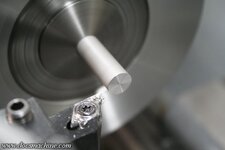
And used a small form tool I had laying about to round the end.

A splash of WD-40 and a bit of green Scotchbrite evens up the finish a little.
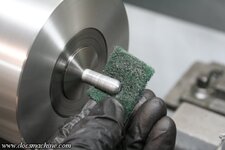
Flipping it around, I faced the other end...

And then swung the compound around to about 6 degrees. For this kind of turning, I also use a screwdriver and back off the gib a touch, so it's easier to turn.

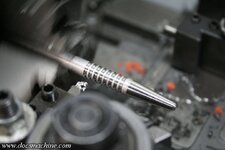
Turn a taper leaving a flat spot on the end about 3/16" in diameter.

A quick lick with a file rounds the blunt end slightly, and another sweep of the Scotchbrite blends and smooths the finish.

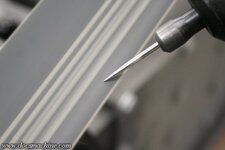
Extend the rod out of the chuck and grip it by the previously-Scotchbrited tail end, and gently condition the rest of the shank.
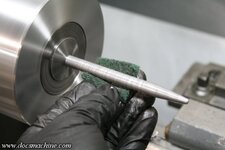
Do it all twice and you have a matching pair.

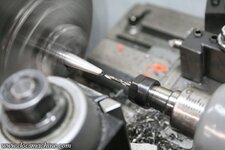
Then, with an itty-bitty spotting drill, drill a tiny spot at the point of the tapered end.
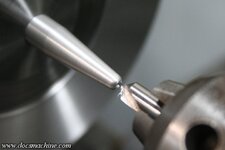
Measure the needle...

Find an appropriate tiny drill bit...
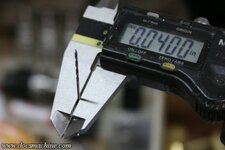
And very carefully drill the end to about 1/2" deep. Use lube, and "peck" a lot to clear the tiny chips. These little bitty drills load up fast.

Use a Dremel with an abrasive wheel to chop the eye off a needle...

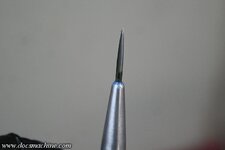
Carefully degrease verything, and use a drop of Loctite or super glue to lock the needle in place.

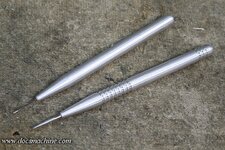
Like Clickspring says, if you have to replace the needle, a little heat will free it right up. After wiping up the excess Loctite, set 'em aside to let the stuff cure, and they're ready to use.
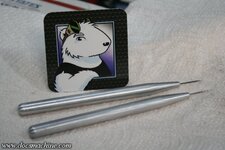
I'll be using these a lot in the next week or two, so I'll give you an after-action report in a little while, but I think they'll work just fine. The needles might be a bit too flexy and skinny to use on, say, mill-scaled hot-roll steel, but in that case, the cheap carbide scribers can be used. For the aluminum and occasionally Delrin parts I've been working on, I think they'll be perfect.
Doc.
While I knew Clickspring has had a whole series of videos, I'm chronically short on TV-watching time, and so had really only seen a bare handful of them. After posting the card-press video, I took the time to check out a few of his other videos, and discovered he'd actually started a second channel, specifically for short videos showing discreet processes- that is, instead of having to watch an entire video about come part, he had a specific video covering individual processes, like gearmaking or heat-bluing.
One of the videos I ran across, was how to make a needle scriber.
Now this I was interested in, as I'm constantly using scribers, but oddly enough, I kind of hate using them. To clarify that particular statement, here are my three most-used scribers:
I say "most used" because I have a fourth, a Starrett, that I love to use, but hate to get dull. And therein lies the problem.
Of the above three, the top one is a Master Mechanic scratch awl. Handy, but the steel is fairly soft, and I've had to resharpen it frequently. Too much of that and the shaft will start running back into the thicker portion, making it harder to sharpen and blunter to use.
The bottom one is a commonly available replacement- a cheap "carbide scriber" off eBay. The carbide tip lasts admittedly forever when used with aluminum, but it's blunt- the shaft is fairly large in diameter, with a short, 'fat' point. I can use it for lots of scribing, but it's nearly useless for tight quarters, the inside of small holes, narrow slots, etc.
The middle one is my favorite. I have no idea who made it, and would love to buy more if a supplier could be found. The shank is nice and long and come down to a needle point that's easily small enough for virtually all the tiny features I might scribe.
The problem is, while the steel is very good quality and I've only had to resharpen it a couple of times, it too is going to eventually "wear out". I could make one just like it, but the big trick is in shaping and hardening the point- I can do it, but it's a lot of labor and we're back the the issue of it eventually wearing out.
Years ago, I read an article by Frank Ford (warnimg, time **** page!) about a scriber he'd made which used old- as in antique- steel phonograph needles. Now, you can buy these by the binload off of Bay (pack of 500 for $22?) and I'd always meant to order a pack or two and whip something like that up.
In fact, years ago, I wound up with a small pill bottle full of such needles, likely from one of the "lots" of machinist tools I'd picked up. The problem there is I don't know what I did with them.
Anyway, getting back to the Clickspring video, his solution was simple- use a heavy sewing needle. Simple, durable, sharp, thin, and easily- and cheaply- replaced if and when it gets dull. Why didn't I think of that?
Click's handle is fairly fancy (ish) but I thought I could make do with some aluminum. I checked my racks, and sure enough I had a couple chunks of 3/8" mystery aluminum that I'd bought from the local Homey-Dee.
Click suggests that about 5 inches (I thought he was Australian? ) would feel most comfortable, so I lopped off two 5" lengths in the bandsaw.
Faced one end...
And used a small form tool I had laying about to round the end.
A splash of WD-40 and a bit of green Scotchbrite evens up the finish a little.
Flipping it around, I faced the other end...
And then swung the compound around to about 6 degrees. For this kind of turning, I also use a screwdriver and back off the gib a touch, so it's easier to turn.
Turn a taper leaving a flat spot on the end about 3/16" in diameter.
A quick lick with a file rounds the blunt end slightly, and another sweep of the Scotchbrite blends and smooths the finish.
Extend the rod out of the chuck and grip it by the previously-Scotchbrited tail end, and gently condition the rest of the shank.
Do it all twice and you have a matching pair.
Then, with an itty-bitty spotting drill, drill a tiny spot at the point of the tapered end.
Measure the needle...
Find an appropriate tiny drill bit...
And very carefully drill the end to about 1/2" deep. Use lube, and "peck" a lot to clear the tiny chips. These little bitty drills load up fast.
Use a Dremel with an abrasive wheel to chop the eye off a needle...
Carefully degrease verything, and use a drop of Loctite or super glue to lock the needle in place.
Like Clickspring says, if you have to replace the needle, a little heat will free it right up. After wiping up the excess Loctite, set 'em aside to let the stuff cure, and they're ready to use.
I'll be using these a lot in the next week or two, so I'll give you an after-action report in a little while, but I think they'll work just fine. The needles might be a bit too flexy and skinny to use on, say, mill-scaled hot-roll steel, but in that case, the cheap carbide scribers can be used. For the aluminum and occasionally Delrin parts I've been working on, I think they'll be perfect.
Doc.