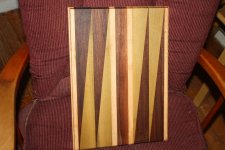
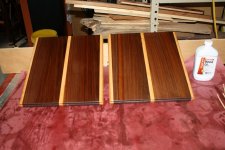
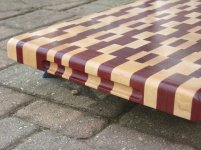
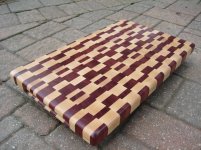
A little late to the discussion, but for cutting boards I like:
- a tight-grained 'hard' hardwood.
I don't want an 'open' grain, so oak, etc are out of the running. I don't want most 'tropical' hardwoods, because of the possible 'oily' resins in the wood that may or may not be all that food/people safe (look up cocobolo and allergic reactions, for instance). Poplar is too soft (for me), so Hard maple (aka 'rock maple') is my usual choice (for a 'working' cutting board, as opposed to an 'artistic' one).
Glue is usually Titebond II or III. I'm not going to be soaking a wooden cutting board, so Titebond II is 'plenty' water resistant. If your use (or heathenish users) might be soaking the wooden object in water, then use Titebond III.
btw, if you go to the Titebond website at
http://www.titebond.com, you can get the Product Selector and one of the available question choices is for wooden cutting boards.

Which selects either Titebond II or III, as both are FDA approved for indirect food contact.
Gorilla Wood Glue is a water-resistant PVA-type wood glue (similar to Titebond II).
Glued and clamped is -usually- enough. A 'big' cutting board made of several wide pieces of wood might or might not get biscuits or similar, mostly to help make glue-up and assembly a bit easier (the biscuits help to align the faces of the pieces of wood and help in that way, either that or use some cauls across the face of the glue-up).
More than one way to do the task.