To avoid these ads, REGISTER NOW!

making picture frames

bls2dpj

Active member
Joined
Dec 2, 2009
Messages
42
Location
Wichita, KS
Okay, I collected a bunch of barn wood an would like to make some picture frames out of it, 8x10, 12x16, 18x20, etc. I wanted to get some suggestions on how to join the wood together at each 45 degree corner. Any ideas/suggestions would be appreciated.

DJ
 
Last edited:
To avoid these ads, REGISTER NOW!

Duck

Well-known member
Joined
Dec 16, 2009
Messages
75
Location
Byron, GA.
If you have a plate jointer, you could put in biscuits.
Hobby Lobby carries wavy staples in the framing section. These staples are used to join frames at the corners.
Whatever method you use, make sure you a good wood glue, like Tite-Bond.
Employ lottsa clamps too.
Duck
 

Lhorn

Well-known member
Joined
Sep 17, 2008
Messages
1,487
I tried to use those wavy staples once. Is there some trick to using them or a special tool? It was my experience that that it takes a lot of pounding to drive those things in. I put my mitered pieces of wood in a 90 degree clamp and there was no possible way to drive those things and keep the joint together. Not even close. My father in law made some frames by putting the mitered pieces of wood together then drillinga hold through the joint from the side and using wood dowels to hold the joint. He'd then run them through the router to profile the wood and it hid the dowels pretty well. It's good enough for a rustic appearing frame anyway
 

srmofo

Well-known member
Joined
Oct 15, 2009
Messages
6,161
Location
SW ohio
I tried to use those wavy staples once. Is there some trick to using them or a special tool? It was my experience that that it takes a lot of pounding to drive those things in. I put my mitered pieces of wood in a 90 degree clamp and there was no possible way to drive those things and keep the joint together. Not even close. My father in law made some frames by putting the mitered pieces of wood together then drillinga hold through the joint from the side and using wood dowels to hold the joint. He'd then run them through the router to profile the wood and it hid the dowels pretty well. It's good enough for a rustic appearing frame anyway

actually there is
http://www.google.com/products?hl=en&q=corrugated+fastener&um=1&ie=UTF-8&sa=N&tab=wf

or by hand

A corrugated fastener is installed by hand using a hammer. The fastener should be installed into one of the wood components first, with the fastener traveling about halfway through the thickness of the wood. The other piece of wood can then be added and hammered into place. For more delicate work, place the second piece of wood onto the fastener and alternate your hammer on the two pieces of wood to join them together a bit at a time. A corrugated fastener should never run the same direction as the wood grain, as this may split the wood.
 

csp

Well-known member
Joined
Mar 23, 2010
Messages
5,719
Location
Franktown, CO
Pocket screws

Lowes sells an inexpensive (~$40) kit from Kreg with screws, the correct drill bit, drilling guide, etc. I find these easier to use than biscuits and create a much stronger joint.
 

msnow

Well-known member
Joined
Nov 16, 2009
Messages
192
I would also suggest pocket screws via a kregg jig. If you want a really expensive option I have heard nothing but good things about festool's domino joining system. The cheapest option assuming yo have the technology and don't mind the look is to half lap the 45s and glue and brad nail.
 

rockchucker

Well-known member
Joined
Mar 27, 2010
Messages
1,764
Location
Seattle WA
Cut your Angles at just a RCH under 45 Degrees. Just a tiny bit. Apply Glue to both sides of the Miter. Pin them together with a Brad Nailer. Use as long of nails as possible and set 2 pins in each corner on each side. Total of 16 pins if the Wood allows. If not then just stick with 8. Make sure the Corners line up very well and all excess glue is wiped off then put them in this style of clamping device...


http://www.amazon.com/dp/B0035Y5KL2/?tag=atomicindus08-20


Make sure you can tighten each corner individually not just the whole unit all at once. This way you can pinch a particular corner to tighten the Miter. Always use a perfectly flat surface for all work being done. This step is very important to achieve desired results. Check for Square and adjust accordingly. Set to dry and you are done.


Other tips would be to try to use one single piece of wood and keep the flow around the whole Frame. This way if there are slight differences in the wood at least the Miters are cut from very close to the same imperfections. This will match the Grain Better. You will waste a little bit of wood by cutting a Triangle out of every corner but you want to keep the same edge of the piece of wood on the outside of the Picture Frame.


Before cutting the stock for the picture frame make sure you run the whole piece through a router for the desired recess to accept the Picture, Matting, Glass and Backing Board.
 

Kevin54

MEMBER EMERITUS
Joined
Jan 12, 2005
Messages
29,341
Location
Urbana, Ohio
Cut your Angles at just a RCH under 45 Degrees. Just a tiny bit. Apply Glue to both sides of the Miter. Pin them together with a Brad Nailer. Use as long of nails as possible and set 2 pins in each corner on each side. Total of 16 pins if the Wood allows. If not then just stick with 8. Make sure the Corners line up very well and all excess glue is wiped off then put them in this style of clamping device...


http://www.amazon.com/dp/B0035Y5KL2/?tag=atomicindus08-20


Make sure you can tighten each corner individually not just the whole unit all at once. This way you can pinch a particular corner to tighten the Miter. Always use a perfectly flat surface for all work being done. This step is very important to achieve desired results. Check for Square and adjust accordingly. Set to dry and you are done.


Other tips would be to try to use one single piece of wood and keep the flow around the whole Frame. This way if there are slight differences in the wood at least the Miters are cut from very close to the same imperfections. This will match the Grain Better. You will waste a little bit of wood by cutting a Triangle out of every corner but you want to keep the same edge of the piece of wood on the outside of the Picture Frame.


Before cutting the stock for the picture frame make sure you run the whole piece through a router for the desired recess to accept the Picture, Matting, Glass and Backing Board.

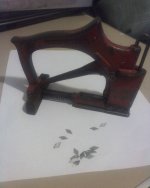
:lol_hitti http://www.everything2.com/title/Red **** hair

Why is it always a red one?

On the other hand....when you glue it, use Gorilla Glue. I swear by that stuff. When it dries it swells slightly, therefore tightening the joint.
 
Last edited:

GarageEnvy

Well-known member
Joined
Nov 17, 2009
Messages
1,282
Location
Fresno
My wife was a professional picture framer for about a decade. She always simply glued and brad nailed her corners and then puttied them. Jabberwoki has the right tool for framing but it's not for joining the corners. It is used to tightly fit the backing on. When we went to trade shows there were always vendors selling pneumatic blind nailers that drove brads at a perfect angle but that's way out of line for home use. Most professional picture framers see the wavy connectors as "amateur hour" stuff.
 
To avoid these ads, REGISTER NOW!
OP
B

bls2dpj

Active member
Joined
Dec 2, 2009
Messages
42
Location
Wichita, KS
Well I decided to get a kreg pocket screw jig. So far All I have done is practice with a bunch of scraps but I think for my little project this will work out just fine. Thanks for all the advice!!

DJ
 

Dmar836

Well-known member
Joined
Apr 7, 2008
Messages
53
Location
Kansas City
I can't imagine securing corners of an 8X10 frame with pocket screws unless the material is quite thick. When one buys pre-finished lengths of framing material, the cross section is quite varied. I would the the Kreg would be of limited use.... at least for frame building.
BTW, I have built them in many sizes using the glue and brad method mentioned. On pre-finished material, filler or even melted crayon can be used to fill brad holes. I have had them fail only when dropped from a wall. Of the two or so that have done that, they took a good hit on an angle yet they were repairable.
JMO,
Dave
KC
 

Jack Burton

Well-known member
Joined
May 22, 2009
Messages
105
As far as the angles, whether it's a miter saw or a table saw you'll probably want to true them. The shop I worked at had a sliding miter cutter aka guillotine, but you can do what the old timers did and make a shooting board. Not only will you learn a new skill, but you'll have an excuse to learn about planes and sharpening if you don't already know.

If you're painting them, I'd probably try to spline the corners on the TS. Otherwise the biscuits as Duck suggested seem like a good way to go. Corrugated fasteners are not worth the headache, especially in a hardwood IMO.

The most time consuming part will be getting a nice square glue-up jig ready to go or I guess you can buy a clamp jig from Lee Valley.

I'd also paint the end grain of each joint with a glue-water mix right before assembly. It won't make the joint any stronger but it will seal and prevent shrinkage.

If you do decide to make a jig and there is a possibility the glue from the joints might stick to the jig, use small pieces of wax paper.
 
Last edited:

ksfarmboy

Well-known member
Joined
Dec 3, 2009
Messages
73
Location
The Wheat State
Sorry I'm late to the party, but I've used a Pushmaster tool to stick "W" shaped staples into frame corners. We've mainly done barnwood frames as well and the system works pretty well in the barnwood. However, you can find a piece of wood that is still solid and hard to put a staple in. I put together a 28" by 40" frame a couple of months ago with 3 staples per corner and it is holding just fine!

http://www.clubframeco.com/picture_frame_joining_tools.html

http://www.rockler.com/product.cfm?page=11455
 

cnc-me

Well-known member
Joined
Jan 6, 2010
Messages
1,183
Location
MI
Pin and glue first.
Then, drive in those pocket screws.
The bigger it is, the more you need to put in the screws.
Brads or pins, don't hold ****, but they make great clamps.
"Biscuits" work good too but are harder to align.
We had a run of 6000 frames for electronic doorbell units for
Trine Corp. these were all done with biscuits.
Clamped until dry, with stretch wrap using a turntable.
I don't think we ever had one come apart.
Though we fixed many of our competitors units
that were stapled.
Just My 102 cents (2 cents with inflation)
-John
 

Maudie Mc Salmon

New member
Joined
May 10, 2013
Messages
2
Location
Georgetown, Texas USA
My1602 Red Devil framing staple gun won't staple any more. Is there a setting on the gun to a deeper depth? What can I do to make it work? I would appreciate your help if any one know how to adjust or repair this hand held framing stapler.
 
To avoid these ads, REGISTER NOW!
Top Bottom