To avoid these ads, REGISTER NOW!

Making pistons & connecting rods

FarmerSid

Well-known member
Joined
Dec 12, 2005
Messages
145
Location
Ontario, Canada
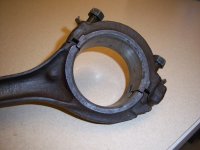
Hey All! I think I got a new project I want to try. I have access to a Haas super mini mill CNC mill. I want to try and make pistons and connecting rods for my tractor. It's a Farmall 300 gas. I have a original rod to go by. The rod cap is angled. How much of the piston can I make on the CNC? Anybody interested in sharing their skills? I have MasterCAM X4 to use.
 
To avoid these ads, REGISTER NOW!

ZRX61

Well-known member
Joined
Aug 15, 2006
Messages
28,716
Location
Solar Blight Valley, SoCal
Made some pistons MANY years ago, the trick is getting the correct grade of aluminum.. which is accomplished by melting down other pistions to make the new ones.

& remember that pistons aren't perfectly round.. ;)
 
Last edited:

larry_g

Well-known member
Joined
Apr 28, 2007
Messages
16,872
Location
oregon
Hey All! I think I got a new project I want to try. I have access to a Haas super mini mill CNC mill. I want to try and make pistons and connecting rods for my tractor. It's a Farmall 300 gas. .

Have you checked things out at http://www.redpowermagazine.com/forums/index.php

There are a bunch of good people there who may lead you to the information you want. They might also have sources for new or used parts you require.


lg
no neat sig line
 

KJF470

Member
Joined
May 10, 2006
Messages
17
Murphy's Motorsports uses Haas CNC exclusively for making rods and pistons. 4140 material for rods and I think something like 7074 (not 100% sure) aluminum for the pistons. Search Murphy's Motorsports.com!
 

kevinstj

Well-known member
Joined
Feb 9, 2010
Messages
50
I agree with ZRX61 that the grade and also the proper temper are important(Give Wiseco piston a call and telll them what your doing,i'm sure they will tell you the grade and temper, its not a secret) but i'm not sure what ZRX61 is talking about that pistons aren't perfectly round. Why the hell would they make them out of round???
 

adam728

Well-known member
Joined
Aug 9, 2009
Messages
2,900
Location
Michigan
I agree with ZRX61 that the grade and also the proper temper are important(Give Wiseco piston a call and telll them what your doing,i'm sure they will tell you the grade and temper, its not a secret) but i'm not sure what ZRX61 is talking about that pistons aren't perfectly round. Why the hell would they make them out of round???

Because pistons are not uniform thickness, and therefor expand different amounts around their circumfrenece. The area for the wrist pin has much more material and expands more.

At room temp pistons are eliptical when looking stright down from the top, and usually slightly bell shaped when veiwed from the sides. Neither of these can really be seen with the naked eye, you need to grab a micrometer and measure different parts of the piston.
 

rsanter

Well-known member
Joined
Dec 22, 2007
Messages
18,492
Location
visalia ca
I recoment not to unless you really have to.
I have made rods and pistons for really old engines and model sized engines and it is more work than you think it is.

with that said, if you want it for the challange, then go for it.

what have I done:
generally I have tried to find the closest matching piston I can find to the original and made it work. sometimes you can do a non-standard overbore to fit another application into your engine (example: a .017 overbore will fit certain chevy pistons into a ford)
you can modify the wristpin bore to change the pin height

rods are a little easier to make (imop) and you can make them out of some good steel. the alternative is to do the same and find a similar rod that can work

bob
 
OP
F

FarmerSid

Well-known member
Joined
Dec 12, 2005
Messages
145
Location
Ontario, Canada
Thanks for all the replies people! I appreciate it. I have been to red power magazine and have talked to Murphy's motor service. I know Murphy's uses 4340 for rods. He wasn't to interested in sharing info and I don't blame him. It's his bread and butter. I have the tools to make my own so I don't see the need to pay for them. It's not only the money and from what I hear, Murphy's is a top notch place to deal with, but I would like to learn how to use this machine for this and other things we may need around the farm. Anything I would make would be for personal use anyways.

I have found off the shelf pistons that I could use but they would depend on the stroke I want to run. They are around $100 each plus rings and wrist pin so I got to thinking why not try or look into making my own.

Another thing is I know some local people that hang around tractor sites and I want to keep this project hush hush. LOL! There seems to be tons people here that have some great machining skills and are super happy to help out so that's why I ask this here.
 

speed bump

Well-known member
Joined
May 28, 2008
Messages
6,317
Location
Butte Montana
Pistons are typically cast or forged not machined. You then finish them off by machining. I suppose you could machine them out but honestly for $100 a pop a can't see bothering.

The metal isn't to hard to figure out, buy an ASM vol 20 and pick the material that is best for the app or talk to a metallurgist.
 

APEowner

Well-known member
Joined
Oct 2, 2009
Messages
4,164
Location
Sunny, New Mexico
Because pistons are not uniform thickness, and therefor expand different amounts around their circumfrenece. The area for the wrist pin has much more material and expands more.

At room temp pistons are eliptical when looking stright down from the top, and usually slightly bell shaped when veiwed from the sides. Neither of these can really be seen with the naked eye, you need to grab a micrometer and measure different parts of the piston.

I have to call BS on that one.

This is a slight oversimplification but it's the truth. Pistons are in fact not round and have a taper from top to bottom. It's not only the expansion rate from the different amounts of materials but also the fact that they're heated from the top and cooled from the sides (and in some cases the bottom) that dictate the room temperature shape.
 
To avoid these ads, REGISTER NOW!

APEowner

Well-known member
Joined
Oct 2, 2009
Messages
4,164
Location
Sunny, New Mexico
Ok ok ok ok....I will be a better man and say I'm wrong. I just called Ross and they say that all of their pistons are cam turned all the way down to the cheapest of cheap. Do you think a farmall piston would be cam turned also, or just round with added clearance because of low rpm use?

As I was typing my original reply I was wondering how critical that would be in a Farmall. I have never gotten far enough into a Farmall engine to know how much taper their pistons are likely to have. The problem with experimenting is that you might damage the block. I suppose if that happens you can really put that CNC to work and make a new one..
 
OP
F

FarmerSid

Well-known member
Joined
Dec 12, 2005
Messages
145
Location
Ontario, Canada
Geez guy's! All I want to do is get some help on learning how to draw up a connecting rod in MasterCAM and make them on a buddies CNC mill and maybe some pistons if possible.

Some things I need to figure out is:

Do I make the cap separate?
Do I make the mating surfaces of the cap and rod need to have locating grooves on them?
Since the cap is angles at about 45 deg, how should I drill the holes for the cap bolts?
 

APEowner

Well-known member
Joined
Oct 2, 2009
Messages
4,164
Location
Sunny, New Mexico
Geez guy's! All I want to do is get some help on learning how to draw up a connecting rod in MasterCAM and make them on a buddies CNC mill and maybe some pistons if possible.

Well, we went the long way to get here but I guess what we're saying is that unless you determine that the original piston isn't cam ground it's probably not worth it to try and make the pistons on the CNC.

Traditional automotive connecting rods and caps are made from two separate parts. The cap is located in relation to the rod by the bolts. I would rough machine the two separate parts including undersized bolt holes in the cap then clamp the two parts together, drill and ream the bolt holes to size in a manual mill and then bolt the assembly together for the rest of the machining. Don't forget that the pin bore and the bore for the bearing are honed to size.
 

rsanter

Well-known member
Joined
Dec 22, 2007
Messages
18,492
Location
visalia ca
Geez guy's! All I want to do is get some help on learning how to draw up a connecting rod in MasterCAM and make them on a buddies CNC mill and maybe some pistons if possible.

Some things I need to figure out is:

Do I make the cap separate?
Do I make the mating surfaces of the cap and rod need to have locating grooves on them?
Since the cap is angles at about 45 deg, how should I drill the holes for the cap bolts?

you can make the cap seperate as you will need to do a boring and then honing operation to final size the rods

for cap location I like to either use locating pins or hollow pins (that surround the rod bolt) depending on the amount of meat you will have in that area

for drilling the holes I would make a fixture that will hold the rod and the cap centered together and then the whole works is clamped tight and then you do your drilling

I would also look at making a H beam rod. if you are going to do CNC that should not be that much more work. you will get a stronger rod and it will be easier to locate the upper rod bolt in the unit.
one thing that can make it easier is to design it to take a rod bolt instead of a rod stud and nut

bob
 

adam728

Well-known member
Joined
Aug 9, 2009
Messages
2,900
Location
Michigan
please explain...
I thought his answer was correct

bob

He did some research and came up agreeing with my answer.


I won't claim that every piston out there is cam ground or bell shaped, but every one of them I've worked with has been. Even your cheapest of the cheap Weed Eater's have precisely shaped pistons, and they sure don't run right when the supplier slips out a bad batch!
 

Tantara

Well-known member
Joined
May 22, 2008
Messages
217
I had a friend who seized the piston in his snowmobile because looking from the top the elliptical shape was 90 degrees off on the piston.


Brad
 
OP
F

FarmerSid

Well-known member
Joined
Dec 12, 2005
Messages
145
Location
Ontario, Canada
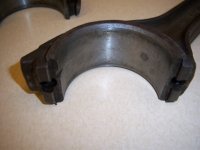
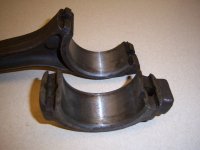
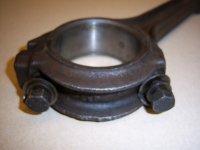
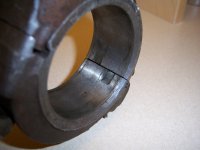
Here is a few pictures of the stock rod.
 

Attachments

  • 3.jpg
    3.jpg
    136.1 KB · Views: 20
  • 4.jpg
    4.jpg
    139.7 KB · Views: 13
  • 8.jpg
    8.jpg
    140.6 KB · Views: 10
  • 12.jpg
    12.jpg
    135.8 KB · Views: 10
  • 13.jpg
    13.jpg
    131.8 KB · Views: 10
  • 20.jpg
    20.jpg
    138 KB · Views: 11
  • 17.jpg
    17.jpg
    138.7 KB · Views: 12

kartracer55

Well-known member
Joined
Jun 21, 2005
Messages
5,317
Not totally sure about the application here but you are getting into risky territory. Considering the loading involved, I would be hesitant, especially without doing any sort of FEA, even roughly through Pro/Mech or Cosmos or the like.

Another thing I would consider is manufacturing the rod cap. I am not sure what you planned, but if you planned to machine the solid rod and cut later, be sure to account for the saw kerf, otherwise when you cut it and go to bolt it back up, it will not be round. In that case, making them separate like rsanter suggested might be better.

I just wouldn't want to see a cool project turn into a wrecked engine
 

bimmer1980

Well-known member
Joined
Feb 5, 2009
Messages
2,104
Location
York, PA
not to be a discourager as well, but learning 3D CNC'ing will take a little time. I would suggest starting off by machining a few simple things.... maybe a aluminum name plate. THen step it up to a mainfold plate or carb spacer.

Trying to jump in on a complicated part will be so much time and frustration that you may end up abandoning the project......

do you have experince with drawing in any 3D program?

I use ProEngineer Wildfire occassionally, and it took me awhile to learn it. Luckily, I had taken a class in college on the older rev of it. We spent a whole semester learning the in's and out's......

best of luck!
 
To avoid these ads, REGISTER NOW!
Top Bottom