To avoid these ads, REGISTER NOW!

Managing speed on air tools

taylor27

New member
Joined
Sep 25, 2016
Messages
3
I have been looking into getting a die grinder or cutoff tool to wire brush areas that I can't reach with my angle grinder. The issue is they all run at around 22,000 rpm and any wire brushes that will fit them have a max speed of 4,500 rpm.

Does anyone know if you can dial back the pressure coming from the compressor to lower the speed of the grinder? Or will that just drop the torque so the head stops spinning the moment you touch the metal?
 
To avoid these ads, REGISTER NOW!

lazer50

Well-known member
Joined
Aug 12, 2016
Messages
606
Location
east central indiana
Most cut off tools have an adjusting screw so you can meter the speed.my die grinders do as well.what to do in your case is adjust screw to the wire brush speed with trigger full on.please realize that the wires will fly out on brushes so safety glasses are a must.
 

MrGiggles

Well-known member
Joined
Dec 11, 2014
Messages
2,524
Round wheels will fling bristles if you run them wide open. I run them in my grinder at full pressure, just have to be easy on the throttle. Great for cleaning up rust and grime.

Regulating your air pressure down will reduce the speed and the torque.
 
OP
T

taylor27

New member
Joined
Sep 25, 2016
Messages
3
Thanks for the info guys. I will be getting a cut off tool regardless as I have cutting to do in some tight spots. I'll try turning down the pressure at the tank first to see if that helps. And of course safety comes first. Definitely don't want metal wires in my eyes!
 

lazer50

Well-known member
Joined
Aug 12, 2016
Messages
606
Location
east central indiana
You didnt understand what i meant in my previous post.a regulator is fine, turning the compressor pressure down will only make your tool lose power.you want the same power but slower speed correct?on a cut off tool and some die grinders the adjustment for the r p m speed is on the tool itself!look at your air tools unless you have a really generic brand there will be a set screw type adjuster.you hook the air hose up apply the trigger,then turn screw for desired speed.its most always on those tools because of the high speeds and for safety a guy can turn it down.
 

Astro_Pneumatic_Tools

Well-known member
Joined
Oct 30, 2013
Messages
2,108
Location
South El Monte
Yes its called an inline regulator. You can even get fancy ones with gauges. Here's a cheapo similar to one I have on one of my air hammers. http://www.tooltopia.com/astro-pneu...Qc982FocddZWca-kvdq6HgDMblOXuQZzfMRoCVCnw_wcB

What you callin' cheap!? :mad:

Haha, just kiddin'

We include those attached to our $350 pneumatic rivet nut setting guns, they just work.

To the OP, lessing pressure absolutely reduces torque. Ideally, you want to use a tool naturally rated near the max rpm of your attachment.
 
To avoid these ads, REGISTER NOW!

coldh2o

Well-known member
Joined
May 21, 2013
Messages
1,424
Location
Ontario, Canada
No useful input to the thread...read the title as "Managing air tools on speed" and came looking for something else...
 

ynned

Well-known member
Joined
Feb 27, 2013
Messages
1,151
Location
N.E. Ohio
Perhaps the issue (as with many things) is pressure vs volume. I think you'd need full pressure so the force is there, but less volume so it can't spin fast. Maybe reduce the inlet diameter.

Here's an interesting gizmo Google turned up, a speed control muffler. It looks like it regulates volume on the outlet side.
 

winlinmac

Well-known member
Joined
Aug 17, 2015
Messages
3,742
Location
USA
Correct me if I'm wrong, but I thought most air tools have a built in air pressure regulator, no? Check to see if yours have one, don't settle for the cheapest air tools
 
Last edited:

wcemail

Member
Joined
Sep 21, 2016
Messages
17
Location
Wetumpka, Alabama
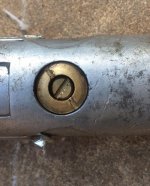
My die grinder has a RPM adjusting screw. It has a NAPA label on it. The outside screw holds the adjusting tight so I loosen the outside screw, adjust the inside screw to correct RPM and tighten outside screw. (See Photo)
 

Attachments

  • diegrinder.jpg
    diegrinder.jpg
    141.2 KB · Views: 10

md21722

Well-known member
Joined
Nov 30, 2015
Messages
1,840
Location
Mt Juliet, TN
To the OP, lessing pressure absolutely reduces torque. Ideally, you want to use a tool naturally rated near the max rpm of your attachment.

This is good advice. Some die grinders may be adjustable, but I don't believe they are adjustable all the way down to the needs of a 4,500 RPM wire wheel. I have a 3" wire wheel that's rated for 12,000-14,000 RPM IIRC. I use it on a 12,000 RPM die grinder. Then there are things like this http://www.tptools.com/TP-Tools-ProLine-Low-Speed-Air-Die-Grinder,3271.html?b=d*8125 for the larger, or slower speed wheels.
 
Last edited:

sberry

Banned
Joined
Jun 18, 2005
Messages
35,747
Location
Brethren, Michigan
You don't have to run them wot and you csan regulaste the speed with pressure on many tools. You can stall the ones I had in the pic. Turn down the reguklator a pinch, yes with loss of speed is some power.
I can see we need some work in this thread about pressure and volume. If pressure does not drop when vol goes up either you are not moving any air or the vol is beyond sufficient for the tool. Dropping the pressure reduces the volume, increasing the line size reduces pressure drop for the same vol or allows more to flow. Only important if the demand isn't being met.
Did I word this correctly? But,,,,,,,,,,,,,, now we get back to the obsession with hi flow couplers. Actually one that is sufficient is all that is required and the object isn't to see how much air we can let out. This is where 2 stage has an advantage, can be turned up a little on the same size lines to make up for losses or to reduce some loss in mainline transportation in extreme circumstances, most not applicable to Joe Hometime.
 

sberry

Banned
Joined
Jun 18, 2005
Messages
35,747
Location
Brethren, Michigan
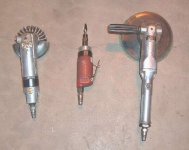
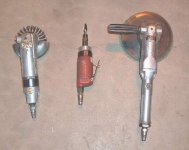
There are tools I don't have, they wouldn't hurt and may be handy but the 3 I pic are the real work bulls and actually have duplicates in these as I have all the wheels and attachments configured for them on somewhat the same platform. I love these for specialty and the reason is regulation. For grinding and steel fab really use 4 1/2 due to the operating cost.
The sander and the grinder make some power but use some air, these are really for 5 hp 2 stage comps to work right. I have a 5 inch I can cut the disks from 7 but don't use flaps on electrics although I might if I wasn't used to this which with regulation is very safe and doesn't spit chunks like grinding wheels do. The operator isn't tempted to shoot himself with dross with it.
I got 3 of the 4 inch 90 degree with the wheel on it in the pic, they are very very good and one has a lot of hours and then some on it. Never so much had to tighten a screw on any of them. I did replace a bearing in the sander head but it had a lot of road behind it then, several years ago and it was a common brg I had on the shelf and worked great since.
You can buy better tools, all these can be found for 400 a piece if you look but its a waste of money and I don't care how hard you think you will work them. Replacement but a click away, every part brand new for 60$,, ha I wore one sander out, this is the second unit in a career and it still works well. This is the kind of thing Napa and the likes sell but can be bought under several brands and even price points. I wouldn't have a problem doubling the price and adding a 3 yr warranty. I wouldn't have any insecurity about tossing these in the gang box and have. These have been in several plants, oil sites, worked on a couple trains and reside at the benches in a fab shop for several years of regular use.
Prices probably jumped since this pic was done.
 

Attachments

  • air tools small 10.JPG
    air tools small 10.JPG
    49.1 KB · Views: 14
  • air grinders 3.JPG
    air grinders 3.JPG
    37 KB · Views: 8
Last edited:

MrGiggles

Well-known member
Joined
Dec 11, 2014
Messages
2,524
Perhaps the issue (as with many things) is pressure vs volume. I think you'd need full pressure so the force is there, but less volume so it can't spin fast. Maybe reduce the inlet diameter.

Here's an interesting gizmo Google turned up, a speed control muffler. It looks like it regulates volume on the outlet side.

I'm not an expert on this, but high pressure drops to nothing when resistance is lost, if there is not sufficient volume to back it up. You can't have one without the other, and you need both for torque and speed in an air tool.

Additionally, a lot of an air tool's force comes with momentum. Torque from a stop is next to nothing.

I've seen screwdrivers and paint guns with regulators inline just before the tool, but never a grinder or cut off tool. They just don't work well when choked.
 
To avoid these ads, REGISTER NOW!
Top Bottom