To avoid these ads, REGISTER NOW!

Manifold Coupling- is it wrong

mkarlin

Well-known member
Joined
Jun 18, 2016
Messages
220
Location
Northeast
I am trying to find out if I am better off teeing off to each of my watts manifolds from the main 1 1/4 in copper tube, or if I should couple then together and have the 1 1/4 in tube feed one manifold that is then coupled to the other manifolds (as pictured) ?

6700 sg ft floor 5/8 in pex tubing, all around 475 foot loops, 3 manifolds 2 x 6 loop and 1 x 3 loop

Does this make sense?

Also learning about head pressure pressure and the flow rate, way more confusing that I expected

Mike
 

Attachments

  • IMG_8113.jpg
    IMG_8113.jpg
    50.7 KB · Views: 140
To avoid these ads, REGISTER NOW!

mobetta

Well-known member
Joined
Feb 10, 2010
Messages
370
Location
twin cities, mn
im no expert on best use but your manifold diagram looks fine.
for some reason I think the air vent seems to be in the wrong place.( i recall right off the supply side pre pump???) could be wrong tho....
Also i see no expansion tank??

Im sure an experienced member will correct me....


using an ecm zone pump they're smart enough to adjust speed according to head(which for your slab is just restriction in length of runs)
 
OP
M

mkarlin

Well-known member
Joined
Jun 18, 2016
Messages
220
Location
Northeast
im no expert on best use but your manifold diagram looks fine.
for some reason I think the air vent seems to be in the wrong place.( i recall right off the supply side pre pump???) could be wrong tho....
Also i see no expansion tank??

Im sure an experienced member will correct me....


using an ecm zone pump they're smart enough to adjust speed according to head(which for your slab is just restriction in length of runs)

You are 100 % right I planned to adjust the air vent, just did not redraw. Nice catch

And The expansion tank is the little round ball on the return side of the manifold line, but maybe I should have it in on the supply side of the boiler and not the return of the manifold? I just did not have it labeled well
 

mobetta

Well-known member
Joined
Feb 10, 2010
Messages
370
Location
twin cities, mn
my last system had the ex tank hanging off the bottom of an air scoop. I'm not sure best practice for location but dont skip it.
 

yeldogt

Well-known member
Joined
Jan 2, 2012
Messages
18,184
Is this a new system?

Viessmann use ODR and pipe the DHW indirect -- direct.

Oil boiler?

They don't link together .. separate pathways for supply and return.

look up the application guide -- lots of good info
 
OP
M

mkarlin

Well-known member
Joined
Jun 18, 2016
Messages
220
Location
Northeast
Is this a new system?

Viessmann use ODR and pipe the DHW indirect -- direct.

Oil boiler?

They don't link together .. separate pathways for supply and return.

look up the application guide -- lots of good info


Thanks

Yes it’s a new boiler. And I will make that change. Mostly unsure of the manifolds
 

yeldogt

Well-known member
Joined
Jan 2, 2012
Messages
18,184
If you are using a Viessmann boiler -- they have detailed application guides.

Especially if this is oil ...
 
OP
M

mkarlin

Well-known member
Joined
Jun 18, 2016
Messages
220
Location
Northeast
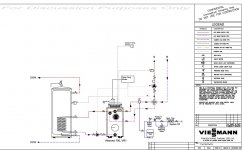
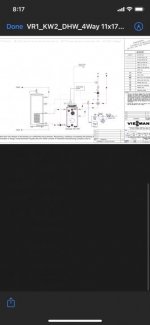
Yes agreed. I will be using this diagram. The picture I posted was for the manifolds and the fact that they are all coupled together and feed off each other instead of from tees
 

Attachments

  • 95322F6F-D64D-4E03-9269-B92457AF2354.jpg
    95322F6F-D64D-4E03-9269-B92457AF2354.jpg
    18.8 KB · Views: 22

yeldogt

Well-known member
Joined
Jan 2, 2012
Messages
18,184
Does not blow up well

I can see that the indirect is direct piped ..... you want full boiler temp going to the indirect coils for fast recovery. If it's oil -- I have only done Buderus and then it was a combination of radiators and radiant. Typically you only use a cast iron boiler if you want/ need the hotter temps of radiators (old school big cast or the steel panels).

I have done a few houses with gas cast iron boilers .. again Buderus. With radiators they get piped using the "pumping away" system with the radiators as the primary loop with ODR and the radiant loops using a mixing device ..... I used 3 ways on them and on a few tiny spots the the thermo type valves
 
OP
M

mkarlin

Well-known member
Joined
Jun 18, 2016
Messages
220
Location
Northeast
Does not blow up well

I can see that the indirect is direct piped ..... you want full boiler temp going to the indirect coils for fast recovery. If it's oil -- I have only done Buderus and then it was a combination of radiators and radiant. Typically you only use a cast iron boiler if you want/ need the hotter temps of radiators (old school big cast or the steel panels).

I have done a few houses with gas cast iron boilers .. again Buderus. With radiators they get piped using the "pumping away" system with the radiators as the primary loop with ODR and the radiant loops using a mixing device ..... I used 3 ways on them and on a few tiny spots the the thermo type valves


Sorry let me try it this way. It is a Viessmann Oil boiler should have mentioned that sorry
 

Attachments

  • boiler viessman.jpg
    boiler viessman.jpg
    140.9 KB · Views: 24

yeldogt

Well-known member
Joined
Jan 2, 2012
Messages
18,184
I just did a 200 propane wall boiler with the 300 SS indirect -- are you running all radiant off of the oil boiler ?

Why not propane condensing if going that route ?
 

yeldogt

Well-known member
Joined
Jan 2, 2012
Messages
18,184
Also -- I have not tried to do this.

The new pumps like the alpha can be set up with delta temp setting -- it becomes its own reset off of a low loss header. How low temp can the Viessmann boiler run?

... that was the nice thing about the old cast iron Buderus gas boilers .... they were low temp cast boilers. Unlike almost all boilers in the world that have to have high temp return water -- above 140. Buderus cast was designed to work at lower temps w/o thermal shock.
 
OP
M

mkarlin

Well-known member
Joined
Jun 18, 2016
Messages
220
Location
Northeast
Also -- I have not tried to do this.

The new pumps like the alpha can be set up with delta temp setting -- it becomes its own reset off of a low loss header. How low temp can the Viessmann boiler run?

... that was the nice thing about the old cast iron Buderus gas boilers .... they were low temp cast boilers. Unlike almost all boilers in the world that have to have high temp return water -- above 140. Buderus cast was designed to work at lower temps w/o thermal shock.

Yeah my understanding is this is a non-condensing so I am running a 4 way mixing value to address that issue. Should be ok based on how it is setup


Wish I could get my head wrapped around the manifold issues and whether to tee it or couple them
 

stokefire7

Well-known member
Joined
Oct 5, 2011
Messages
616
I am trying to find out if I am better off teeing off to each of my watts manifolds from the main 1 1/4 in copper tube, or if I should couple then together and have the 1 1/4 in tube feed one manifold that is then coupled to the other manifolds (as pictured) ?

6700 sg ft floor 5/8 in pex tubing, all around 475 foot loops, 3 manifolds 2 x 6 loop and 1 x 3 loop

Does this make sense?

Also learning about head pressure pressure and the flow rate, way more confusing that I expected

Mike


It doesn't matter.
 

yeldogt

Well-known member
Joined
Jan 2, 2012
Messages
18,184
I just noticed you were using 1 1/4 pipe -- what is the flow through the manifold ?

Some manifolds have restrictions .... you have to have the flow. in many past 8 loops of 250 1/2 is starts to create too much head.

Will the boiler do outdoor reset with minimum temp ?

I really like LLH with one temp water .... it's fool proof
 
OP
M

mkarlin

Well-known member
Joined
Jun 18, 2016
Messages
220
Location
Northeast
I just noticed you were using 1 1/4 pipe -- what is the flow through the manifold ?

Some manifolds have restrictions .... you have to have the flow. in many past 8 loops of 250 1/2 is starts to create too much head.

Will the boiler do outdoor reset with minimum temp ?

I really like LLH with one temp water .... it's fool proof


The flow through the manifold. I assume you mean what is the manifold diameter. 1in

Yeah the boiler will do outdoor reset. I got the controller that does all of that and monitors the water heater

Not sure what LLH is ?

Also question (you seem knowledgeable) when you size a pump for head pressure and gallon per minute. do you size the pump for the total of gallon per minute (160,000btu/10,000) 16 gpm for the whole system or per loop 1.2gpm. Just have alittle trouble figuring out if I am accurate or not with the gpm and the head pressure

Also is it better to flow at 0.5 gpm or 2 gpm. Can’t decide is slower is better for heat transfer

Thanks
 

yeldogt

Well-known member
Joined
Jan 2, 2012
Messages
18,184
I don't think you need 1.2 per loop .... 1/2 gpm seems more correct.

The needed flow is all about the BTU's needed -- GPM.

As much as I don't like to fall back on "common rules" .. I will . 1" pipe will flow 7.5 and 75k and 1/25 will do 12 and 120k with no problems and no noise. That's why you see 1 1/4 pipe on the supply --- often dropping to 1" feeding each manifold.

When you go higher water temps -- you transfer more heat ...but radiant is low. you have to watch the flow through the first manifold. I never do it that way -- string them along .... It's going to work as long as within the parameters. The rule of thumb (here I go again) .... is 8 loops of 1/2 on the manifold for a standard 1/2 set up. But -- I just did a a room with plates and 3/8 piping. 11 loops -- But I only need 20k BTU under the worst possible conditions. So my total flow would only be 6 at 5head ... and that is never going to happen. All the loops are under 200'.


Tell me -- have you looked into the most modern way to pipe that boiler?

Google low loss header ... what is this heating? house -- one big space ... total heat loss.

In my new house I have two manifolds near the boiler in the mechanical room and due to space and pex piping requirements another two 30' away. The manifolds in the mechanical room are close to the boiler and the copper line out to the remote area had to be 1.25 .. there was no savings dropping down to 1" pipe to the individual manifolds off the 1.25.

This is a picture of the not finished system .... you can see the LLh in the one picture.

you don't want to over pump.
 

Attachments

  • IMG_2763.jpg
    IMG_2763.jpg
    68.5 KB · Views: 25
  • IMG_2762.jpg
    IMG_2762.jpg
    66.3 KB · Views: 19
To avoid these ads, REGISTER NOW!
OP
M

mkarlin

Well-known member
Joined
Jun 18, 2016
Messages
220
Location
Northeast
I don't think you need 1.2 per loop .... 1/2 gpm seems more correct.

The needed flow is all about the BTU's needed -- GPM.

As much as I don't like to fall back on "common rules" .. I will . 1" pipe will flow 7.5 and 75k and 1/25 will do 12 and 120k with no problems and no noise. That's why you see 1 1/4 pipe on the supply --- often dropping to 1" feeding each manifold.

When you go higher water temps -- you transfer more heat ...but radiant is low. you have to watch the flow through the first manifold. I never do it that way -- string them along .... It's going to work as long as within the parameters. The rule of thumb (here I go again) .... is 8 loops of 1/2 on the manifold for a standard 1/2 set up. But -- I just did a a room with plates and 3/8 piping. 11 loops -- But I only need 20k BTU under the worst possible conditions. So my total flow would only be 6 at 5head ... and that is never going to happen. All the loops are under 200'.


Tell me -- have you looked into the most modern way to pipe that boiler?

Google low loss header ... what is this heating? house -- one big space ... total heat loss.

In my new house I have two manifolds near the boiler in the mechanical room and due to space and pex piping requirements another two 30' away. The manifolds in the mechanical room are close to the boiler and the copper line out to the remote area had to be 1.25 .. there was no savings dropping down to 1" pipe to the individual manifolds off the 1.25.

This is a picture of the not finished system .... you can see the LLh in the one picture.

you don't want to over pump.


It is hearing a 6700 sq foot farm shop with 15 ft ceiling

I got a 161k btu. Boiler

And I looked at the manual but not sure what you mean by the modern way?

Yeldogt. Not sure if it would be easier but happy to DM you my contact if that would make it easier?
 

yeldogt

Well-known member
Joined
Jan 2, 2012
Messages
18,184
Modern may be a poor choice of works ..... I'm just trying to understand what other piping methods they show when using that boiler with only radiant ..

Typically you see them piped with circuit 1 on higher type radiant and circuit 2 on the mixing valve for the low temp radiant. 1 protects the boiler ... it's still running ODR.
 
OP
M

mkarlin

Well-known member
Joined
Jun 18, 2016
Messages
220
Location
Northeast
Modern may be a poor choice of works ..... I'm just trying to understand what other piping methods they show when using that boiler with only radiant ..

Typically you see them piped with circuit 1 on higher type radiant and circuit 2 on the mixing valve for the low temp radiant. 1 protects the boiler ... it's still running ODR.


Yeldogt: When you size a pump for 16 loops and each loops needs 0.5 or 1 gpm so you use an 8 or 16 gpm pump or since its all one but loop is it a pump that performs at your head pressure needed at the 0.5 to 1 gpm?

Sorry for the dumb questions, have tried to find the answer and have not had much luck.
 

yeldogt

Well-known member
Joined
Jan 2, 2012
Messages
18,184
Yeldogt: When you size a pump for 16 loops and each loops needs 0.5 or 1 gpm so you use an 8 or 16 gpm pump or since its all one but loop is it a pump that performs at your head pressure needed at the 0.5 to 1 gpm?

Sorry for the dumb questions, have tried to find the answer and have not had much luck.

It's really head pressure that gets you .. that's why you always see the tube length max. I did a 3/8 plate system -- ll loops of just under 160ft. Way under what an alpha pump can do. That under 5 GPM and 5 of head (going by memory on head) .... my 1/2 loops are longer -- but not to 300. Low 200's ... 225. All about keeping the head in control.

People call them pumps -- they don't pump ... they circulate.

The flow is based on the BTUs needed .... I needed -- 23k btu output to the room for the 11 loops. That's 1/2 gallon per min at around 110 -120 (can't remember my number). Heat transfer is temp and GPM.

Think like water -- how much flow will you get through the first manifold. Linking them as the picture the last manifold needs to see what it has to produce. I guess what I'm trying to say ... I don't know where to get the flow through number .. have never seen that published. It would have to be a guess based on the pipe size and any added head ... I'm not that smart ! I know feeding each from the mail pipe will work ... so, I don't mess with success.

Now someone will come on and say ... I always do it that way. Radiant in many ways is very forgiving .. you can do much wrong and it still works. Poor flow and heat transfer problems will only show up on the coldest day when the system starts to fall behind.

That's why I always say -- keep the tubing a bit tighter and add more tubing. keep the loops shorter and add another loop on the manifold. Shorter loops and more of them make for a better system.

My ll loops of 3/8 cost me the same as doing 9 -- in tubing. I had to buy large loops of 3/8 tubing ... I still had waste with 11 ...

I just bought a few K feet of 1/2 pexalpex -- the cost of the 1000 foot rolls is so cheap .... what are you saving?
 
OP
M

mkarlin

Well-known member
Joined
Jun 18, 2016
Messages
220
Location
Northeast
It's really head pressure that gets you .. that's why you always see the tube length max. I did a 3/8 plate system -- ll loops of just under 160ft. Way under what an alpha pump can do. That under 5 GPM and 5 of head (going by memory on head) .... my 1/2 loops are longer -- but not to 300. Low 200's ... 225. All about keeping the head in control.

People call them pumps -- they don't pump ... they circulate.

The flow is based on the BTUs needed .... I needed -- 23k btu output to the room for the 11 loops. That's 1/2 gallon per min at around 110 -120 (can't remember my number). Heat transfer is temp and GPM.

Think like water -- how much flow will you get through the first manifold. Linking them as the picture the last manifold needs to see what it has to produce. I guess what I'm trying to say ... I don't know where to get the flow through number .. have never seen that published. It would have to be a guess based on the pipe size and any added head ... I'm not that smart ! I know feeding each from the mail pipe will work ... so, I don't mess with success.


Now someone will come on and say ... I always do it that way. Radiant in many ways is very forgiving .. you can do much wrong and it still works. Poor flow and heat transfer problems will only show up on the coldest day when the system starts to fall behind.

That's why I always say -- keep the tubing a bit tighter and add more tubing. keep the loops shorter and add another loop on the manifold. Shorter loops and more of them make for a better system.

My ll loops of 3/8 cost me the same as doing 9 -- in tubing. I had to buy large loops of 3/8 tubing ... I still had waste with 11 ...

I just bought a few K feet of 1/2 pexalpex -- the cost of the 1000 foot rolls is so cheap .... what are you saving?


Thanks for the reply.

I am going to individually pipe each manifold and I calculated a head pressure of 25 and my BTU is around 143K. my boiler is a 161K
 

yeldogt

Well-known member
Joined
Jan 2, 2012
Messages
18,184
I'm seeing 400sf as the upper ideal -- I have never used 5/8. What did you use to determine length and loop number?

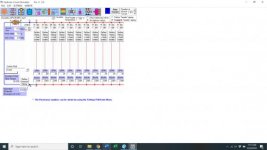
This is my 11 loop of 3/8 -- see how it's all figured out. This was done as it was outside of my typical setup knowledge. I wanted to keep to one circulator and the head on this one had me a bit confused
 

Attachments

  • rptcx7v93l70.jpg
    rptcx7v93l70.jpg
    19.2 KB · Views: 6
OP
M

mkarlin

Well-known member
Joined
Jun 18, 2016
Messages
220
Location
Northeast
I'm seeing 400sf as the upper ideal -- I have never used 5/8. What did you use to determine length and loop number?

This is my 11 loop of 3/8 -- see how it's all figured out. This was done as it was outside of my typical setup knowledge. I wanted to keep to one circulator and the head on this one had me a bit confused

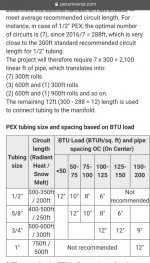
Thanks. When I spoke to watts and the seller of the manifolds and pipes. 500 ft was the tube loop length at 5/8 they recommended. Hopefully want be an issue.
 

Attachments

  • 6D635B67-4B33-4317-A42D-CBE279294445.jpg
    6D635B67-4B33-4317-A42D-CBE279294445.jpg
    95.5 KB · Views: 1
Last edited:
OP
M

mkarlin

Well-known member
Joined
Jun 18, 2016
Messages
220
Location
Northeast
I'm seeing 400sf as the upper ideal -- I have never used 5/8. What did you use to determine length and loop number?

This is my 11 loop of 3/8 -- see how it's all figured out. This was done as it was outside of my typical setup knowledge. I wanted to keep to one circulator and the head on this one had me a bit confused

I should add we are figuring a delta of 20deg. In at 100 out at 80
 

yeldogt

Well-known member
Joined
Jan 2, 2012
Messages
18,184
I'm guess you should be in the 12-14 head range .. but I don't have the calculations for 5/8.

Did anyone run them for you ?


The norm is about 20 delta ..... but, that depends on many factors ... pipe layout being a big one. You need the flow to keep that up
 
OP
M

mkarlin

Well-known member
Joined
Jun 18, 2016
Messages
220
Location
Northeast
I'm guess you should be in the 12-14 head range .. but I don't have the calculations for 5/8.

Did anyone run them for you ?


The norm is about 20 delta ..... but, that depends on many factors ... pipe layout being a big one. You need the flow to keep that up

Yeah I had heating person run them and they said given my setup and size of the shop I could get away with 450-475 foot loops. They told me the pump I needed would do 16gpm and 25head pressure. He had me get a pump just alittle larger so it was not maxed out (taco 2400-50)

I am wondering if I should place a balancing valve to be able to dial it back if needed (easier to have it and not need it than need and not have it?) https://www.supplyhouse.com/Taco-ACUF-125-AT-2-1-1-4-Threaded-ACCU-FLO-Balancing-Valve
 

yeldogt

Well-known member
Joined
Jan 2, 2012
Messages
18,184
Yeah I had heating person run them and they said given my setup and size of the shop I could get away with 450-475 foot loops. They told me the pump I needed would do 16gpm and 25head pressure. He had me get a pump just alittle larger so it was not maxed out (taco 2400-50)

I am wondering if I should place a balancing valve to be able to dial it back if needed (easier to have it and not need it than need and not have it?) https://www.supplyhouse.com/Taco-ACUF-125-AT-2-1-1-4-Threaded-ACCU-FLO-Balancing-Valve

Get a Alpha type pump and forget it ..... match to the need.

With that 4 way valve you don't want another short cycle pathway.

Shorter loops allow for less head -- = less pump = less cost to run.

Shorter loops make the delta easier to manage .. same with flow.

For most systems ---it's best to have everything open and start the system and see how it works. balance through the manifold if needed.

On a fully engineered system where you have various loop lengths in a given manifold the engineer will give you the flow at each one.
 
OP
M

mkarlin

Well-known member
Joined
Jun 18, 2016
Messages
220
Location
Northeast
Get a Alpha type pump and forget it ..... match to the need.

With that 4 way valve you don't want another short cycle pathway.

Shorter loops allow for less head -- = less pump = less cost to run.

Shorter loops make the delta easier to manage .. same with flow.

For most systems ---it's best to have everything open and start the system and see how it works. balance through the manifold if needed.

On a fully engineered system where you have various loop lengths in a given manifold the engineer will give you the flow at each one.


Thanks for the reply. The good or bad news is the loops are already in. They are all within 5-10 feet of each other in lenght

I will look into the alpha pump as an option
 

yeldogt

Well-known member
Joined
Jan 2, 2012
Messages
18,184
Thanks for the reply. The good or bad news is the loops are already in. They are all within 5-10 feet of each other in lenght

I will look into the alpha pump as an option

Understand ..... got to work with what is there.

Years ago just out of college in the 80's I bought a big old house in Philadelphia -- steam heat. Partially working -- some radiators disconnected. Parts in the garage. A mess. The first couple of people I had out wanted to convert it to hot water ... run lots of pipe and pumps --$$ ......... then I had an old timer from a main line company (big houses with steam on the main line). He knew the company that installed it 80 odd years prior! .. said don't mess with it. they knew what they were doing. He identified most of the parts in the garaged -- got it all back together with a new new boiler. Fantastic . The guys that know steam are all dead now .. Steam is great -- nobody understands it.

Radiant has some of the same problems. You can go crazy with some systems -- shooting for perfection. That was the problem with how it was years back when Pex first started to be available -- too many controls/ pumps. In an effort to cut costs and get more of the heating business -- it's gone the other way to some degree. IE -- "sales" tries to get initial PEX lengths and loops down to save a few $$. Unfortunately -- it's the lengths and loops that matter. These make the system work better and at lower temp and lower head. On small systems running natural gas the savings may be small. The goal is constant circulation -- modern circulators can do this with very little electric power if you do it correctly.
 
OP
M

mkarlin

Well-known member
Joined
Jun 18, 2016
Messages
220
Location
Northeast
Understand ..... got to work with what is there.

Years ago just out of college in the 80's I bought a big old house in Philadelphia -- steam heat. Partially working -- some radiators disconnected. Parts in the garage. A mess. The first couple of people I had out wanted to convert it to hot water ... run lots of pipe and pumps --$$ ......... then I had an old timer from a main line company (big houses with steam on the main line). He knew the company that installed it 80 odd years prior! .. said don't mess with it. they knew what they were doing. He identified most of the parts in the garaged -- got it all back together with a new new boiler. Fantastic . The guys that know steam are all dead now .. Steam is great -- nobody understands it.

Radiant has some of the same problems. You can go crazy with some systems -- shooting for perfection. That was the problem with how it was years back when Pex first started to be available -- too many controls/ pumps. In an effort to cut costs and get more of the heating business -- it's gone the other way to some degree. IE -- "sales" tries to get initial PEX lengths and loops down to save a few $$. Unfortunately -- it's the lengths and loops that matter. These make the system work better and at lower temp and lower head. On small systems running natural gas the savings may be small. The goal is constant circulation -- modern circulators can do this with very little electric power if you do it correctly.


Hoping for success. If the pump I choice does not work then I can rethink/replace, and hopefully thats the worst that happens


I have tried to read the risk of too large a pump (pressure and flow) but all I can find is noise and some cavitation that can make the pump life span shorter. Is that correct? Just dont want to hurt the system


Mike
 
To avoid these ads, REGISTER NOW!
Top Bottom