To avoid these ads, REGISTER NOW!

Masonry advice needed

palsor1

Well-known member
Joined
Jun 11, 2008
Messages
45
Location
Austin, Texas
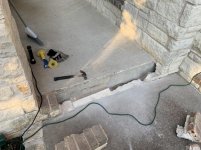
Well it's Christmas vacation so I'm taking care of the long list of home improvement tasks that have built up. One item on the list is fixing a loose step in front of the house. However, I discovered something I didn't expect and I need some advice having never really done masonry work before...

The first picture attached shows the front of our house. The loose step is the brick step on the left. You can see the dust in front of it from me busting out some mortar. It leads to a front patio that is off to the left of the picture.

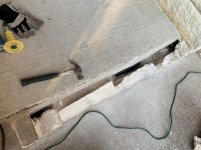
The second and third pictures show what I discovered under the step. As far as I can tell, it looks like the builder poured the concrete for the landing and faced it with limestone, then decided they needed to pour the slab for the patio after. I expected that to all just be concrete and to be mortaring brick on top.

Now I'm not sure what to do. My concern is getting a good stable base for the step to sit on which presumably means filling in that gap between the landing and the patio. My current best guess is to fill the space with sand about an inch from the top, then pour some concrete on top of that to make it level with the landing. Once that dries, the mortar and replace brick on top of that.

Will that work? Any suggestions?
 

Attachments

  • UNADJUSTEDNONRAW_thumb_2057.jpg
    UNADJUSTEDNONRAW_thumb_2057.jpg
    148.9 KB · Views: 121
  • UNADJUSTEDNONRAW_thumb_205c.jpg
    UNADJUSTEDNONRAW_thumb_205c.jpg
    131.7 KB · Views: 126
  • UNADJUSTEDNONRAW_thumb_205a.jpg
    UNADJUSTEDNONRAW_thumb_205a.jpg
    145.3 KB · Views: 123
Last edited:
To avoid these ads, REGISTER NOW!

Varty Yo

Well-known member
Joined
Sep 4, 2016
Messages
97
Location
Sask Canada
Your best course of action would be to put a angle iron attached to the step and relay the brick ontop of that. The sidewalk and concrete step move differently so its best to keep the step all on its own. It will happen again as one moves more then the other.
 

olytdi

Well-known member
Joined
Dec 3, 2011
Messages
2,202
Location
Olympia, Washington
I would make a mix of mortar consisting of 3 parts course (builder's) sand and one part Portland cement. Fill the void with this not too wet -- mixed with hard fill (concrete, stone, or the like). When you get it to the proper height, trowel it off such that it is at the proper height. Let it set for a day or two and replace your stones using a 3 part sand, one part Portland cement and a half part lime. Keep the mix stiff but workable and set your stones. Either scratch out the joints such that you will point them later, or strike them as a finished joint. Lightly acid wash a number of days later.

You can "paint" the backs and bottoms of the stones with some bonding latex but be careful not to get it on the face or top of the stones...don't make any of the mixes too wet...
 
Last edited:

Hilltopmasonry

Well-known member
Joined
Oct 12, 2015
Messages
2,172
Whatever you choose to do make sure to leave a void between the step and the bottom of the masonry to allow for movement of the landing

I usually put a piece of plywood down set all the brick or stone and then slide the plywood out when you’re done leaving a nice even gap

If you use mortar I would strongly recommend using a concrete bonder


Sent from my iPhone using Tapatalk
 
Last edited:

ConCretin

Well-known member
Joined
Jan 20, 2011
Messages
3,379
Location
Central Maine
My first thought was similar to your's and olytdi's but I like Varty Vo's solution as well. If you had conditions such as frost that created differential movement, I might even go that route. In your case however, simpler is probably better. Remove any loose material, fill the void with concrete and re-lay the brick.
 
To avoid these ads, REGISTER NOW!
OP
P

palsor1

Well-known member
Joined
Jun 11, 2008
Messages
45
Location
Austin, Texas
Thanks everyone. I’ll try watching some of those videos today. For what it’s worth, we’re in central Texas so freezing/frost isn’t an issue. It rarely gets below freezing, and when it does it’s never long enough for the ground or concrete to start to freeze.
 

yeldogt

Well-known member
Joined
Jan 2, 2012
Messages
18,184
Well -- it is a strange detail. It looks like they tried to figure out an elevation change from the sidewalk to the patio -- installed the landing. Lots of different materials involved ... including the material ringing the landing.

All that moves differently -- there is not much you can do about that. Can you get matching brick or the Limestone?

My preferred method when I need a step -- I buy a limestone or bluestone tread. Typically a rock faced limestone as they are cheaper. This way you have one thing to place and you don't have all the mortar joints in the brick.

I can't tell the color -- but you could check to see what's available. What condition is the other step? Was the plan to try as reuse what you have ... looks like some is broken.

The reality is over time .. 20 years ... things move and maintenance is required when using dissimilar materials ..... an all brick set of steps is moving the same.

I really think the problem was not enough support under the step -- the connection point to the patio is not really doing anything ... it's all about the base and that right side is thin .... weight on the step over time worked it lose.

If it was me I would try and get treads that matched .. Have you tried to lay brick ?

I alway use a high lime based mortar -- it's sticky and more elastic vs a high cement content mortar. Frankly -- I would fill the void with some mortar and rubble to make a flat full base for whatever you go with and fix the face front.

masonry moves
 

Hpozzuoli

Well-known member
Joined
Dec 11, 2013
Messages
3,428
Location
Rhode Island
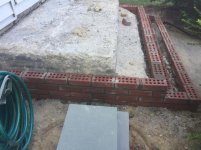
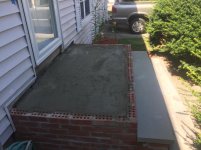
Something tells me that void is from settling over the years and not by design. I would never intentionally leave a cavity under a few tons of walkway. If this was my job I would fill the void with cement and then mortar those brick back in.

I did this job a few months ago. It was a poured staircase that the customer wanted covered in brick. Any and all voids were filled. There were a few at the bottom similar to the OP’s that I didn’t get pics of, but they were filled.
 

Attachments

  • 2DCA4A00-A301-483A-BF31-8CE7D94153D4.jpg
    2DCA4A00-A301-483A-BF31-8CE7D94153D4.jpg
    152 KB · Views: 36
  • 88009442-8955-4ACF-8431-594E2870CE37.jpg
    88009442-8955-4ACF-8431-594E2870CE37.jpg
    150.5 KB · Views: 31
  • 6DE4B301-A4F9-41E3-ACBD-5822FA902A46.jpg
    6DE4B301-A4F9-41E3-ACBD-5822FA902A46.jpg
    149.9 KB · Views: 31
To avoid these ads, REGISTER NOW!
Top Bottom