To avoid these ads, REGISTER NOW!

Masonry bit question

bchee

Well-known member
Joined
Aug 20, 2007
Messages
6,148
Location
Texas
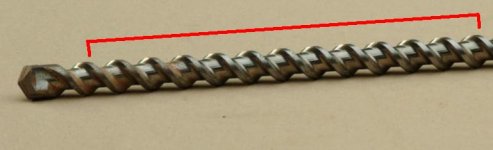
Does the highlighted portion of this bit serve any useful purpose?

My guess is that, for any bit, the flutes serve to direct the drilled material out of the hole, however they don't actually do any cutting.

For a masonry bit, the spirals don't seem like they do anything at all. Am I way off here?:headscrat
 

Attachments

  • Drill_masonry.jpg
    Drill_masonry.jpg
    28.1 KB · Views: 31
To avoid these ads, REGISTER NOW!
OP
B

bchee

Well-known member
Joined
Aug 20, 2007
Messages
6,148
Location
Texas
Why not make the bit like a tile bit? Just a cutting head with a straight shaft?
 

Attachments

  • tile.JPG
    tile.JPG
    3.7 KB · Views: 4

Jack Olsen

Super Moderator
Staff member
Joined
Mar 22, 2009
Messages
6,678
Location
Los Angeles
The flutes evacuate material that's already been cut loose. If you allow gravity to keep that material down there, it will continue to get chopped up by the blade -- dulling the cutting edge and increasing heat-induced friction, which will further dull the cutting edge.

(And here's the answer to the question you're not asking: get a hammer drill, even if it's a cheap $30 one -- otherwise, you're going to keep going through bits like they're candy.)
 

rockchucker

Well-known member
Joined
Mar 27, 2010
Messages
1,764
Location
Seattle WA
100% ^


If you are not using a Masonry Bit along with a Roto-Hammer or Hammer Drill then you are wasting your time and money.
 

nate379

Banned
Joined
Feb 2, 2009
Messages
7,279
Location
Palmer, AK
And a shop vac. I pull the bit out every 10-15 seconds and **** the **** out of the hole.
Not so bad on green concrete, but I drilled some holes in a 70-80 yr old slab and I went through 4 bits on 12 holes.
 

Coach James

Well-known member
Joined
Jun 24, 2005
Messages
8,934
Location
Sandhills of North Carolina
Absolutely get a hammer drill. I have a hammer drill and rotary hammer and both have their place. I use my 4yo son to help by holding the ShopVac whenever possible.

Also, if the concrete were as thin as tile, you could probably get by with no flutes. If the tile were 4 to 6 inches thick, the tile bits would also have flutes.

Coach
 
OP
B

bchee

Well-known member
Joined
Aug 20, 2007
Messages
6,148
Location
Texas
I'm going to drill in brick.
If I use a hammer drill, does the bit have to be in contact with the back of the chuck?
 
To avoid these ads, REGISTER NOW!

JPRACING

Well-known member
Joined
Aug 10, 2010
Messages
757
I'm going to drill in brick.
If I use a hammer drill, does the bit have to be in contact with the back of the chuck?

do not use a hammer drill in brick when it goes thru it will take a chunk of brick out the backside also you said the first bit the spirals don't seem like they do anything at all, they have to be pull out of the hole to remove the material they are not like a meta lor wood bit
 

rockchucker

Well-known member
Joined
Mar 27, 2010
Messages
1,764
Location
Seattle WA
Just some information pertaining to the subject...


The hammer drill vibrates in and out very fast to make masonry drilling much easier.
Rotary hammers are drills with a piston on the inside which is operated by the motor and gears. When the motor turns, it moves a gear, which then moves a rod. The rod hits a hammer mechanism which transfers the strike force into the rotary hammer bit. All of this happens very rapidly. Because there is a piston being struck, the force of the blow against the bit is much harder than that of a hammer drill.

Hammer drills have a motor that turns a splined gear type mechanism inside the tool. These splined gears are meshed together and hit against each other creating a vibrating action that is transferred to the drill chuck and bit. The hammering is rapid, but the force is only a fraction of that delivered by a rotary hammer.

The primary use for the rotary hammer is to drill holes (from 1/4" to 2" in diameter) in hard concrete using a solid bit. It's also used for light chipping.

The primary use for the hammer drill is to drill holes (from 3/16" to 7/8" in diameter) in masonry or brick. It's also used as a heavy-duty drill motor for standard drilling.

Typically, a hammer drill has a chuck and uses bits that have straight shanks. Most rotary hammers use bits that have either slots and grooves in the shank (SDS) or spline shanks. Also becoming popular is a slotted shank bit called the "SDS-Max" which is for larger hammers.
There is a major difference between a standard hammer drill and a rotary hammer drill. A standard hammer-drill uses 2 grooved plates that rotate opposite of each other; when they slip and the grooves connect, a bang is heard, "hammering" the chuck in and out, allowing a carbide bit to go through masonry materials. This method generates quite a bit of noise and often requires hearing protection. A rotary hammer is extremely more efficient than a regular hammer drill, because it drives a piston that compresses an air pocket, that, in turn, pounds the chuck with measurable impact energy. There really is no question which is better and faster. Rotary hammer drills do the same job in far less time, with less noise and with less effort. For many applications, like drilling into tough materials like aged concrete, a rotary hammer is the only tool to use.
 
OP
B

bchee

Well-known member
Joined
Aug 20, 2007
Messages
6,148
Location
Texas
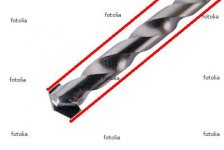
So if the flutes are intended to clear the material, why is the head larger than the flutes. I see a lot of masonry bits like this

I don't see how the flutes "catch" the material
 

Attachments

  • bit.jpg
    bit.jpg
    12.9 KB · Views: 8

Stuey

Well-known member
Joined
Jan 8, 2008
Messages
11,034
Location
28m above sea level
My impression is that the flutes are narrower than the cutting edge so that they don't rub on the rough walls of the newly bored hole. They do clean out debris from the hole. Powder and chips build up at the cutting surface and the flutes pull it out. The flutes don't release all of the debris, which is why everyone recommends to pull the bit out a little every so often. That breaks up any additional accumulation, and clears out the debris at the cutting end of the hole.
 
To avoid these ads, REGISTER NOW!
Top Bottom