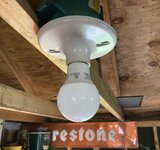
You don't go by "equivalent wattage," you go by ACTUAL wattage. If a fixture can handle 100W (for example), it can handle 100 ACTUAL Watts. If an LED bulb only uses 17W, that's WAY below the 100W maximum. It doesn't matter that it's "equivalent" to a 100W incandescent; the actual wattage is what matters, and it's well below the rating of the fixture.
The following is a rant:
This "equivalent wattage" BS is the result of people INCORRECTLY using wattage as a measure of light bulb brightness for decades. Wattage has (almost) NOTHING to do with brightness. Wattage is a unit of power. In other words, the higher the wattage your light bulbs are, the more money it's going to cost you on your electric bill. Likewise, lower wattage = cheaper electric bill. That's the ONLY thing wattage means! Not brightness! This is why a 17W LED has about the same brightness as a 100W incandescent, even though it uses only about 1/5th of the power.
Now, it's true that a 100W incandescent bulb is brighter than a 60W incandescent bulb. However, that doesn't mean that more watts = brighter bulb. A more correct way of looking at it is this: a 100W bulb uses almost twice as much POWER as a 60W bulb. The 2 bulbs are almost identical, use the same technology, yet one is going to cost you almost twice as much money on your electric bill as the other. Why such a big difference in power? It's because the 100W bulb is brighter than the 60W. Wattage = power, not brightness. But if you want more brightness, you'll need more power. If you want to know the BRIGHTNESS of a bulb, look at the amount of lumens it produces. It'll say it right on the packaging. A typical 60W incandescent bulb has a brightness of about 800 lumens. A 100W incandescent has a brightness of about 1600 lumens. So if you're shopping for an equivalent LED bulb, you should look for bulbs with the same number of lumens as the incandescent bulb you're replacing. The problem is, if I told you a bulb provides 800 lumens, you'd have no idea what I was talking about, and you'd have no idea how bright that is. But if I said "it's about as bright as a 60W bulb" then you'd know exactly what I was talking about, and you could picture in your mind how bright it is. This is why all LED bulb manufacturers have "equivalent to 60W" or similar on their packaging, instead of simply stating the lumens of the bulb.
So, the ONLY reason your LED bulbs say "equivalent to 100W" is so you have an idea of how bright the bulb is. It has nothing to do with the actual power consumption, or the amount of wattage your light fixture can handle. I can pretty much guarantee your fixtures can handle AT LEAST 100 (actual) watts. And you're worried about going from 9.5W up to 17W? It's not a problem.