I assume this is the best forum here for this question since it relates to the use of a torque wrench. I am changing the alternator out on my mothers Mazda CX-5 and was surprised to see a torque range specified instead of a torque spec on all the bolts. I am by no means a professional wrench so maybe this is commonplace but it caught me by surprise. I was curious as to the rational behind expressing the torque spec as a range. It would seem that picking the midpoint would make more sense to me. Any thoughts on this? To clarify I am not really concerned (I’ll just torque it to the middle value) just interested in the rational.


You are using an out of date browser. It may not display this or other websites correctly.
You should upgrade or use an alternative browser.
You should upgrade or use an alternative browser.
Mazda Service Manual Torque Spec Range
- Thread starter Stobal
- Start date
dnschmidt
Well-known member
Torque is an indirect ******** method of determining bolt stretch which is what you really want to know. Giving it a god like specification to three decimal places makes little sense as everything depends on independent variables such as lubrication, friction, is there lube under the bolt flange and about 100 other things. A general range is more real world than a single number.
Last edited:
VolvoRyan
Well-known member
That's a curious way to do it. In the old days, Volvo would provide a middle value with a +/-. Nowadays, Volvo only specifies torque values for where it really matters.
I think the funny thing is that most values we see for foreign cars, which seem to be ultra-precise ft-lb numbers, probably were originally just convenient (easy to remember) n-m numbers.
-Ryan
I think the funny thing is that most values we see for foreign cars, which seem to be ultra-precise ft-lb numbers, probably were originally just convenient (easy to remember) n-m numbers.
-Ryan
I've owned a couple Mazda's and worked on many, I've never seen where the range was specified like a dry vs lubed spec or something, so I always just aimed for somewhere in the middle or smidge to the higher side. So if the range was say 76-92ft-lbs, I'd probably do 85ft-lbs.
There's also an aspect of feel to the torque specs. Sometimes I'd creep up on the numbers if they seemed weird, like a really high number on a small bolt or low number on a big bolt. So rather than going to straight to 85ft-lbs in the above example, I might start at 50ft-lbs and get a feel for if the bolt is snugging down right. This isn't specific to Mazda, just torqueing things in general, sometimes need to sneak up on the numbers.
There's also an aspect of feel to the torque specs. Sometimes I'd creep up on the numbers if they seemed weird, like a really high number on a small bolt or low number on a big bolt. So rather than going to straight to 85ft-lbs in the above example, I might start at 50ft-lbs and get a feel for if the bolt is snugging down right. This isn't specific to Mazda, just torqueing things in general, sometimes need to sneak up on the numbers.
Thanks for the replies. I share most of the same sentiments already voiced, common sense and “feel” can go a long way in not breaking stuff. Knowing how to sense the bolt stretch is paramount. Just thought it was an odd way to do it. Plus it makes the service manual unnecessarily busy looking and prone to using a wrong value imo. I attached a photo of what I mean.  I mean I am completely familiar with dry vs lubed and enjoyed reading all the divergent opinions on the anti-seize thread and the effect on torque specs and health of hardware.
I mean I am completely familiar with dry vs lubed and enjoyed reading all the divergent opinions on the anti-seize thread and the effect on torque specs and health of hardware.Also wanted to add that this job is a major PITA in these CX-5. A lot of loosening stuff to simply get it out of the way and lots of engine bay Tetris to get the part removed. The lower mounting bolt is held captured by the frame even when fully loose. You have to rotate the alternator just to remove the bolt and then do a crazy flip and rotate so it fits out the top. WTF were these designers thinking.
Bagherra
Well-known member
Former UH-1, AH-1 & UH-60 mechanic here, just about every torque specification on helicopters has a torque range. Cant really thing of any part where it was a specified torque value...
That’s very interesting. Never would have imagined. I would have figured anything crucial in aviation would have very strict and exact values.Former UH-1, AH-1 & UH-60 mechanic here, just about every torque specification on helicopters has a torque range. Cant really thing of any part where it was a specified torque value...
jayemm
Well-known member
You don't need to go thru all those gyrations when changing the belt tensioner on the CX-5. I changed it on mine. True, the lower (and only) bolt hits the frame and can't be pulled out , but the tensioner casting has a slot that allows it to be slid out without removing the bolt. In other words, the bolt "hole" in the casting doesn't fully encircle the bolt shank, it's open on the side.Also wanted to add that this job is a major PITA in these CX-5. A lot of loosening stuff to simply get it out of the way and lots of engine bay Tetris to get the part removed. The lower mounting bolt is held captured by the frame even when fully loose. You have to rotate the alternator just to remove the bolt and then do a crazy flip and rotate so it fits out the top. WTF were these designers thinking.
Sorry if I wasn’t clear, but I had to switch out the alternator. Removing the tensioner was just step one. I can assure you that the job is a pain in the ***. You run into the same issue with the lower bolt on the alternator, and getting the alternator out does indeed require “those gyrations.”You don't need to go thru all those gyrations when changing the belt tensioner on the CX-5. I changed it on mine. True, the lower (and only) bolt hits the frame and can't be pulled out , but the tensioner casting has a slot that allows it to be slid out without removing the bolt. In other words, the bolt "hole" in the casting doesn't fully encircle the bolt shank, it's open on the side.
Last edited:
jayemm
Well-known member
Gotcha. Thanks for the clarification. I'm hoping my CX-5's alternator never needs changing. Did you go OEM Mazda for the new alternator?Sorry if I wasn’t clear, but I had to switch out the alternator. Removing the tensioner was just step one. I can assure you that the job is a pain in the ***. You run into the same issue with the lower bolt on the alternator, and getting the alternator out does indeed require “those gyrations.”
cvairwerks
Well-known member
In more than 40 years of aerospace work, including test and engineering lab work, I’ve seen a specific, single value torque callout, exactly one time. Callout was for 1200 lb/ft, for the bolts on the flanges for a transonic wind tunnel.
In more than 40 years of aerospace work, including test and engineering lab work, I’ve seen a specific, single value torque callout, exactly one time. Callout was for 1200 lb/ft, for the bolts on the flanges for a transonic wind tunnel.
Gotcha. Thanks for the clarification. I'm hoping my CX-5's alternator never needs changing. Did you go OEM Mazda for the new alter
So, it is my mothers car and after hearing what she was quoted I told her just to get the part and I would do the work. It was a remanufactured from one of the auto stores but after seeing the hassle involved I would maybe consider a factory part of it meant never having to address the issue again. Although I will say the factory part is kind of pricey If you cannot get wholesale pricing. It is kind of disappointing that the original one failed with less than 100k but what can you do.Gotcha. Thanks for the clarification. I'm hoping my CX-5's alternator never needs changing. Did you go OEM Mazda for the new alternator?
Spec'ing a range makes sense from a service POV. It's like throwing something into a trash can. If it ends up in the can, good. Not in can, bad. You don't get extra credit if the fast food bag goes exactly in the center of the opening. It's essentially a go/no go spec instead of a statistical target.
This also makes the math easier. If I spec nominal (57 +- 9) I have to do some math in my head to think about what range I need to hit. Yes, with a digital torque wrench I'll just set the target value. If you are doing this with a beam style wrench I need to think about the minimum I need to hit etc. It's easier to know I need the pointer between two values. Yeah, it does mean I need to do the mental math to figure out 57 is the middle of 48 and 66. Presumably I don't care where I am in that range. I think with most bolts like those that hold brackets they really don't care beyond, tight enough to no back out, and don't break the damn bold.
This also makes the math easier. If I spec nominal (57 +- 9) I have to do some math in my head to think about what range I need to hit. Yes, with a digital torque wrench I'll just set the target value. If you are doing this with a beam style wrench I need to think about the minimum I need to hit etc. It's easier to know I need the pointer between two values. Yeah, it does mean I need to do the mental math to figure out 57 is the middle of 48 and 66. Presumably I don't care where I am in that range. I think with most bolts like those that hold brackets they really don't care beyond, tight enough to no back out, and don't break the damn bold.
Exactly. If a wrench is +-4% choosing the middle is the only sane value to choose.I always aimed for the middle of the range, never had a problem.
We did tests at work for M16 screws at 100Nm. If I recall right, the difference between totally dry threads and well lubed threads resulted in a 40% different clamping force.
BTW bolt stretch isn't really always a thing, only happens for high tension connections. You do not stretch alternator bolts in any meaningful amount when you tighten them. The clamping force is what you want to achieve with a specific torque. It's calculated out of the thread pitch and average expected friction. Lube throws torque values way off... There's even a notable difference between zinc plated fasteners and black (blued) fasteners... Of course in high tension applications, the stretch is critical too.
For higher precision, they often use a torque angle instead or together with a torque value setting. And for really high precision there are special load-cell screws, or special screws where you can measure the actual load with a special ultrasound device.
And when dimensioning torque values by the DIN standard we use at work, I think the coefficient that takes into account an average mechanic working with an average torque wrench is very high, like 1.6 or 1.8 (and hand tightening ~5 or 6). That means the equation takes about a 60% higher safety factor - considers the operator may overtighten for 60%-80% of the prescribed value... Of course the standards can be very different and I think it also depends on how high of a torque we're talking about (overtightening 10Nm to 20Nm is easy, but 300Nm to 600Nm won't happen easily....). And that safety factor is added up to the standard safety factor of ~1.5 (you can't dimension something to withstand just exactly as much as it is required, you always need some safety...).
Another thing to consider - the flange thickness compared to bolt/screw diameter is very important in how easy it is for a screw/nut to unscrew itself, and of course also how much the bolt/screw will stretch (the larger it is the more it can stretch). I think in general if the flange thickness is three times the diameter of the bolt, the connection is considered self-securing (won't tend to unscrew by itself under vibrations). For example, a cylinder head is 10-20 times the diameter of the stud and those don't get unscrewed by themselves. But if you use the same screw to secure some sheet metal, it's very likely to unscrew by itself and you for example need to use a nylock nut... There's a lot more to it than just 3xboltdiameter, this is just a simple design guideline. If possible, you try to avoid sinking allen head screws too far - the higher they are, the thicker the flange (on e.g. an alloy engine cover - and in case of a cover sealing in oil, this also has the benefit of enlarging the "pressure cone" of each screw, so it gives you a more even pressure on the gasket... so anyway, thick flanges are usually much preferred).
BTW bolt stretch isn't really always a thing, only happens for high tension connections. You do not stretch alternator bolts in any meaningful amount when you tighten them. The clamping force is what you want to achieve with a specific torque. It's calculated out of the thread pitch and average expected friction. Lube throws torque values way off... There's even a notable difference between zinc plated fasteners and black (blued) fasteners... Of course in high tension applications, the stretch is critical too.
For higher precision, they often use a torque angle instead or together with a torque value setting. And for really high precision there are special load-cell screws, or special screws where you can measure the actual load with a special ultrasound device.
And when dimensioning torque values by the DIN standard we use at work, I think the coefficient that takes into account an average mechanic working with an average torque wrench is very high, like 1.6 or 1.8 (and hand tightening ~5 or 6). That means the equation takes about a 60% higher safety factor - considers the operator may overtighten for 60%-80% of the prescribed value... Of course the standards can be very different and I think it also depends on how high of a torque we're talking about (overtightening 10Nm to 20Nm is easy, but 300Nm to 600Nm won't happen easily....). And that safety factor is added up to the standard safety factor of ~1.5 (you can't dimension something to withstand just exactly as much as it is required, you always need some safety...).
Another thing to consider - the flange thickness compared to bolt/screw diameter is very important in how easy it is for a screw/nut to unscrew itself, and of course also how much the bolt/screw will stretch (the larger it is the more it can stretch). I think in general if the flange thickness is three times the diameter of the bolt, the connection is considered self-securing (won't tend to unscrew by itself under vibrations). For example, a cylinder head is 10-20 times the diameter of the stud and those don't get unscrewed by themselves. But if you use the same screw to secure some sheet metal, it's very likely to unscrew by itself and you for example need to use a nylock nut... There's a lot more to it than just 3xboltdiameter, this is just a simple design guideline. If possible, you try to avoid sinking allen head screws too far - the higher they are, the thicker the flange (on e.g. an alloy engine cover - and in case of a cover sealing in oil, this also has the benefit of enlarging the "pressure cone" of each screw, so it gives you a more even pressure on the gasket... so anyway, thick flanges are usually much preferred).
Last edited:
Bagherra
Well-known member
Many of the bolts required cotter pins thru castle nuts, and you'd have to line up a castlelation (sp?) to get the pin to go thru.That’s very interesting. Never would have imagined. I would have figured anything crucial in aviation would have very strict and exact values.
cvairwerks
Well-known member
A standard note on our drawings is to torque castle nuts to the specified range and go up or down up to one flat to align for a cotter key.
We used to have ball lock bolts and nuts for some installations, and they were torque to the specified range and loosen until the pin popped out on the bolt, signifying the ball lock was engaged.
Eddie bolts are torque until the drive ears shear off on the nuts.....no value given.
Night before last, I actually had a grease drain plug that is called out to tighten by hand, then safe-t-cable.
We used to have ball lock bolts and nuts for some installations, and they were torque to the specified range and loosen until the pin popped out on the bolt, signifying the ball lock was engaged.
Eddie bolts are torque until the drive ears shear off on the nuts.....no value given.
Night before last, I actually had a grease drain plug that is called out to tighten by hand, then safe-t-cable.
Makes perfect sense.Many of the bolts required cotter pins thru castle nuts, and you'd have to line up a castlelation (sp?) to get the pin to go thru.
Maybe this is semantics but my understanding is that bolt stretch IS always a thing. That the clamp force is the literally the reaction of of the bolt stretching under load like a spring. Now granted the amount of said elongation is truly minuscule but it is certainly “meaningful” in that it is the source of the clamp force.BTW bolt stretch isn't really always a thing, only happens for high tension connections. You do not stretch alternator bolts in any meaningful amount when you tighten them. The clamping force is what you want to achieve with a specific torque. It's calculated out of the thread pitch and average expected friction. Lube throws torque values way off... There's even a notable difference between zinc plated fasteners and black (blued) fasteners... Of course in high tension applications, the stretch is critical too.
Therefore torque specs are calculated from the ideal amount of bolt stretch which in turn provides the clamp force.
I completely agree with what you are saying regarding friction and why that throws “torque specs” way off when lubrication or materials changes the expected coefficient of friction, but to me that is what makes the idea of bolt stretch all the more important. A specified applied torque value can lead to varying amounts of bolt stretch depending on the factors noted (primarily friction) which is problem because that calculates ideal amount of bolt stretch is actually what we are after.
I hope I am explaining myself well. Again this might just be a difference in semantics vs a conceptual disagreement.
In part, this is the difference in how physicist sees the problem, and how an engineer sees itMaybe this is semantics but my understanding is that bolt stretch IS always a thing. That the clamp force is the literally the reaction of of the bolt stretching under load like a spring. Now granted the amount of said elongation is truly minuscule but it is certainly “meaningful” in that it is the source of the clamp force.
Therefore torque specs are calculated from the ideal amount of bolt stretch which in turn provides the clamp force.
I completely agree with what you are saying regarding friction and why that throws “torque specs” way off when lubrication or materials changes the expected coefficient of friction, but to me that is what makes the idea of bolt stretch all the more important. A specified applied torque value can lead to varying amounts of bolt stretch depending on the factors noted (primarily friction) which is problem because that calculates ideal amount of bolt stretch is actually what we are after.
I hope I am explaining myself well. Again this might just be a difference in semantics vs a conceptual disagreement.
 But there's more to it and clamping force is not caused by bolt stretch. In fact, bolts stretch due to the clamping force. I'll try to explain though English is not my main language so I hope I won't mix up some stuff.
Where does the force come from? Typical explanation is to imagine you "uncoil" the thread and observe what is happening. Here's a nice photo:
You're basically pushing the gray block "into" a hill (Y direction). That's force P. You can split that force into the force that's actually moving the block up (Pcos(a)) and the force that's pushing onto the hill (Psin(a)). That force that pushes into the hill creates a friction force that counteracts you from pushing it up the hill.
Pitch defines how "tall" the hill is. A fine threaded fastener (small pitch) gives you a huge mechanical advantage, 20Nm on an M16x1 screw gives a way higher clamping force than 20Nm on an M16x2 thread...
All you want to do to tighten well is defy the friction. Friction is "normal force" (Psin(a)) times friction coefficient. You make the Psin(a) smaller by using a fine pitch. You make the friction coefficient smaller by using oil or slick fasteners (ground, polished, chromed...).
If you do not have friction, you can achieve an unlimited force. Friction is everything, that is why torque wrenches are often inaccurate...
Anyway, screw/bolt stretch does not really play a role in such fundamentals. Clamping force is literally just axial force that's converted from the torque/moment you apply on the nut or the screw/bolt. Deformation of the material (stretch) is the consequence of the force - the other way around wouldn't make sense
Without friction, the fastener would loosen as soon as the torque was released, and everything in the world would fall apart!
The inclined plane free body diagram is a bit more subtle about the angle (pitch) vs preload-torque dependency, since the smaller the angle (finer the pitch), the more the preload itself is via Qcos(a) creating friction, whereas at larger angles, Q via Qsin(a) is directly resisting adding additional preload. And the friction isn't shown in that diagram, but depends on the sum of both normal vectors Qcos(a) and Psin(a). So going lower in angle gets you less Psin(a) friction but more Qcos(a) friction. This is one reason aerospace uses fine pitched fasteners... they are comparatively less likely to back out under vibration.
Thread pitch is actually a pretty weak contributor to the nut factor, especially as the bolt diameter grows. There are several complex equations for predicting this effect on the torque-preload relationship, which is generally called the "nut factor", "K", defined as Torque Applied = K* Nominal Outer Diameter of Fastener * Preload.
I plugged some rough numbers into one of them showing doubling thread pitch for M6 and M16 fasteners, it's like 10% different for M6, 5% for M16.
(In practice, the frictions in these equations are hard enough to determine that K itself (a catch-all factor) gets empirically determined by test with torque and tension sensors for given combinations of hardware and lubrication conditions.)
This is a pretty good short treatment of the topic with good examples: https://pieng.com/dissecting-the-nut-factor/

The inclined plane free body diagram is a bit more subtle about the angle (pitch) vs preload-torque dependency, since the smaller the angle (finer the pitch), the more the preload itself is via Qcos(a) creating friction, whereas at larger angles, Q via Qsin(a) is directly resisting adding additional preload. And the friction isn't shown in that diagram, but depends on the sum of both normal vectors Qcos(a) and Psin(a). So going lower in angle gets you less Psin(a) friction but more Qcos(a) friction. This is one reason aerospace uses fine pitched fasteners... they are comparatively less likely to back out under vibration.
Thread pitch is actually a pretty weak contributor to the nut factor, especially as the bolt diameter grows. There are several complex equations for predicting this effect on the torque-preload relationship, which is generally called the "nut factor", "K", defined as Torque Applied = K* Nominal Outer Diameter of Fastener * Preload.
I plugged some rough numbers into one of them showing doubling thread pitch for M6 and M16 fasteners, it's like 10% different for M6, 5% for M16.
(In practice, the frictions in these equations are hard enough to determine that K itself (a catch-all factor) gets empirically determined by test with torque and tension sensors for given combinations of hardware and lubrication conditions.)
This is a pretty good short treatment of the topic with good examples: https://pieng.com/dissecting-the-nut-factor/
Last edited:
As for the original question, I'm not a Mazda engineer, but here's what I see: the range of torque specified grows and shrinks based on the criticality.
In the Mazda engine assembly diagram below, the random bracket at the front of the engine has a 30% ratio of upper/lower torque spec, but the rocker thingies (I'm not an engine guy) are more like 10%, and the most critical head fastener has a low initial torque then an angle, which will result in better controlled preload.
To me this means: set the torque wrench to the middle of the range (or the nearest possible detent, depending on how the units break). The torque tool has some allowed variation in torque applied, say ±5%. (Then the nut factor (friction, etc.) uncertainty stacks onto this and makes the achieved fastener preload more like ±25% if you're lucky. Lubricating helps lower the scatter, but obviously follow manufacturer's directions here.)
The engineer has (or should have) run the numbers assuming you achieved the low end of the torque range (and an assumed worst-case high torquing friction, worst-case low joint friction, and temperature effects) and determined that the assembly can handle its design loads at that resultant low-design preload. The engineer has/should have run the numbers on the high end of the torque range (and an assumed worst-case low torquing friction, etc.), and determined the fastener and what it is clamping won't get overloaded from that resultant high-design preload.
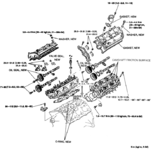
In the Mazda engine assembly diagram below, the random bracket at the front of the engine has a 30% ratio of upper/lower torque spec, but the rocker thingies (I'm not an engine guy) are more like 10%, and the most critical head fastener has a low initial torque then an angle, which will result in better controlled preload.
To me this means: set the torque wrench to the middle of the range (or the nearest possible detent, depending on how the units break). The torque tool has some allowed variation in torque applied, say ±5%. (Then the nut factor (friction, etc.) uncertainty stacks onto this and makes the achieved fastener preload more like ±25% if you're lucky. Lubricating helps lower the scatter, but obviously follow manufacturer's directions here.)
The engineer has (or should have) run the numbers assuming you achieved the low end of the torque range (and an assumed worst-case high torquing friction, worst-case low joint friction, and temperature effects) and determined that the assembly can handle its design loads at that resultant low-design preload. The engineer has/should have run the numbers on the high end of the torque range (and an assumed worst-case low torquing friction, etc.), and determined the fastener and what it is clamping won't get overloaded from that resultant high-design preload.
Last edited:
It is indeed typical in aerospace to see the torque called out as a range, but personally I prefer to specify it as a single value ± a range (as values or as a percentage). This is more straightforward, less prone to math errors, and enables the operator to easily determine if a torque tool is suitable based on its specifications vs the specified tolerance.
2ndGearRubber
Well-known member
And here I am, just tightening fasteners.
FWIW mazda has used this format since at least the 90s. It's in my miata shop manuals.
FWIW mazda has used this format since at least the 90s. It's in my miata shop manuals.
One advantage of the Mazda approach: for the wider/less-critical ranges it also lets you use torque tools that might be out-of-range if set at the midpoint. Like that 84–112 N•m bracket could be properly torqued by almost all 3/8 or 1/2" torque wrenches.