To avoid these ads, REGISTER NOW!

Measure this,....

andyvh1959

Well-known member
Joined
Feb 15, 2020
Messages
2,598
Location
Green Bay WI
if you can. How many of you have met someone that can't read a tape measure, and that someone was in a production or manufacturing facility. Manager at one of our contract shops commented how hard it is to find personnel able to read a tape measure. Perhaps its a lack of basic math skills? Not able to "see" the sixteenths of an inch on the tape measure? For that matter the 32nds or 64ths.

I recently did an audit on a hydraulic crimping machine. I used my dial vernier caliper to measure/confirm the crimp diameter. Production engineer I was with said "old school!" as he nodded approval. I said I prefer the dial vernier caliper so I don't have to deal with batteries, it always works. Have not used a Micrometer in a while, but like to use those too.

My wife used to be the registrar at a local high school. She had a student in her office working on his schedule, she asked him for the time, he didn't answer, she looked up and pointed to the analog clock on the wall. He said, "I can't tell the time on that." Sad.
 
To avoid these ads, REGISTER NOW!

saltwater4life

Well-known member
Joined
Dec 20, 2009
Messages
95
Yeah I do industrial maintenance at Michelin and can’t tell you how many calls I respond to where the only issue is operators and process technicians not knowing how to read measurements
 

dukefx

Well-known member
Joined
Aug 24, 2022
Messages
391
These things may seem obvious to some but others may not have been taught. Lets not be Ellen Degenerate where she mocks teens that can't use a round dial phone.
 

Sumboodie

Well-known member
Joined
Mar 20, 2021
Messages
10,745
Location
AK
if you can. How many of you have met someone that can't read a tape measure, and that someone was in a production or manufacturing facility. Manager at one of our contract shops commented how hard it is to find personnel able to read a tape measure. Perhaps its a lack of basic math skills? Not able to "see" the sixteenths of an inch on the tape measure? For that matter the 32nds or 64ths.

I recently did an audit on a hydraulic crimping machine. I used my dial vernier caliper to measure/confirm the crimp diameter. Production engineer I was with said "old school!" as he nodded approval. I said I prefer the dial vernier caliper so I don't have to deal with batteries, it always works. Have not used a Micrometer in a while, but like to use those too.

My wife used to be the registrar at a local high school. She had a student in her office working on his schedule, she asked him for the time, he didn't answer, she looked up and pointed to the analog clock on the wall. He said, "I can't tell the time on that." Sad.
I've never seen a dial caliper with a vernier scale on it. Interesting.
 

mogandave

Well-known member
Joined
Nov 4, 2021
Messages
3,052
Location
Bangkok
I've never seen a dial caliper with a vernier scale on it. Interesting.

Nor have I. I held out for a long time with the dial, but I like the digital better anymore.

In the plant (sheet metal fab) part of orientation for new workers was teaching how to read and use a tape measure and we would test them. We told everyone, if you can't read a tape measure, we can't use you.

We taught them:
1. How to read the scale
2. Why the hook was loose, and how to take advantage of it
3. How to catch the end with your finger so as not to let it snap back
 

MushCreek

Well-known member
Joined
Jan 14, 2015
Messages
9,829
Location
Upstate South Carolina
When my son was in college for engineering, he was asked on a test what the smallest division on a scale was. He put .010, or 1/100th of an inch. It was marked wrong, and he was told that it's 1/64". He was going to let it go, but I insisted that he bring one of my scales to show the professor. Actually, I have seen a scale with 1/128ths, but they aren't very common.
 

AA/FC

Well-known member
Joined
Dec 9, 2010
Messages
2,080
I know a union Journeyman Millwright who is completely illiterate (He can only write/sign his name) and I was told he uses an "easy read" tape measure at work. This person is not a millennial, he's probably getting close to retirement age, he's been a Millwright for decades.... And don't get me wrong, he's a great guy, I know him personally, he has done very well for himself over the years. I won't go into details but he has accomplished a lot in his life. He's done better for himself than a lot of "regular" people I know.
 
Last edited:

kaymccampbell

Well-known member
Joined
Feb 27, 2015
Messages
29,616
Location
Upstate New York
@andyvh1959 , @Sumboodie , @engineer2 , @mogandave , I'll pass on the inability to read, write, understand measuring instruments. That verges on the religious and political. What's getting me is the dial vernier caliper. It's not something in my lexicon. Has anyone got a picture?

In my toolboxes, I have 2 types of calipers. Legged and beam. At least that's what I was taught to classify them as.

Of the legged, I have inside, outside, hermaphrodite, and layout/scribing.

Of the beam, I have vernier, dial, and digital.


I have noticed in recent years that folks, even machining folks, are substituting vernier for beam in describing their beam calipers, thus we get vernier, which I don't think most folks know what it actually is, dial vernier and digital vernier, instead of vernier beam, dial beam, and digital beam. I do know the language changes over time, but......
 

Sweetcorn

Well-known member
Joined
Feb 14, 2018
Messages
681
Location
North Central Ohio
I've trained a bunch of apprentices (Tool and Die) over the years and I'll never take shots at younger people for simply not knowing how to use certain tools. Most adults don't know how to use calipers or even why they'd want to, so it isn't like they are going to teach their kids how to do it. High schools haven't pushed "real world" knowledge on students in decades; it's all college prep courses now.

I know there are a ton of under-qualified workers filling jobs in factories, I see it every day. I really do enjoy showing people how to do things. I can't tell you how many times I've heard "Nobody has ever shown me how to do that before!" It's pretty rewarding. :giggle:

I've encountered some who just don't want to learn something, but that is really rare. No big deal to me though, I just move on.

I'm not saying the OP does this, but I see enough people belittle/treat others poorly because they don't know how to do something and it doesn't do a damn thing to improve any situation. I implore my fellow garage journal friends who have the skill and knowledge to do things, to show those around you who are struggling how to succeed at some of those tasks. Be nice, be helpful, and make some friends along the way.

The short of it is, I've met a lot of people over the years who didn't know know much about anything mechanical because they never had the opportunity to learn from someone. Those who've wanted to learn about it have done so and enriched their lives because of it.
 

mogandave

Well-known member
Joined
Nov 4, 2021
Messages
3,052
Location
Bangkok
@andyvh1959 , @Sumboodie , @engineer2 , @mogandave , I'll pass on the inability to read, write, understand measuring instruments. That verges on the religious and political. What's getting me is the dial vernier caliper. It's not something in my lexicon. Has anyone got a picture?

In my toolboxes, I have 2 types of calipers. Legged and beam. At least that's what I was taught to classify them as.

Of the legged, I have inside, outside, hermaphrodite, and layout/scribing.

Of the beam, I have vernier, dial, and digital.


I have noticed in recent years that folks, even machining folks, are substituting vernier for beam in describing their beam calipers, thus we get vernier, which I don't think most folks know what it actually is, dial vernier and digital vernier, instead of vernier beam, dial beam, and digital beam. I do know the language changes over time, but......

And forty years ago, everyone called them Helios....
 

RoninB4

Well-known member
Joined
Jul 22, 2020
Messages
3,618
Location
Under My House
It amazes me that some folks don't know how to read basic measuring tools like a tape measure but I certainly don't degrade or make fun of them. It's an opportunity to help them and I relish the honor. Same for people in a machine shop. Should someone choose to enter manufacturing it's really one of the things they should make a point of learning but it's not always critical. Now if you're working in a fabrication type job then it IS critical and their responsibility to learn, still I'll try to help if someone wants to learn and just doesn't know. There are far too many people that are lazy who don't try to learn any more than they are taught in school, some college educated. Some even believe that digital is more precise than analog, repeating a fallacy they were told without thinking about it.

Helios is indeed a brand name of measuring instruments. I was in the trades 40 years ago but never heard a caliper referred to as a "Helios". Maybe it's a regional thing. Kay types faster than I do.
 

strutaeng

Well-known member
Joined
Dec 12, 2011
Messages
2,290
Location
Dallas, TX
I carry a folding rule when I go to construction job site. I sometimes get a "Wow" when I start measuring things like rebar spacing and such with it.

I also carry a 25' measuring tape and a digital measuring instrument. But the folding rule is so handy, especially because you can fold the first segment 90 degrees and extend it a few feet to measure something out of reach.
 
OP
A

andyvh1959

Well-known member
Joined
Feb 15, 2020
Messages
2,598
Location
Green Bay WI
Ha, just realized my description of a dial vernier caliper could be a misnomer. Though, even with a dial, it does have a vernier scale on the beam. Type in a Google search for a vernier caliper and see what comes up, mostly true vernier (no dial, no digital) but also vernier scale with a digital display. Type in dial caliper and up comes what I mistakenly described as a dial vernier caliper. So, I like a dial caliper.

Your stride, length of a finger or forearm, folding rule, tape measure, vernier caliper, micrometer, laser (?), all depends on the level of accuracy needed when measuring a distance, length or thickness. Just glad I was raised by a dad who knew the effectiveness of every option and how to use them. In a life skills class, even for students not going into the trades, its still good to teach kids how to use a tape measure.

With the name Helios brought up, I just now recall I have a classic Helios caliper in the pouch in my tool cart. It was my dad's, along with the Starett micrometer that my dad used. Before my dad passed, when he knew it was coming, he requested to be buried in a brand new pair of Craftsman blue coveralls, with tools in his folded hands along with a Rosary. I may request to go the same way, tribute to him. He was the only blue collar guy from his family of five brothers and two sisters, all of them were professionals, business owners, but he was damned proud of his career choice, right to the end.
 
Last edited:

txvwnut

Well-known member
Joined
Jan 1, 2015
Messages
7,657
Location
Bedford, Texas
I've never heard of calipers being called by the brand name in my region, and I actually own a Helios caliper as does dad.
 
OP
A

andyvh1959

Well-known member
Joined
Feb 15, 2020
Messages
2,598
Location
Green Bay WI
When my son was in college for engineering, he was asked on a test what the smallest division on a scale was. He put .010, or 1/100th of an inch. It was marked wrong, and he was told that it's 1/64". He was going to let it go, but I insisted that he bring one of my scales to show the professor. Actually, I have seen a scale with 1/128ths, but they aren't very common.
Definitely not wrong, and the instructor could have used the opportunity to learn from it, teach from it. Especially since your son's answer was technically a finer division (.010" versus .015"). The test question would be subjective to the device used to measure and inch or metric scale standard. The smallest division on a common tape measure would be 1/32". On a common inch graduated vernier caliper it is 1/64", as the vernier is graduated in eight. On a common metric graduated vernier caliper it is .010mm, as the vernier is graduated in ten. Technically the metric vernier is more accurate, based on a division of ten versus eight.

I recall back in the late 80s I worked with Bosch engineers to install the 1st ABS brake system on Pierce fire trucks. That meant we had to machine the ends of the wheel hubs to shrink fit on the tone wheel. The Austrian Bosch engineer was all metric, and when measuring for the machining needed on the hub end I was referring to inch measurements. I chuckled when he asked, "Vhut is dis 128th of an inch?" He preferred the logic of tens of metrics, wasn't being uppity about it, just preferred metrics. His point was well taken, and I switched to discussion with him in metric. Yet, all the machining prints for our shop was done in inch standard, down to thousandths of an inch.
 
To avoid these ads, REGISTER NOW!

neophyte

Well-known member
Joined
Apr 23, 2012
Messages
9,783
Location
Pennsylvannia
When my son was in college for engineering, he was asked on a test what the smallest division on a scale was. He put .010, or 1/100th of an inch. It was marked wrong, and he was told that it's 1/64". He was going to let it go, but I insisted that he bring one of my scales to show the professor. Actually, I have seen a scale with 1/128ths, but they aren't very common.
I actually bought a “Ruler” with either 1/128ths or maybe 1/100ths marked.
(yes, technically “Scale” is the proper terminology, bit none or few of my teachers in grade school stressed that)
At an art supply store decades ago.
It wasn’t some fancy “machinist” precision brand either, such as Starrett or Brown & Sharpe.
It was just stamped stainless steel, with stamped markings (I think)
You could measure the individual notches with a fingernail.
 

merkyworks

Well-known member
Joined
Nov 11, 2016
Messages
587
Location
Texas
I prefer dial calipers over digital calipers, analog clocks over digital. But when it comes to tape measures I must admit, the FastCap style is so much easier to read than the Stanley style. Edit: Can still read the Stanley though haha

EEB5E600-2898-43F1-82D2-FC9567A79852.jpeg
 

Big Bad Dad

Well-known member
Joined
Jan 31, 2010
Messages
2,664
Location
Southwest/ Central Va.
As an old carpenter, I much prefer the Stanley style. The ones that I can not stand are the tape measures with both inch and metric scales on the same blade. I use my tapes in different directions, depending on what I am doing, and can read the inch scale from both sides. Those with the metric half just screw me up....
 

housewolf

Well-known member
Joined
Feb 3, 2021
Messages
1,144
Location
East Texas
I prefer dial calipers over digital calipers, analog clocks over digital. But when it comes to tape measures I must admit, the FastCap style is so much easier to read than the Stanley style. Edit: Can still read the Stanley though haha

EEB5E600-2898-43F1-82D2-FC9567A79852.jpeg
I’m retired from the plumbing trade after 45 years. I gotta admit when I ask to borrow a tape on a job site visit and someone hands me one with the fractions wrote on it, I’m lost. Way too busy for me. I can measure to the 1/16” at a glance with one like the Stanley 😂
 

RPH

Well-known member
Joined
Dec 17, 2006
Messages
4,190
Location
Michigan Thumb
**** happens. And then you have this.

NASA lost its $125-million Mars Climate Orbiter because spacecraft engineers failed to convert from English to metric measurements when exchanging vital data before the craft was launched, space agency officials said Thursday.

A navigation team at the Jet Propulsion Laboratory used the metric system of millimeters and meters in its calculations, while Lockheed Martin Astronautics in Denver, which designed and built the spacecraft, provided crucial acceleration data in the English system of inches, feet and pounds.

As a result, JPL engineers mistook acceleration readings measured in English units of pound-seconds for a metric measure of force called newton-seconds.”
 

Wiz02

Well-known member
Joined
Jul 13, 2007
Messages
2,399
Location
Southeastern PA
I prefer dial calipers over digital calipers, analog clocks over digital. But when it comes to tape measures I must admit, the FastCap style is so much easier to read than the Stanley style. Edit: Can still read the Stanley though haha

EEB5E600-2898-43F1-82D2-FC9567A79852.jpeg
I must be living in a cave, as I have never seen a "FastCap" style tape measure before. Interesting idea, but I keep my tape measures for far too long so it may be years before I am ready to buy one and who knows what will be on the market then.
 

merkyworks

Well-known member
Joined
Nov 11, 2016
Messages
587
Location
Texas
RPH said:
**** happens. And then you have this.

NASA lost its $125-million Mars Climate Orbiter because spacecraft engineers failed to convert from English to metric measurements when exchanging vital data before the craft was launched, space agency officials said Thursday.

A navigation team at the Jet Propulsion Laboratory used the metric system of millimeters and meters in its calculations, while Lockheed Martin Astronautics in Denver, which designed and built the spacecraft, provided crucial acceleration data in the English system of inches, feet and pounds.

As a result, JPL engineers mistook acceleration readings measured in English units of pound-seconds for a metric measure of force called newton-seconds.”

I work/design in Imperial units everyday and it is what I prefer. However Metic base 10 system is ridiculously easy and honestly does make more since.
 
Last edited:

rmack898

Well-known member
Joined
Jan 23, 2007
Messages
3,199
Location
Honu Grove NE Florida
This is a true story.

In a past life (25 years ago) I had a boat dealership and we were looking to expand and take on a new boat line. After most of the negotiations with the prospective boat builder were done, we took a trip to visit the manufactures facilities and see how the boats were built.

We toured the plant in the morning , had lunch, and then we had a meeting in the conference room. Right after we sat down, the office manager came in and whispered in the ear of the owner of the company. He said excuse me and got up and left the conference room. A few minute later he returned with a Stainless steel .357 magnum with a 6" barrel and placed it on the table and started to continue our discussions like nothing was out of the ordinary.

When he realized the shocked look on my face seeing the pistol on the table, he stopped to explain. He said Willie called Jimbo a stupid **** and Jimbo was going to shoot Willie. He said that Jimbo was on probation and he couldn't afford to have Jimbo go to jail for shooting Willie as Jimbo was the only one in the lamination shop that could read a tape measure.

I wound up signing a dealer agreement with that builder and sold a bunch of their boats. They are still a major boat builder and still in business today.

I couldn't make this up, I still shake my head when I think about it today.
 

Kenstone1

Well-known member
Joined
Oct 2, 2015
Messages
734
There are tapes that have .10" graduations out in the world, but not used much, might be called "engineering" tapes.
So, with 1/10 graduations, numbered 1 thru 9 between every inch, a user only needs to be able to count to 10 (actually 9).
With measurements expressed in inches plus tenths there is no confusion associated with fractions.
I don't know of many trades that use a tape to need any more accuracy than 1/10".
Too bad none of those trades use tapes marked in 1/10" though.
jmo,
.
 

AA/FC

Well-known member
Joined
Dec 9, 2010
Messages
2,080
I must be living in a cave, as I have never seen a "FastCap" style tape measure before. Interesting idea, but I keep my tape measures for far too long so it may be years before I am ready to buy one and who knows what will be on the market then.

Around here we call them "Easy Read" tape measures.... I've never heard of "Fastcap" until two minutes ago. lol.

.
 

RoninB4

Well-known member
Joined
Jul 22, 2020
Messages
3,618
Location
Under My House
Technically the metric vernier is more accurate, based on a division of ten versus eight.
-Not to pick at your statement but unit division does not mean greater accuracy. Something of a given size occupies just that much space (other factors out) and it doesn't matter if you define that by meter, inch, shaku, furlong, or chi, the object is still the same size. The only difference is what instrument you're measuring it with. Size is size regardless of the measuring unit. A caliper is no more accurate in mm than it is in inch. A caliper shouldn't even be trusted (operative word here) to accuracy greater than +/- .0762 (mm), +/-.003 (inch). Having worked with Europeans most of my life I've heard that same mistaken assertion than metric is more accurate than inch because it's in finer graduations. Same sort of thinking that digital is more accurate than analog. Size doesn't change per the unit of measure, accuracy changes per the instrument used to measure it with. One unit of measure is not inherently more accurate than another.

To the OP- I'm sure you already knew this. Not trying to start an argument, just trying to clarify for those getting familiar with the inch/metric/accuracy/instruments decisions. I've worked with inch and metric most of my life, it's still the same size with one conversion.
 

alinc100

Well-known member
Joined
May 26, 2013
Messages
3,042
Location
Dearborn,MI
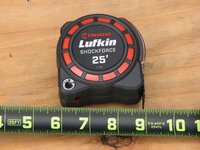
As I've gotten older and our construction sites darker I have found this Lufkin tape is easier to read on my eyes.The black/neon green takes sometime to get used to as well as their markings but it shines nicely with the green laser I use as well.
Now ,for those of us who can't read a vernier scale how ,in the example above did we get from 3.3_ cm in step 1, where I assume _ is the value in step 2 shouldn't it read 3.34 cm? where did the 1 come from?
 

Attachments

  • 3-inch-body.jpg
    3-inch-body.jpg
    379.2 KB · Views: 30

redwrench60

Well-known member
Joined
Sep 10, 2011
Messages
6,076
Location
East Tennessee
I run over metric tapes with the forklift. I strongly discourage Un-Easy read tapes in the shop. Being able to see the world around you in yards, feet, inches and fractions of an inch is a big part of building, fixing, fabricating and communicating in a shop or on a job site in the United States.

Measuring tapes, rules, squares, dial calipers, micrometers, dial indicators and gages ect. are found wherever quality work is being done. I suppose if you never hit a lick in your life it doesn’t matter that you can’t show me with your fingers what an 1/8th of an inch looks like.
 

RPH

Well-known member
Joined
Dec 17, 2006
Messages
4,190
Location
Michigan Thumb
I run over metric tapes with the forklift. I strongly discourage Un-Easy read tapes in the shop. Being able to see the world around you in yards, feet, inches and fractions of an inch is a big part of building, fixing, fabricating and communicating in a shop or on a job site in the United States.

Measuring tapes, rules, squares, dial calipers, micrometers, dial indicators and gages ect. are found wherever quality work is being done. I suppose if you never hit a lick in your life it doesn’t matter that you can’t show me with your fingers what an 1/8th of an inch looks like.
World runs on metric. Accept the inevitable move towards it. 0.125” = 3.175 mm.
Metric strength comes from easy conversions from the base 10 application. By moving a decimal point you can go up or down easier. Hard to do when you have a **** load of fractions.
 
To avoid these ads, REGISTER NOW!
Top Bottom