To avoid these ads, REGISTER NOW!

Measuring the angles on a cross brace

Patrick Boyle

Well-known member
Joined
Jun 28, 2010
Messages
188
Location
Western Montana
Ok, I know this is basic stuff here, but I was never taught how to figure this out. In my lovely illustration we're looking at a side view of an imaginary work bench. The table top attaches to the wall and sits on top of a 2x4 mounted horizontally for support. There is another 2x4 mounted horizontally near the floor for the cross brace to mount on The cross brace will be notched out and attached to the 2x4 for support.

bench.jpg


My question is, how do you figure out the length of the cross brace, and what angle cuts you need to make it all come out square, especially at the wall there the 2x4 is notched out?
 
To avoid these ads, REGISTER NOW!

bimmer1980

Well-known member
Joined
Feb 5, 2009
Messages
2,104
Location
York, PA
do you remember any trigonometry from high school? You will need some "sine" and "cosine" functions to figure it out... you will need a calculator that has these functions...

Having said that.... here is a basic formula to help you out...

A- one of the base leg of the triangle or the "top"
B- the other base leg or the side of your workbench
C- is the hypotenuse or the diagonal bracing on your bench.

A squared plus B squared will equal C squared if the angle between A and B is 90 degrees.....

Therefore... If the inside edge of the top workbench is 24" and the Height from the inside corner to the inside edge of the angle is 30" then the inside edge of the angle brace will be the following...

24x24 + 30x30 = C squared
so 1476 = c squared
then take the square root to get C and you have 38.4187" for the inside edge of the angle brace.
 

hh76

Well-known member
Joined
Nov 9, 2010
Messages
3,450
Location
NE Wisconsin
you can figure it out mathmatically, but probably a lot easier to just level the top and measure.

I'd cut the bottom of the brace first, then hold it up in place and mark the second cut.
 

smschriefer

Well-known member
Joined
May 28, 2009
Messages
842
Location
Yorktown, VA
^^^ I generally lay it out on the ground and then cut as required. As a rule of thumb, I use the 3,4,5 rule based on the geometric equation for finding the length of the legs for a right triangle - A squared + B squared = C squared. So, 9+16=25. You can also figure your angles by using a framing square using this same formula. So if you do a 24 inch top (6*4), the long leg would be 30 inches (6*5), and the leg against the wall would be 18 inches (6*3).
 
Last edited:

bimmer1980

Well-known member
Joined
Feb 5, 2009
Messages
2,104
Location
York, PA
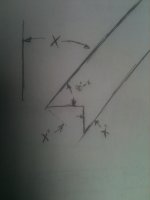
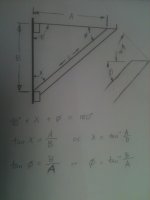
I did a couple of quick sketches and took a picture with my iphone... not the clearest, but hopefully it will be understandable.

Let me know if you have questions...

Honestly, I would get it close with a template and cut everything from that. Typically, rough framing usually negates any super accuracy....
 

Attachments

  • Table angles.jpg
    Table angles.jpg
    188.8 KB · Views: 127
  • Brace Angles.jpg
    Brace Angles.jpg
    189.4 KB · Views: 101

bimmer1980

Well-known member
Joined
Feb 5, 2009
Messages
2,104
Location
York, PA
also, for what it's worth, using the numbers in my above example you get the following:

X is 38.659 degrees

Theta is 51.34 degrees.

38.659 + 51.34 + 90 is 180 degrees.

All triangle have to have angles that add up to 180.

Have fun!
 
OP
P

Patrick Boyle

Well-known member
Joined
Jun 28, 2010
Messages
188
Location
Western Montana
Well this definitely helps, it's just going to take some practice to be able to visualize this in my head. I should probably start making some sawdust using Bimmer's drawings and see what I come out with. Thanks!
 

MBfreak

MEMBER EMERITUS
Joined
Dec 10, 2010
Messages
2,301
Location
Linkoping , Sweden
Bimmer

All triangles add up to 180 degrees.
Kind of.
Get yourself a sphere. ( A basket ball will do very nicely)
Mark out three points on the surface, well spaced.
Draw straight lines between the three points.
Measure the inside angle between each pair of lines and add up .
Not 180 degrees!

We were calculating the size of a sphere based on this when I studied for a BSc back in 1963. Our math teacher had the knack of making math interesting, challenging and imaginative. THINK FIRST AND COUNT AFTERWARDS was his credo.

A excellent and entertaining book on this and many other facts of the natural sciences is
" One, two, three, infinity " by Georg Gamow. ( Who sadly never got the Nobel Price in Physics)

I recommend it for the third grade kid as well as for the PhD.
His method of establishing the value of pi using matches and a US flag is wonderful.


Ola
 

bimmer1980

Well-known member
Joined
Feb 5, 2009
Messages
2,104
Location
York, PA
MBFreak--fair enough--there is an exception to every rule.

Altho--the OP is making a flat workbench...not a ball....

Therefore....I was keeping it as simple as possible.......
 

bad_idea

Well-known member
Joined
Jun 11, 2011
Messages
4,332
Location
Pasquotank, NC
lay it out on the floor and measure off of that. keep it simple. there was a whole lot of shipyard workers who couldn't read a ruler but built ships. those ships looked better than most today.
 

DanarchyCustoms

Well-known member
Joined
Nov 30, 2011
Messages
275
Location
Hudson Valley, NY
If you lay it out on the ground you can use a speed square to read the angles and then cut test scrap pieces of those angles and confirm that they are right. Recently I have downloaded a free Trig app and have been using that lately, extremely happy with it.
 
To avoid these ads, REGISTER NOW!

mrobins297aaa

Well-known member
Joined
Sep 20, 2010
Messages
3,283
Location
south east michigan
on a 90 deg triangle with a 45 deg brace.

A and B will be equal and the length of the brace will be 1.414 x A or B

i.e. 24" top with a 24" vertical, the brace would equal 1.414 x 24 = 33.94
 

BWS

Well-known member
Joined
Sep 3, 2006
Messages
923
Location
Mnts of Va
Theres a "brace" table or scale on a good framing square.....for those looking into traditional methods.And at least three other ways to do that on a framing square......just off the top of my head.
 

DekeT

Well-known member
Joined
Aug 12, 2011
Messages
2,234
Location
USA
Bimmer

All triangles add up to 180 degrees.
Kind of.
Get yourself a sphere. ( A basket ball will do very nicely)
Mark out three points on the surface, well spaced.
Draw straight lines between the three points.
Measure the inside angle between each pair of lines and add up .
Not 180 degrees!

We were calculating the size of a sphere based on this when I studied for a BSc back in 1963. Our math teacher had the knack of making math interesting, challenging and imaginative. THINK FIRST AND COUNT AFTERWARDS was his credo.

A excellent and entertaining book on this and many other facts of the natural sciences is
" One, two, three, infinity " by Georg Gamow. ( Who sadly never got the Nobel Price in Physics)

I recommend it for the third grade kid as well as for the PhD.
His method of establishing the value of pi using matches and a US flag is wonderful.


Ola

Entertaining, but lines on a curved surface are arcs and not straight lines. Theorom for 180 triangulation is limited to planes. Measure along the chords inside the sphere that are coplanar and it of course becomes 180 degrees.
 

gte718p

Well-known member
Joined
Mar 12, 2009
Messages
3,975
Entertaining, but lines on a curved surface are arcs and not straight lines. Theorom for 180 triangulation is limited to planes. Measure along the chords inside the sphere that are coplanar and it of course becomes 180 degrees.


In a polar coordinate system the three points are coplanar. A plane can be defined by any two orthogonal vectors. Three points can be used to define the vectors. It's just not a cartesan plane. If you really want to confuse people map the triangle to 4 or 8 dimension space.
Modern physics made my head spin.

I think for most people normal Cartesian space is just fine, and triangles should add to 180.
 

DekeT

Well-known member
Joined
Aug 12, 2011
Messages
2,234
Location
USA
In a polar coordinate system the three points are coplanar. A plane can be defined by any two orthogonal vectors. Three points can be used to define the vectors. It's just not a cartesan plane. If you really want to confuse people map the triangle to 4 or 8 dimension space.
Modern physics made my head spin.

I think for most people normal Cartesian space is just fine, and triangles should add to 180.

Three points in any coordinate system define a plane. But back to the original question, I would not even use a scale or math to do this. A sliding t-bevel and pencil is all you need.
 
Last edited:

darkk

Well-known member
Joined
Dec 24, 2009
Messages
3,361
Location
Willimantic, Ct.
Take a piece of cardboard and just cut out the size you need. Put it against the wall and draw the line you want, cut it out and use as a template for the angles.
 

mdbeck1

Well-known member
Joined
Mar 7, 2010
Messages
2,297
Location
Norman, OK
Ok. You can do this mathematically but all mathematics is an estimation (I'll probably get an argument on that one but after two bourbons...). A practicle rough framing answer is...
1. Temporarily attach the bench top to the wall.
2. Put a level on it against the wall and get it level.
3. Turn the level 90 degrees to get it level. Clamp a piece of 2X4 direct to the ground.
4. Go to the END of the workbench. Measure the brace board.
5. Cut a brace board to make the brace board.
 

dreamwc

New member
Joined
Nov 9, 2014
Messages
1
Ok, so for those of us who are not a freaking math genius...how about the dummy method to figure out the length needed to match two 2x4's on an angle?

I do not need all the smart *** math equations. I had tons of guys on our crew who could not even spell their damn name, yet they did perfect carpentry work, so you cannot tell me these guys knew how to calculate this ****. NOw, quit showing the hell off and someone tell us the simple way please!
 

bad_idea

Well-known member
Joined
Jun 11, 2011
Messages
4,332
Location
Pasquotank, NC
I posted post number 10 2 years ago. It was not showy then and it is not showy now. No need to be a jackass, just read.
 
OP
P

Patrick Boyle

Well-known member
Joined
Jun 28, 2010
Messages
188
Location
Western Montana
Ok, so for those of us who are not a freaking math genius...how about the dummy method to figure out the length needed to match two 2x4's on an angle?

I do not need all the smart *** math equations. I had tons of guys on our crew who could not even spell their damn name, yet they did perfect carpentry work, so you cannot tell me these guys knew how to calculate this ****. NOw, quit showing the hell off and someone tell us the simple way please!

Pull the stick out of your ***, no one owes you anything.
 

Kevin54

MEMBER EMERITUS
Joined
Jan 12, 2005
Messages
29,341
Location
Urbana, Ohio
you can figure it out mathmatically, but probably a lot easier to just level the top and measure.

I'd cut the bottom of the brace first, then hold it up in place and mark the second cut.

^^^^This right here^^^^

Figure out how you want the bottom brace, cut it, level a top board from the wall out, then mark your cut.

Trig, sine, cosine, and all of that is too big of a hassle when it comes to support legs.

BTW.....instead of notching your support leg like shown, either just cut it straight vertical, or cut a flat on the bottom of your cut to match the 1 1/2" of your 2x and set the support leg on top. Notching it is too big of a hassle. I cut mine straight vertical and have it sitting on top of my foundation. I have five supports in 24' of length, and have two surface plates, vise, large arbor press, and a bunch of other stuff on top, plus I can jump up and down on it with my 250 pounds.

Make sure you use some 3" #8 DECK SCREWS and NOT drywall screws to fasten things to the wall.

I can take some pics later as to what mine looks like, if you like.

Also....I looked at your sketch again. You can build your top as a square, with 2x's at 16" intervals in between. No need to set the top on a ledger board like you are showing. Make your top complete, tack any small board a couple of places along the wall at a level line, set your top on it, then clamp a couple of 2x's straight up and down as legs until you get your angled supports made. I think it took me 2 hours to make my 24' bench top complete.
 
Last edited:
To avoid these ads, REGISTER NOW!
Top Bottom