To avoid these ads, REGISTER NOW!

Metal building insulation DIY time

Deude_Mann

Well-known member
Joined
Feb 7, 2020
Messages
113
Location
Laredo, TX
So I am budgeting for retrofit installation of vinyl backed fiberglass insulation in a 30x40x12 metal building and am weighing the cost of hire vs DIY. The insulation and installation would be this style here, wide cut battens held in place with banding, roof and walls. Like this...

https://www.metalbuildinginsulation.com/insulation-ceilings.html

attachment.php


I am trying to get an idea of the DIY man hours required for this from those who have DIYed it themselves. I am at a skill level where I can handle the job, and will have the requisite lifting equipment like a scissor lift. I'll have about 4 hours a day to do the job.

Diving a little deeper here:
The building is new and will be sprayed, walls and ceiling, with 1" of closed cell foam insulation, pro installed. This will seal up the building and act as the vapor barrier.

So there are at least two basic ways to go here for additional insulation that I am considering. One is to have an additional 1" of closed cell foam sprayed in for a total of 2", and then coat that with a fire resistant coating. Two is to just use 1" of spray foam to seal the building and then go with another system over that like the batten/banding system. I am trying to avoid the cost and labor of having to frame and drywall or otherwise add an additional layer of heavy covering. For this workshop I don't need to go to that extent.

I suspect either will be about the same cost if I consider my time for batten insulation or pay the installers to do it. The main benefit of the batten insulation would be the higher cumulative R-value, the inherent fire protection, and the better finished appearance.

I am in Central Texas and so the building will be air-conditioned, most likely with a mini-split.

I bring all this up in case someone has another suggestion.
 

Attachments
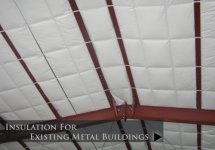
  • retrofitinsulation.jpg
    retrofitinsulation.jpg
    117.6 KB · Views: 163
Last edited:
To avoid these ads, REGISTER NOW!

Marctrees

Well-known member
Joined
Mar 5, 2015
Messages
6,265
Location
TX/LA border - Toledo Bend
Get a scrap piece of foam insulation and try your best to light it w a torch.

Actually theres a few videos of this on Youtube.

You will see it does not need the fancy paint, UNLESS you have a specific mandated insurance requirement.

Marc
 
OP
D

Deude_Mann

Well-known member
Joined
Feb 7, 2020
Messages
113
Location
Laredo, TX
I did read up on spray foam flammability and watch a few youtube videos.

Here is one showing closed cell (2 lb) polyurethane foam with and without a fire-resistant coating.

That is one of my main concerns, not giving my insurance company a reason to deny a claim should the unthinkable happen. Though fortunately I am not in an area subject to building permits, city inspections, and HOA demands, I am still shooting for a clean, reasonably safe result.
 
Last edited:

pmiranda

Well-known member
Joined
Jul 15, 2008
Messages
1,504
Location
Austin, TX
Once you're sealed up with the spray foam, you might consider rigid foam insulation boards like foamular. It's light and easy to place and support. R5, but also needs some fire protection
 

The J

Well-known member
Joined
Mar 4, 2010
Messages
152
What is the cost of additional closed cell foam to meet your desired R value?
If the crew is there with their equipment already, why not have them lay down a thicker layer?
I would weigh cost versus your time and effort to add additional insulation to the closed cell spray foam.
 

inphx

Well-known member
Joined
Feb 23, 2012
Messages
1,275
Location
Phoenix/Scottsdale AZ
That photo seems to be a roll of the fiberglass bat the installer tosses over the ribs before screwing in the sheeting. It's economical to do at that time. Isn't closed cell 3.2 to 3. R value per inch.. with 1" .. the fiberglass batt like in the photo seems comparable. I would think spraying the foam would be more $$
 
OP
D

Deude_Mann

Well-known member
Joined
Feb 7, 2020
Messages
113
Location
Laredo, TX
What is the cost of additional closed cell foam to meet your desired R value?
If the crew is there with their equipment already, why not have them lay down a thicker layer?
I would weigh cost versus your time and effort to add additional insulation to the closed cell spray foam.

Yes I am considering that as well. The benefit of switching to batten (with vapor barrier) is higher R value for the same cost, and better finished appearance.
 
Last edited:
OP
D

Deude_Mann

Well-known member
Joined
Feb 7, 2020
Messages
113
Location
Laredo, TX
That photo seems to be a roll of the fiberglass bat the installer tosses over the ribs before screwing in the sheeting. It's economical to do at that time. Isn't closed cell 3.2 to 3. R value per inch.. with 1" .. the fiberglass batt like in the photo seems comparable. I would think spraying the foam would be more $$

The image is for insulation that is installed AFTER the cladding hence the term retrofit. The type that goes on before the cladding is usually not thick enough to fill the purlins. Retrofit is much thicker.
 
Last edited:

dcg9381

Well-known member
Joined
Jun 20, 2018
Messages
11,660
Location
Austin, TX
By FAR, the easiest way to accomplish your insulation goals is to follow that closed cell with as much open cell as you need on the ROOF... And the roof should be your big focus anyway.

With 1" of closed cell on the walls, it sounds like you're going to frame and then insulation becomes a cake walk with it being relatively easy to do - adding insulation (perhaps massive amounts) while framing walls.

I get the desire for a "fire barrier" at the ceiling. I can tell you I've been in so many hangers and bardo's that operate without a fire break in the ceiling. I'm comfortable with it being like that in my own building. If you handle the walls, it'd take a fairly massive fire - or perhaps a point on roof lightening strike to catch the inside of the roof on fire.
 

readhead

Well-known member
Joined
Dec 8, 2012
Messages
6,175
Location
Durango, Co.
Was a thermal break tape installed between the sheeting and the secondary steel when it was erected?

You are getting some bad information on blanket insulation thickness.
 

pmiranda

Well-known member
Joined
Jul 15, 2008
Messages
1,504
Location
Austin, TX
By FAR, the easiest way to accomplish your insulation goals is to follow that closed cell with as much open cell as you need on the ROOF... And the roof should be your big focus anyway.

Really? The walls are more area than the roof in his building.


BTW, speaking of lightning strikes.. if the steel frame is grounded and the metal sheathing is screwed to the frame with metal screws... is there any need for additional lightning arrestors? Unlike a wood frame or pole barn, I'd think not?
 

dcg9381

Well-known member
Joined
Jun 20, 2018
Messages
11,660
Location
Austin, TX
Really? The walls are more area than the roof in his building.

Yes. It's not an area thing. You'd be right if it was. Most of the solar heating is on the roof (even with a reflective roof). Heat loss is also roof.... Look at recommended R values for residential construction - you'll find what I'm recommending.

It's also a "difficulty" based recommendation. It's much easier to DYI walls than it is to handle a roof (unless you do the old school attic deal).

Final concern - not sure you can spray foam on that "blanket" of insulation. I've seen at least one post where that didn't take.

BTW, speaking of lightning strikes.. if the steel frame is grounded and the metal sheathing is screwed to the frame with metal screws... is there any need for additional lightning arrestors? Unlike a wood frame or pole barn, I'd think not?

I don't have any on my building. Then again, I've had just a "nearby" strike release enough EM to smoke cat 5 wires at the terminators. I mention lightening not for the electrical hazard but as the strike tends to have very high heat.
 
OP
D

Deude_Mann

Well-known member
Joined
Feb 7, 2020
Messages
113
Location
Laredo, TX
By FAR, the easiest way to accomplish your insulation goals is to follow that closed cell with as much open cell as you need on the ROOF... And the roof should be your big focus anyway.

With 1" of closed cell on the walls, it sounds like you're going to frame and then insulation becomes a cake walk with it being relatively easy to do - adding insulation (perhaps massive amounts) while framing walls.

I have a line-item quote with a separate price for additional open cell on the ceiling. I know someone in the DFW area (similar summer heat and humidity) that went with this approach and it is working for him.

Was a thermal break tape installed between the sheeting and the secondary steel when it was erected?

You are getting some bad information on blanket insulation thickness.

I'm not sure what you mean by the secondary steel, do you mean the purlins? If so, then no.

On the blanket thickness, I'm not sure what you mean. The purlins are about 6" deep, so if a fiberglass batten completely filled the purlin space then it would definitely insulate better than the relatively thin pre-cladding insulation that was referred to earlier.

EDIT: On correction, now I see that some do very thick pre-cladding installations of fiberglass batting. The stuff I have seen around here is much thinner, about R6 at best.

Final concern - not sure you can spray foam on that "blanket" of insulation. I've seen at least one post where that didn't take.

I do not know where this came from but I would not spray foam on top of an existing layer of vinyl coated batten. This building right now has no insulation at all, just steel, so the spray foam would go directly onto the cladding as usual.
 
Last edited:
OP
D

Deude_Mann

Well-known member
Joined
Feb 7, 2020
Messages
113
Location
Laredo, TX
By FAR, the easiest way to accomplish your insulation goals is to follow tor perhaps a point on roof lightening strike to catch the inside of the roof on fire.

Funny you should mention that... There is a small hole in my concrete driveway where a lightning strike hit. It completely fried the electrical system of a vehicle parked next to that spot and the entire wiring harness had to be replaced. About a 1/4 mile down the road there is a telephone pole that has the top four feet of it blown off from a lightning strike. We are up in the hills so things get interesting when a large thunderstorm comes through. So it does happen here occasionally.
 
Last edited:

Marctrees

Well-known member
Joined
Mar 5, 2015
Messages
6,265
Location
TX/LA border - Toledo Bend
FYI - in E TX 3000 sq ft OC... 1500 walls @4", and 1500 under roof @7" was $4k total.

In and out in one day, allll done....move on w project.... instead of rolling around w scaffold bitching how many days ?

I got 6 bids, ranging from 4k to 5.7k.


Marc
 

readhead

Well-known member
Joined
Dec 8, 2012
Messages
6,175
Location
Durango, Co.
We routinely do R38 with blanket insulation. The insulation over the secondary steel, purlins and girts, provides the thermal break. You can insulate at the sheeting but with no thermal break moisture will condense on the purlins and girts. Your salesman was not very knowledgeable.
 
OP
D

Deude_Mann

Well-known member
Joined
Feb 7, 2020
Messages
113
Location
Laredo, TX
OK I have gathered more information and here is the deal:

I spoke with a tech support person at Lamtec, the company that makes the facing material that is bonded (by companies like Bay Insulation) with the fiberglass batt insulation. The person I spoke with was quite knowledgeable and helpful. I described what I wanted to do and after some back and forth here is the summary...

So the Lamtec product is only rated for fire protection when there are NO combustible products behind their product. Clearly fiberglass insulation is not combustible, but foam is (at least compared to fiberglass). So the problem is not necessarily the double vapor barrier issue (perhaps a separate debate) but that the spray foam would have to be treated with something like an intumescent paint before the retrofit batt/film layer was installed.

So, in order to do what I propose, double vapor barrier issue aside, the installation would have to be:
1. Spray foam
2. Intumescent paint
3. Bay Insulation product (batt fiberglass with protective film)

That's starting to add up on labor and materials, so I am more likely to go with either all spray foam or all Bay Insulation. I know both systems have pros and cons along with their proponents and opponents.

TO BE CLEAR, Lamtec DID NOT say that my 1-2-3 process above was OK, they merely described what the issue was. I don't want anyone to take from this post that Lamtec said my 1-2-3 above was OK because I'm not the expert.

Thanks all, hope this makes sense.
 
Last edited:
To avoid these ads, REGISTER NOW!
OP
D

Deude_Mann

Well-known member
Joined
Feb 7, 2020
Messages
113
Location
Laredo, TX
OP is in S. Texas, I don't think condensation on the frame will be a big deal most of the time?

Nope, probably not. Plus the space will be air conditioned to remove moisture, and winter heating is really not a big deal or really needed.

Seeing you are in Bastrop (TX) you know of what I speak. :)
 

Marctrees

Well-known member
Joined
Mar 5, 2015
Messages
6,265
Location
TX/LA border - Toledo Bend
For FG batts, it's very good to deal w Bay, w the Lamtec products.

Two things...

#1 - Be aware all Lamtec facings are available "Microperfed"... little tiny holes punched so a film that was low permeance is now high permeance.

AFAIK in SA you would choose perfed.

Ask Bay, but study yourself.


#2 - VERY important - Google "Condensation Plane" in insulated walls and then make SURE your proposed 1" pf CC foam is thick enough to achieve it.

Again, ask Bay, but study yourself.

Some folks doing "flash and batt" overlook this and end up w condensation within the insulation.

Study both of these yourself, and ask Bay... Assuming you have a knowledgeable salesperson... Bay had in the TX region an older Lady that worked from home... she was VERY smart.... she was there a year ago anyway.

Marc
 
Last edited:

dcg9381

Well-known member
Joined
Jun 20, 2018
Messages
11,660
Location
Austin, TX
I have a line-item quote with a separate price for additional open cell on the ceiling. I know someone in the DFW area (similar summer heat and humidity) that went with this approach and it is working for him.

My building is foam over steel. I know of about 10 other buildings in central Texas that are exactly the same way with no issues. My only concern with your setup is that you already have insulation up there and they are spraying on the underside of the insulation blanket, not the steel.. So find someone who has done it with the same surface that you're doing. I don't KNOW that it won't work, but I've seen at one post (not in Texas) of foam falling off the insulation that it was sprayed on to..
 

Marctrees

Well-known member
Joined
Mar 5, 2015
Messages
6,265
Location
TX/LA border - Toledo Bend
Re: Intumescent paint - I asked a few of my foam bidders about how often they hear of guys w shops using it... These were established for some years decent size contractors...

They all said almost never.

I think years ago when spray foam came out it was much more flammable than now, so more used the paint, covered w sheetrock, etc.

Again, something to study as you know it aint cheap... and study like NFPA or similar, NOT info from the paint company !!

Marc
 

pmiranda

Well-known member
Joined
Jul 15, 2008
Messages
1,504
Location
Austin, TX
Do you plan to have any interior finish other than the insulation facing? If you use drywall there wouldn't be any worry about fire safety IMO, although it's a fair amount of work to do compared to metal panels.
 
OP
D

Deude_Mann

Well-known member
Joined
Feb 7, 2020
Messages
113
Location
Laredo, TX
My only concern with your setup is that you already have insulation up there and they are spraying on the underside of the insulation blanket, not the steel..

To be clear, I am NOT going to spray foam over existing insulation regardless of what I do. The building is already up and has no existing insulation.
 
OP
D

Deude_Mann

Well-known member
Joined
Feb 7, 2020
Messages
113
Location
Laredo, TX
For FG batts, it's very good to deal w Bay, w the Lamtec products.

Good I am hearing good things about Bay Insulation from two people now, including the guy I spoke to at Lamtec.


#1 - Be aware all Lamtec facings are available "Microperfed"... little tiny holes punched so a film that was low permeance is now high permeance.

AFAIK in SA you would choose perfed.

Ask Bay, but study yourself.

Thanks. Perf regardless, or only if I had foam underneath?

#2 - VERY important - Google "Condensation Plane" in insulated walls and then make SURE your proposed 1" pf CC foam is thick enough to achieve it.

Again, ask Bay, but study yourself.

Some folks doing "flash and batt" overlook this and end up w condensation within the insulation.

Interesting, I did not know "flash and batt" was a thing, assuming it is what I am considering doing here, that is a thin layer of closed cell with batt over that. I'll look into condensation plane. IIRC 1" of closed cell is a good barrier but I'll double check. It seems like with the perf, and humidity control in the insulated space (air conditioning) and our relatively mild winters, I might be OK.

However I am getting pretty close to just sealing up the building with tape and going with the Bay Insulation system. Based on several quotes, it is $5K for 2" of installed closed cell spray foam (R-13) and only $3K for the Bay Insulation R-19 kit (comes with all materials).

This is not a straight comparison since I have to install the batting but it looks pretty simple from what I have seen watching various youtube videos. Plus the final product will be fire rated and look nicer IMO.
 
Last edited:
OP
D

Deude_Mann

Well-known member
Joined
Feb 7, 2020
Messages
113
Location
Laredo, TX
Do you plan to have any interior finish other than the insulation facing? If you use drywall there wouldn't be any worry about fire safety IMO, although it's a fair amount of work to do compared to metal panels.

Yep I am trying to avoid the time required for installing drywall. I have considered it seriously however, at least for the lower portion of the walls.
 
OP
D

Deude_Mann

Well-known member
Joined
Feb 7, 2020
Messages
113
Location
Laredo, TX
Re: Intumescent paint - I asked a few of my foam bidders about how often they hear of guys w shops using it... These were established for some years decent size contractors...

They all said almost never.

I think years ago when spray foam came out it was much more flammable than now, so more used the paint, covered w sheetrock, etc.

Again, something to study as you know it aint cheap... and study like NFPA or similar, NOT info from the paint company !!

Marc

You are right about cost... That intumescent paint is EXPENSIVE, about $0.80 per sq ft. so almost the same cost as the foam itself.
 

Marctrees

Well-known member
Joined
Mar 5, 2015
Messages
6,265
Location
TX/LA border - Toledo Bend
Re: Perf in San Antonio -

AFAIK you want perf in "Cooling" climates.

Again, AFAIK on BOTH sides.

That's what we did in a 4800 ft Mueller building on the TX coast 13 yr ago.

We did 3" ? draped over purlins and 6"? batts below that, ALL faces all sides perfed Lamtec material.

Marc
 

Marctrees

Well-known member
Joined
Mar 5, 2015
Messages
6,265
Location
TX/LA border - Toledo Bend
Lamtec shows little if anything about the Perf option on their site, last I looked anyway.

I would consider contact someone in their applications engineering dept to ask about vapor barrier and perfing in YOUR geo climate area.

Marc
 
OP
D

Deude_Mann

Well-known member
Joined
Feb 7, 2020
Messages
113
Location
Laredo, TX
Well, thanks to Marctrees, introducing me to the term 'flash and batt' opened up a plethora of information. Google searching on that brought up a bunch of information on the technique which is indeed a 'thing'; it's apparently a big thing. There are whole standards written on the proper techniques, like this one:

http://www.sprayfoam.org/files/docs/tech-docs/2020TechDocsTips/SPFA-146_011020.pdf

NOTE: The above document only applies to certain zones in the U.S., in particular the southern states, so don't use it if you live in Minnesota for example.

According to this, 1" of closed cell (a.k.a. medium density) foam is sufficient. In fact only 1/2" is enough to prevent condensation if I read it correctly. I am still looking into the fire code implications. The person at Lamtec did say that if there is any flammable material behind the batt, that their film did not meet fire code.
 

Marctrees

Well-known member
Joined
Mar 5, 2015
Messages
6,265
Location
TX/LA border - Toledo Bend
Consider this - Walk into your building on a good sunny day and leave all lights off.

Look around to see obvious daylight... especially where ALL walls meet roof.

If you do not see much daylight, maybe forget the foam and go only w FG.


If you DO see much daylight, take photos to show your foam contractor the areas that need special sealing attention.

Typical building WILL show lotsa daylight... cause usually closure strips are NOT installed everywhere they should be, and even if they are the guys tossing on the roof steel want to get home and a bunch of the closures will be twisted up, gone or whatever, admitting light as evidence.

Marc
 
OP
D

Deude_Mann

Well-known member
Joined
Feb 7, 2020
Messages
113
Location
Laredo, TX
Good tip.

I do see daylight on the end walls since the trim panels that cover the gap between the wall and ceiling panels are just there to prevent water intrusion; light can bounce its way into the inside of the building there. I talked to the spray foam contractors specifically about that area. So with batt that gap between the wall panels and the ceiling panels (end walls only) would have to be sealed up.

There are some very small gaps around the walk-through door that could be taken care of with sealing tape or the like.

Otherwise, the building is pretty damn light tight. I have not seen any other spots after looking several times.
 
Last edited:
OP
D

Deude_Mann

Well-known member
Joined
Feb 7, 2020
Messages
113
Location
Laredo, TX
From what I can tell so far, 'flash and batt' does not meet international fire code unless there is an additional fire barrier on top of the batting, like drywall. Someone correct me if I am wrong here.
 
OP
D

Deude_Mann

Well-known member
Joined
Feb 7, 2020
Messages
113
Location
Laredo, TX
OP
D

Deude_Mann

Well-known member
Joined
Feb 7, 2020
Messages
113
Location
Laredo, TX
So to follow up, it was recommended that I not use the perf material, at least not in this area. It is not really needed, but closer to the coast it might be.

I have sealed up the walls with aluminum tape and spray can foam and it is light-tight now. That took maybe $150 in materials and a few hours time, not too bad.

The Bay Insulation is delivered and ready to be installed as soon as I have all of the rough wiring installed.
 

aggie113

Well-known member
Joined
Jul 22, 2015
Messages
470
Location
San Antonio, TX
Was the outside not wrapped with tyvek before siding installed? Curious about the use of aluminum tape as I thought the closed cell took care of finding any gaps or spaces where air could get in. I'm a couple weeks away from insulation install and planning on spraying closed cell on 2x6 wood framed walls and ceiling.
 

My Old Tools

Well-known member
Joined
Jun 4, 2014
Messages
5,427
Location
Hamrick Lake, TX
My building was insulated as built with fiberglass over the frame before sheeting. Then a second layer was added to the roof with strapping like you pictured. I'm very happy with the performance so far, much cooler in summer and warmer in winter, no sweating. Next week my MrCool AC will go in and I'll report on the performance under those conditions. We are more humid than SA, but just about as hot.
 
To avoid these ads, REGISTER NOW!
Top Bottom