To avoid these ads, REGISTER NOW!

Metal building ventilation

minsab

New member
Joined
Apr 8, 2022
Messages
2
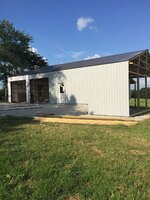
Hello - I am looking for some recommendations on how to vent my shop, I think I have an idea but would rather get some input on the best way to go about this. I built a 35 x 40 stud frame building with metal exterior, I had the walls spray foamed with 4" of open cell foam. The interior walls are covered with OSB and the ceiling has metal I used blown in cellulose insulation in the attic. The building is really tight there are no soffit vents and the ridge cap has foam between the metal and the cap. I have a lot of condensation issues in the spring and summer, located in Central Missouri with high humidity.

I was originally thinking about gable vents on each end, with one being powered do I need to also install a ceiling vent? What are my options to keep air moving and to help with the condensation issues? With the building having a ceiling in it do I need to look more into venting the interior rather than the attic? I like the idea of a powered gable vent as one end of the gables has an additional 12' 3 sided carport off of the building so the powered vent would be technically under roof so no issues with weather. I've included some photos of the carport for reference.

Looking for advice or recommendations on the best way to go about this. Thanks.
 

Attachments

  • IMG_7942.JPG
    IMG_7942.JPG
    395.4 KB · Views: 14
  • IMG_7968.JPG
    IMG_7968.JPG
    507.8 KB · Views: 14
  • IMG_7979.JPG
    IMG_7979.JPG
    523 KB · Views: 15
To avoid these ads, REGISTER NOW!
OP
M

minsab

New member
Joined
Apr 8, 2022
Messages
2
No vapor barrier under the slab and it just gets damp and musty in there if you leave it locked up once the weather starts warming up. There is a big temperature swing. Floor will sweat and there is noticeable moisture on some metal surfaces at times. Usually if I leave one of the windows in the shop open it will help but I'd like to add some type of ventilation. That's why I wasn't sure if venting the attic would help anything or not?
 

billconner

Well-known member
Joined
Jul 20, 2021
Messages
6,993
Location
Thousand Islands NYS
You have a giant source of moisture in the floor. A vent in one gable and fan exhausting out the other will probably solve moisture issues in bv attic plus keep it cooler below. I don't know how to seal a floor but we're it mine, I'd find out. An exhaust fan below or an attic fan to get rid of the moisture might help, basically pulling dryer exterior air.
 

ericm

Well-known member
Joined
Apr 17, 2016
Messages
1,963
Location
Southern Oregon
Venting lots of outside air in to the conditioned space will make your insulation kind of a waste. If it's well sealed, then venting the attic, while it's a good idea to get rid of heat, would not get rid of water in the conditioned space.

I'd look into running a dehumidifier or a mini split to remove water from the air. And coating the slab with something, if there is anything that works.
 
To avoid these ads, REGISTER NOW!

billconner

Well-known member
Joined
Jul 20, 2021
Messages
6,993
Location
Thousand Islands NYS
My quick look yielded mostly putting plastic on slab and a new floor on top. There are some epoxy coatings - Laticrete has one - that are claimed to provide a vapor barrier and stick. Seems there are a lot of problems with epoxy coatings failing from slab moisture too.

Unless you want to build up floor several inches, I think I'd look at the coatings.
 

ericm

Well-known member
Joined
Apr 17, 2016
Messages
1,963
Location
Southern Oregon
Whats the soil drainage like around the building? Does it have rain gutters? Even with good drainage and a low water table you can get moisture coming up though the concrete if there are no gutters and all that water just dumps right next to the building.
 

Showkey

"MEMBER EMERITUS"
Joined
Aug 9, 2014
Messages
8,638
Location
Wausau WI
There are dozen or more prior posts on the slab sweating with temperature changes.
Its a very common topic in spring when that cold slab is exposed to warm moist air.
Often if the building is not insulated the condensation will collect on the walls and ceiling and may actually rain inside the building.

It‘s usually NOT a vapor barrier under the slab issue. This warm moist often saturated air meeting any thing with a low temperature Condensation on the surface. Gallons of water will collect.

The slab is acting like a giant glass ice tea and the glass sweats when exposed to warm moist ( humid ) air.

The same ( condensation) will happen to cars, tools, machinery and any other items with mass.

Common solutions:

Warm the slab
control the temperature and moisture in the building with HVAC
control the air exchange ( better seal)
if the building seal is reasonably tight dehumidify the air to remove the moisture and keep it outside building.

If the door of the building are opened often…….there’s little chance of stopping the slab sweat.
As the slab warms the sweating will stop.

My attached garage slab sweats every spring.
My shop slab where the building is heated all winter and the seal is tight and the door is not open for long periods of time never sweats. The slab is still cool and the building doesn’t not need AC remains below75* but does need a dehumidifier from MAY to OCTOBER.
 

Builder Wayne

New member
Joined
Sep 22, 2023
Messages
1
Assuming proper insulation, building tightness, etc. perhaps the best single approach to sweating buildings wherever the condensation is occurring, would be to install a greenhouse type exhaust fan which responds to both heat and humidity levels, They can be purchased on amazon with a 110 volt cord for under a hundred dollars. A bit more as building size increases. This corded fan unit makes installation very easy, and cost effective. There is no silver bullet, as there are many variables which contribute to condensation, such as the climate in your area. An exhaust fan which senses heat and humidity is a great addition for every garage or barn type structure.
 

Fav Onefour

Well-known member
Joined
Jul 14, 2022
Messages
772
Location
MN cold and hot
The attic is outside of your conditioned space. Treat it that way. In fact, I'm concerned about condensation you can't see that is happening in the attic. Steel sheeting alone is not a vapor barrier. Might be worth poking your head up there to see if that's your source of musty smell.
I would separately treat inside and outside conditioned space. Passive ventilation in the attic works if it can vent and cross flow. The indoor space will take a little more work. Usually the indoor condensation only happens in extremes when surfaces are below dew point. You can manage the humidity inside or change the material surface temps. There are quite a few options depending on the direction you take.
 
To avoid these ads, REGISTER NOW!
Top Bottom