To avoid these ads, REGISTER NOW!

Metal ceiling in pole barn

Buckeye_Guy

Member
Joined
Jul 13, 2012
Messages
19
A few years ago I had a pole barn built. It is 40' X 40' with a 10' ceiling (10 feet from the concrete floor to the bottom of the trusses).

I ran wiring for lighting. But I don’t want to install the fixtures until a metal ceiling is installed on the bottom of the trusses.

There’s a lumber yard near me that sells metal ceilings for barns. My biggest problem is that I do not know the proper procedure for installation. So I am looking for guidance on how to install it.

Thanks
 
To avoid these ads, REGISTER NOW!

biggziff

Well-known member
Joined
Apr 9, 2015
Messages
623
Location
Upstate NY
A few years ago I had a pole barn built. It is 40' X 40' with a 10' ceiling (10 feet from the concrete floor to the bottom of the trusses).

I ran wiring for lighting. But I don’t want to install the fixtures until a metal ceiling is installed on the bottom of the trusses.

There’s a lumber yard near me that sells metal ceilings for barns. My biggest problem is that I do not know the proper procedure for installation. So I am looking for guidance on how to install it.

Thanks
Won't the lumber yard or manufacturer help you with that info?
 

OH_Varmntr

Well-known member
Joined
Apr 2, 2017
Messages
320
Location
Ohio
Are you from Ohio? Just guessing from your screen name.

If you follow this link there are some basic instructions that show overlap, what screws to use, where to install the screws, the number of screws needed, trims, etc...

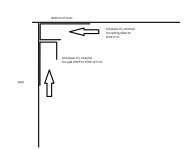
What it doesn't clearly point out, is what trim to install in the transition between the ceiling and the walls. There is a j-trim with frieze here that is a single trim that allows the ceiling steel to slide in it and the wall steel to as well. Or, if you're like me and didn't want to special order the trim, just use two pieces of j-channel.

Do you know your truss spacing? Depending upon truss spacing, you may need to go with thicker steel to span the trusses, especially if you intend on blowing insulation in the ceiling in the future.

There's kind of a lot to know before we can point you in the right direction.
 
OP
B

Buckeye_Guy

Member
Joined
Jul 13, 2012
Messages
19
Are you from Ohio? Just guessing from your screen name.
Yes. About 40 minutes north of Dayton.

If you follow this link there are some basic instructions that show overlap, what screws to use, where to install the screws, the number of screws needed, trims, etc...

Excellent! Thank you – I’ll check it out.

What it doesn't clearly point out, is what trim to install in the transition between the ceiling and the walls. There is a j-trim with frieze here that is a single trim that allows the ceiling steel to slide in it and the wall steel to as well. Or, if you're like me and didn't want to special order the trim, just use two pieces of j-channel.
Thanks. And this brings up another question: I eventually want to install interior walls (steel). Dumb question, but what is typically installed first? Is steel put up for the walls first, followed by the steel ceiling? Or is the steel ceiling installed first?

Do you know your truss spacing?
The trusses are 2 foot on center.

Thanks – really appreciate the feedback.
 

PeterT

Well-known member
Joined
Jul 31, 2011
Messages
1,476
Location
Toledo Ohio
I did my 50x100 shop ceiling with 36" w x 24' l panels. I had very few cuts, they overlapped by about 6" in the center. The only cuts I had to make were the last row, if you can avoid cutting.

I did my walls first, used 2x6 interior walls insulated between the pole barn 'pole's

I bought a $150 drywall lift and I couldn't of done it w/o that lift.
 

OH_Varmntr

Well-known member
Joined
Apr 2, 2017
Messages
320
Location
Ohio
If you order the j-trim with frieze it doesn't matter what you put up first. Actually it doesn't matter either way.

Here's how I did mine with all j-trim. If you check out the link in my signature, you'll see my ceiling is done but I haven't hung and on the walls yet.
 

Attachments

  • Untitled.jpg
    Untitled.jpg
    33.7 KB · Views: 251

Rc_Guy

Well-known member
Joined
Apr 14, 2013
Messages
4,437
Location
Minnesota
You have to add 2x4's every 2-3' between the trusses with joist hangers. Then I would just order the steel in 20' sections and the edge trim pieces and colored screws and put it up on ceiling.
 

4cyclic

Well-known member
Joined
Sep 30, 2013
Messages
104
Location
Grand Isle, Vt
You have to add 2x4's every 2-3' between the trusses with joist hangers. Then I would just order the steel in 20' sections and the edge trim pieces and colored screws and put it up on ceiling.

Add a drywall lift and you're good to go.
 

finn

Well-known member
Joined
Mar 27, 2005
Messages
16,227
Location
The UP, God's country
I ran 1”x4” purlins 90 degrees to the bottom of the trusses, and screwed the metal. I laid out my pattern to hit the truss bottom cord as well.

My truss spacing is 24”. You may need a heavier purlin if your spacing is greater than that.

I also premiered the lights. If I did it again, I’d surface mount conduit, or install the wire and at least use surface mount boxes.

Cutting the holes for the boxes was the hardest part.

Buy a cheap drywall lift to raise the panels.
 
Last edited:
To avoid these ads, REGISTER NOW!

sideways

Well-known member
Joined
Aug 21, 2010
Messages
77
Location
North Eastern Maryland
Hi Buckeye_Guy, adding my 2 cents here. I have a 30 x 50 pole barn and put up a metal ceiling using a lot of advice from many on this site. It was good advice. My trusses were 4’ apart and I had the manufacturer cut the lengths at 16’ 6”. I was able to run all the lengths and just overlap each length by just a few inches. This way, I didn’t have to buy more ceiling than I needed. You can also overlap the sides to keep from cutting long trims – unless you want to. The first thing I did was run lengths of 6 mil plastic perpendicular to the trusses. I used a good bit of duct tape sealing the seams. This provides a good moisture barrier when it’s hot and humid during the summers and prevents the ceiling from sweating. I thought about buying or renting a drywall lift to get the metal sheets in place but finally settled on constructing a crude, “T” shaped support my grandson used to hold up one end of the metal while I carried the other end up and screwed it to the bottom of the trusses using the matching, self-sealing screws provided by the manufacturer. I used “J” channel around the top of the walls which looked very nice and provided additional support to the ceiling. Then, my grandson dropped the insulation between the trusses directly on the top of the ceiling and rolled it out. Nothing fancy or difficult and All-in-all, I’m very happy with the way it turned out - mainly because I did it myself using good advice provided by other on this site and, help from my grandson. Just my 2 cents.
 
OP
B

Buckeye_Guy

Member
Joined
Jul 13, 2012
Messages
19
If you order the j-trim with frieze it doesn't matter what you put up first. Actually it doesn't matter either way.

Here's how I did mine with all j-trim. If you check out the link in my signature, you'll see my ceiling is done but I haven't hung and on the walls yet.
Thanks for the drawing! Makes more sense now.

I bought a $150 drywall lift and I couldn't of done it w/o that lift.
Good advice. Will do.

Look at my build thread too, for info. Link below. Also info on modifying the drywall lift.
Thanks – I am checking it out now.

Thanks for the advice, sideways. And this in particular caught my eye:
The first thing I did was run lengths of 6 mil plastic perpendicular to the trusses. I used a good bit of duct tape sealing the seams. This provides a good moisture barrier when it’s hot and humid during the summers and prevents the ceiling from sweating.
When they built my barn they installed a vapor barrier ("wrap") on the walls and roof. Is it still necessary for me to install plastic before installing the metal ceiling panels?
 

stm317

Well-known member
Joined
Aug 8, 2017
Messages
1,339
When they built my barn they installed a vapor barrier ("wrap") on the walls and roof. Is it still necessary for me to install plastic before installing the metal ceiling panels?

Was it plastic sheeting, or a woven Tyvek/Housewrap kind of material? Tyvek is a moisture barrier, but not a vapor barrier. It's semi-permeable. In colder climates, you usually want a moisture barrier on the outside, insulation in the middle, and a vapor barrier on the inside.

Vapor barrier can be plastic "Visqueen" sheeting, or it can be the paper kraft facing on traditional fiberglass insulation batts. Certain types of foam insulation can act as a vapor barrier too.
 
Last edited:

NUTTSGT

Super Moderator
Staff member
Joined
Sep 14, 2009
Messages
50,907
Location
Northern Central Ohio
Yes. About 40 minutes north of Dayton.

You might want to add a location to your profile as you will probably get asked that question again in the future. Simply putting Southwest Ohio will help you get better advice from your fellow members.


OH_Varmntr has given you some good advice as have other members. A drywall lift is a great piece of equipment to assist with hanging the sheets. One thing I'll recommend, if you don't already have an impact driver, now is the time to get one.
 

stm317

Well-known member
Joined
Aug 8, 2017
Messages
1,339
It is not regular plastic - it is some kind of woven material. They called it a "wrap."

Sounds like Housewrap, which is a moisture barrier. It's a good thing that it's there. It's also a good idea to have some type of vapor barrier in place between the metal and insulation. Not having some sort of vapor barrier on the conditioned side of the insulation can create moisture issues within your wall/ceiling. This is somewhat dependent on the type of insulation you use, as well as the type of venting in your attic (if any).
 
Last edited:

Rc_Guy

Well-known member
Joined
Apr 14, 2013
Messages
4,437
Location
Minnesota
Thank you.

It seems people need to read all of the available information in the thread.

He’s already said his trusses are 24” centers. My pole barn is 24” as well.

Why would you want to take the time and read the OP question and the replys? Easier to just answer with what ever ya want!

Easier, indeed! Also a great way to muck up a thread!

Not everyone is a perfect as you guys but when I asked about the trusses I clicked the button on this thread that is supposed to continue where I last read the thread, obviously it didn't and I missed a few post's. I'll try to be perfect like you guys.

I do find it odd though that the trusses are 2' on center, around here they are 8' on center.
 

OH_Varmntr

Well-known member
Joined
Apr 2, 2017
Messages
320
Location
Ohio
Not everyone is a perfect as you guys but when I asked about the trusses I clicked the button on this thread that is supposed to continue where I last read the thread, obviously it didn't and I missed a few post's. I'll try to be perfect like you guys.

I do find it odd though that the trusses are 2' on center, around here they are 8' on center.

Well you don't have to get all sardonic on us now :beer:

Truss spacing depends on a lot of things. As long as the rest of the structure can withstand the forces, they can be a lot further apart than 8' as well.

I chose 4' on my building since I knew it would be easier to finish the interior using those spans than it would be using 8' spans. I could have done 16' spacing too, it just means everything else needs to be stronger (more expensive!) to be able to withstand those spans.
 

sideways

Well-known member
Joined
Aug 21, 2010
Messages
77
Location
North Eastern Maryland
Well, Buckeye_Guy, I"ll have to defer to someone on the site who is more experienced than I am for this question. I'm not sure if bthe vapor barrier was placed between your joists actual roofing material or whether you will run into a similar problem if you put up a ceiling underneath with insulation on top of that. I recall someone on the site advising me that it's much easier and less time consuming to add a barrier when you are in the process of finishing out your shop, rather than "wishing" you had taken the extra time later on. My walls were not wrapped, nor was my roof and when I thought I might have a better idea....I heeded their advice and, I'm glad I did. Having your walls and roof wrapped should be a big help.
 

Dick in Wisconsin

Well-known member
Joined
Mar 3, 2012
Messages
3,048
Location
Shawano, Wisconsin
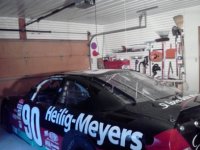
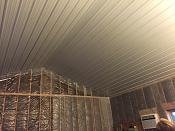
We did a similar thing in the attached garage and the in the detached race shop.

In the attached garage, we used the middle thickness of the Menards steel roofing (heavy!).

For the race shop, we put up a heavy poly as a vapor barrier and then used the lightest weight Menards steel roofing. Had it cut to length (1" increments). Trusses are 24" on center. Contractor used the white self-tapping hex head screws off the shelf at Menards on every other truss (i.e. ever 48"). Insulation was blown in above that.

Worked great!
 

Attachments

  • Aft-CeilingWall#90-comp.jpg
    Aft-CeilingWall#90-comp.jpg
    66.8 KB · Views: 125
  • GarageCeiling_PeakFin.jpg
    GarageCeiling_PeakFin.jpg
    5.5 KB · Views: 226
  • GarageCeilingFlat.jpg
    GarageCeilingFlat.jpg
    7 KB · Views: 253

finn

Well-known member
Joined
Mar 27, 2005
Messages
16,227
Location
The UP, God's country
There's no need for any extra framing to hang the steel on if his trusses are 24" OC.

The reason I ran the 1x4 90 degrees to the trusses is so I could pre drill holes for the screws and not worry about missing the narrow bottom cord of the truss.

I hung the metal ceiling alone and didn’t want to be locating screws while on a ladder and holding the steel in place.
 
To avoid these ads, REGISTER NOW!
Top Bottom