To avoid these ads, REGISTER NOW!

Metal Lathe. Looking for advice.

HemiRambler

Well-known member
Joined
Apr 20, 2010
Messages
270
Location
Cleveland, Ohio
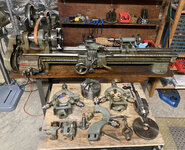
My buddy ran a lathe his entire career, 6 months before retirement - he lost a finger running one. Point being no matter how experienced you are - you can't let your guard down for a single second. Having dispensed that warning...you are effectively saying "I've never driven a car before...which one should I get?" It's a bit of a loaded question. I work on cars, and some race cars - to give you an idea of my typical projects. I would NOT consider anything much smaller than a 12X36 - and bigger IF you have the room (think of it as a 70's Nova - sure you could get a Yugo and it'd take you to the corner just as well, but won't pull that trailer very well either) really depends on your goals. I'd also AVOID flat belt machines because they typically wont have the speed to run carbide tooling very well - which generally means getting something made in the 60's or later. You definitely want the ability to cut threads. Personally I can't stand the sum-flung-dung stuff but depending on your location you might not have a choice. Regardless of what you get - these are DANGEROUS - they can certainly be operated safely with TRAINING. If you have a local community college around - you might do well to see if they offer any machining classes. They will get you started off in a direction prone to keep all your fingers. (Just watched a video of a "self taught" lathe operator yesterday - his "being careful" was basically a horrible accident looking for a place to happen- and he didn't respond very well to those that tried to offer him some guidance. Don't make THAT mistake. I just moved a 12X36 from a basement - it was a 1,200lb. machine that the original owner had passed away - that is a GOLD mine for a home guy trying to get a decent machine! Be patient, let your buddies know, talk to the local machine shop - they might have some good advice for you too! Bets of luck in your search - it is definitely worth the effort in time and money to let you look at fixing things in an entirely different light. Here's a bending die I made on the lathe for a tube bender. Fun project!
 

Attachments

  • bend12.jpg
    bend12.jpg
    95.8 KB · Views: 70
  • bend8.jpg
    bend8.jpg
    52.1 KB · Views: 63
Last edited:
To avoid these ads, REGISTER NOW!

jmarkwolf

Well-known member
Joined
Jan 15, 2013
Messages
1,813
Location
Southeast Michigan
You don’t need to get it perfect the first time.
Try to find something that is a package deal, that includes tooling so you can start using it right away.
Once you have a machine and start using it, it will be much easier to understand what you really need. If you shopped smart, you can recover your initial costs when you sell the first machine to buy what you now know suits your needs.

Daveco puts it very well.
 
OP
I

iSpark

Well-known member
Joined
Sep 12, 2015
Messages
283
Location
Coastal SC
Thanks for all the replies and advice.
I'll most likely end up buying new with assorted tooling.
Looking at a Grizzly G9972Z or something close to that.
 

Aaron_W

Well-known member
Joined
Feb 6, 2018
Messages
2,907
Location
Northern California
Thanks for all the replies and advice.
I'll most likely end up buying new with assorted tooling.
Looking at a Grizzly G9972Z or something close to that.

My "big" lathe is a 1970s USA made 11x24" lathe, I think it is a nice size for general purpose work. While it doesn't seem like it would make a difference, 11" lathes are often substantially beefier than 10" lathes.


Something to consider with any of the import lathes smaller than a 12" swing, none of them have a full quick change gear box. You will need to physically swap out gears to cut threads. Of course part of that is that this lathe is still only 1/2 the price of the cheapest Grizzly 12x36.

I'm not familiar with this particular lathe, but looking at the specs it looks like it is basically the same as their 10x22 but a little bigger and heavier.
 

Downwindtracker 2

Well-known member
Joined
Jun 13, 2019
Messages
1,715
Location
BC
The 10 x22 lathe was a copy of the Austrian Maximat 8" . It is a better lathe the Austrian, it has metal gears, instead of plastic. If you want to cut threads on a lathe, you want 60 rpm or less. To get that out of our 10x22, Lathemaster (no longer in business) sold a planetary sheave that cut the speed in half.
 
OP
I

iSpark

Well-known member
Joined
Sep 12, 2015
Messages
283
Location
Coastal SC
I looked at the Precision Matthews lathes, they look good. I'm not sure about the DC motors though.
Would a DC motor be something to avoid?
 

Downwindtracker 2

Well-known member
Joined
Jun 13, 2019
Messages
1,715
Location
BC
When they mention changing out gears there are two types here. Most often when the old books talk about change gears, they mean a change in the gear train. The more modern lathes have the open on the bottom "Norton" quick change gear stack. But to change to metric the input shaft gearing is changed. My generic Taiwanese is like that. The more modern lathes have both the speed and the threading shaft controlled by a enclosed gearbox.
 

dutchgray

Well-known member
Joined
Sep 28, 2014
Messages
6,467
Location
Dorset. England.
When they mention changing out gears there are two types here. Most often when the old books talk about change gears, they mean a change in the gear train. The more modern lathes have the open on the bottom "Norton" quick change gear stack. But to change to metric the input shaft gearing is changed. My generic Taiwanese is like that. The more modern lathes have both the speed and the threading shaft controlled by a enclosed gearbox.

If you're really lucky you might find a lathe with the metric/imperial transition gear set built into the gearbox so its all on levers, like the one I have.

If you're really lucky youl have a Hardinge which was pretty much designed to make single point threading as easy as possible.
 
To avoid these ads, REGISTER NOW!

brownbagg

Well-known member
Joined
Mar 20, 2006
Messages
5,208
i have an atlas for over 30 years. all i ever done was build a wooded concrete truck for xmas toy
 

Aaron_W

Well-known member
Joined
Feb 6, 2018
Messages
2,907
Location
Northern California
I looked at the Precision Matthews lathes, they look good. I'm not sure about the DC motors though.
Would a DC motor be something to avoid?

The PM lathes are well regarded, but you are getting into a lot more money.

Once you get over $2000 unless you know you want a smaller lathe (10x22) I would start thinking about spending the $3000+ for a 12" with a quick change gear box. The PM 1228 is a decent smallish lathe that does have a QCGB. Not only are the PM lathes a little higher quality, you get quite a bit of tooling with them. Tooling is not cheap so definitely look at everything that comes with the lathe when making comparisons.

Your budget might be different from mine, but at the $2000+ range I'd want to be pretty sure I was going to be happy with the lathe I bought for quite some time.

Location matter for used machine tools, but $2000 is a very nice budget for vintage machines. Of course this gets back to what is available and do you have the skills to tell the good from the bad.

The PM 10" lathe has a power feed on the cross slide as well as the lead screw, many of these smaller lathes only have power feed on the lead screw.

If you have the space and the budget and want to get past all of this, most people would probably be quite satisfied with a PM 1236, 1236T or 1340.
 
Last edited:

Downwindtracker 2

Well-known member
Joined
Jun 13, 2019
Messages
1,715
Location
BC
Tooling isn't that bad for a lathe. Just going off the top of my head :

3 jaw chuck, comes with all new lathes
4 independent jaw chuck, come with most new lathes
Drill chuck, comes with most new lathes
4 station tool post, comes with all new lathes
Tailstock center, comes with all new lathes

And here are the things we bought for the 10x22
Quick change tool post
faceplate
Fellow rest , 2 supports bearing
center rest,3 support bearings
chip pan
cabinet
1/2 speed sheave

The only ones on this list that I think are really important are the cabinet and chip pan.

You should have set of mics, the 0-4" Chinese copies of Etalon that my son bought, he was satisficed with them, even using them at work. A 6" electronic caliper are handy for rough measurement. Drill bits, center drill bits and tool bits. Shars is place to get cheap Chinese.
 

BFBOB

Well-known member
Joined
Sep 20, 2011
Messages
5,073
I started with a Taiwan 9x18, mostly because I got it essentially free - bought two damaged/returned units from local distributor, fixed them both, sold one for what I'd paid.
That was in 1985, and I still have it and use it. Every time I get to wishing for a bigger/better lathe I look around and reailize I have NO room for it. Also, it was all I could do to get the current one down the stairs into the shop even after disassembling it to the max.
Consider the practical considerations!
 

c7z06

Well-known member
Joined
Nov 4, 2020
Messages
125
Location
Edgewater, MD
I posted this in another forum, but thought it might be useful here.

In a previous life, I bought and sold used machinery out of a ship container to make a few extra $. I kept the stuff I liked most, at least for a time. During that period, I owned both Clausing and Rockwell 12" x 36" lathes, and preferred the Clausing. Both of them were perhaps 60's or early '70s vintage. I also owned early Logan and Powermatic lathes of similar size and liked both. I owned a number of South Bend lathes up to 10L in size. I never came across or acquired any imports at that time.

The Clausing I owned had hardened and ground ways. While the ways on all of mine were in good shape, I managed to inspect dozens of others that were not. The most frequently found flaws aside from missing or damaged gears and/or bearings were:

The hardened and ground ways would have chunks missing from chucks and heavy stock having fallen on them. Non-hardened ways would have dents around the headstock area, and worn areas from the headstock out to a foot or more. You could catch your fingernails on the ridges.

Lead screws had thinned thread areas mostly from about 6" from the headstock out to a couple of feet or more.

Substantial run-out in the spindle, or a seized spindle (particularly in early South Bends with the spindle running directly on cast iron)

Worn or mis-sized tailstocks with shims under them

Rough or damaged cross-slide or compound slide ways

Tooling that doesn't fit the lathe

For all that is good about vintage American made machinery, buying it is very much a shot in the dark. Even if you get to inspect it, you have to know what to look for. Not withstanding all that, if you can find a good piece, or if you have the skill and patience to rebuild one, it is a joy to own.
 

Attachments

  • South Bend 9A.jpg
    South Bend 9A.jpg
    649.5 KB · Views: 27

JackOfDiamonds

Well-known member
Joined
Jul 31, 2020
Messages
706
Location
Idaho (USA)
I have had 2 Grizzly G4003-type lathes which is use relatively heavily. One Grizzly and one Taiwanese version of the same thing. The non-grizzly was slightly better but the grizzly is fine. I was able to buy replacement gears and other parts from grizzly which made me happy and there are decent user groups for these and other similar import lathes.

I think the south bend and other small American lathes commonly recommended are overrated. They are have slow spindles, likely to be worn out and hard to get parts for, lack metric settings and other modern features, and aren't quite big enough. The import lathes are good enough that you actually have something to start with and you can add a VFD or upgraded stand, DRO etc and not be wasting your time.

I had a mini lathe but I might as well have lit $1000 on fire for all the good it did me.
 
To avoid these ads, REGISTER NOW!
Top Bottom