To avoid these ads, REGISTER NOW!

Metal or Plastic for back-boxes?

Steevo

Well-known member
Joined
Aug 18, 2009
Messages
8,738
Location
43.49600, -112.04300
If you are wiring a new-construction garage/shop from scratch, would you use metal boxes for receptacles, or would you go with plastic ones?

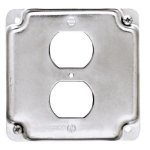
I don't mind using plastic ones for the light switches, since these don't take much wear and tear, but the outlets that are going to be along the wall above my workbenches seem like they would be more robust if I used metal quad boxes with metal covers to hold the receptacles. My thinking is that pushing in and pulling out plugs and tripping over cords tends to exert stress on the box that the receptacle is screwed into. Given the volatile environment above a workbench, or on a garage wall, it seems to me that using metal like the pictures below would be sturdier and longer-lasting.

In my case, they will be nailed/screwed to wood studs and will have sheet rock on the walls.
Tell me why you would or would not use plastic or metal.
 

Attachments

  • quadbox.jpg
    quadbox.jpg
    8.3 KB · Views: 26
  • duplexcover.jpg
    duplexcover.jpg
    9.2 KB · Views: 25
Last edited:
To avoid these ads, REGISTER NOW!

Aceman

Well-known member
Joined
Jan 28, 2007
Messages
2,513
Location
Eastern Oregon
I really don't think it makes a difference myself. Yeah, the plastic can strip out if you're not careful but that device screw is threading into about a 1/2" or so of plastic. That metal box only has 1/16" of threads holding the device screw.

FYI, that industrial raised duplex cover you're showing is for exposed boxes. You're looking for a mud ring or plaster ring. They come in different thicknesses, I usually like to go 1/8" thicker than the drywall thickness to get the mud ring flush with the surface. 1/2" drywall=5/8" mud ring.

I forget to mention, 4 square bracket boxes have the added bonus of more wiring room. So if you're leaning towards metal boxes anyhow.....
 

-JP

Well-known member
Joined
Apr 22, 2008
Messages
118
Location
Racing Capitol of the World
In an effort to make sure we are all on the same page...I believe what you are asking about is actually the device "cover plate", not the back box.

The photos show a metal back box on the left and as Aceman pointed out, the 4-square cover shown on the right photo is for exposed installation.

If indeed you are debating plastic (nylon) cover plates versus metal, I can only say the nylon type are pretty much indestructable if you purchase a name brand and are very inexpensive to replace if they do get scratched.
 
OP
S

Steevo

Well-known member
Joined
Aug 18, 2009
Messages
8,738
Location
43.49600, -112.04300
I was actually talking about the back box, behind the sheetrock.
For the covers, it would be nice to be able to find something as indestructible as the steel covers used for exposed installations.
 

-JP

Well-known member
Joined
Apr 22, 2008
Messages
118
Location
Racing Capitol of the World
Now that we are clear on your question...I would suggest using the Phenolic type of back box when using NM type cable (romex) wiring methods.

The metal boxes are more expensive and usually not needed for residential applications.

The plastic boxes are JUNK. They are way to flexible, will melt and/or burn, and the "threads" for your device screw are actually a thin blade of steel that strips easy. They also have cable openings with a plastic flap to apply pressure to the cable and they don't work at all but do a great job of getting in the way.

Phenolic boxes (sometimes called "union" boxes) are very heavy duty with thick walls that will not flex or break unless you hit them hard with a hammer. They are basically fireproof and will not melt. The threads run deep into the box for the entire length of the box. Phenolic boxes cost more than the plastic but less than the metal boxes.

Bottom line is as always, you get what you pay for.
 

marty_p

Well-known member
Joined
Aug 1, 2008
Messages
1,411
Location
SE LoUiSiAna
RE:

...And you'll save time with JP's very durable suggestion, in that the metal boxes require the extra step of grounding! :)
 

Gary S

Well-known member
Joined
Dec 27, 2008
Messages
2,972
Location
Bismarck, ND
I prefer plastic. I did my entire garage a few years ago, and I used all plastic. Here is my reasoning. Wire nuts have a bad habit of eventually causing bad connections when they "let go". Once in a great while, the wire that is "let go" pulls out and touches the box. If it touches a plastic box, you have a dead circuit. You get to find the bad connection and fix it. If it touches a metal box, you either trip a breaker with sparks or you end up with a "hot box". I've been in the electrical business for over 40 years, and I have touched enough "hot boxes", shorted electrical devices, and other places I should have never put my hands. I don't need any more of that excitement in my life.
 

walrus

Well-known member
Joined
Nov 12, 2008
Messages
11,682
Location
Maine
I prefer plastic. I did my entire garage a few years ago, and I used all plastic. Here is my reasoning. Wire nuts have a bad habit of eventually causing bad connections when they "let go". Once in a great while, the wire that is "let go" pulls out and touches the box. If it touches a plastic box, you have a dead circuit. You get to find the bad connection and fix it. If it touches a metal box, you either trip a breaker with sparks or you end up with a "hot box". I've been in the electrical business for over 40 years, and I have touched enough "hot boxes", shorted electrical devices, and other places I should have never put my hands. I don't need any more of that excitement in my life.

Not sure how you have a hot box if its bonded correctly
 

Gary S

Well-known member
Joined
Dec 27, 2008
Messages
2,972
Location
Bismarck, ND
Not sure how you have a hot box if its bonded correctly

You won't have a hot box if it was bonded correctly, but I"ve worked on a lot of wiring over the years that wasn't done correctly the first time. Each time I stumble onto someone else's mess that wasn't done right, I get surprises I don't like.
My preference is still for plastic because I get fewer of those shocking surprises from plastic than I do from metal.
 

HoosierBuddy

Well-known member
Joined
May 9, 2006
Messages
2,931
Location
Southern Indiana
Not to trying to jack the thread...but by "bonding"...do you mean the ground wire to a metal box should be grounded to the box and the grounding lug on the device in the box?

Just curious.

I've got an old house with plaster walls and noted the electrician that rewired my upstairs (replacing the original knob and tube) would often (or maybe always) wrap the ground wire around one of the clamping screws inside the metal work boxes.

If I recall correctly, he'd then take the end of the ground clip it to the green lug on the recepticals. Is that what code requires?

Phil
 
To avoid these ads, REGISTER NOW!

walrus

Well-known member
Joined
Nov 12, 2008
Messages
11,682
Location
Maine
Not to trying to jack the thread...but by "bonding"...do you mean the ground wire to a metal box should be grounded to the box and the grounding lug on the device in the box?

Just curious.

I've got an old house with plaster walls and noted the electrician that rewired my upstairs (replacing the original knob and tube) would often (or maybe always) wrap the ground wire around one of the clamping screws inside the metal work boxes.

If I recall correctly, he'd then take the end of the ground clip it to the green lug on the recepticals. Is that what code requires?

Phil
Using the cable clamp screw to bond a box would be ok if the clamp wasn't being used to clamp a wire in the box, otherwise I'd say its shaky at best. Not sure if it'd be tight enough, thereby not a good conductive path to the box. I'm sure some will say its not made to be a ground but if the clamp is gone, its fine for grounding if you ask me.
 

tdkkart

Well-known member
Joined
Jun 17, 2006
Messages
6,887
Location
Eastern Iowa
Wire nuts have a bad habit of eventually causing bad connections when they "let go".


So you're saying that based on your 40 years experience wire nuts are not a very good solution, and that they can cause many problems??

Hmmm, maybe I have been right at least twice in my life??

I HATE wire nuts, and consider them a piss-poor engineer's *********.
 

walrus

Well-known member
Joined
Nov 12, 2008
Messages
11,682
Location
Maine
I've never seen one "let go" so I'd be curious what you'd use in their place.

I never seen a properly applied one let go, for a piss-poor invention there must be billions of them in the field not failing, hmmm, seems like a decent invention to me
 

tfi racing

Well-known member
Joined
Apr 19, 2008
Messages
2,907
Location
Cedar,BC
Wire nuts have a bad habit of eventually causing bad connections when they "let go". /QUOTE]

Its not the wire nut's "bad habit"!It is a case of the user's incompetence,a correctly sized and properly installed wire nut or marrette as we call them up here will not "let go" all by itself.

My preference is for metal boxes,more of a personal bias than anything else.I have tried plastic boxes and I just don't like them.
 

Coach James

Well-known member
Joined
Jun 24, 2005
Messages
8,933
Location
Sandhills of North Carolina
I'm not a pro and don't question the judgement of pros, but I hate plastic boxes. I have been replacing switches and receptacles in my building and one of the problems has been plastic boxes with the holes for attaching devices stripped out or the boxes warped. Some are the blue plastic and some are a grey color that feels even flimsier than the blue ones.

I'm going to look up phenolic boxes. Thanks jp

Coach
 

-JP

Well-known member
Joined
Apr 22, 2008
Messages
118
Location
Racing Capitol of the World
Your welcome Coach.

Plastic boxes meet code requirements but they are junk.

Whenever I step onto a jobsite and see plastic boxes I know I am dealing with an "Electrician" who is either inexperienced, low-budget, low quality, or sometimes all of the above. It is a big red flag that there are usually other problems with the electrical installation.

Phenolic boxes are the most economical choice with an acceptable level of quality for all residential and even some "Light" commercial projects. But hey, if you want to spend the extra money and take the extra time to put in metal boxes you can't do any better. Just make sure you bond that metal box so that Gary won't get shocked! :shocking:
 

bluesman2a

Well-known member
Joined
Aug 16, 2005
Messages
1,312
Location
Atlanta, Ga.
I HATE the feeling of those flimsy boxes. I also prefer NOT to spend the extra $$'s and time fooling with metal.

Not sure if they are phenolic or not, but I have had good luck with the Carlon brand Super Blue boxes. They are much thicker than the standard plastic box. I also get them in the DEEPer models so it's not quite such a squeeze to get things in.

Now I do like a good solid plate up front, I found these at either Depot or Lowes very cheap (like $.99 each) and in conjunction with the thicker Super Blue boxes makes for rock solid plugs. Plus the galvanized look goes well with what I plan on doing for the wainscotting.

DSCF0503.jpg
 

gc427

Well-known member
Joined
Aug 7, 2009
Messages
263
Location
Glendale, AZ
Your welcome Coach.

Plastic boxes meet code requirements but they are junk.

Whenever I step onto a jobsite and see plastic boxes I know I am dealing with an "Electrician" who is either inexperienced, low-budget, low quality, or sometimes all of the above. It is a big red flag that there are usually other problems with the electrical installation.

Phenolic boxes are the most economical choice with an acceptable level of quality for all residential and even some "Light" commercial projects. But hey, if you want to spend the extra money and take the extra time to put in metal boxes you can't do any better. Just make sure you bond that metal box so that Gary won't get shocked! :shocking:

Well spoken! :thumbup:

Spend a few extra dollars and go the extra mile with metal components. You will be glad you did later.

Plastic and phenolic components are usually priced cheaper for a reason. They are generally not a durable. Plastic does not last as long as metal.
 

kbs2244

Well-known member
Joined
Nov 11, 2006
Messages
14,065
If I am installing a box that I suspect will see hard usage I build a wooden plate behind it.
A couple of 1x2s along the back edge of the studs and then a piece of ½ ply bridging them.
Then you can screw not only to the stud at the side of the box but also through the back of the box into the ply.

Real sturdy.

This means I am stuck with 1 1/2 inch deep boxes, which I don’t like, but I don’t have to worry about the box ever coming loose and wiggling around behind the drywall.

Oh, and I have never used plastic boxs.
I just don't trust them.
 
Last edited:
To avoid these ads, REGISTER NOW!
Top Bottom