To avoid these ads, REGISTER NOW!

Metal roofing panels for walls

Murrdog

Active member
Joined
Jan 31, 2020
Messages
37
Location
Lincoln Nebraska
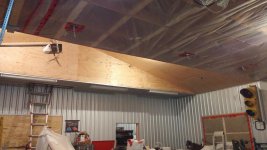
Been searching for information about people using metal panels for interior wall and or ceiling covering. Curious how this works out? Is it possible to hang items from the panels like OSB? How’s the insulation behind work out?

Love to see pictures or ideas. I’ve used OSB in my attached garage and really didn’t like painting it and the seams are kinda a distraction. Thanks in advanced guys!
 
To avoid these ads, REGISTER NOW!

Bert_

Well-known member
Joined
Dec 24, 2016
Messages
9,753
Location
NW Iowa
It's pretty common. If you want to hang stuff you just do it from the girts. paint can tend to get scratched if you lean a lot of metal things against your wall.
 
OP
M

Murrdog

Active member
Joined
Jan 31, 2020
Messages
37
Location
Lincoln Nebraska
It's pretty common. If you want to hang stuff you just do it from the girts. paint can tend to get scratched if you lean a lot of metal things against your wall.

I never considered having to add girts... I'm doing a stick build. That would add a bit of complexity to the install. For some reason I was thinking that I could just screw to the 2x6 horizontally.

I really like the thought of the ceiling since it will be cathedral scissor truss 4/12 inside with 16'8" peak. Not really excited about hanging or painting OSB that high up.
 

rusty1

Well-known member
Joined
Feb 6, 2009
Messages
518
Location
No. Illinois
2x6 studs aren't usually laid out for metal panels,..you could possibly lay them out to do this but the panels would not be as solid/stable.
...lay out your horizontal nailers so you can hang stuff up on the secure nailers,

..you could run the metal horizontally on your studs..
 

stm317

Well-known member
Joined
Aug 8, 2017
Messages
1,339
Typically called "liner panel", it's a thinner gauge metal than exterior stuff.

I like it for a ceiling, where the gloss finish can reflect lots of light, but I'm not sure about using it for walls. I know that it's done a lot, but the ribs can make it difficult to hang shelves, cabinets, etc. And if you have free standing shelves or cabinets, the ribs mean that you end up with a gap on the back where things will inevitably get stuck/lost.

It's usually installed vertically, which would be tough to do with traditional spacing of stick built framing and no girts. You could install it horizontally and not use girts, but the ribs are likely to catch dust and dirt if you do that. It either ends up looking dirty, or creating more work for yourself if you have to clean your walls frequently.
 
Last edited:

Bert_

Well-known member
Joined
Dec 24, 2016
Messages
9,753
Location
NW Iowa
I've seen a few guys hang it horizontal. Not nearly as common as vertical. Even on a stick build most run horizontal strapping over the studs then the tin vertical.
 
OP
M

Murrdog

Active member
Joined
Jan 31, 2020
Messages
37
Location
Lincoln Nebraska
So, On the ceiling hows the panel hold up to insulation weight? not sure the weight or R value of mine but its a 6/12 exterior and 4/12 interior truss setup. so i assume it will basically be filled. Just dont like the thought of panels bowing or sagging in the future.
 

Bert_

Well-known member
Joined
Dec 24, 2016
Messages
9,753
Location
NW Iowa
So, On the ceiling hows the panel hold up to insulation weight? not sure the weight or R value of mine but its a 6/12 exterior and 4/12 interior truss setup. so i assume it will basically be filled. Just dont like the thought of panels bowing or sagging in the future.

What's the spacing on your trusses? The common panels can usually span 4' with insulation on top. Panels with deeper ribs can go further.
 
To avoid these ads, REGISTER NOW!

ard

Well-known member
Joined
Feb 16, 2015
Messages
4,391
Location
Sierra Foothills... California
Keep in mind that classic construction includes features that act to control the movement of air and moisture/vapor.

They may not have arrows on them saying “this is a vapor barrier”...and it may not be a specific item, like ‘this layer is the vapor barrier;.

Take Sheetrock, joint compound/tape and paint: THIS is a air/vapor barrier., it keeps moist warm air that is in the roof, inside the room. If this air leaks into the wall cavity and hits the inside of the outer wall, it can condense and leave water in the wall.

So... recognize that sheet metal panels (unless somehow you are sealing every joint, lap and but w caulk or gasket) are not a vapor barrier.

HTH
 

Innovate1

Well-known member
Joined
Jul 28, 2014
Messages
4,289
Location
Illinois near St. Louis, Missouri
I am considering this for my 14' high ceiling. Material is more but no taping, mudding, or painting. Thinking this is an overall cost savings. Conventional construction with trusses on 2' centers so no issue with sag.

My main concern is the air sealing. Out in the middle where the panels overlap I think it will be good. Not quite like drywall but very close. But on the edges with the ridges it will be difficult. Have access to a 4 x 8 CNC router (once the virus restrictions are over) so could cut a strip that fits the panel and use a bit of caulk. Could also make a template and use a guide bushing.

Then there are the outlets for lights. Need to keep them in the valleys which could be difficult. I suppose I could just hang them close to location and place them after the tin is up. No way I want to do all the wiring after the tin is up.

Adding stuff will be more difficult. At this point I am leaning toward drywall.
 

homebuilt burner

Well-known member
Joined
Dec 8, 2014
Messages
1,763
Location
central Wisconsin
In my father's shop there is 3/4" plywood up the first 8 feet, then metal panel above that. The ceiling metal hangs on the trusses 4 feet apart, blown-in cellulose on top of that.

My woodshop is drywall with metal panels screwed to the bottom of the trusses for a ceiling. So metal panel, vapor barrier, and then 16" of blown-in cellulose. Trusses are spaced 24" on center.
 

Firebrick43

Well-known member
Joined
May 12, 2015
Messages
14,109
Location
West central Indiana
I am considering this for my 14' high ceiling. Material is more but no taping, mudding, or painting. Thinking this is an overall cost savings. Conventional construction with trusses on 2' centers so no issue with sag.

My main concern is the air sealing. Out in the middle where the panels overlap I think it will be good. Not quite like drywall but very close. But on the edges with the ridges it will be difficult. Have access to a 4 x 8 CNC router (once the virus restrictions are over) so could cut a strip that fits the panel and use a bit of caulk. Could also make a template and use a guide bushing.

Then there are the outlets for lights. Need to keep them in the valleys which could be difficult. I suppose I could just hang them close to location and place them after the tin is up. No way I want to do all the wiring after the tin is up.

Adding stuff will be more difficult. At this point I am leaning toward drywall.

Just put up visqueen before the panels and bring it down over the wall some distance. Remember to tape seams and penetrations such as light boxes.
 

harley jim

Well-known member
Joined
Dec 6, 2013
Messages
11,415
Location
Cleveland Tn..........out in the sticks
My neighbor did this in his new shop. It is stick built and he put two rows of nailers in between the studs insulated with unfaced insulation and covered it with a thin plastic, much thinner than visqueen. He did the ceiling and walls with standard white metal then surface mounted the electric with extra conduit clamps and uses it to hang tool from. He mounted cabinets to the wall. It's very clean and bright.

Sent from my SM-A102U using Tapatalk
 

Showkey

"MEMBER EMERITUS"
Joined
Aug 9, 2014
Messages
8,638
Location
Wausau WI
My shop that someone else built .........has metal siding on the inside, hung vertical, attached to horizontal strapping.
Easy to clean, durable, bright..........would do again.
Wish they would have done the ceiling in metal, they drywall did the ceiling.

Side bar: Metal siding makes WiFi from the outside more difficult.
 

R6 Racer

Well-known member
Joined
Feb 21, 2010
Messages
1,632
Location
Northern Ontario Canada
Mine is steel interior walls & ceiling.
Walls are 2 x 4 construction then strapped horizontally with 2 x 4 on their side. The walls were insulated (vertically) before the "strapping" went on. Then insulated again horizontally between the strapping. The wall steel went on vertically. The ceiling trusses were blocked every 2 feet (as were the walls) Then vapor barrier went up then the steel. Blown in insulation was installed in the attic 18" deep.

As for attaching stuff, i'm in the process of shelving a 12' x 6' area. The strapping is super solid so it's getting used.
I strapped the wall vertically with straps between the steels ridges. I have a vert strap every 4' that's attached to the strapping in the walls every 2'. Meaning the shelves have 12 attachment points.
The down side is that I needed to back the shelves with 1/4" plywood so I didn't have stuff falling off the back of the shelves.

In 1 pic you can see the vert steel on the walls & the blocking that is between the ceiling trusses. The other 2 pics show the walls at different stages.

Something I realized well after the fact, was that I turned my whole shop into a huge faraday cage.

I hope that all makes sense.


Steve
 

Attachments

  • 20180127_172721.jpg
    20180127_172721.jpg
    133.7 KB · Views: 67
  • 289.jpg
    289.jpg
    124.4 KB · Views: 64
  • 20160309_184900.jpg
    20160309_184900.jpg
    95.6 KB · Views: 58
To avoid these ads, REGISTER NOW!
Top Bottom