To avoid these ads, REGISTER NOW!

Metallurgy

mjoekingz28

Well-known member
Joined
Jun 20, 2011
Messages
717
Location
Mississippi
What are some ways to check your metals?

A few I know of is to see if a magnet is attracted to the metal.

If it is unpainted you can examine its texture and color.

You can thump it with a fingernail or a key.


Any other ways to 'examine' a metal?

Or does it really come down to the chemists, mixers, and blacksmiths who make it and therefore it is all a **** shoot and just plain guessing what you have?
 
To avoid these ads, REGISTER NOW!

welder4956

Well-known member
Joined
Apr 8, 2010
Messages
3,084
Location
Birmingham, AL USA
Spark test:
spark%20chart.gif


Drill test - if drilling produces coarse particles rather than a chip, the metal is likely cast iron rather than steel.
 

zkling

Well-known member
Joined
Jan 23, 2007
Messages
16,939
There's the taste test, as well as the smell test.

Are you trying to determine mechanical properties or material class type?
 

helterskelter

Well-known member
Joined
Mar 26, 2010
Messages
296
If you're looking for alloys you can use an XRF analyser. I use one fairly regularly and it works really well for identifying a base material. There are more accurate methods for finding exact compositions.

Then you can check hardness using one of the standardized hardness checks to see what condition the alloy is in (hardened, annealed, etc).

You could also do a cut-up to see if it was forged (you'll see grain flow) or cast, etc.

What do you want to know?
 

Jim Pelosi

Well-known member
Joined
Nov 30, 2015
Messages
79
There are a few chemical tests on the market. You blot a cloth in a solution and wrap it around a conductive "brush". The positive terminal of a 9v battery is run to the test specimen and the negative to the "brush". You then wipe the metal with the damp brush for a minute or so (like brush plating). Then you wait for a few minutes and compare the colors on the swab to a color chart that comes with the kit. It will tell you what flavor of metal you are dealing with.
We do this at work all the time to make sure we're using the right material. Mostly to tell between 303, 304 & 316 stainless.

Sent from my SM-G360P using Tapatalk
 

Jim Pelosi

Well-known member
Joined
Nov 30, 2015
Messages
79
Forgings usually have a much wider part line than cast pieces. Assuming the partings haven't been ground or machined off.

Sent from my SM-G360P using Tapatalk
 
OP
M

mjoekingz28

Well-known member
Joined
Jun 20, 2011
Messages
717
Location
Mississippi
Don't forget the file test for hardness.


Very good idea! It is neat to discover metals and their properties without causing places for fractures to start or any other forms of weakening it.


On a side note: where can I find manganese that is local. I see it is in cloves, spinach, oats and other foods, but is there a local source of the pure metal?

thx again
 
OP
M

mjoekingz28

Well-known member
Joined
Jun 20, 2011
Messages
717
Location
Mississippi
If you're looking for alloys you can use an XRF analyser. I use one fairly regularly and it works really well for identifying a base material. There are more accurate methods for finding exact compositions.

Then you can check hardness using one of the standardized hardness checks to see what condition the alloy is in (hardened, annealed, etc).

You could also do a cut-up to see if it was forged (you'll see grain flow) or cast, etc.

What do you want to know?


The only real metal work I know of in my community is the Nucor steel mill. I think they mostly recycle waste metals into....??? Something, maybe rebar or blanks....


I don't know what I want to know? Maybe the many centuries of what blacksmiths have learned and is now into aircraft, tools, building frames, etc...


I like how you can make a metal stronger, but when it fails it can bite you as it stress fractures. But an old steel may be weaker and heavier but will maybe bend and let you know in advance before catastropic failure.


So, to answer your question in short, METALLURGY! It seems unspoken to me as you really dont read or hear much more than chrome on trucks and scooters, lightweight aluminum wheels, chrome-vanadium and chrome- moly(bdenum?) tools. There appears to be a whole lot of behind the scenes going on. I dont even recall a course for anything remotely related to metals in school or colllege or even advertising for programs that teach such things.
 
OP
M

mjoekingz28

Well-known member
Joined
Jun 20, 2011
Messages
717
Location
Mississippi
I cant seem to quit posting in a row.

How do metals act and what are their properties? How well will they handle stress and torque? How do bicycle makers tune the frame of a bike to act as its suspension? What about electrical contact? Are yellow metals, ie gold, copper, the best conductors for an electrical current to pass and make speakers sound good and just plain be good in an electrical system (no gremlins, static, distortion, blown fuses)....also, how a loudspeaker works.....how coiling a strand of copper makes a magnetic field and makes the speaker excrude or move!
 
OP
M

mjoekingz28

Well-known member
Joined
Jun 20, 2011
Messages
717
Location
Mississippi
Forgings usually have a much wider part line than cast pieces. Assuming the partings haven't been ground or machined off.

Sent from my SM-G360P using Tapatalk


How and why metals expand and contract with heat? How a bolt actually stretches when torqued AND without ruining it in the process?


There are probably many more unmentioned cool things about metal. I've never been big on carpentry and woodwork!
 

Steinmetz

Well-known member
Joined
Oct 11, 2012
Messages
2,274
Location
Washington State
Buy "Metallurgy for the Non-Metallurgist", edited by Prof. Arthur Reardon. It's published by the ASM. It is probably available on their website, or at Amazon.

And read it. Much better than posting questions here.
 

Techie1961

Well-known member
Joined
Feb 18, 2014
Messages
1,520
Location
Pickering Ontario Canada
I cant seem to quit posting in a row.

How do metals act and what are their properties? How well will they handle stress and torque? How do bicycle makers tune the frame of a bike to act as its suspension? What about electrical contact? Are yellow metals, ie gold, copper, the best conductors for an electrical current to pass and make speakers sound good and just plain be good in an electrical system (no gremlins, static, distortion, blown fuses)....also, how a loudspeaker works.....how coiling a strand of copper makes a magnetic field and makes the speaker excrude or move!

:wtf::headscrat
 

Maui

Well-known member
Joined
Sep 16, 2012
Messages
2,901
Location
Upstate NY
The book "Metallurgy for the Non-Metallurgist" that Steinmetz referenced above was written for practicing professionals but has been purchased by over 1,000 colleges, universities, and labs throughout the world. Depending on where you live it may be on the shelf of a nearby college library. Entering your zip code into the appropriate box in the following link will tell you what nearby school purchased it and what the call numbers are:

http://www.worldcat.org/title/metallurgy-for-the-non-metallurgist/oclc/787848232

Borrowing it may be an option if you don't have the available funds to purchase it. You can see what it costs on Amazon for example:

http://www.amazon.com/dp/1615038213/?tag=atomicindus08-20


Maui
 

uart

Well-known member
Joined
Nov 17, 2011
Messages
1,226
Location
Australia
On a side note: where can I find manganese that is local. I see it is in cloves, spinach, oats and other foods, but is there a local source of the pure metal?

The metal "trace elements" (like iron, manganese, zinc, chromium etc) that are present in foods are generally just very low concentrations. And chemically are typically present as "organic complexes", so not as a pure metal form. From a nutritional perspective spinach contains "a lot" of iron, but that doesn't mean that you can weld it. :p123

Pure manganese would not really be a useful material (structurally or mechanically), but it is very useful as an alloying ingredient in steel (btw, this statement is true for many of the alloying elements used in steel). Manganese is present at levels around the 0.5% to 1% mark in most common steels, and up to about 10% to 15% in some specialty alloy steels.
 
Last edited:
To avoid these ads, REGISTER NOW!

helterskelter

Well-known member
Joined
Mar 26, 2010
Messages
296
So, to answer your question in short, METALLURGY! It seems unspoken to me as you really dont read or hear much more than chrome on trucks and scooters, lightweight aluminum wheels, chrome-vanadium and chrome- moly(bdenum?) tools. There appears to be a whole lot of behind the scenes going on. I dont even recall a course for anything remotely related to metals in school or colllege or even advertising for programs that teach such things.

Metallurgy is taught in Material Science Engineering courses. Most Mechanial Engineers get at least a crash course. Recommend getting a textbook and doing some reading. There's a ton of information out there.
 

Maui

Well-known member
Joined
Sep 16, 2012
Messages
2,901
Location
Upstate NY
Over the past several decades most college level metallurgy programs have been disbanded or absorbed into other departments such as Materials Science or Mechanical Engineering. Very few Universities offer a degree in Metallurgy anymore. Some exceptions can be found at the Colorado School of Mines, University of Alabama, and Michigan Tech. Many Universities do a poor job of teaching metallurgy, especially from an industrial application point of view. This happens because most of the professors who teach these courses have never held a job outside of an academic institution, and have no direct experience working in an industrial environment. They can't teach what they don't know.

Maui
 

Steinmetz

Well-known member
Joined
Oct 11, 2012
Messages
2,274
Location
Washington State
Over the past several decades most college level metallurgy programs have been disbanded or absorbed into other departments such as Materials Science or Mechanical Engineering. Very few Universities offer a degree in Metallurgy anymore. Some exceptions can be found at the Colorado School of Mines, University of Alabama, and Michigan Tech. Many Universities do a poor job of teaching metallurgy, especially from an industrial application point of view. This happens because most of the professors who teach these courses have never held a job outside of an academic institution, and have no direct experience working in an industrial environment. They can't teach what they don't know.

Maui

I still remember how to prepare samples for metallographic analysis. It's been awhile, though.
 

User_Name

Well-known member
Joined
Jul 30, 2008
Messages
281
Location
Teegeeack
On a side note: where can I find manganese that is local. I see it is in cloves, spinach, oats and other foods, but is there a local source of the pure metal?

thx again

Don't bother. If you're tempted to play with heavy metals you might want to look up their toxicities, particularly when inhaling dust, before searching them out. Inhaled Manganese is neurotoxic, a la Parkinson's.

For anyone who's interested in the metallurgy book by Reardon it's available for download on Library Genesis (I'm not posting a link - the place is about as kosher as Napster was back in the day).
 

Jim Pelosi

Well-known member
Joined
Nov 30, 2015
Messages
79
A great place to start is to Google " statics and strength of materials ". It gives you a practical use for different materials. One of the most useful areas of study for things mechanical.

Sent from my SM-G360P using Tapatalk
 

Rileysan

Well-known member
Joined
Sep 11, 2015
Messages
4,298
Location
Milwaukie, Oregon
What are some ways to check your metals?

A few I know of is to see if a magnet is attracted to the metal.

If it is unpainted you can examine its texture and color.

You can thump it with a fingernail or a key.


Any other ways to 'examine' a metal?

Or does it really come down to the chemists, mixers, and blacksmiths who make it and therefore it is all a **** shoot and just plain guessing what you have?

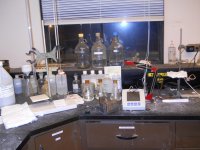
There are numerous ways to examine or test metals to determine their composition, but the easiest (and most common) is using a spectrometer to measure the wavelength of light emitted from metal while using a lazer to spark the surface of the metal. You can also examine the grain structure of the metal in question under high magnification, or use a Brinell hardness tester to arrive at an educated guess as to what the alloy is made-up of.

In the old days, you had to shave very small/thin samples from the metal in question, dissolve it into liquid at room temperature, distill the liquid along with certain reagents, then titrate the liquid using an acid or sodium hydroxide. It's a painfully long process that I have had only minimal exposure to. Metallurgists with the skill to do this are few and far between.

Picture 1: Distiller used exclusively to test for Nitrogen in metal
Picture 2: pH tester, various acids and reagents used in testing metal and sand
Picture 3: Various reagents and a 4 gas spectrometer - the older spectromers could only test up to 4 elements at a time

Pure manganese would not really be a useful material (structurally or mechanically), but it is very useful as an alloying ingredient in steel (btw, this statement is true for many of the alloying elements used in steel). Manganese is present at levels around the 0.5% to 1% mark in most common steels, and up to about 10% to 15% in some specialty alloy steels.

Manganese alloy steel comprises ~50% of the castings we make. This alloy used to make rock crushing parts because it wears better than any other alloy steel, but is very brittle and has low tensile strength.

Brian
 

Attachments

  • Picture 006.jpg
    Picture 006.jpg
    138.9 KB · Views: 23
  • Picture 007.jpg
    Picture 007.jpg
    139.4 KB · Views: 21
  • Picture 008.jpg
    Picture 008.jpg
    129.1 KB · Views: 22
Last edited:

Rileysan

Well-known member
Joined
Sep 11, 2015
Messages
4,298
Location
Milwaukie, Oregon
Very good idea! It is neat to discover metals and their properties without causing places for fractures to start or any other forms of weakening it.


On a side note: where can I find manganese that is local. I see it is in cloves, spinach, oats and other foods, but is there a local source of the pure metal?

thx again

You can't buy Manganese in its pure form as it is not found that way in nature. The purest form you can buy is ferromanganese alloy (about 70% Mn).

Brian
 

Maui

Well-known member
Joined
Sep 16, 2012
Messages
2,901
Location
Upstate NY
As Riley mentioned one of the common ways for laboratories to determine the chemical composition of a steel is to use Optical Emission Spectroscopy (OES), otherwise known as spark testing. They basically vaporize a small amount of the material from the test sample and then analyze the vapor for chemical composition. You can read about it here:

http://www.shimadzu.com/an/elemental/oes/oes.html

The entire test takes just a few minutes, and provides the complete chemistry including carbon content. Labs that are equipped to perform this type of test will sometimes run independent measurements for carbon and sulfur since these tend to be important elements that can be measured more accurately using a LECO combustion analyzer.

Hand-held X-ray guns are typically used for sorting scrap materials or determining what alloy a material might be, but they can't measure carbon content. A scanning Electron Microscope (SEM) can also be used for performing chemical analysis, but they are best used for qualitative analysis in determining what chemical elements are present, and not necessarily how much of each element is there. Methods that can be used at home for determining what a material might be can include spark testing from a grinder (great chart supplied by Welder) determination of density, magnetic properties, and corrosion resistance. For example austenitic stainless steels (304 stainless is a common example) are very corrosion resistant, non-magnetic (unless they have been heavily cold worked), and can be the same or slightly more dense than plain carbon steels due to the increased alloy content.

Maui
 
Last edited:

Steinmetz

Well-known member
Joined
Oct 11, 2012
Messages
2,274
Location
Washington State
As Riley mentioned one of the common ways for laboratories to determine the chemical composition of a steel is to use Optical Emission Spectroscopy (OES), otherwise known as spark testing. They basically vaporize a small amount of the material from the test sample and then analyze the vapor for chemical composition. You can read about it here:

http://www.shimadzu.com/an/elemental/oes/oes.html

The entire test takes just a few minutes, and provides the complete chemistry including carbon content. Labs that are equipped to perform this type of test will sometimes run independent measurements for carbon and sulfur since these tend to be important elements that can be measured more accurately using a LECO combustion analyzer.

Hand-held X-ray guns are typically used for sorting scrap materials or determining what alloy a material might be, but they can't measure carbon content. A scanning Electron Microscope (SEM) can also be used for performing chemical analysis, but they are best used for qualitative analysis in determining what chemical elements are present, and not necessarily how much of each element is there. Methods that can be used at home for determining what a material might be can include spark testing from a grinder (great chart supplied by Welder) determination of density, magnetic properties, and corrosion resistance. For example austenitic stainless steels (304 stainless is a common example) are very corrosion resistant, non-magnetic (unless they have been heavily cold worked), and can be the same or slightly more dense than plain carbon steels due to the increased alloy content.

Maui

An older way (widely used in steel manufacturing) is to dissolve the sample of the pour and form a ligand with the element to be evaluated, then spectrophotometrically determining a concentration. It was pretty quick. Had to be because adjustments often had to be made on the molten material.
 

Maui

Well-known member
Joined
Sep 16, 2012
Messages
2,901
Location
Upstate NY
Yep - when the final chemical additions are made to the melt a test sample has to be taken and analyzed to determine if the chemical composition limits for the grade of steel that is being produced have been met. And the melt shop needs an answer quickly, usually within about 10 minutes or less. The older methods worked pretty well. Today it's usually done with a spark tester or X-ray machine together with a combustion tester for measuring weight percent carbon and sulfur.

The chemical composition will tell you if you're working with the correct grade of steel. But as Wakefield pointed out that's just one piece of important information. How the material was processed matters too. And how it was heat treated is critical, since the tool you make is only as good as the heat treatment that it receives.

Maui
 

mowkep

Well-known member
Joined
May 7, 2017
Messages
471
Location
Stow, Ohio
I work with magnesium quite a lot. I believe the majority of which is now imported from.......China. Makes we wonder how pure it is
 

Rlapointe87

Well-known member
Joined
Apr 27, 2017
Messages
87
Location
Connecticut
Don't know if it was mentioned here but you can use an acromag . We use it at work to verify weld wire is the correct alloy


Sent from my iPhone using Tapatalk
 

atthebeach

Well-known member
Joined
Mar 18, 2014
Messages
311
Location
At The Beach
If Reardon's book wets your appetite to learn more and get some hands on experience, you might check what your local community college offers. A very long time ago I used to teach a metallurgy class after work at the local community college. I had a masters degree in material science and was working in a large machine shop where we also did quite a bit of welding and heat treating. The school had a well equipped materials lab where the students were able to perform a wide variety of common material test methods in addition to some heat treating. You might have a similar opportunity in your area.
 
To avoid these ads, REGISTER NOW!
Top Bottom