To avoid these ads, REGISTER NOW!

Meter to main panel question.

acer66

Well-known member
Joined
Dec 4, 2010
Messages
4,418
Location
Western North Carolina
Hi,
Not so much garage but electrical related.
The whole house is getting rewired by me since I just passed the home owners electrical test. :drink:


Outside sits a 200A meter disconnect which is going to feed a 200A main panel.
Distance is around 35' and the main panel is inside.
I have a great tendency to over complicate things so I would like a more professional person take a look at what the best way is
to get the power from the meter to the panel
or if I did do something not to code.

View media item 68819Meter
View media item 68822Cinderblock basement wall ends just a tad over the center of side knock outs.
View media item 68821This how the interior looks like where the meter sits.
View media item 68820This is the main panel, bonding screw removed and I added two ground bars.
I was hope to get the power in at the lower left underneath the disconnect.
The panel is located in the utility room with furnace, water heater and pressure tank etc for the well.
I still need to get a lug for the incoming grounding wire but so far I could only find neutral lugs,
can they also be used for the grounding wire?
The copper line is hvac related and has nothing to do with the panel.
View media item 68823Picture is sideway, I used nuts as spacers which might be nuts behind the panel but that is changed quickly if that is not up to code.

Everything will be inspected so it needs to be all according to the NEC2014.

Thank you very much
 
To avoid these ads, REGISTER NOW!

Stuff

Well-known member
Joined
Aug 31, 2013
Messages
572
Good for you for passing your test. Now the real work starts!

Get rid of the nuts. Kindorf/unistrut if allowed. Some inspectors want to see plywood behind the panel.

HVAC needs to be secured to the wall and behind the back of the panel so as to not be in the electrical space.
 

AntonLargiader

Well-known member
Joined
Nov 20, 2016
Messages
1,372
Location
Charlottesville, VA
If you are going to put any circuits in from the side of the panel, go with two sheets of plywood (to get the right thickness) back there for stapling to. You're going to want to support the incoming feed somehow, anyway. I guess you're goming in the bottom with conduit?

I would also drop it down an inch or so to make it easier to tighten the NM clamps at the top, assuming you're going to have some circuits going out the top and through the joists.

What's the Homeowner's Electrical Test?
 

pgilmore7

Well-known member
Joined
Feb 12, 2015
Messages
141
Location
Riverview Florida
I think he was implying that you have to drink to pass the test. I can pass a lot of tests like that, or at least at the time I think I can.


Sent from my iPhone using Tapatalk
 
OP
A

acer66

Well-known member
Joined
Dec 4, 2010
Messages
4,418
Location
Western North Carolina
Good for you for passing your test. Now the real work starts!

Get rid of the nuts. Kindorf/unistrut if allowed. Some inspectors want to see plywood behind the panel.

HVAC needs to be secured to the wall and behind the back of the panel so as to not be in the electrical space.

Thanks, plywood it is and the hvac line will be removed.
 
OP
A

acer66

Well-known member
Joined
Dec 4, 2010
Messages
4,418
Location
Western North Carolina
If you are going to put any circuits in from the side of the panel, go with two sheets of plywood (to get the right thickness) back there for stapling to. You're going to want to support the incoming feed somehow, anyway. I guess you're goming in the bottom with conduit?

I would also drop it down an inch or so to make it easier to tighten the NM clamps at the top, assuming you're going to have some circuits going out the top and through the joists.

What's the Homeowner's Electrical Test?

I will put plywood behind it and I planning on coming in with conduit from the lower left side below the main breaker so I do not have to run the feeder cables thru the panel.

Yes, most circuits, hopefully all, will come in thru the top in-between the joists.
Height is not such an issue since the joist are only a tad over 6' off the ground and I am taller than that.

Here in NC where I live they let the home owner take an electrical test and if you pass you can do your own electric.
 

AntonLargiader

Well-known member
Joined
Nov 20, 2016
Messages
1,372
Location
Charlottesville, VA
Height is not such an issue since the joist are only a tad over 6' off the ground and I am taller than that.

What I mean is that you will be securing the wires in NM clamps at the top, and if you leave some daylight there you can get screwdriver and finger access from the side. Right now you can't.

Another thing is you have the panel at the joist ends. Are you going to end up doing a lot of joist drilling directly above the panel? Both of my panels are on 'long joist' walls, so there is plenty of room for the circuits to fan out.
 

mm08822

Well-known member
Joined
Jan 13, 2012
Messages
5,860
Location
NJ
I suggest you move the panel to the right 8" or more so you can enter on the left side as well. If not, you are losing a lot of access to the panel.

Also seriously consider lowering the panel several inches b/c you are restricting top entry to only anything that comes through that bay of joists.

Agree with the two sheets of 3/4" plywood or nailers and 1 piece of plywood. Best to paint nailers/that rest directly on masonry. Cut plywood large enough to give you 8" all around panel for minimum nailing space. Have top of plywood **** up against joist bottom.
 

Stuff

Well-known member
Joined
Aug 31, 2013
Messages
572
Working clearance is supposed to be 6'6" in front of panel and 30" wide. If your ceiling/joists height is less you are starting off with a violation. Most inspectors would let you get away with it but there are some out there that might make you dig before approving.
 

mm08822

Well-known member
Joined
Jan 13, 2012
Messages
5,860
Location
NJ
Working clearance is supposed to be 6'6" in front of panel and 30" wide. If your ceiling/joists height is less you are starting off with a violation. Most inspectors would let you get away with it but there are some out there that might make you dig before approving.

There is an exception to the 6.5' rule. In existing dwellings it can be less than that. I replaced one service in a 5' ceiling and it was terrible.

Cant tell from POP's pics if this is all new space where panel is or not. Check with AHJ before going further.
 

theoldwizard1

Well-known member
Joined
Feb 22, 2011
Messages
43,095
Location
SE MI
Check with your building department, but 35' from the meter base to the first disconnect (main breaker) seems like a long distance. They may require some kind of disconnect on the outside, close to the meter.
 

tailshaft56

Well-known member
Joined
Oct 11, 2016
Messages
61
Location
Miami Ok
I recommend Wiring A House by Rex Cauldwell. Just like the Spaggeti sauce "it's in there". LOL

Got my copy @ Barnes and Noble.
 
OP
A

acer66

Well-known member
Joined
Dec 4, 2010
Messages
4,418
Location
Western North Carolina
Thanks for all the replies, as mentioned there is an exemption for existing buildings for the working height in front of the panel but worst case scenario I can dig out a few inches of the dirt floor.

Another question I have is how, conduit? to run what wire from meter to panel since, I assume, I need to start with with exterior rated cable at the meter?

Oh and when I was looking at the main panel yesterday I noticed that the factory installed now non bonded to the panel neutral and ground bar are slightly different.
Is it okay to use that ground bar as a neutral bar?

Thank you
 
OP
A

acer66

Well-known member
Joined
Dec 4, 2010
Messages
4,418
Location
Western North Carolina
I suggest you move the panel to the right 8" or more so you can enter on the left side as well. If not, you are losing a lot of access to the panel.

Also seriously consider lowering the panel several inches b/c you are restricting top entry to only anything that comes through that bay of joists.

Agree with the two sheets of 3/4" plywood or nailers and 1 piece of plywood. Best to paint nailers/that rest directly on masonry. Cut plywood large enough to give you 8" all around panel for minimum nailing space. Have top of plywood **** up against joist bottom.

Sounds good, I will lower it a bit but the panel also has several knock outs at the upper left and right sides.

Would any code speak against mounting a receptacle box on that plywood if I make it big enough?

Thanks
 

mm08822

Well-known member
Joined
Jan 13, 2012
Messages
5,860
Location
NJ
Sounds good, I will lower it a bit but the panel also has several knock outs at the upper left and right sides.

Would any code speak against mounting a receptacle box on that plywood if I make it big enough?

Thanks

No code issue for that. I like using a 4"sq box with offset ****** to do those. Mount that low on the side so you can still use the space above it for routing cables and stapling.
The more room you provide with plywood, more flexibility you have for future adds and the job stays looking nice instead of piecemealing everything together and it shows then! If you can afford 12" on sides go for it. Now is the time.
 

mm08822

Well-known member
Joined
Jan 13, 2012
Messages
5,860
Location
NJ
Thanks for all the replies, as mentioned there is an exemption for existing buildings for the working height in front of the panel but worst case scenario I can dig out a few inches of the dirt floor.

Another question I have is how, conduit? to run what wire from meter to panel since, I assume, I need to start with with exterior rated cable at the meter?

Oh and when I was looking at the main panel yesterday I noticed that the factory installed now non bonded to the panel neutral and ground bar are slightly different.
Is it okay to use that ground bar as a neutral bar?

Thank you

I would go with pvc conduit all the way and thwn conductors.

Mark up your pics with proposed conduit routing and post them.
 

Stuff

Well-known member
Joined
Aug 31, 2013
Messages
572
Oh and when I was looking at the main panel yesterday I noticed that the factory installed now non bonded to the panel neutral and ground bar are slightly different.
Is it okay to use that ground bar as a neutral bar?

Once the ground screw/strap is removed both bars can be used as neutrals. It should state that on the panel's label.
 
To avoid these ads, REGISTER NOW!

AntonLargiader

Well-known member
Joined
Nov 20, 2016
Messages
1,372
Location
Charlottesville, VA
Would any code speak against mounting a receptacle box on that plywood if I make it big enough?

That's common, almost standard, practice. It's the only thing on that circuit, so you have power for a work light no matter what other circuits need to be turned off. Code requires it to be GFCI, as it's in an unfinished basement.

EDIT: You often see them wired to the very bottom row when they beneath the panel, even when the panel isn't full. Keeps the gutters cleaner, and those wires are out of the way of whatever else you are working on.
 
Last edited:
OP
A

acer66

Well-known member
Joined
Dec 4, 2010
Messages
4,418
Location
Western North Carolina
Thanks you very much y'all, I thought I knew a bit more about electrical then I really do know
and I will post a route/mark up of the run.

Cant tell from POP's pics if this is all new space where panel is or not. Check with AHJ before going further.

Old walls with new floor framing on top but as said, worst case scenario I can dig out a few inches of the dirt floor.

I so far have only very good experience with the inspectors and they already went out of their way to to find a solution so I would not loose my permit due to the one year limit of no permit pulling for free.
 
Last edited:
OP
A

acer66

Well-known member
Joined
Dec 4, 2010
Messages
4,418
Location
Western North Carolina
Okay, here it goes, I just did "real" mockups because my computer skills are not very good and it helped me also to understand better what I am dealing with.

Here is the whole exterior wall, the meter box to the right and the main sits in the second room roughly where the 3. walled up window to the left is.
View media item 68953Here are the option I came up with.
A:The easiest, I think, would be to run the conduit horizontal on the outside right under the siding but that would be a serious eyesore.
B:Run a pipe down to a LB body which connects to a LB body on the inside like posted in the second following picture.
View media item 68946View media item 68950C:Go straight thru the meter box via the knockout on the right, might be the best but is bit more work since the hole needs to go thru wood and cider block and you have to be more careful around the meter box.View media item 68952View media item 68951This is how all options, with option A being a bit different at the top, would connect to the main panel.
View media item 68949View media item 68945
Almost all wires would come from the top or right into the panel.
Except for a 50A for the range, the MHF for the garage and a 10g for the a/c I have only 14 and 12g wires and the house is just 1400 sf.

I hope that helps.

Thank you
 

mm08822

Well-known member
Joined
Jan 13, 2012
Messages
5,860
Location
NJ
The conduit cuts off the entire left side access to the panel. You also need room for a connector at the panel.

I suggest you come in the top center of the panel enclosure with that 90. Flip the entire enclosure so the main is on top. Otherwise looks good.
 
OP
A

acer66

Well-known member
Joined
Dec 4, 2010
Messages
4,418
Location
Western North Carolina
The conduit cuts off the entire left side access to the panel. You also need room for a connector at the panel.

I suggest you come in the top center of the panel enclosure with that 90. Flip the entire enclosure so the main is on top. Otherwise looks good.

Okay I would move the panel more to the right.

I am on the fence with flipping it, the reason why I did that is most of my wires will come from the top
and if I flip the panel there will be less room to work on the top and the main breaker is in the way.

What of the proposed solutions would you choose?

Thanks
 

AntonLargiader

Well-known member
Joined
Nov 20, 2016
Messages
1,372
Location
Charlottesville, VA
With modern boxes, you can still keep things really tidy with top-entry. Plenty of pics online illustrate that.

If most of your wires come in from the right, you could have the service enter the panel from the top left and then just arc down to the lugs. Can you put the main neutral lug on the other neutral bar? That would keep the right side very clear.

I personally would probably have it enter from the top middle, and then have the individual circuits enter from the top left and top right, even if they have to cross under the conduit to do so. That's pretty much how my main panel is now.

How many branch circuits are you expecting to have?
 

mm08822

Well-known member
Joined
Jan 13, 2012
Messages
5,860
Location
NJ
Okay I would move the panel more to the right.

I am on the fence with flipping it, the reason why I did that is most of my wires will come from the top
and if I flip the panel there will be less room to work on the top and the main breaker is in the way.

What of the proposed solutions would you choose?

Thanks

I disagree with that. This panel has a lot of room above the main. You really would be better off with main on top. Wire the main and grounds first and the branch circuits will be easy to lay in around the larger conductors.

Make sure you use PLYWOOD. 3/4 preferred with nailers behind it especially where you plan to drive staples. Otherwise, OSB will blow apart as you put lots of staples in a small area and everytime you drive staples, you will feel the hammer bounce back at you.
 

Stuff

Well-known member
Joined
Aug 31, 2013
Messages
572
Make sure you use PLYWOOD. 3/4 preferred with nailers behind it especially where you plan to drive staples.

Agree. Thinner means the staples/nails/screws go right through and hit the concrete behind. Very aggravating.
 
OP
A

acer66

Well-known member
Joined
Dec 4, 2010
Messages
4,418
Location
Western North Carolina
Thank for all the advice, there are three pt 2x4 nailers, top center bottom behind it, and I used osb because that is what I had in 3/4 but I see the point.
I did some digging and found a 1/2" ply which I am going screw on top of the osb so that should make for a solid backing.

If I would come in from the top I could use aType LR Conduit Body because the radius of the 90deg bend would make the panel much lower but even the conduit body would, imho would cut quite a bit into the space for running cable.

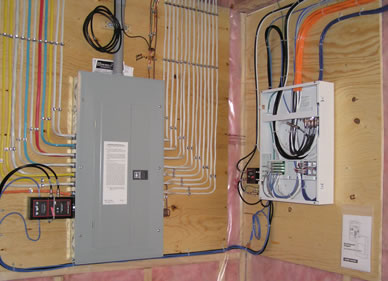
One thing the picture does not show is that the house ends like 8' so there is little chance that anything will come from that side and the panel is much bigger then I really need but I like the room.

As of now I will have 25 circuits, 4 of them being 240V.

I have to check if the oem neutral and ground bar are interchangeable.

And I know you are all going to roll your eyes that I am so hung up on keeping the entry on the lower left side but would it not work if I move the panel further to the right and leave the conduit where it is so the would be more space between the panel and the conduit so run cables?

Thank you
 

bczygan

Well-known member
Joined
Nov 4, 2009
Messages
22,002
Location
DETROIT! Arsenal of Scrappers
If you feel that the circuits coming in the top are too restricted in space by having the entrance cable coming in there, then some or all can come in the sides.

Electrical%20Panel.jpg
 
OP
A

acer66

Well-known member
Joined
Dec 4, 2010
Messages
4,418
Location
Western North Carolina
Wow, that looks very clean but is up to code to have the nm cable exposed like that?

I need to check but I think my panel has most knock outs on the top
but on the other hand that might be an excuse to buy a knock out tool.
:beer:


Edit: I thought about your picture again bcygan and it almost wants me to hang a full 4x8' sheet of ply.
 
Last edited:

bczygan

Well-known member
Joined
Nov 4, 2009
Messages
22,002
Location
DETROIT! Arsenal of Scrappers
Wow, that looks very clean but is up to code to have the nm cable exposed like that?

I need to check but I think my panel has most knock outs on the top
but on the other hand that might be an excuse to buy a knock out tool.
:beer:


Edit: I thought about your picture again bcygan and it almost wants me to hang a full 4x8' sheet of ply.

Time for the electrical experts. Might just be OK in a utility room.
 

wyliesdiesels

Well-known member
Joined
Aug 14, 2012
Messages
19,983
Location
Modesto, CA
Wow, that looks very clean but is up to code to have the nm cable exposed like that?

I need to check but I think my panel has most knock outs on the top
but on the other hand that might be an excuse to buy a knock out tool.
:beer:


Edit: I thought about your picture again bcygan and it almost wants me to hang a full 4x8' sheet of ply.

Yes NM-b can be exposed as long as its not subject to damage...
 

mm08822

Well-known member
Joined
Jan 13, 2012
Messages
5,860
Location
NJ
Ask Wylie to ship you some heat. Or I could ship you some snow if you're feeling left out.
 
To avoid these ads, REGISTER NOW!
Top Bottom