To avoid these ads, REGISTER NOW!

Mezzanine design/debate

FredWurlitzer

Active member
Joined
May 30, 2019
Messages
41
Location
Western NY
Anyone with a background in structural engineering here?

I’ve been debating on the design of my mezzanine before I commit to framing the building. This mezzanine would encompass a portion of the building (roughly 31x15 footprint). Here is the quick and dirty..

- 32x36x14 post frame on 20”Wx42”D concrete footings w/wet set brackets (already in place)
- 7’7” post AND truss spacing (40psf snow load)
- 3-ply 2x6 OR 2x8 posts depending on loads
- 6/12 TC and 3/12 BC scissor trusses

I would like to build a mezzanine that does NOT require support from below in order to maximize space and eliminate posts in the middle of the building. In order to do so, I would like a truss (or trusses, meaning 2-ply) to carry the weight of the mezzanine from above.

I would plan to have an LVL designed to span the 31’ for the outer side of the joists to attach to. 2x10s at 16” OC for joists. My questions are the following:

- What is the total dead load of the 31’x15’ mezzanine?
- Is 30psf sufficient for a live load for general storage?
- Can a 32’ span scissor truss be designed to carry such a live AND dead load?
- Is this idea totally cost prohibitive?

Ultimately, I would like to build something different and unique but also want to keep budget in mind.
 
To avoid these ads, REGISTER NOW!

firebirdparts

Well-known member
Joined
Jun 8, 2016
Messages
10,588
Location
Kingsport, TN
I find your third question most interesting, and I think there’s no reason to use a scissor truss for that job. Weak weak weak. A truss of some other sort might be appropriately cheaper than LVL. Just ask at the truss store. I say the entire space at the edge of the mezz is available to do the job in.

I don’t care enough to calc dead load so I would go 10 dead 40 live.
 

bluedog225

Well-known member
Joined
Jan 31, 2012
Messages
3,275
Location
Texas
I’ve got something similar for my loft. 25’. The engineer used 2x12 joists and double 14” lvl. Also the joists at each side are perpendicular to the others. About 6 feet. And there is one intermediate post on one side. And 3/4 ply. Not sure if engineering or because the floor plan allowed. I’d get and engineer to approve once you draw it up.
 

cannuck

Well-known member
Joined
Nov 30, 2021
Messages
4,607
Location
Rural SK
Not structural or any other kind of official engineer, but have designed/built a few mezzanines. I tend to favour wooden I beams for spans/loading such as you see. At 15' I would much rather have 3 colums (paralleled/sistered with you building posts) and probably a steel I beam to carry that load from below and avoid a massiver - re-engineering of the roof trusses.....IF you have overhead space to do so.
 

My Old Tools

Well-known member
Joined
Jun 4, 2014
Messages
5,432
Location
Hamrick Lake, TX
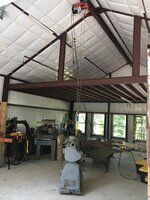
If the LVL is sufficient to carry the load, why is the truss involved in the load calculations at all? If the overhead structure is involved, I would look at a king post or queen post style bent (see timber framing). My building is metal but it uses a queen post for the loft.
 

Attachments

  • shop.jpg
    shop.jpg
    150.3 KB · Views: 104
  • shop2.jpg
    shop2.jpg
    262.4 KB · Views: 108

dcg9381

Well-known member
Joined
Jun 20, 2018
Messages
11,660
Location
Austin, TX
I'm no structural engineer, but there are tools online for buying LVLs where you give it a span and live / dead load and it'll tell you what you need for that span.

You can see a large LVL in the middle of my deck here when we were building a house. We needed it there to handle estimated load for a hot tub.

1669056514977.png
 
OP
F

FredWurlitzer

Active member
Joined
May 30, 2019
Messages
41
Location
Western NY
I find your third question most interesting, and I think there’s no reason to use a scissor truss for that job. Weak weak weak. A truss of some other sort might be appropriately cheaper than LVL. Just ask at the truss store. I say the entire space at the edge of the mezz is available to do the job in.

I don’t care enough to calc dead load so I would go 10 dead 40 live.

I want to use scissor trusses in order to have headroom in the mezzanine with a 14ft eave/sidewall height.

I think you’re misunderstanding what I’m trying to do, and that’s probably my fault for not explaining it good enough. The LVL will be held up (or, hung?) by/from the truss. The LVL will also hold the floor joists. That one particular truss would have to be engineered differently than the others to accommodate the additional load.
 
OP
F

FredWurlitzer

Active member
Joined
May 30, 2019
Messages
41
Location
Western NY
I would use 10 psf for dead load and I'd like to use 40 for live load but you might be OK with 30.

Rather than a beam or truss carrying half the load, did you consider TJIs?
Thanks! I would like 40, but also want to keep in mind overall loads that are imposed on the truss and post.

The joists would be running the 15’.. not the 31’. Unless you meant to use the TJI as the ledger beam instead of an LVL?
 
OP
F

FredWurlitzer

Active member
Joined
May 30, 2019
Messages
41
Location
Western NY
If the LVL is sufficient to carry the load, why is the truss involved in the load calculations at all? If the overhead structure is involved, I would look at a king post or queen post style bent (see timber framing). My building is metal but it uses a queen post for the loft.
Yes!! Your pictures are exactly what I’m looking to do but with timber framing!

That’s why I’m trying to determine the loads that will be imposed on that one particular truss. That truss will be bearing on a 3-ply post on each side. The LVL that is acting as the joist ledger (31’ span) would also be fastened to the post that the truss is bearing on.

I suppose that particular truss doesn’t necessarily need to be a scissor truss.
 

strutaeng

Well-known member
Joined
Dec 12, 2011
Messages
2,261
Location
Dallas, TX
I want to use scissor trusses in order to have headroom in the mezzanine with a 14ft eave/sidewall height.

I think you’re misunderstanding what I’m trying to do, and that’s probably my fault for not explaining it good enough. The LVL will be held up (or, hung?) by/from the truss. The LVL will also hold the floor joists. That one particular truss would have to be engineered differently than the others to accommodate the additional load.
That truss will need to be a steel truss for that to work. I don't see a light-wood roof truss being able to carry that much weight.

Maybe a heavy timber truss with glulams, but connections get involved and cost would be high. More for architectural purposes

On the other hand, a steel truss can be engineered with WT top and bottom chords, and angle webs. Needs to be framed into steel tubes or wide flange for columns.

Can be shop fabricated and erected with a crane.

Maybe a really deep glulam at the mezzanine level can work instead of the roof truss hanger option. Those can be designed with "camber" or upward sweep that will help with deflection. At those longer spans, deflection is what governs anyways.
 
OP
F

FredWurlitzer

Active member
Joined
May 30, 2019
Messages
41
Location
Western NY
That truss will need to be a steel truss for that to work. I don't see a light-wood roof truss being able to carry that much weight.

Maybe a heavy timber truss with glulams, but connections get involved and cost would be high. More for architectural purposes

On the other hand, a steel truss can be engineered with WT top and bottom chords, and angle webs. Needs to be framed into steel tubes or wide flange for columns.

Can be shop fabricated and erected with a crane.

Maybe a really deep glulam at the mezzanine level can work instead of the roof truss hanger option. Those can be designed with "camber" or upward sweep that will help with deflection. At those longer spans, deflection is what governs anyways.
If you look at one of the previous responses with pictures (steel framing), that’s exactly what I’m trying to do.

I’m not sure what you mean with the last paragraph. I’m having a hard time picturing what that would look like.
 
OP
F

FredWurlitzer

Active member
Joined
May 30, 2019
Messages
41
Location
Western NY
This mezzanine will essentially be 2 post and truss spaces deep (trusses to sit directly on posts). About 15’..

With that said, could attic trusses be considered? I could probably use 2x8s for floor joists as the span would be cut in half. Again.. they would have to be beefy at 7’7” spacing, plus snow, live and dead loads imposed.
 

billconner

Well-known member
Joined
Jul 20, 2021
Messages
6,950
Location
Thousand Islands NYS
Thanks! I would like 40, but also want to keep in mind overall loads that are imposed on the truss and post.

The joists would be running the 15’.. not the 31’. Unless you meant to use the TJI as the ledger beam instead of an LVL?
I meant just span the 32' with TJIs, no lvl, no hanging from trusses. Load bearing walls between posts to support TJIs. Just seems much simpler. You could use steel bar joists in place of TJIs. Would have to compare costs.
 

strutaeng

Well-known member
Joined
Dec 12, 2011
Messages
2,261
Location
Dallas, TX
I’m not sure what you mean with the last paragraph. I’m having a hard time picturing what that would look like.
I meant a floor beam at the mezzanine level, clear spanning 32'. Mezzanine joists frame into the big glulam. Looks like a 5 1/8"x22" glulam can work. There are different grades of Glulams and different species/sizes. That's just ballpark.
 

duneslider

Well-known member
Joined
Jan 20, 2013
Messages
2,247
Location
Riverton, Utah
You can get TJI's that will span 32', they are the 24" deep TJI's. I've never personally seen them used. I also question whether the columns on your exterior wall will handle that much additional weight. I am guessing not but there might be something that could be done to make it work. You really really need to get an engineer involved to do this. There are several ways this could be accomplished and they should be able to easily help you find the most cost effective way to make this work. Putting a steel I-beam in might be the cheapest method.
 
To avoid these ads, REGISTER NOW!

Augus7us

Well-known member
Joined
Jan 14, 2017
Messages
1,190
Location
Central Ohio
Interesting, are you guys saying forget the ledger board (LVL) all together and just run 32' I joists stacked on a wall in between his posts?

Basically instead of going from back to front connecting to a ledger board with joist hangers, go side to side and stack the i joists on the walls in between the posts?

I built a 10'x30' in my 30'x40', but I built a wall under mine so no need for joist hangers. The I joist method never occurred to me.
 

duneslider

Well-known member
Joined
Jan 20, 2013
Messages
2,247
Location
Riverton, Utah
Interesting, are you guys saying forget the ledger board (LVL) all together and just run 32' I joists stacked on a wall in between his posts?

Basically instead of going from back to front connecting to a ledger board with joist hangers, go side to side and stack the i joists on the walls in between the posts?

I built a 10'x30' in my 30'x40', but I built a wall under mine so no need for joist hangers. The I joist method never occurred to me.
There are a lot of ways to tackle this but none would be right or wrong. No matter what I don't think his structure is setup to do any of them without an engineer taking a look and designing something to work.

He is looking at a really long span and no matter what method is used the weight has to be held up by something and with how big that is there is a lot of weight the longer the spans get.
 

billconner

Well-known member
Joined
Jul 20, 2021
Messages
6,950
Location
Thousand Islands NYS
I found 16" TJIs that would span 32' 16" o.c. 14" if 12" o.c - just.

I thought you said you had a continuos stem wall on a spread footing with wet set brackets, but could be confused. If so, that will easily support a load bearing wall carrying mezzanine.

Important point above - the load has to be supported and if just posts on piers, it may not be enough.

Using term mezzanine but for code purposes, it seems the elevated floor is more than 1/3 the main floor, and therefore may be a second floor. Limited headroom at sides might allow it to be a mezzanine. That all if code matters to you.
 
OP
F

FredWurlitzer

Active member
Joined
May 30, 2019
Messages
41
Location
Western NY
You can get TJI's that will span 32', they are the 24" deep TJI's. I've never personally seen them used. I also question whether the columns on your exterior wall will handle that much additional weight. I am guessing not but there might be something that could be done to make it work. You really really need to get an engineer involved to do this. There are several ways this could be accomplished and they should be able to easily help you find the most cost effective way to make this work. Putting a steel I-beam in might be the cheapest method.

I’ve never thought about the TJI spanning the 32’ method.. and I’m intrigued! As to cost effectiveness, I have no idea. I would then have to figure out how to support that steel beam.

24” deep joists, yikes! That seems a little counterproductive if they are indeed that tall.
 
Last edited:

strutaeng

Well-known member
Joined
Dec 12, 2011
Messages
2,261
Location
Dallas, TX
Ah ok.. I think when you say “glulam” you’re referring to something like an LVL?
No. A glulam is made up of dimensional lumber, glued together and then planed to determined dimensions. You can specify them with higher quality laminations on the outer extremes, where stresses are higher, so they can take more load.

There's western species and southern species. Around here, it's the southern species that's available.

Then there's like 3 appearance grades IIRC. Industrial, Architectural and something else.


And I mentioned before they can be ordered with camber. Doesn't help in your case since your ratio of live load to dead load is like 4:1.

You can also use a W16x31-ish steel beam with a 2x6 nailer on top. Same idea. Not sure which would be cheaper.

I hope this helps.

Edit: https://en.m.wikipedia.org/wiki/Glued_laminated_timber
 
OP
F

FredWurlitzer

Active member
Joined
May 30, 2019
Messages
41
Location
Western NY
I found 16" TJIs that would span 32' 16" o.c. 14" if 12" o.c - just.

I thought you said you had a continuos stem wall on a spread footing with wet set brackets, but could be confused. If so, that will easily support a load bearing wall carrying mezzanine.

Important point above - the load has to be supported and if just posts on piers, it may not be enough.

Using term mezzanine but for code purposes, it seems the elevated floor is more than 1/3 the main floor, and therefore may be a second floor. Limited headroom at sides might allow it to be a mezzanine. That all if code matters to you.
A 14” or 16” TJI would be ok height-wise, I would think. I don’t want to lose vertical space in order to maximize headroom above and below.

That’s partly why I made this post.. as my piers are already in. They’re a minimum 18-20” in diameter (some pushing 20-24”) and at the required 42” depth. Filled with 4K psi concrete. I also have my wet set brackets in place which will fit a 3-ply column.

I can’t imagine at 7’7” spacing, a 3-ply 2x8 column wouldn’t be able hold some of these hypothesized loads? Majority of post frame buildings I see now-a-days use something around the size of a 3-ply 2x6 for posts..

In regards to code and definitions, it’s not much of a concern around here. They are quite lax about anything other than a new dwelling/house.
 
Last edited:

billconner

Well-known member
Joined
Jul 20, 2021
Messages
6,950
Location
Thousand Islands NYS
Without continuous foundation, the load bearing wall to support the TJIs is not as simple, but if the footings are big enough, a header between posts could work.

A simple load diagram, snow loading, size of footing (14" diameter?), and an idea of soil under footing can tell pretty quickly if it's doable. (I think it's iffy - 16'x7'-7" tributary area = 113 sf; loft and roof live and dead loads probably over 110 psf all together; over 12,000 pounds. Requires 4000 psf soil on a 24" diameter footing. Just spit balling.)
 
OP
F

FredWurlitzer

Active member
Joined
May 30, 2019
Messages
41
Location
Western NY
Without continuous foundation, the load bearing wall to support the TJIs is not as simple, but if the footings are big enough, a header between posts could work.

A simple load diagram, snow loading, size of footing (14" diameter?), and an idea of soil under footing can tell pretty quickly if it's doable. (I think it's iffy - 16'x7'-7" tributary area = 113 sf; loft and roof live and dead loads probably over 110 psf all together; over 12,000 pounds. Requires 4000 psf soil on a 24" diameter footing. Just spit balling.)
I appreciate the calculations!

I’m going to show my calculations. Let me know if I’m missing something.

Let’s keep the 110psf for total load. Mezzanine will be 31’x16’ = 496 sq/ft
496 sq/ft x 110psf = 55,000lbs

Now let’s assume I do have headers on each eave end to support 31’ clear span TJI joists. (I’m starting to think this may be my only option) Each header will encompass 3 posts for a total of 6.

55,000lbs / 6 posts = 9,167 lbs per post

22” diameter circle = 2.66 sq/ft

After reviewing soil bearing charts (which I found to vary WIDELY), I figure mine to be 2-4 kg/cubic cm.

2-4kg/cm3 = 4,096-8,193 psf

2.66sq/ft x (4,096-8,193psf) = 10,895-21,793lbs depending on capacity.

I would think my piers would be adequate in my application?

Now to determine post size to hold 9,167lbs each…
 
OP
F

FredWurlitzer

Active member
Joined
May 30, 2019
Messages
41
Location
Western NY
Interesting, are you guys saying forget the ledger board (LVL) all together and just run 32' I joists stacked on a wall in between his posts?

Basically instead of going from back to front connecting to a ledger board with joist hangers, go side to side and stack the i joists on the walls in between the posts?

I built a 10'x30' in my 30'x40', but I built a wall under mine so no need for joist hangers. The I joist method never occurred to me.
Yes.. that’s basically what some are suggesting. This may be my best approach depending on the cost of a TJI.
 

firebirdparts

Well-known member
Joined
Jun 8, 2016
Messages
10,588
Location
Kingsport, TN
I want to use scissor trusses in order to have headroom in the mezzanine with a 14ft eave/sidewall height.

I think you’re misunderstanding what I’m trying to do, and that’s probably my fault for not explaining it good enough. The LVL will be held up (or, hung?) by/from the truss. The LVL will also hold the floor joists. That one particular truss would have to be engineered differently than the others to accommodate the additional load.
I’m the one that was unclear. It’s not necessary to preserve headroom over the edge of the platform, because you can’t walk through that space. What you need over the edge of the platform is STRENGTH and there’s no downside if you get it.

You could consider a parallel truss which exists in the space where a handrail would be. This would eliminate the LVLs from the scope.

I hope that illustrates how filling the space is actually okay, even if you don’t choose that option.

This is getting into hard-to-quantify engineering, but if you put a rafter tie above the edge of the platform, suitably connected, that in combination with your scissors truss is much much stronger. That would be a really cheap way to do it, but the truss company won’t know how to incorporate that into the design, I don’t think. They have a mostly automated way of designing.
 
Last edited:

billconner

Well-known member
Joined
Jul 20, 2021
Messages
6,950
Location
Thousand Islands NYS
I appreciate the calculations!

I’m going to show my calculations. Let me know if I’m missing something.

Let’s keep the 110psf for total load. Mezzanine will be 31’x16’ = 496 sq/ft
496 sq/ft x 110psf = 55,000lbs

Now let’s assume I do have headers on each eave end to support 31’ clear span TJI joists. (I’m starting to think this may be my only option) Each header will encompass 3 posts for a total of 6.

55,000lbs / 6 posts = 9,167 lbs per post

22” diameter circle = 2.66 sq/ft

After reviewing soil bearing charts (which I found to vary WIDELY), I figure mine to be 2-4 kg/cubic cm.

2-4kg/cm3 = 4,096-8,193 psf

2.66sq/ft x (4,096-8,193psf) = 10,895-21,793lbs depending on capacity.

I would think my piers would be adequate in my application?

Now to determine post size to hold 9,167lbs each…
The center of the three posts is more heavily loaded than 1 or 3, but I'm surprised by the load bearing capability of the soil. By default, I assume 2000 psf. Here's the chart from the IRC. You must basically be on solid rock.


CLASS OF MATERIAL​
LOAD-BEARINGPRESSURE(pounds per square foot)​
Crystalline bedrock​
12,000​
Sedimentary and foliated rock​
4,000​
Sandy gravel and/or gravel (GW and GP)​
3,000​
Sand, silty sand, clayey sand, silty graveland clayey gravel (SW, SP, SM, SC, GMand GC)​
2,000​
Clay, sandy, silty clay, clayey silt, silt andsandy siltclay (CL, ML, MH and CH)​
1,500b​
 

Augus7us

Well-known member
Joined
Jan 14, 2017
Messages
1,190
Location
Central Ohio
I personally would not put anything on the posts. Whether you use a ledger board or just go with the I joists, I would build 2x walls inbetween the posts and sister 3 or 4 2x's and rest the LVL on them (if LVL is used) or I joists on the wall. Build the wall on 16" centers and stack the joists so they fall on a stud at 16"'s. Double top plate. Now its built like a house for the most part.

This is basically how I built mine, except I don't have a clear span underneath.
 

billconner

Well-known member
Joined
Jul 20, 2021
Messages
6,950
Location
Thousand Islands NYS
I personally would not put anything on the posts. Whether you use a ledger board or just go with the I joists, I would build 2x walls inbetween the posts and sister 3 or 4 2x's and rest the LVL on them (if LVL is used) or I joists on the wall. Build the wall on 16" centers and stack the joists so they fall on a stud at 16"'s. Double top plate. Now its built like a house for the most part.

This is basically how I built mine, except I don't have a clear span underneath.
I don't disagree but those load bearing walls still need a foundation, and the op only has the floor slab, no footing and stem wall, between the posts.
 
OP
F

FredWurlitzer

Active member
Joined
May 30, 2019
Messages
41
Location
Western NY
I personally would not put anything on the posts. Whether you use a ledger board or just go with the I joists, I would build 2x walls inbetween the posts and sister 3 or 4 2x's and rest the LVL on them (if LVL is used) or I joists on the wall. Build the wall on 16" centers and stack the joists so they fall on a stud at 16"'s. Double top plate. Now its built like a house for the most part.

This is basically how I built mine, except I don't have a clear span underneath.
Yeah, see billconner’s post. I wouldn’t consider putting a 2x wall on top of a 5” thick slab and no continuous footing with such a load.
 
OP
F

FredWurlitzer

Active member
Joined
May 30, 2019
Messages
41
Location
Western NY
The center of the three posts is more heavily loaded than 1 or 3, but I'm surprised by the load bearing capability of the soil. By default, I assume 2000 psf. Here's the chart from the IRC. You must basically be on solid rock.


CLASS OF MATERIAL​
LOAD-BEARINGPRESSURE(pounds per square foot)​
Crystalline bedrock​
12,000​
Sedimentary and foliated rock​
4,000​
Sandy gravel and/or gravel (GW and GP)​
3,000​
Sand, silty sand, clayey sand, silty graveland clayey gravel (SW, SP, SM, SC, GMand GC)​
2,000​
Clay, sandy, silty clay, clayey silt, silt andsandy siltclay (CL, ML, MH and CH)​
1,500b​

Yeah I honestly have no idea on what to figure for soil bearing capacity. Let’s just say I could probably build a mortared stone foundation for this garage with all of the rocks I pulled.

The charts are very inconsistent.. for example:
 

Attachments

  • C3F6D44E-1306-41F9-B04F-617F35E208EB.jpeg
    C3F6D44E-1306-41F9-B04F-617F35E208EB.jpeg
    521.6 KB · Views: 39
  • 20738B02-9E29-4E10-81AB-98DE880090C5.jpeg
    20738B02-9E29-4E10-81AB-98DE880090C5.jpeg
    302.2 KB · Views: 43
Last edited:

billconner

Well-known member
Joined
Jul 20, 2021
Messages
6,950
Location
Thousand Islands NYS
Yeah I honestly have no idea on what to figure for soil bearing capacity.
Well at least you can see from building code chart the basis of my opinion. Short of hiring an engineer, I don't know how you decide. I would suggest that a wall built on the slab probably will be support the loft. It is after all around 800 pounds (16x50) per linear foot of wall and a 2x6 plate on a 4-5" as slab way more bearing even on clay than needed. Just not frost protected. Do you think your slab edge will heave? Probably not.

Simple 2x6 wall (2 left and 2 right I suppose) between posts and 32' TJIs and decking - seems way simpler than other approaches and probably less expensive than many.

I'm at family in rural PA and internet *****, but pretty sure I found 14 and 16" TJIs that would span 32' and support it 40 psf. Iirc Weyerhauser, and a premium grade.
 
To avoid these ads, REGISTER NOW!
Top Bottom