To avoid these ads, REGISTER NOW!

Microscopic electronic repair. How to?

bwringer

Well-known member
Joined
Jan 1, 2013
Messages
10,277
Location
Indianapolis
You're gonna be SO mad if that part is just a jumper...

I once went through all sorts of convolutions to figure out a teensy (but not as teensy as this) resistor's value only to find it was "0"; a jumper packaged like a resistor for the sake of convenience. Or maybe there was a different version of the circuit out there that used a resistor.
 
To avoid these ads, REGISTER NOW!

LXCam

ALLIANCE MEMBER
Joined
Apr 23, 2013
Messages
19,124
Location
AZ
Ordered this digital microscope

Could use some recommendations for some high quality extra small tweezers.
I had no idea something like that was at that kind of price range. As much as it despises me to buy from Amazon I gotta have one. I’m not working with your level of micro components, but I do a lot of forensics with my phone utilizing macro pics. That’d be far better.
 

Max

ALLIANCE MEMBER
Joined
Jun 16, 2018
Messages
3,329
Location
Georgia
Those "microscopes" are, unfortunately, no good. I bought one of those a few years back and it's dollar store quality with horrific resolution. The lense also needs to be pressed up to the componemt to see.

The Andonstar AD246S and equivalent scopes are good. I personally have the JOYALENS JL249MS.
Damn GJ is costing me money again. :) Thank you.
 

Max

ALLIANCE MEMBER
Joined
Jun 16, 2018
Messages
3,329
Location
Georgia
Damn GJ is costing me money again. :) Thank you.
In for a penny, in for a pound - I also ordered a Hakko desolderer and solder station. I decided that my 55 year old Heathkit soldering station should be upgraded. :)
 
Last edited:
OP
G

Grant Gunderson

Well-known member
Joined
May 17, 2013
Messages
2,319
Location
Bellingham, WA
Damn GJ is costing me money again. :) Thank you.

In for a penny, in for a pound - I also ordered a Hakoo desolderer and solder station. I decided that my 55 year old Heathkit soldering station should be upgraded. :)
Haha. In for a penny, in for a few grand is more like it! That HAKKO gun has made a task I used to dread actually enjoyable. I won’t say this site has cost me a small fortune over the years…. It’s more like a very large fortune. However having the proper tools and more importantly learning the proper techniques here is priceless.
 

djbmw

Well-known member
Joined
Jun 20, 2013
Messages
1,138
Location
Ottawa, Ontario, Canada
As luck would have it,... the control board on my stove/oven crapped out and wouldn't kick the oven element on. Turns out my lower element failed (was slowly failing over the past few weeks, and then finally blew up), which caused more current load to pass through the lower element relay (causing it to arc more than it should), and when the heating element blew it sent back voltage through one of the SOT-23 diodes. I had to order a new relay, but already had the diodes. Overall it took ~ 1.5 hours to tear apart the oven, troubleshoot, order the new relay, repair the board (I used a solder sucker on the relay and hot air on the diode to remove), and re-assemble the oven - Just in time for Xmas!

Bad Relay & Burnt Diode

1766485262247.png

Burnt Diode Under Microscope (SOT-23 (BAV70 A4)

1766485284360.png

Diode Removed
1766485309708.png

Bad Relay & New Relay(s) - I only need one (for now)
1766485350130.png

New Diode Soldered In

1766485383254.png
 
To avoid these ads, REGISTER NOW!

larry4406

Well-known member
Joined
Jan 27, 2006
Messages
19,247
Location
Northern Virginia
As luck would have it,... the control board on my stove/oven crapped out and wouldn't kick the oven element on. Turns out my lower element failed (was slowly failing over the past few weeks, and then finally blew up), which caused more current load to pass through the lower element relay (causing it to arc more than it should), and when the heating element blew it sent back voltage through one of the SOT-23 diodes. I had to order a new relay, but already had the diodes. Overall it took ~ 1.5 hours to tear apart the oven, troubleshoot, order the new relay, repair the board (I used a solder sucker on the relay and hot air on the diode to remove), and re-assemble the oven - Just in time for Xmas!

Bad Relay & Burnt Diode

1766485262247.png

Burnt Diode Under Microscope (SOT-23 (BAV70 A4)

1766485284360.png

Diode Removed
1766485309708.png

Bad Relay & New Relay(s) - I only need one (for now)
1766485350130.png

New Diode Soldered In

1766485383254.png
Impressive!
 

powertrip

Well-known member
Joined
Apr 29, 2010
Messages
1,027
Location
Columbus Ohio
That's a chip resistor. I work on this scale of stuff daily building sensors. I use a Hakko fx-951, T15-D08 tip and a lot of experience.
 

djbmw

Well-known member
Joined
Jun 20, 2013
Messages
1,138
Location
Ottawa, Ontario, Canada
That's a chip resistor. I work on this scale of stuff daily building sensors. I use a Hakko fx-951, T15-D08 tip and a lot of experience.
Are you referring to my repair? Its not a resistor - its a high-speed switching double diode (SOT-23 (BAV70 A4)).

OP's component, however, might indeed be a chip resistor - its hard to tell from the photo.
 
OP
G

Grant Gunderson

Well-known member
Joined
May 17, 2013
Messages
2,319
Location
Bellingham, WA
IMG_7416.jpeg
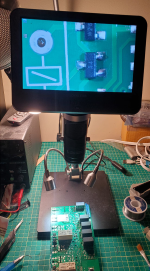
Electronic microscope arrived. See fluke test lead for scale. I need some much smaller probs. Any recommendations?
BTW that component reads .2Ω on a good board. Any idea what to order for a replacement? I should preface this, that I dont know **** about working on PCB's but Im willing to invest in the equipment and learn.

IMG_7420.jpeg

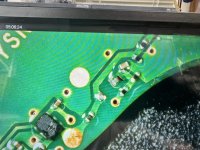
Same board for scale. This wireless transmits power / reads the torque sensors and Hall effect sensors off of a e-bike motor.

IMG_7418.jpeg
This is another bad board. It's obviously missing a component and another is dislodged.
IMG_7421.jpeg
This is a known good board out of another motor.
Any idea what these components are?

The larger black one thats completely missing off of the board above reads 1MΩ on the good board
The grey component reads .9KΩ


These may be way too small in reality to fix, but there is ZERO parts or support from the MFG and I get a lot of these motors in with the same issues. Worst case scenario, is that I am improving my skills at diagnosing the issues, so willing to invest some resources and time in trying to repair them.
 

djbmw

Well-known member
Joined
Jun 20, 2013
Messages
1,138
Location
Ottawa, Ontario, Canada
The scope images look nice! There's writing on the face of the component (the one i've identified as a possible diode below ) that you should be able to see if you move the lights around, and/or focus the lens differently. It can also help to use a Q-tip with rubbing alcohol on it to clean off the component. You might also need to swap lenses or lower the scope closer to the board. At first glance, here's what the components appear to be:
1766684937497.png
 

ATW

Member
Joined
Aug 22, 2014
Messages
14
Location
UK
Grant, sometimes a degree of caution needs to be applied when measuring components "in circuit", the surrounding circuit may be a more significant (higher or lower value depending on configuration series/parallel) than the component you think you are measuring.

Take the 0.2R - in IMG_7420 the copper pour/plane(s) that it is bridging appears to go fully around the center cut out of the board (at the 2 o'clock it gets a bit thin, maybe changes to other side or inner layer). If this is the case probing both ends of the component you will be measuring the resistance of the plane/pour.

The "grey" component, most likely a capacitor, if measured in circuit using Ohms scale of multimeter, you are most likely measuring the resistor next to it. To get an accurate reading of that possibly remove the good one and measure on capacitance scale of multimeter.

Andy
 

djbmw

Well-known member
Joined
Jun 20, 2013
Messages
1,138
Location
Ottawa, Ontario, Canada
Grant, sometimes a degree of caution needs to be applied when measuring components "in circuit", the surrounding circuit may be a more significant (higher or lower value depending on configuration series/parallel) than the component you think you are measuring.

Take the 0.2R - in IMG_7420 the copper pour/plane(s) that it is bridging appears to go fully around the center cut out of the board (at the 2 o'clock it gets a bit thin, maybe changes to other side or inner layer). If this is the case probing both ends of the component you will be measuring the resistance of the plane/pour.

The "grey" component, most likely a capacitor, if measured in circuit using Ohms scale of multimeter, you are most likely measuring the resistor next to it. To get an accurate reading of that possibly remove the good one and measure on capacitance scale of multimeter.

Andy
100%!
And, to make life easier, taking components this small "out of circuit" just means unsoldering one leg and slightly raising or moving it so that its not contacting the pad/trace. This way its still attached to the board with the other leg and you dont lose it, but it's electronically out of circuit.

ESR Capacitance meters (in circuit) are decent on larger components but struggle on stuff this small - just lift a leg, measure with your multimiter, and solder it back in place.
 

djbmw

Well-known member
Joined
Jun 20, 2013
Messages
1,138
Location
Ottawa, Ontario, Canada
I need some much smaller probs. Any recommendations?
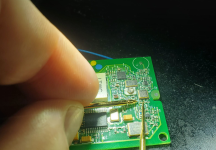
Hi Grant - I forgot to reply to this question. I have a variety of leads but my go-to are cheapies from Amazon, made by Bionso. They are silicone leads and the probes are interchangeable. The probes I use for this type of work are the 1mm sized ones. Here's a link to the current Amazon listing: https://www.amazon.ca/dp/B0CXQNVRJG

And here's a few comparison pictures of the 1mm vs 2mm probes:

1767285638523.png
1767285668845.png
1767285743126.png
 
OP
G

Grant Gunderson

Well-known member
Joined
May 17, 2013
Messages
2,319
Location
Bellingham, WA
Hi Grant - I forgot to reply to this question. I have a variety of leads but my go-to are cheapies from Amazon, made by Bionso. They are silicone leads and the probes are interchangeable. The probes I use for this type of work are the 1mm sized ones. Here's a link to the current Amazon listing: https://www.amazon.ca/dp/B0CXQNVRJG

And here's a few comparison pictures of the 1mm vs 2mm probes:

1767285638523.png
1767285668845.png
1767285743126.png
Thanks! I ordered those along with some metering tweezers as well as a set of HAKKO hot tweezers.

I still need to see if I can read the numbers off of those components. Will be a project once things settle after the holidays and the kids are back in school.
 
To avoid these ads, REGISTER NOW!
Top Bottom