This is a one step forward and two steps back sort of post.
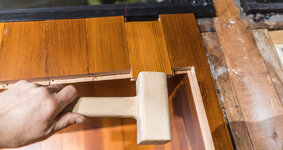
With the boxes in place I had to start to figure out how to get the fir to wrap around, in and onto the the cabinets. There's a ton of stupid returns and no real obvious path or direction and I spend a lot of time staring at it trying to figure it out. I knew I needed to fur out the inside of the upper display area so I could start installing the fir so I tacked and glued in some furring strips so I'd have something to nail the fir to. Sort of makes me wonder if they should firring strips. The first board to meet the cabinet from the wall was going to have all these ridiculous cuts, miters and worrisome places where things need to join.
I decided that I needed to make the doors so I could use them in the calculations. Since they're to be 1/4" or, more technically 6mm, I decided to make them in one go.
By keeping the boards clamped together while I was cutting them to size I kept them identical.
I write on the hole drilling rail so I know where to drill and where to skip. The hinges have to be exactly between the other set of holes so the stop on the rail is flipped from 16mm to 32mm.
Meanwhile the truly productive family member is ripping the scrap boards into shelves.
The doors went on and I headed off to pistol practice where I shoot with Ben on the Portland team. It's one of my regular "guy" nights out and after I was able to ask Ben about my many mitered dilemma.
I was looking at so many miters and so much complicated joinery it was really making me feel like I was not going to be able to make this look right. Fortunately, when Ben isn't convincing me to buy, say a Pardini 22, he's also good at talking me down when I've gone to too far. His sage advice?
It's a midcentury house - everything is supposed to be simple. There are no miters in a midcentury house. Plywood isn't even edge banded (they had better plywood then) and construction is always simpler than you expect. Plus, he added, the boxes should have some kind of border to set them off. We've been using a three color chord of natural wood, white and black and I should set off the display area with some black trim. Add a border and use that to terminate the end grain of the fir. End grain miters never go well and my plan included a lot of them.
His idea was both excellent and liberating. My ideas were way too complicated and not really in keeping with the house. So today I bought some 5/4 fir which I would use to make a small trim line and to intercept the end grains. 5/4 is actually 1" in the real world and using that on the 3/4 fir (which is 3/4 - go figure) leaves it 1/4" proud which should look good I hope.
The same jig that I used to keep the cabinet sides the same width has an attachment to make small strips so I set it for 6mm and started ripping 1" strips of 6mm - because at this point I use whichever unit is closer to me at the time.
These will be sanded down and painted black and soon I'll have an idea of how I'm going to use them.
Sadly, it was around this time that I thought to adjust the hinges to make them square, flat and ready for the doors to accept the first fir that I noticed that they were askew and beyond my ability to adjust them with the hinge plate adjustments. Upon closer inspection the line of holes that was supposed to be drilled at exactly 37mm from the edge was off. On every cabinet.
This is what it should look like but...
Somehow when I set up the jig I messed up and one of the two rails was off. By about 4-5mm which meant the strip of holes wasn't aligned perfectly to the edge and that made it beyond the adjustment capability of the hinges. At this point I didn't take any photos because I was feeling really queasy. It meant that all the cabinets were wrong and the only thing to do was to do them all over.
Lara tried to think of a way to rescue it but I've been down this road before. When you're using this stuff it has to be bang on accurate. Maybe you can be off by 1mm but much more and things cascade into a disaster.
I realized that because we built the cabinets all symmetrical I could swap the sides and redrill them and only have to remake one side panel where we cut the hole for the electrical box.
I can't tell you how happy I was that we didn't glue the boxes up. We took them out, unscrewed them and banged them apart. I reset the jig and checked it about 10 times. Then a couple more. Then I re drilled all the holes (save the center panels which just hold shelves) on the back of the sides.
So we end the day seemingly farther behind than we started. It will be a miracle if this gets done in time.
Gregor


 That's an awesome description!