To avoid these ads, REGISTER NOW!

MIG welder problem

Aquaticbob

Well-known member
Joined
Dec 3, 2013
Messages
488
Location
Seattle
I have a lincoln handy mig welder I've been learning on the past few months, and it's now starting to have a strange issue.

After welding for about a 30 to 45 minute period, with welding times of no more than like 15 seconds at a time (max) on and off for the whole time my all of the sudden I'll be welding along and it starts kicking back like there's too much wire feed, then it goes back to normal as I keep working along. I have been cleaning my metal very thoroughly with an angle grinder to the point where it's nice and shiny right before I weld on it.

I'm good on my gas flow, I've triple checked that
I've tested over and over and my settings are good for the metal thickness
My metal is clean as I can get it

For example: I'm welding a T joint, and about halfway through it starts kicking back and popping like too much WFS, so I kill it. I start over again right at that point and it's fine until I move another .5" and then it starts again. This time I keep going, and after maybe 2 seconds it's back to bacon sizzle. I'm at a loss as to what could be going on other than my wire feeder is inconsistently feeding. Any ideas?
 
To avoid these ads, REGISTER NOW!

dodgemike

Well-known member
Joined
Feb 7, 2014
Messages
92
I have the 3200 HD Lincoln. Don't
want to insult your intelligence, but do you have the
drive roller flipped for the wire size your using? The
tension on the roll is critical also. Only other thing I
could think of is if something happened to the liner.

Sent from my SCH-S720C using Tapatalk 2
 

Danguitarman

Well-known member
Joined
Nov 3, 2013
Messages
180
Location
Twin Cities, MN
I've used crappy spools of wire that will hang up in the feed rollers, liner, or tip. Is the tension on the rollers set correctly? If you have them too tight, it'll sorta smash the wire so it wants to curl and do funky stuff. I'd also check both sides of the lead where the wire goes in and out of it. If there's any sorta ragged edges that the wire might touch, file em down till they are smooth. Sounds to me like your wire's hanging up on something or you just have a crappy spool. Hope this helps.
 
OP
A

Aquaticbob

Well-known member
Joined
Dec 3, 2013
Messages
488
Location
Seattle
I have the 3200 HD Lincoln. Don't
want to insult your intelligence, but do you have the
drive roller flipped for the wire size your using?

Yep flipped that when I put my new spool in. Forgot to mention that above.

I've used crappy spools of wire that will hang up in the feed rollers, liner, or tip. Is the tension on the rollers set correctly? If you have them too tight, it'll sorta smash the wire so it wants to curl and do funky stuff. I'd also check both sides of the lead where the wire goes in and out of it. If there's any sorta ragged edges that the wire might touch, file em down till they are smooth. Sounds to me like your wire's hanging up on something or you just have a crappy spool. Hope this helps.

Tension is good. I don't see anything that the wire could be getting caught on, on either end of the line. I might try turning the feed speed low and running a bit of wire through and see if I see anything on the inside. It's weird it only does it after quite a bit of time. I think I'll take a second thorough look over everything mentioned and what I've tried to see if there is some random problem somewhere
 

rsanter

Well-known member
Joined
Dec 22, 2007
Messages
18,487
Location
visalia ca
Pull your liner and inspect it. You may have a kinked liner that causes an increased resistance when in certain positions.
Sounds like a problem I have had in the past

Bob
 

Danguitarman

Well-known member
Joined
Nov 3, 2013
Messages
180
Location
Twin Cities, MN
I really wouldn't put it past the wire itself, either. Sometimes they spool it up weird, so in certain spots it'll sorta "wobble" like it's not straight. It usually happens when the wire's almost used up on the roll, but I've had it happen intermittently throughout the entire roll.
 

Rookie2

Well-known member
Joined
Feb 27, 2013
Messages
1,925
Location
Western Pa.
Kicking back , does it push the gun away from the work ? If it pushes away without burning hotter then it may be a loose electrical connection. gun or ground, If the wire speeds up at those times then i would suspect the wire feed speed control circuit.
 
To avoid these ads, REGISTER NOW!

zkling

Well-known member
Joined
Jan 23, 2007
Messages
16,939
Sounds like you are dropping "voltage". Try cranking the voltage up high for a given feed and see if you still have the problem. That would help to indicate if there was a true problem with the power source. Like Rookie said, check all connections to make sure they are solid.
 

beakie

Well-known member
Joined
Feb 21, 2014
Messages
492
Location
Ontario, Canada
before mucking around too much with settings, liners, internals, etc

check your ground.

as much time as you spend grinding where you are about to weld, if you don't have a proper ground you aren't getting 100% of the current transferred.

look at how your ground clamp touches the material, it's a very small contact patch of metal on metal.
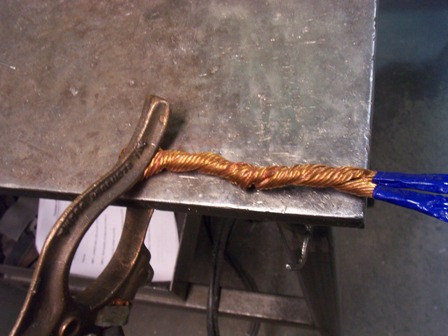
simple solution, grab short (1') length of welding wire, strip all sheath off, except 2" off each end. clamp onto that, onto the work piece... make a sandwich, for lack of a better term.

much better ground, simple, and even if it doesn't resolve this situation of yours, it is of great benefit in the future.


EDIT

quick googling and here is an example
better-ground-1.JPG
 

Engine

Well-known member
Joined
Jan 9, 2014
Messages
646
Location
Kentucky
I had a similar problem with my Hobart Handler. I finally concluded that it was a ground problem. It usually happened after I had been welding on the same piece for over a minute steady. Now I'm more careful to put the ground clamp close to the joint and to be sure the surface is clean. It seems to happen a lot less often now.
 

C96

Well-known member
Joined
Nov 30, 2013
Messages
1,251
Not familiar with a handy mig, but sounds like it might be a portable 120 volt unit. If this is the case, make sure to plug the unit into a 20 amp dedicated circuit. If you’re on just a general purpose outlet any other intermittent load shared on the circuit could be causing your problem. Also, don’t use extension cords as the voltage drop may be adding to the situation.

Good Luck :thumbup:
 
To avoid these ads, REGISTER NOW!
Top Bottom