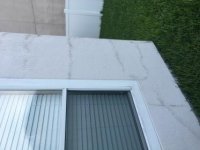
I am a new homeowner to this 15 year old house that was coated with Sherwin Williams sherlastic elastomeric coating last may. Over the last few months, and especially the last few weeks, I've had black mildew growing on the house that traces the cracks in the stucco. It seems the elastomeric coating bridged the cracks. It seems to only be happening on the south and west side of the house, which both get full sun. I can spray it with bleach and it washes off, but it comes right back. Is this normal? What can I do to prevent this?


You are using an out of date browser. It may not display this or other websites correctly.
You should upgrade or use an alternative browser.
You should upgrade or use an alternative browser.
Mildew on stucco along cracks
- Thread starter Weslsew
- Start date
bhonshell37
Well-known member
- Joined
- Dec 15, 2016
- Messages
- 92
When mildew or mold returns, then either one has penetrated beyond the surface
Sent from my SM-G955U using Tapatalk
Sent from my SM-G955U using Tapatalk
FRANKIEWHIPIT
Well-known member
I don't know that It'll work in your instance, I have use "wet & forget" with good results
http://www.homedepot.com/p/Wet-Forget-1-gal-Moss-Mold-Mildew-and-Algae-Stain-Remover-800006/203247154?cm_mmc=Shopping%7cTHD%7cG%7c0%7cG-BASE-PLA-D24-Paint%7c&gclid=EAIaIQobChMI-v72kvHH1QIViFcNCh3OogwzEAQYASABEgK2SvD_BwE&gclsrc=aw.ds&dclid=COf0wqjxx9UCFSK1swod32wMxw
http://www.homedepot.com/p/Wet-Forget-1-gal-Moss-Mold-Mildew-and-Algae-Stain-Remover-800006/203247154?cm_mmc=Shopping%7cTHD%7cG%7c0%7cG-BASE-PLA-D24-Paint%7c&gclid=EAIaIQobChMI-v72kvHH1QIViFcNCh3OogwzEAQYASABEgK2SvD_BwE&gclsrc=aw.ds&dclid=COf0wqjxx9UCFSK1swod32wMxw
73RR
Blank Email
You have moisture under the coating. Mold and mildew need moisture to stay alive and grow. Was this noted on your pre-purchase inspection? If so, what was done/offered at that time? Or, possibly worse, was the fresh coating applied just before you bought the house? If so, you may need some 'other' professional help.
ard
Well-known member
Location???
There are some massive stucco failures going on in California. You need a professional inspection....
There are some massive stucco failures going on in California. You need a professional inspection....
I am in Florida. If it makes any difference, this started around early June, which is also when we started getting rain nearly every day. This has been a very wet summer. I thought it was normal for water to penetrate stucco. As to the coating, is that designed to seal the stucco surface? If so, how is moisture getting in and escaping through the cracks? This was not noted on the home inspection
ard
Well-known member
I am in Florida. If it makes any difference, this started around early June, which is also when we started getting rain nearly every day. This has been a very wet summer. I thought it was normal for water to penetrate stucco. As to the coating, is that designed to seal the stucco surface? If so, how is moisture getting in and escaping through the cracks? This was not noted on the home inspection
It is. And that is THE problem with these elastomeric sealer coats- they are in 'imperfect' water barrier. If water gets in, somewhere, the coating will trap it.
Wind blown rain will go many places. You cannot appreciate it, but thing of this on a macro level- not just looking at one little wall. Think of a large object like a house- and a gentle wind blowing across it. The pressure on the leeward side of the home will be lower than the windward side- not much, but some. Now add water sheeting down the walls. Does it get pulled in around the windows, up under the eves, places where the elastomeric sealant doesnt fully seal it? For sure. Then it is trapped under- the sun comes out, water vapor tries to escape, cracks the elastomeric where it is released- doesnt get great airflow, mold forms.
My 2 cents.
johnyg
Well-known member
the moisture got in some how.sounds they just sealed it in. in fla mold is gold for contractors so be care full !!!!

ard
Well-known member
That makes sense, and I guess the question is, why would you apply this coating without adding some sort of vent for the mositure to get out? The coating obviously can't be removed, so now that it's there, what can be done?
You can strip the stucco off the home and redo.
I really think you need a professional to look at this. I am not sure there are easy, cheap, robust fixes. I just don't know.
My concern is what this trapped moisture is doing elsewhere. THAT is the bigger worry.
What is the construction UNDER the stucco?
There's also been a massive amount of stucco failures in MN.
Neighbor had a house for sale. Stucco inspector called in and realized the damage/moisture issues. $100K to have all of the stucco removed, rotted framing replaced, sheathing, drywall replacement/repair, and new siding.
Neighbor had a house for sale. Stucco inspector called in and realized the damage/moisture issues. $100K to have all of the stucco removed, rotted framing replaced, sheathing, drywall replacement/repair, and new siding.
Last edited:
Finally
Well-known member
The picture is of the first floor, most are block in Florida. Though, the cracks don't look like typical "step" cracks. If block on the first floor, nothing you can do with the stucco, just start looking at all your penetrations.
You should look at a few areas that are typical sources of water intrusion..
1. Windows.. not just the exterior seal against the stucco, but the window frame bottom corners always leak. Use a good quality silicone around all frame corners
2. Exterior penetrations.. A/c lines, electrical, boxes.. etc
3. Back pitched soffit. The driving rain can follow the soffit and go behind the stucco. If you don't have the correct accessory (or mid wall) as noted above, the water cannot drain correctly.
4. Even if you have a midwall joint, it too could have been installed incorrectly and leaking.
Do you see any delamination? Buckling of the stucco. If so, there is nothing you can do at that point but remove the stucco and assess the source of water intrusion.
Anyway, just like an engine, there are many things that can lead to a failure. Process of elimination will help.
You should look at a few areas that are typical sources of water intrusion..
1. Windows.. not just the exterior seal against the stucco, but the window frame bottom corners always leak. Use a good quality silicone around all frame corners
2. Exterior penetrations.. A/c lines, electrical, boxes.. etc
3. Back pitched soffit. The driving rain can follow the soffit and go behind the stucco. If you don't have the correct accessory (or mid wall) as noted above, the water cannot drain correctly.
4. Even if you have a midwall joint, it too could have been installed incorrectly and leaking.
Do you see any delamination? Buckling of the stucco. If so, there is nothing you can do at that point but remove the stucco and assess the source of water intrusion.
Anyway, just like an engine, there are many things that can lead to a failure. Process of elimination will help.
The home is wood frame. No signs of any delamination or buckling. I do have weep screeds.
This is only occurring on the south side of the house on the first floor, and in the south half of the east side of the first floor. The stucco goes right up to the window frames, and there are no other penetrations in the area.
This is only occurring on the south side of the house on the first floor, and in the south half of the east side of the first floor. The stucco goes right up to the window frames, and there are no other penetrations in the area.
ard
Well-known member
There's also been a massive amount of stucco failures in MN.
Neighbor had a house for sale. Stucco inspector called in and realized the damage/moisture issues. $100K to have all of the stucco removed, rotted framing replaced, sheathing, drywall replacement/repair, and new siding.
Hearing the same stories, and a neighbor who was replacing some trim and stumbled upon issues. Lots of $$ to fix.
OP, I am not saying this is your issue- BUT it is important you get to this in case it was a failure to disclose or improper repair done immediately prior to your purchase. If you avoid or wait until you try to sell it could be a real mess.
Hope it is simple though....
73RR
Blank Email
...what he says...^^^^^^^^
Zeke
Well-known member
I am a new homeowner to this 15 year old house that was coated with Sherwin Williams sherlastic elastomeric coating last may. Over the last few months, and especially the last few weeks, I've had black mildew growing on the house that traces the cracks in the stucco. It seems the elastomeric coating bridged the cracks. It seems to only be happening on the south and west side of the house, which both get full sun. I can spray it with bleach and it washes off, but it comes right back. Is this normal? What can I do to prevent this?
The Wet and Forget that was mentioned is a far cry from bleach and will travel to the roots of the mold.
But first of all you shouldn't be having cracks like that especially since elastomeric should be flexible enough to bridge the cracks. I'd look into sandblasting, replastering with a sand finish coat of Type III cement and a stucco finish coat in the texture of your choice.
The Type III intermediate coat is a little known technique that applies a skin coat of the type of cement known as "high early" which is used in emergency repair of concrete roadways and indeed, the repair of a temporary street circuit race track such as the Grand Prix we have here in Long Beach. It will really toughen up your walls but won't cure any underlying problems which you should investigate.
One more piece of advice from a 47 year veteran of the contracting business: don't rely on the advice of most contractors unless you know damn sure that they are experts at exactly what you need done. There is no school for becoming a contractor and most these days have never served an apprenticeship in their line of work. They work a few years probably for some cat that ain't that good to start with and then come off the starting line as contractors themselves. The blind leading the blind.
Multi generation contractors tend to know more and fly by nights need to be culled. Expect to pay for experts but don't buy into any elaborate scheme. Most problems are simple when broken down.