To avoid these ads, REGISTER NOW!

Mill head tramming, alignment

PWC Repair

Well-known member
Joined
Dec 27, 2012
Messages
3,165
Location
Arkansas
I spent a couple hours today getting my mill head straight. I've got it right now sweeping around the table within about 1/4 thou. Didn't change any moving the table to either end. I figured this was good enough for anything I'll be doing. So, what say ye machinists? Is this OK or do I need to have it exact dead nuts?
I used my longest bore centering indicator.
 

Attachments

  • GOPR0028.jpg
    GOPR0028.jpg
    119.5 KB · Views: 265
To avoid these ads, REGISTER NOW!

RoninB4

Well-known member
Joined
Jul 22, 2020
Messages
3,482
Location
Under My House
Not sure what you mean by "1/4 thou", it's standard practice to use decimals and numbers like .00025 instead of 1/4 thou. Not trying to be a jerk here, just trying to get you to speak the language machinists use.

While I applaud you spending the time/effort to get the head trammed in I have a couple of thoughts on the matter if you're interested:

1) I kinda doubt you're getting an accurate reading with that setup. Using the tip of the indicator on a mill table surface that has imperfections far greater than .0005 can/will show a variety of readings. Do you know how small even .001 really is?

2) Tramming the head depends upon just how accurate the intended work needs to be. For general mill work it only needs to be about .001-.003 over a swept area of 6" or so. That would make the head perpendicular to the table about .0005 per inch. Most side milling jobs are on stock 1" or less. Greater accuracy than .001 per inch on a knee mill is wishful thinking.

3) The moment you move the knee up or down that tram may very well change due to the clearance required for it to be a slide fit. It's a knee mill not a Moore jig borer.

4) Moving the table in the "X" axis can also change the tram as the overhanging weight of the table influences the tram for the same reasons listed in #3

5) Moving the quill up or down can change the tram depending upon how much wear is in the quill-to-casting clearance.

6) What you've achieved is a static reading. Will it stay that way during the milling process? Knee mills are notorious for flexing while machining, having cutter deflection, and prone to vibrating enough to leave ripple marks on the milled side walls. Depending upon the condition of your mill and how heavy a cut you attempt it may even throw the head out of perpendicular alignment.

7) You don't even have your table locks set to half way, this can affect how the table sits on the saddle. Usually not important but try using a DTI (.0005 graduations) and see how much the reading changes when applying the table, saddle, and knee locks. You might be surprised. Same goes for the quill. The locks are there for a reason.

I appreciate the effort you've gone to and the desire to achieve accuracy/precision but it's a knee mill, some refer to a knee mill as a graduated drill press. Better to set the tram to how accurate you need the work to be. Excessive attempts at precision where it's not critical is wasted. Precision is a rabbit hole and you need to know how deep NOT to go in order to get on with the job. Attempts to achieve greater precision than the machine is capable of is an exercise in futility, I was like that when I entered the trade in 1977.

Either adjust your expectations, techniques, or buy more machinery capable of the accuracy/precision the job calls for (which is another rabbit hole). I applaud your efforts, keep at it. Ganbatte.
 
Last edited:

Ign

Well-known member
Joined
Jul 7, 2006
Messages
12,769
Location
Butte Peak ND
Under 3 tenths....yeah you're good.

If I can get it around a thou I'm happy -- usually I'll take under 2 thou. Anything better is a waste of time for a manual machine.

Ditto for indicating in your vise.
 

matt_i

Well-known member
Joined
Mar 14, 2008
Messages
10,722
Location
SE Michigan
Good to check as the bolts are tightened up (or maybe they already are! :))

That can change the reading slightly, sometimes you need a small amount of "windage" depending on the machine.

This is one I made in my youth, the welds are a little cringey as of now but hey, it was early. The tramming bar can just be a bolt bent in a vise and a solid point to hold the indicator.

I use a mostly solid (1 hole) 1-2-3 block to span over the table slots. Always a good idea to feel for burrs with your sensitive fingertips and very lightly stone the table there.

tramming_arm_1.jpg
 
Last edited:
OP
P

PWC Repair

Well-known member
Joined
Dec 27, 2012
Messages
3,165
Location
Arkansas
Thanks everyone.
Great info RoninB4
This knee mill I got was lightly used. It seems pretty tight. I did NOT try reading with the locks engaged, I'll try it. I DID however, try raising the knee, lowering the quill, and moving the table on X and Y axis, and everything stayed within .00025 EXCEPT with the knee down and table far right It was closer to .00050
I'm completely new to this but I have used one to mill a couple 2 stroke heads before.
My plan is to be able to drill holes more precisely, skim some damage off aluminum jet ski heads, and since I've got several trashed cylinders around....And I bought a boring head....I'll try to cut a cylinder to a satisfactory finish. And of course whatever else I might learn to do in the process.
 

Ign

Well-known member
Joined
Jul 7, 2006
Messages
12,769
Location
Butte Peak ND
Thanks everyone.
Great info RoninB4
This knee mill I got was lightly used. It seems pretty tight. I did NOT try reading with the locks engaged, I'll try it. I DID however, try raising the knee, lowering the quill, and moving the table on X and Y axis, and everything stayed within .00025 EXCEPT with the knee down and table far right It was closer to .00050
I'm completely new to this but I have used one to mill a couple 2 stroke heads before.
My plan is to be able to drill holes more precisely, skim some damage off aluminum jet ski heads, and since I've got several trashed cylinders around....And I bought a boring head....I'll try to cut a cylinder to a satisfactory finish. And of course whatever else I might learn to do in the process.

So yeah that's "two and a half tenths" and a "half thou."
 

BukitCase

Well-known member
Joined
Apr 11, 2017
Messages
1,075
Location
Oregon
Ronin's point #1 - I use one of these on the table

https://www.mscdirect.com/product/details/00150003

and the same indicator you used; use a feeler that keeps the tip on the granite, set rotation to slowest speed, takes maybe 5 minutes to check tram and maybe 20 minutes to CHANGE it.

If I have things that need slight changes, rather than take the head out of tram I have a couple angle tables - that way I can cut something at 23.9 degrees and go right back to the still trammed main table.

For that kind of operation, I have a couple of these

https://www.amazon.com/dp/B0054RJ7VC/?tag=atomicindus08-20

- you can zero them on the main table, then set them on the angle table and adjust for whatever "out of tram" angle you want. I like the flip up display on that model, comes in handy MOST of the time... Steve
 

MushCreek

Well-known member
Joined
Jan 14, 2015
Messages
9,743
Location
Upstate South Carolina
How do you know that granite is parallel? Every surface plate I've ever seen had a non-precision surface on the underside. They do make granite parallels ($$$)

I have a big (7" diameter) bearing race that I use for tramming. I first checked it on a surface plate to make sure it was flat and parallel.

I worked in a shop where we built very precise and complex plastic injection molds. We had hired a bunch of new guys that had completed a 4 year mold making program. One of the guys drilled a bunch of ejector pin holes, and they were out .017" over 1.875". When asked if he had trammed the mill, he didn't even understand the question! He swore they never taught that in school. Wow.
 

Air21

Well-known member
Joined
Nov 3, 2013
Messages
372
Your next step is to toss the vise up there, square it, then retram against the ground vise bed since that's what your work will actually be referencing off of.
 

RoninB4

Well-known member
Joined
Jul 22, 2020
Messages
3,482
Location
Under My House
All the granite surface plates I've seen have ONE planer surface for use, the bottom is neither planer or parallel to the other (reference) surface.

The bearing MushCreek uses is quite acceptable because he checked the ground surfaces on a surface plate. The size he's using, 7" OD, is a good choice for a knee mill.

Whatever is used has to be verified, even new 1-2-3 blocks can be out of parallel/square and oversize until checked. A feeler gauge does present a continuous surface but IMO is too easy to get inconsistent readings from if it's not dead flat/planer and has burrs on the cut edges.

Not slighting the methods used by anybody here and I'm not the last word in the machine shop either. Things I suggest are the methods, tooling, and instruments used by toolmakers in all the mold/die shops I've worked in for 40 years. Do whatever you want to.

MushCreek- He didn't understand tramming a mill head after 4 years in vocational school? Either he was asleep that day or he needs to get his money back.
 

RoninB4

Well-known member
Joined
Jul 22, 2020
Messages
3,482
Location
Under My House
Referencing the vise bed isn't always a great idea either. Once the work is squeezed in the vise the back jaw is the reference for that direction. Vises should be checked but not used for initial reference IMO. Not saying it's wrong, just not a good habit to use most home shop milling vises as a reference. YMMV.
 
OP
P

PWC Repair

Well-known member
Joined
Dec 27, 2012
Messages
3,165
Location
Arkansas
Your next step is to toss the vise up there, square it, then retram against the ground vise bed since that's what your work will actually be referencing off of.

Except the only vise I have right now is a SHARS angle vise. I saw a video I think 'Doc' made about trueing one up. Might try to follow that.

I'm reading every comment. I also know everybody does things a little different and I'll be no exception. I'm sure it will be like anything else that's a skilled trade, many different ways to come to the same end result. I have an OLD cast iron sine plate that a retired machinist gave me. He was a machinist his whole life in the Chicago/Romeoville area. He passed away a couple years ago. I'd like to skim this old sine plate to remove minor waviness and pitting. There are still many things I need to buy but I'm not made of money and I won't be fixing any watercraft until about April. I bought just enough to get the mill up and running.....Mostly 'Shars' from Discount Tool but I did pay a little more for the 'Certified' stuff.
-hold down, clamping set
-set of R8 collets
-jacobs chuck
-6ps 4 flute end mills
-2" adjustable boring head with bars
-centering indicator kit
-dial bore gauge kit
-3pc angle fly cutters....I use these to recut damaged squishband
-angle vise
-micrometer, caliper, square, ruler kit (cpp/shars quality) Hey, I'd love to have Mitutoyo, Starrett, Sharpe, etc....I just can't afford that right now.
-50ft 10ga bx cable......I have to power it up afterall.
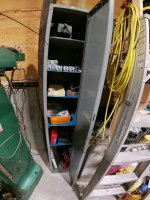
-old locker off Facebook, added shelves and it holds mill stuff only.
I still want a decent large vise, a set of parralell's, a tilting rotary table, some ball end mills, bore depth indicator set, a decent face cutter, and a full set of quality drill bits. So, on down the road, or when I win the lottery I'll buy more. I'm the type of guy that has fabbed up bracketry and spacers, and whatnot with no more that an angle grinder, dremel, and cordless drill :lol:. So I'm betting I'll figure out how to do almost anything on this mill. :thumbup:
 

Monza Harry

Well-known member
Joined
Dec 29, 2018
Messages
1,433
Location
Windsor ON
These are skills and will take time and use to improve, it seems like you are off to a good start! An angle grinder and cordless drill? You started off rich I see, I started out using dads single speed 1/4" B&D drill motor a hacksaw and a dull file. These beginnings do create the perseverance to get skills and use them! Here's a few other possible suppliers of mid to lower range tools with lower prices to go with the quality. Harry
https://cme-tools.myshopify.com
https://www.kittstools.com
And real (industrial quality tools) tools: https://www.pts-tools.com
These are near me so little involved in shipping for me, Arkansas IDK? Hope this helps, at least gives you some ideas for shopping around, there is one in WI that I can't remember the name of I'll edit when it comes to me.
 

RoninB4

Well-known member
Joined
Jul 22, 2020
Messages
3,482
Location
Under My House
I have an OLD cast iron sine plate that a retired machinist gave me. He was a machinist his whole life in the Chicago/Romeoville area. He passed away a couple years ago. I'd like to skim this old sine plate to remove minor waviness and pitting.

-There's a small chance I worked with him, I lived/worked in that area for decades. As for the sine plate I'd strongly advise NOT taking a skim cut with the mill because:

1) The marks left by whatever cutter you use will most likely be greater/deeper than the imperfections that are already on there.

2) A sine plate (if it's a true sine plate, not an ordinary adjustable angle plate) is considered a more precise piece of tooling. The original surfaces were/should have been finished on a grinder. Your mill is not capable of achieving planer/parallel finished surfaces to the accuracy a grinder can. The gent that gave you this would cringe if he saw you milling the surfaces.

I understand the desire to have clean and accurate surfaces. Resist the temptation to skim cut on the mill. Instead, use a larger 2 sided coarse/fine India type stone (often called a hockey puck in the shop) made of carborundum that Norton and other people sell. If you don't have one you'll want to get one. Use kerosene, mineral spirits, or light oil on the stone to keep it from clogging up, do not use most stones dry. With medium pressure go over the sine plate surfaces, keeping the stone flat on the sine plate surface, and rub in a figure 8 motion. There's a feel to knowing when the abrasive is "biting" and when it needs more fluid added. Wash the plate surface off periodically and check the swirl pattern. The idea is to get about 75% of the surface flat and free of displaced metal from dings. Flat surfaces, even if dull looking, are more important than shiny ones.

This method is also used on mill tables and most other surfaces in the shop to verify something is flat, blend in surfaces, and partly remove cutter marks. If you don't have a surface grinder this is what's used. They can be had for less than $20 and will last for years, store/soak in a container that will hold some kerosene/mineral spirits/light oil so it's always ready to use. I have more to say about these but this post is long enough already. Photo attached.
 

Attachments

  • Norton.jpg
    Norton.jpg
    100.3 KB · Views: 27
Last edited:

MushCreek

Well-known member
Joined
Jan 14, 2015
Messages
9,743
Location
Upstate South Carolina
If it's a precision sine plate, a surface grinder is the only practical way to get it flat and parallel. If cast iron, it could be hand scraped, but that requires a very high degree of skill and patience. You'd still have to have a way to check it for flatness and parallelism. There probably aren't very many machinists left that do hand scraping.
 

RoninB4

Well-known member
Joined
Jul 22, 2020
Messages
3,482
Location
Under My House
To identify a true sine plate/bar, there should be two cylinders mounted between the two plates. One is a pivot point, the other sets the angle by distance from the fixed plate. The distance between the centers of the two cylinders is critical, so is the diameter of the cylinders and the flat surface the moving cylinder contacts. Many used sine plates have been damaged by allowing the moving cylinder to drop/impact the flat surface it contacts, resulting in either a dent in the surface, a small flat on the cylinder, or both. This shows an out of parallel condition when indicated on the surface plate. It may look like it needs to be re-ground but it's just off due to the damage. Re-grinding in this condition will throw off the accuracy for angular settings. Careful inspection of all surfaces will reveal whether this is the case or not. I've included a photo of a sine plate and the cylinders for reference. Resist the urge to disassemble it for cleaning, just oil the hinged section and use the fine carborundum stone on any offending surfaces. A small pad of oiled felt between the cylinder and the flat surface should keep it from "clacking" together.

I agree with MushCreek (again). Stone it, check it, and use it. The elderly gent may have made it himself and that makes it irreplaceable since he gave it to you. Photos would be nice.
 

Attachments

  • Sineplate.jpg
    Sineplate.jpg
    36 KB · Views: 23
OP
P

PWC Repair

Well-known member
Joined
Dec 27, 2012
Messages
3,165
Location
Arkansas
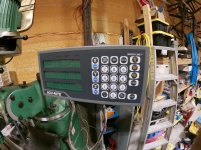
Apparently I was calling this plate the wrong name...I guess it's a 'surface' plate. Pics of it, and of the DRO after I cleaned the scum off of it. Also my mill locker, and the only vise I have right now.

Also for RoninB4, the old mans name was Vester Creech. And back in the day he had something with a 409ci in it that he used to drag race some. He said it came from the factory with 2 headgaskets on each side and you redid that to bump up the power and compression. Maybe it was an Impala??
 

Attachments

  • GOPR0033.jpg
    GOPR0033.jpg
    152.5 KB · Views: 50
  • GOPR0032.jpg
    GOPR0032.jpg
    115.8 KB · Views: 50
  • GOPR0034.jpg
    GOPR0034.jpg
    160.1 KB · Views: 56
  • GOPR0030.jpg
    GOPR0030.jpg
    149.1 KB · Views: 56
  • GOPR0029.jpg
    GOPR0029.jpg
    152.3 KB · Views: 58
To avoid these ads, REGISTER NOW!

RoninB4

Well-known member
Joined
Jul 22, 2020
Messages
3,482
Location
Under My House
Well....that does change things a bit. I would still NOT attempt a mill cut on that plate.

1) Cast iron surface plates are ground, never milled. Period.

2) The pores will never be removed, that's the nature of casting. Even on high end cast iron there will be pores. Tiny ones you need magnification to see but pores nonetheless.

3) Way bigger (looks that way) than a the working envelope of a mill. This surface plate still has uses you're just not aware of yet so don't toss it or use anything on the original surface that you have besides the "hockey puck".

I still say give it a good massage with the "hockey puck" using the fine side, light coat of oil, and call it a day. The light coat of oil is to prevent rust.

The vise you have is a serviceable one but it may very well "kick up" the workpiece once it's clamped because all the force is in one direction instead of in/down like a Kurt or one of the clones. Not saying it's a bad vise, just something to be aware of and check if the workpiece parallel/square is critical.

The name Creech seems vaguely familiar for some reason. Where did he work?
 
OP
P

PWC Repair

Well-known member
Joined
Dec 27, 2012
Messages
3,165
Location
Arkansas
7) You don't even have your table locks set to half way, this can affect how the table sits on the saddle. Usually not important but try using a DTI (.0005 graduations) and see how much the reading changes when applying the table, saddle, and knee locks. You might be surprised. Same goes for the quill. The locks are there for a reason.

Checked it out tonight.......yep, changed by a couple thou locking the ways. So I spent a couple hours doing it over. I really did try to get it as close as I had it before but DAMN, too far left, then too far right, then left.... Finally got within .005" in a 10" sweep with everything locked down. Tilt and nod were both off a bit. And I can move it around then lock it down again and still have within .005" Sometime tomorrow I think I'll try and mill a bit of aluminum and see what happens.
 

RoninB4

Well-known member
Joined
Jul 22, 2020
Messages
3,482
Location
Under My House
So I spent a couple hours doing it over.

-All the more reason to set the tram of the head per how close/accurate the operation requires. Tramming a head should only take about 10-20 minutes, Somebody suggested tightening the bolts/nuts that secure the head a bit at a time while checking the tram, this is SOP and a good procedure. Tightening just about anything on a knee mill (locks included) can throw the tram off, the BP clones seem even more prone to change. Like I stated before, think in terms of variance per inch rather than as a total (+/- .003 over 6" = .0005 per inch) and the length/width of the surface being cut. Shooting for better than .0005 per inch doesn't mean anything with a knee mill. Setting your vise parallel to table/saddle travel can be as close as you want, that's different than tram of the head.

If you need the tram closer than .0005 per inch then you're using the wrong machine IMO. Even if you did get it closer than I've listed is it going to stay that way after taking a healthy cut? Maybe/maybe not. If you're going to mill something have all the locks on except in the direction of travel. For that direction put the lock at half so there's a slight amount of drag, that takes up the excess play in that axis without causing undue wear to the lock mechanism. Good luck, post results.
 

dutchgray

Well-known member
Joined
Sep 28, 2014
Messages
6,461
Location
Dorset. England.
Should I really mention that I tram mine in by lowering the spindle down onto the table and rock it in until its sitting nice and gently tighten the bolts back up, takes 5 minutes and is good enough for anything I am doing on it.
 

RoninB4

Well-known member
Joined
Jul 22, 2020
Messages
3,482
Location
Under My House
Should I really mention that I tram mine in by lowering the spindle down onto the table and rock it in until its sitting nice and gently tighten the bolts back up, takes 5 minutes and is good enough for anything I am doing on it.

-If it's good enough for what you're doing then you're doing exactly what I've described, adjust the machine to what the task requires. I've eyeballed the protractor scale on the machine and merely adjusted to "zero" on some jobs. It was good enough for the bracket I was making.

Excessive precision is wasted if the task doesn't require it. Even if it was dialed in for closer tolerance work last time doesn't mean it stayed that way. Knee mills are notorious for going out of tram settings during heavy cuts. That doesn't mean knee mills are bad, just part of the design and the condition of that particular machine. Knee mills were not meant to take heavy cuts like a bed mill. Knee mills excel at versatility not rigidity. Horses for courses sort of thing.
 
Last edited:

larry_g

Well-known member
Joined
Apr 28, 2007
Messages
16,866
Location
oregon
-If it's good enough for what you're doing then you're doing exactly what I've described, adjust the machine to what the task requires. I've eyeballed the protractor scale on the machine and merely adjusted to "zero" on some jobs. It was good enough for the bracket I was making.

Excessive precision is wasted if the task doesn't require it. Even if it was dialed in for closer tolerance work last time doesn't mean it stayed that way. Knee mills are notorious for going out of tram settings during heavy cuts. That doesn't mean knee mills are bad, just part of the design and the condition of that particular machine. Knee mills were not meant to take heavy cuts like a bed mill. Knee mills excel at versatility not rigidity. Horses for courses sort of thing.

I have another view on this statement
Excessive precision is wasted if the task doesn't require it.

You are not wrong from the commercial shop view. The job shop has to get the parts out the door within spec and in a efficient manner. Those of us not doing this for a living should go through the exercise of setting up the machine for precision work if only for the experience and learning how it is done and what precision we can achieve on our machines. It is not a money making exercise but a learning exercise.

lg
no neat sig line
 
OP
P

PWC Repair

Well-known member
Joined
Dec 27, 2012
Messages
3,165
Location
Arkansas
Woo-Hoo!! Slung out some chips tonight!! I had basically a ruined Seadoo head. I set it up and indicated it, had to shim one side .020", then I took a cut with a 3/4" 4 flute end mill at 325rpm. That's fast in low gear on my Grizzly. It's a rough looking cut but doesn't feel that bad running a finger over it. Then I got excited while playing with power feeds and DRO and missed the section between the domes...:lol_hitti. I also put in a cutter I made to recut the damaged squishband.....worked like a champ :thumbup:. I have a 2 flute end mill, and also another flycutter and tool steel. I might just grind a tip into that steel and reface the head with that flycutter. Anyway, I had some fun learning a bit about my mill.
Things to note.....
-DRO sensors are plugged into the wrong holes, knee is x, etc.
-Knee power feed only works when variable knob is cranked wide open.
-Quill feed engaged makes the micro wheel spin but the quill doesn't move. Engage lever under the wheel feels stiff and doesn't act like it wants to stay engaged.
-If you speed up the left to right (X?) table feed over half speed the table makes a stuttering/vibration noise.
 

Attachments

  • GOPR0050.jpg
    GOPR0050.jpg
    150.3 KB · Views: 42
  • GOPR0051.jpg
    GOPR0051.jpg
    159.6 KB · Views: 47

RoninB4

Well-known member
Joined
Jul 22, 2020
Messages
3,482
Location
Under My House
I have another view on this statement

You are not wrong from the commercial shop view. The job shop has to get the parts out the door within spec and in a efficient manner. Those of us not doing this for a living should go through the exercise of setting up the machine for precision work if only for the experience and learning how it is done and what precision we can achieve on our machines. It is not a money making exercise but a learning exercise.

lg
no neat sig line

-If it's part of a learning exercise then I'd be inclined to agree with you. Nothing wrong with going the extra mile to become more familiar with your mill and gain some more experience. Perhaps I should have included that in my replies. The main point I was trying to get across is not to get into the habit of ALWAYS trying to dial a machine in to the highest degree of accuracy if it doesn't produce a better part. I guess I've done so many over the years that I've forgotten how valuable the first couple of dozen times can be for someone new to doing this. Valid point Larry.
 

RoninB4

Well-known member
Joined
Jul 22, 2020
Messages
3,482
Location
Under My House
To the OP- Not sure how flat the surface needs to be for good gasket sealing but some of those tool marks appear to be more than .0015 deep. Good idea to try on a ruined head to get an idea of what the mill will do, by your description the mill needs some minor work and lubrication on the way surfaces. You might also want to go over the surface with a good DTI to get an idea of whether the surface in a flat plane or not. As the table moves the weight can cause slight tipping, bow/cup, or otherwise influence due to wear. Would be good to know before doing this on a workpiece you need. Also, fly-cutting produces a "cupped" surface due to the tram error in direct relation to the diameter of the cut. A flatter surface is obtained with smaller diameter end mills. Yes it's more cutting passes and leaves tool marks. You're running the cutter too slow if the head is ENTIRELY aluminum with no steel inserts. Look up cutting speeds and you'll get better results. Did you use some sort of cutting fluid while cutting? A cardboard barrier helps contain the chips. Just a suggestion.

Congratulations on your first job.
 

wayout

Member
Joined
Dec 27, 2020
Messages
23
Location
pennsylvania
One thing to remember is that the job dictates the setup.
As an example, boring out a cylinder requires machine clamping forces that mimic the final installation.
All materials you will machine have a certain amount of 'spring' which needs to be accounted for when doing precision work.
 

zmotorsports

ALLIANCE MEMBER
Joined
Oct 20, 2009
Messages
21,312
Location
Northern Utah
Woo-Hoo!! Slung out some chips tonight!! I had basically a ruined Seadoo head. I set it up and indicated it, had to shim one side .020", then I took a cut with a 3/4" 4 flute end mill at 325rpm. That's fast in low gear on my Grizzly. It's a rough looking cut but doesn't feel that bad running a finger over it. Then I got excited while playing with power feeds and DRO and missed the section between the domes...:lol_hitti. I also put in a cutter I made to recut the damaged squishband.....worked like a champ :thumbup:. I have a 2 flute end mill, and also another flycutter and tool steel. I might just grind a tip into that steel and reface the head with that flycutter. Anyway, I had some fun learning a bit about my mill.
Things to note.....
-DRO sensors are plugged into the wrong holes, knee is x, etc.
-Knee power feed only works when variable knob is cranked wide open.
-Quill feed engaged makes the micro wheel spin but the quill doesn't move. Engage lever under the wheel feels stiff and doesn't act like it wants to stay engaged.
-If you speed up the left to right (X?) table feed over half speed the table makes a stuttering/vibration noise.


Congrats on making chips for the first time. To us non-machinists this is a HUGE deal.:beer:

A lot of great advice has already been given but one other thing that I learned was working with proper machine speeds was paramount in finish. Even learning early on it was encouraging to see proper finish and chip formation so I would suggest getting a copy of Machinist's Handbook and jot down some materials that you use the most and have it handy for a quick reference. It really will make your learning curve faster and will produce much more encouraging work.

For example, that .750" cutter on aluminum I would have been running around the 1200-1400 RPM range. Tom Griffin over at Tom's Techniques has an excellent video on surface speed calculations and it helped me a lot when I was learning. Hell I'm still learning.

Example. The formula I use is cutter speed in fpm x 4/ cutter diameter. Using your .750" cutter and aluminum cutting speed of ~250. 250x4/.750= ~1333 RPM.

Best of luck.
 
Last edited:
OP
P

PWC Repair

Well-known member
Joined
Dec 27, 2012
Messages
3,165
Location
Arkansas
Yes, before I started on the head I ran the table around to make sure we were flat before I clamped down and indicated the head. I also thought maybe I should have cranked up the RPM's as it didn't sound like the end mill was working very hard. Now on the squish area I feel like the RPM was about right, I took .045" down in that squish and still didn't remove all the damage! I am aware of clamping forces and trying to mimic those forces because of distortion. These watercraft engines are almost ALL aluminum. There are some steel dowels here and there and most have steel sleeves in the cylinder. I did spray a bit of WD40 as lube but I read that a mix of kerosene and 2 stroke oil works well for machining aluminum. Since I have both on hand I'll mix some up into a little squirt bottle. I'll lube the tableways and pull out the quill engage assembly and see what's going on. Thanks again guys!
 

larry_g

Well-known member
Joined
Apr 28, 2007
Messages
16,866
Location
oregon
. I'll lube the tableways and pull out the quill engage assembly and see what's going on. Thanks again guys!

On the quill drive be sure that you are doing things correctly. I once was on a strange to me mill and could not get the quill feed to engage. I seem to remember on that mill it took ~3 steps to get the quill to move. Set the quill to about mid stroke to make sure that you are off the kick-out and try from there as I seem to remember that was my problem on the strange mill.

lg
no neat sig line
 

zmotorsports

ALLIANCE MEMBER
Joined
Oct 20, 2009
Messages
21,312
Location
Northern Utah
I'm surprised the cylinders are steel lined in the water craft, I was heavily involved in building 2-stroke and some 4-stroke race engines for ATV's and snowmobiles for about 25 years and when I got out of it back around 2012 most everything was Nikasil coated and liners were pretty rare.

As for aluminum cutting fluid, I've become fond of Relton's A9 cutting fluid. I'll usually use either that or WD40 when cutting aluminum.
 
OP
P

PWC Repair

Well-known member
Joined
Dec 27, 2012
Messages
3,165
Location
Arkansas
Zmotorsports, It does seem odd that they stuck with sleeves for so long but maybe it's because these things constantly cycle fresh water. If you run in cooler water and don't allow warmup you can cause a '4 corner' seizure for sure. With the sleeves it's just a simple bore job. The powervalve Yamaha 800 & 1200, and the Kawi 1200 'Ultra' 2 strokes are plated with no sleeve. And most of the new 4 strokes are plated (except Rotax) BUT, they also run a thermostat system to keep engine temps controlled.
 

zmotorsports

ALLIANCE MEMBER
Joined
Oct 20, 2009
Messages
21,312
Location
Northern Utah
Zmotorsports, It does seem odd that they stuck with sleeves for so long but maybe it's because these things constantly cycle fresh water. If you run in cooler water and don't allow warmup you can cause a '4 corner' seizure for sure. With the sleeves it's just a simple bore job. The powervalve Yamaha 800 & 1200, and the Kawi 1200 'Ultra' 2 strokes are plated with no sleeve. And most of the new 4 strokes are plated (except Rotax) BUT, they also run a thermostat system to keep engine temps controlled.

That could be the determining factor on why they're still using sleeves. Cold seizures were a problem on sleds if the owner didn't warm them up properly before flogging on them. Most of my clients left my shop with the understanding of proper warm up but I saw a lot come in who were first time customers and just simply didn't know of the risk. ATV's were somewhat prone but not nearly as common as on the sleds.
 

Shadowdog500

Well-known member
Joined
Dec 7, 2009
Messages
9,828
Location
Down the shore
My neighbor was a machinist and this is the method he showed me using my coaxial indicator.
my head don’t have a nod so I only tram the tilt.

Tram to the table. You are really traming the head to the plane that the table moves on and the top surface of the table is the closest you will ever get to that plane. If your vise don’t tram the same as the table try to figure out what’s wrong with the vise.
 
Last edited:

Provincial

Well-known member
Joined
Sep 21, 2011
Messages
6,855
Location
Near Salem, OR
I ended up with a brand new Honda Accord brake rotor. I checked it for runout, and it is as close to perfectly parallel between the two faces and no runout as I can measure. I just clamp it to the table lightly and sweep the outer edge of the top braking surface. No dealing with T-slots!
 
To avoid these ads, REGISTER NOW!
Top Bottom