To avoid these ads, REGISTER NOW!

milling machine stand design: waddya think?

BTL-A4

Well-known member
Joined
Feb 28, 2018
Messages
1,252
Location
Santa Clarita
I bought a used Rong Fu round column mill. I need a stand for it. Thought I'd make one out of wood. It weighs 660 lbs, plus the weight of the vise and anything else I put on the stand. Has anyone made a stand for a mill like this, or anything else this heavy, out of wood? Any thoughts and comments are appreciated.

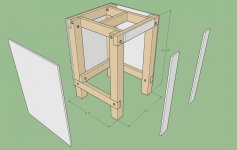
It's 4x4 posts supporting 2x4 cross members. Everything is bolted together with 3/8" bolts and nuts and washers. After seeing them load my machine in my truck supported by one 2x4 between the forklift tines, I think it's safe to build the stand out of wood like this.
In addition, I have 1/2" plywood panels screwed and glued to the outside. The bolt heads are installed flush so the plywood can go over them. I may even glue the 4x4's and 2x4's together. I will drill holes in the 2x4's to put the mounting bolts for the top in. The mill can then be mounted to the top. I plan to make the top at least 3/4" thick and may even double it up. The top is not shown in the sketch.
This design matches the rest of the garage (I built cabinets everywhere) and will help with any shear (think of the stand moving from a rectangle to a trapezoid).

I looked online for 2x4 load calculators and found one (http://www.timbertoolbox.com/Calcs/ddsimplebeam.html) that was easy to use that gave me a max load of 1130 lbs using "#2 Doug Fir-Larch" which is available at my local big box stores.

The mill rests on the top, so the load is spread out over the 4 posts and all the cross members, but the front and rear cross members are able to support the weight.

The depth dimension is driven by the depth of the mill base and location of the mounting holes, and the width dimension is driven by the width of the tool chest I'm putting under this.

I've included a sketch.

Thanks!
 

Attachments
  • wood stand sketch.jpg
    wood stand sketch.jpg
    85 KB · Views: 99
Last edited:
To avoid these ads, REGISTER NOW!

rattle_snake

Well-known member
Joined
Jun 25, 2015
Messages
5,175
Location
Chandler, AZ
Wood is fine and will support. Suggest glue instead of bolts.

Many metal workers avoid wood at all costs, well because. It's not metal.
 

DocsMachine

Well-known member
Joined
Sep 16, 2006
Messages
1,849
Many metal workers avoid wood at all costs, well because. It's not metal.

-Actually, the only reason machinists avoid wood, for a machine tool stand, is because it moves. Wood expands and contracts with humidity and temperature.

The thing is, that's not nearly as big an issue as some make it out to be. A mill in a base like that isn't going to change dimension just because it's humid outside- the base has no way to affect the location between the spindle and the table.

AND... even if you do have a "worst case example", a small lathe on a wood bench, even then the motion of the wood isn't going to impart much error, unless you're making jet engine parts and have to hold tenths. :D

That wood base will be fine.

Doc.
 

gorilla

Well-known member
Joined
Dec 13, 2007
Messages
1,650
I would add some brackets to the legs so you could anchor it to the floor if needed.
 
OP
B

BTL-A4

Well-known member
Joined
Feb 28, 2018
Messages
1,252
Location
Santa Clarita
They are through bolts with washers and nuts. I did not use screws because I did not want the wood to split. I designed it with the rabbeted ends to minimize movement.

You think 3/8" bolts are sufficient? 1/4" are too small and 1/2" are too big. The 3/8" washers are about 13/16" in diameter so I can fit them on the narrow ends of the rabbeted joints.

I thought about making it with mortise and tenon joints but I'm making it to match the rest of the garage, so what's under the covers just needs to be structurally sound.

I'm not worried about flex since I'm a hobbyist. These machines often come new with a metal stand that is known to be flimsy.

I'd like a metal stand, but that's beyond my budget at this time. I'd like to learn to weld at some point; this is the third time I've needed something that I could have welded myself had I known how. When the COVID restrictions are over, I may look into taking a welding class. The local community college has an excellent welding program.
 

RoninB4

Well-known member
Joined
Jul 22, 2020
Messages
3,491
Location
Under My House
Couple of thoughts:
1) Mill 600+ pounds, stand 100(?) pounds. Center of gravity very high and very top heavy.
2) Fairly small width/depth to height ratio with high center of gravity makes tip-over a big concern IMO. Cranking table out to ends with additional weight on it makes tip-over even more possible. You want this whole arrangement stable and rock solid, current stand design is ok for drilling some holes, not milling anything larger than a cereal box IMO
3) Bolting stand to wall and/or floor something I'd seriously consider. Either that or expand the stand footprint if you need to use wood. Anchor to floor/wall or reduce stand height.
4) That stand will allow the mill to vibrate, likely a lot. Not a problem if taking small cuts, bigger problem if heavy cuts are taken.
5) Through bolts/nuts with large/thick washers a good idea. I'd not want to trust only a glue that's subject to bond fracture from vibration. Some would say "Not going to happen" but 600+ pounds of milling machine requires a whole lot of faith in just a glue bond on wood fibers.
6) Maybe you can get out of the way if/when the mill tips over or the stand throws in the towel and it won't kill/injure you but that mill isn't going to be very useful if it does drop 3 feet to concrete. Ensure the safety of the operator AND the machine.
7) Welcome to the world of machining, it will throw chips everywhere so use barriers (even cardboard) to keep chips contained. Read, ask questions, be safe cuz machinery doesn't care if your fingers are in the way.
 
Last edited:

RoninB4

Well-known member
Joined
Jul 22, 2020
Messages
3,491
Location
Under My House
I'd like a metal stand, but that's beyond my budget at this time. I'd like to learn to weld at some point; this is the third time I've needed something that I could have welded myself had I known how. When the COVID restrictions are over, I may look into taking a welding class. The local community college has an excellent welding program.

-Using 3/8 through bolts will be fine, screws should be avoided here. The included metal stands ARE flimsy unless you reinforce the stand or aren't taking a heavy cut (you will at some point in the future).

-Taking a welding class is an excellent idea and will pay dividends in your future. For the cost of the wood and bolts you intend to use a trip to the local metal salvage yard could net you enough steel to fabricate a good solid stand for the mill. I recently made a stand to put a 400 pound transformer 6 feet off the ground.
 

Attachments

  • SAM_0349.jpg
    SAM_0349.jpg
    54.7 KB · Views: 73

matt_i

Well-known member
Joined
Mar 14, 2008
Messages
10,725
Location
SE Michigan
It can be useful to level it, and for sure you don't want rock. So you might work on some leveling feet.

The plywood shear panels are an excellent idea, I would consider construction-adhesive in your plans, something like Loctite 8X.
 

Monza Harry

Well-known member
Joined
Dec 29, 2018
Messages
1,433
Location
Windsor ON
I think that a wooden stand will work, I would use screws/bolts with glue. Points/concerns others have pointed out are valid, I would also add (small risk) is fire, so if you would consider using your stand as a temporary solution to get your mill operational to use for building your permanent stand and other projects, you will need to learn to weld for steel construction and the class you mentioned would seem as good a start point as any, with the bonus of giving you access to a machine you don't yet own to finish your stand. Perhaps discuss with the teacher weld sequencing for extra learnin' that wasn't, likely included in the first round of classes. I feel that your wooden stand should be fine to start, I would just keep in mind that there are pluses and minuses to that answer. Harry
 

mark8040

Member
Joined
Mar 8, 2007
Messages
18
I just finished a similar project for my Precision Matthews 727V. Only difference is that I built mine in steel. I'm certainly not trying to convince you to change your construction to steel, just thought you might want to see another design. The intent of the 3 drawer chest to hold tooling and measuring equipment and the bottom shelf to hold rough stock. I built the bottom shelf just high enough to get a floor jack underneath if I ever have to lift it up and get it on rollers to move.

Craftsmen 3 drawer center chest from Lowes. ~$100? Sanded of the red and painted to match.
Adjustable feet from McMaster-Carr.
3" legs, everything else 1 1/2" square tubing.
Aluminum expanded metal left over from another project.
3/4" plywood top.
Rattle can paint job, Rustoleum Smokey Gray.
 

Attachments

  • PXL_20201017_180534431.jpg
    PXL_20201017_180534431.jpg
    146.6 KB · Views: 139
  • PXL_20201017_180557191.jpg
    PXL_20201017_180557191.jpg
    146.6 KB · Views: 117

jmarkwolf

Well-known member
Joined
Jan 15, 2013
Messages
1,812
Location
Southeast Michigan
I made a very similar stand for my old round shaft mill. The 4x4 posts were not notched, and the 2x6 braces were bolted to the sides of the 4x4 posts, with 3/4in ply on the top and for the bottom shelf.

Outside top dimensions were approx 12in oversize for stability.

Lasted 15 years without problem until I sold it. Pic below.

attachment.php
 

Attachments

  • HF_Tabletop_Mill2.jpg
    HF_Tabletop_Mill2.jpg
    91.8 KB · Views: 541

lis2323

Well-known member
Joined
Dec 25, 2016
Messages
3,234
@mark8040. That is beautiful. Nice work!


While I can totally appreciate the design and craftsmanship that goes into many stands I’ve seen... wooden versions just don’t seem right for metalworking machinery. JMHO of course [emoji14]


Sent from my iPad using Tapatalk
 
To avoid these ads, REGISTER NOW!

larry_g

Well-known member
Joined
Apr 28, 2007
Messages
16,872
Location
oregon
I have just a bit of personal experience with metal vs wood stands with a lathe. When starting out in the hobby machining I acquired a Logan 10" lathe on a light weight 1" tube frame. That lathe would chatter enough to walk the whole stand about. Sometime later I bought a second identical lathe on a heavy wood stand. That machine was stable with little to no chatter. I swapped the lathes on the stands and the chatter followed the metal stand.

I concluded that the metal stand had a harmonic frequency near the lathe and the wood has a harmonic frequency no where near that of the lath and that the wood would actually damp out the vibrations of the lathe.

So take the above as one data point in your research. I believe that your stand is workable but I would suggest that you put a lower shelf on the bottom braces and then put a concrete pier block in there. Mass is your friend and anything that will damp out vibrations is good.

lg
no neat sig line
 

2oolhound

Well-known member
Joined
Dec 18, 2010
Messages
5,918
Location
BC Canada
I have the same machine. I'd gotten some 20' lengths of 4" channel for free (rusty) just prior so I made my stand out of steel and put a 3/8" steel top on it. I was anxious to get the mill going so I plugged it in before bolting it down to the deck. I quickly saw how much they vibrate. Knowing this I'm surprised to see the successful accounts of people using wood stands but it sounds like that would be adequate.

I started welding by buying a $60 stick welder and going at it. I'd read some books and there's youtube too but you don't need to wait till you take a coarse. Don't get me wrong, a coarse would be awesome but you can get going on your own before that cheaply. I've added a $40 mig now. I know I'm no welder yet but for many, many little things it's so handy. I test my welds by jumping on the work or wrenching etc. to make sure it's strong enough for what I'm doing.

Just sayin, if you see a cheap deal on an old working welder go for it as it pays for itself in spades fast. Just jumping in and doing it is experience which adds up and will only help if you eventually can take some coarses.
 

MushCreek

Well-known member
Joined
Jan 14, 2015
Messages
9,754
Location
Upstate South Carolina
If you have the room, make a small work bench, well wider than the mill. Then it won't tip over, and it will give you a place to lay tools and work pieces. If you don't have the room, find a way to ballast a smaller stand, like concrete in the base so it won't be topheavy. I've built wooden workbenches strong enough to hold a 2000 lb. plastic injection mold without the slightest sagging. I make the legs with tapered pieces of plywood, glued to a 2X4 inside. The 2x4 bears the weight, and the glued and screwed plywood prevents wobble.makes for a very strong, steady bench.
 
OP
B

BTL-A4

Well-known member
Joined
Feb 28, 2018
Messages
1,252
Location
Santa Clarita
Couple of thoughts:
1) Mill 600+ pounds, stand 100(?) pounds. Center of gravity very high and very top heavy.
2) Fairly small width/depth to height ratio with high center of gravity makes tip-over a big concern IMO. Cranking table out to ends with additional weight on it makes tip-over even more possible. You want this whole arrangement stable and rock solid, current stand design is ok for drilling some holes, not milling anything larger than a cereal box IMO
3) Bolting stand to wall and/or floor something I'd seriously consider. Either that or expand the stand footprint if you need to use wood. Anchor to floor/wall or reduce stand height.
4) That stand will allow the mill to vibrate, likely a lot. Not a problem if taking small cuts, bigger problem if heavy cuts are taken.
5) Through bolts/nuts with large/thick washers a good idea. I'd not want to trust only a glue that's subject to bond fracture from vibration. Some would say "Not going to happen" but 600+ pounds of milling machine requires a whole lot of faith in just a glue bond on wood fibers.
6) Maybe you can get out of the way if/when the mill tips over or the stand throws in the towel and it won't kill/injure you but that mill isn't going to be very useful if it does drop 3 feet to concrete. Ensure the safety of the operator AND the machine.
7) Welcome to the world of machining, it will throw chips everywhere so use barriers (even cardboard) to keep chips contained. Read, ask questions, be safe cuz machinery doesn't care if your fingers are in the way.

1-2. I was curious about what it would take to tip it over. The mill is currently on some moving dollies close to the floor. I extended the table as far to one side as I could and stood my 165 lb. weight on it. The mill didn't budge. I had to jump up and down to get it to move even a little.

3. I think bolting it to the floor will definitely help with stability.

4. I have a 12" lathe on a wood bench and it doesn't vibrate much unless I'm taking cuts that are too heavy. That's a sign to back off.

5. Yeah, I'm not fond of just glue either. I was planning on using 3/8" bolts.

6. See #'s 1-3.

7. Thanks. I've had a smaller mill and a lathe for a few years now. This stand is for a bigger mill since the one I have is proving too small.
 
OP
B

BTL-A4

Well-known member
Joined
Feb 28, 2018
Messages
1,252
Location
Santa Clarita
It can be useful to level it, and for sure you don't want rock. So you might work on some leveling feet.

The plywood shear panels are an excellent idea, I would consider construction-adhesive in your plans, something like Loctite 8X.

I was told that glue is not good for lumber this big due to the amount of flex. The joints can break. I asked about glue that moves with the wood. Does the Loctite 8X expand and contract with the wood?
 
OP
B

BTL-A4

Well-known member
Joined
Feb 28, 2018
Messages
1,252
Location
Santa Clarita
I just finished a similar project for my Precision Matthews 727V. Only difference is that I built mine in steel. I'm certainly not trying to convince you to change your construction to steel, just thought you might want to see another design. The intent of the 3 drawer chest to hold tooling and measuring equipment and the bottom shelf to hold rough stock. I built the bottom shelf just high enough to get a floor jack underneath if I ever have to lift it up and get it on rollers to move.

Craftsmen 3 drawer center chest from Lowes. ~$100? Sanded of the red and painted to match.
Adjustable feet from McMaster-Carr.
3" legs, everything else 1 1/2" square tubing.
Aluminum expanded metal left over from another project.
3/4" plywood top.
Rattle can paint job, Rustoleum Smokey Gray.

Nice! If I could only weld...
 

RoninB4

Well-known member
Joined
Jul 22, 2020
Messages
3,491
Location
Under My House
Why glue when fasteners are an inexpensive and reliable solution? A glue bond is only as good as the depth of penetration and the how secure those fibers are. Wood also absorbs moisture and may/may not affect the bond and/or fibers. Your call.
 

MushCreek

Well-known member
Joined
Jan 14, 2015
Messages
9,754
Location
Upstate South Carolina
The proper glue, properly used will be stronger than the wood. A joint without glue will eventually loosen up and become wobbly. You want glue AND fasteners; at least screws, and a few through-bolts wouldn't hurt to prevent a catastrophic failure.

Here is the work bench design I referred to. Glued and screwed it makes for a completely rigid assembly. I use solid core doors for a top. If I were putting a heavy machine on it, I would add another set of legs in the middle.
 

Attachments

  • bench1.jpg
    bench1.jpg
    42 KB · Views: 29
  • bench.jpg
    bench.jpg
    19.3 KB · Views: 33
OP
B

BTL-A4

Well-known member
Joined
Feb 28, 2018
Messages
1,252
Location
Santa Clarita
Well, I decided to get a steel one made. It seemed a better option and I found the money to do it.
Thanks for all the input and ideas. I hope someone else finds this info useful.
 

gte718p

Well-known member
Joined
Mar 12, 2009
Messages
3,972
My RF mill has been sitting on 2x4 base held together with deck screws for eight years. Works perfectly.
 
To avoid these ads, REGISTER NOW!
Top Bottom