To avoid these ads, REGISTER NOW!

Mind taking a look at this install-half done?

Gigfy

Well-known member
Joined
Jan 30, 2011
Messages
82
It's been awhile since I've done this kind of electrical. I'd appreciate letting me know if you see any safety issues. I figure it's easier to fix them now, before the sub-panel has branch circuits in it.

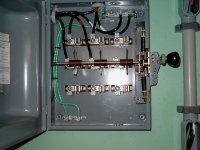
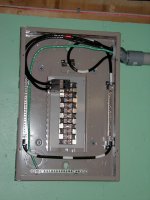
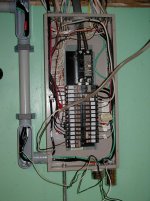
Pictures are of the main panel, transfer switch, sub-panel, and finally a picture of the whole layout.

The main panel is about 30 years old. The sub and transfer switch are brand new. I recognize there are some safety issues in the main (double tapped neutrals, no AFCI). I plan to fix those issues when I move some of the branch circuits over to the sub.

In the first pic, the wire sloppily hooked up on the main and running across the front of the pic is for the dryer, and it's temporary. Likewise, in the bottom of the picture, the wires for the lightning arrestor and surge protector are temporarily disconnected and just hanging there.
 

Attachments

  • P1010031.jpg
    P1010031.jpg
    140.4 KB · Views: 726
  • P1010032.jpg
    P1010032.jpg
    135.5 KB · Views: 641
  • P1010033.jpg
    P1010033.jpg
    115 KB · Views: 627
  • P1010035.jpg
    P1010035.jpg
    97.2 KB · Views: 566
To avoid these ads, REGISTER NOW!

mrb

Well-known member
Joined
Dec 31, 2008
Messages
3,734
need a hold down for the backfed main breaker in your subpanel, and i dont know if you need to do anything bonding wise with the metallic offset ******* (why did you use them?)

other than that it seems ok, i would have laid it out a little different (out of the main panel, one LR up into the bottom of the transfer switch, straight out of the top left of the transfer switch into the subpanel)
 

mrb

Well-known member
Joined
Dec 31, 2008
Messages
3,734
what connects to the other input of the transfer switch?
 

Norcal

Well-known member
Joined
Mar 16, 2008
Messages
13,754
need a hold down for the backfed main breaker in your subpanel, and i dont know if you need to do anything bonding wise with the metallic offset ******* (why did you use them?)

other than that it seems ok, i would have laid it out a little different (out of the main panel, one LR up into the bottom of the transfer switch, straight out of the top left of the transfer switch into the subpanel)

The main is factory, but there is a hold down clip on the breaker.
 

oleguy

Well-known member
Joined
Nov 22, 2009
Messages
273
need a hold down for the backfed main breaker in your subpanel, and i dont know if you need to do anything bonding wise with the metallic offset ******* (why did you use them?)

other than that it seems ok, i would have laid it out a little different (out of the main panel, one LR up into the bottom of the transfer switch, straight out of the top left of the transfer switch into the subpanel)

what if you put a LL to bottom of xfer switch?
 

ishiboo

Well-known member
Joined
Oct 27, 2010
Messages
9,481
Location
Oshkosh, WI
It's been awhile since I've done this kind of electrical. I'd appreciate letting me know if you see any safety issues. I figure it's easier to fix them now, before the sub-panel has branch circuits in it.

Pictures are of the main panel, transfer switch, sub-panel, and finally a picture of the whole layout.

The main panel is about 30 years old. The sub and transfer switch are brand new. I recognize there are some safety issues in the main (double tapped neutrals, no AFCI). I plan to fix those issues when I move some of the branch circuits over to the sub.

In the first pic, the wire sloppily hooked up on the main and running across the front of the pic is for the dryer, and it's temporary. Likewise, in the bottom of the picture, the wires for the lightning arrestor and surge protector are temporarily disconnected and just hanging there.

The older CH panels always look like **** compared to the QO from that era. The neutral busses are always double-tapped and if you have to pull a wire out from the bottom its a damn mess.
 
OP
G

Gigfy

Well-known member
Joined
Jan 30, 2011
Messages
82
Thanks for taking a look at this and for the comments.

"I would have laid it out a little different (out of the main panel, one LR up into the bottom of the transfer switch, straight out of the top left of the transfer switch into the subpanel)"

You're right MRB. That would have made for a neater layout to come up through the bottom of the transfer switch, and I would have preferred it. The reason I didn't do it that way is because I didn't feel like there was a lot of room in the transfer switch to run both the feeder wires from the main panel and the feeder wires from the generator (not installed yet) up past all the transfer contacts. I just felt it could get a little messy running all those wires up through the bottom of the box, so I decided to sacrifice a little appearance on the layout in order to make it a little less cluttered around the contacts.

As Norcal mentions, there is a hold down for the main breaker in the sub. It's the little white looking clip. I guess that's the way Cutler Hammer currently does it.

On installing the generator input. I've decided to get a different generator and would be interested in opinions. Here's the background:

I've learned the generator I currently have is junk from the standpoint of electronics (solid state) devices, and will probably cook my furnace, microwave, etc.

I've looked into a power conditioner, but found a decent one is about the cost of a new generator. So I've decided to get a new generator.

I want a small one for several reasons (less fuel, less cost, less noise). I don't want one for luxury (to run my whole house) rather one to keep my furnace, microwave, a few lights, and maybe a TV for news. You can see, I really don't need one to run much.

From what I gather the little red Honda inverter generators are among the best for electronics and supposedly have a better source of power (in frequency consistency, wave distortion, and voltage regulation) than even what comes in from the PoCo. I believe they are also among the quietest and use less fuel. Not trying to do a commercial for Honda, just explaining the reason why I've decided on their generator.

I've narrowed it down to two options, and would appreciate thoughts.

One option is to get their 5000 watt inverter generator that has 220V capability. This would be a fairly straightforward hookup in the transfer switch.

The other option would be to get their 3000W inverter generator that has only 120V capability. If I used this one, I'd have to install my "critical" circuits on one leg in the subpanel (with "non-critical" circuits) on the other leg. Then hook the 120V generator up on the critical leg in the transfer switch. I wouldn't have any 220V circuits in the subpanel, so there wouldn't be any chance of backfeeding the other "non-critical" leg of the subpanel through a 220v device.

I would prefer the smaller 120V generator because it uses quite a bit less fuel, it's cheaper, and it's slightly less noisy. However, if there are better reasons to go with the larger 220V generator, I'd be interested in knowing them.

Thanks.
 

bjcouche

Well-known member
Joined
Sep 11, 2010
Messages
509
Location
Ohio
It's a bit hard to see due to the angle of the photo,but in your sub panel, is the neutral buss bar on the left side isolated from the box? If I remember that box manufacturer correctly, to use the panel with the neutral and ground bonded together (as you would for a main panel) the two buss bars are tied together as you did. To use it as a sub panel, you simply didn't install the jumper, and used the left as the ground and the right as the neutral. If indeed the buss on the left is insulated, you're good to go.

Also, in your transfer switch you have a terminal available for your generator's neutral to land to. But you don't have a spare terminal for the generator ground. I'm unsure if you can land the generator ground inside the sub panel instead. If the ground terminals are the pass through type, meaning you can use a continuous cable with it's insulation stripped in the center, you could use that method between the main and sub. But then you'd have to buy more ground wire to free up the terminal...

In investigating my setup (was installed before I bought the house) the transfer switch didn't have a buss bar for the neutrals. Both the neutral for the generator and the neutral from the main simply went through the transfer switch box and was terminated on the sub panel.

just some thoughts.
 
OP
G

Gigfy

Well-known member
Joined
Jan 30, 2011
Messages
82
BJ,

Thanks of the observations. The neutral bus bars in the subpanel are both isolated on plastic stand-offs. You bring up a good point. Originally the box came with both left and right bars on the plastic stand-offs but bonded to each other with a naked aluminum strap. The bar on the right was intended to be the neutral bar and could be un-bonded from the other bar, and un-bonded from the box. The bar on the left was intended to be the ground bar and was bonded to the box by the uninsulated aluminum bonding strap.

Although it may invalidate the UL listing of the box, I slightly altered the box by removing the uninsulated aluminum bonding strap, and replaced it with an insulated copper wire. I also added the ground bar at the bottom of the box. My reason for doing this was that CH's new AFCI breakers don't have a long enough neutral wire to reach the neutral bar if the neutral bar is on the other side of the box, so I decided to make a neutral bar on each side of the box by turning the ground bar on the left into a second neutral bar. I could have decided to splice extra length of wire to AFCI breakers, but wasn't really excited about having splices in a brand new box. If I did invalidate the UL listing by my alterations, screw em'. I figure it the lesser of two evils to add my own bonding strap and ground bar, vs. having to splice all the AFCI's on one side of the panel. CH needs to get their act together and make all their boxes with neutrals on both sides, or make longer wires on their AFCI's.

You may not see it clearly in the photo, but the ground bar on the transfer switch has two main lugs that sit on top of the bar (for the main panel to the subpanel) and then a regular slot in the ground bar itself (It's a green screw on the extreme right slot of the ground bar.) This regular slot accepts a #4 wire, and that's where I plan to put the ground for the generator.
 

bjcouche

Well-known member
Joined
Sep 11, 2010
Messages
509
Location
Ohio
I really like your creative reuse of the left bar as another neutral by removing or not installing the bonding screw, then changing the uninsulated jumper wire to an insulated wire. Then adding a commonly available ground bar that the box was designed to accommodate in the first place. The NEC is starting to get more concerned with panel neatness and your panel mod makes this more possible. I hate having to come into the side of a panel, land the black to a breaker on that side, then run the neutral clear around the entire box to the neutral bar. I fully agree about the AFCI white leads. Some manufacturers have neutral buses on both sides. Those that do not should be required to have their AFCI breakers with long enough leads to reach their neutral bar without splicing. My box has the AFCI's spliced due to this problem.
All told, excellent job. I can't find anything wrong with your design, you've obviously done some research to get this done properly. I'm very nit picky about my wiring, sizing, neatness etc. and would be happy to have this type of work in my home.

Brian
 

GreyOwl

Well-known member
Joined
Oct 23, 2007
Messages
550
Location
North Las Vegas
I thought I read somewhere on here a while back that the neutral was supposed to be switched along with both hots--to prevent a possible backfeed on the neutral. If I misread just disregard this comment.
Charles
 

mrb

Well-known member
Joined
Dec 31, 2008
Messages
3,734
I thought I read somewhere on here a while back that the neutral was supposed to be switched along with both hots--to prevent a possible backfeed on the neutral. If I misread just disregard this comment.
Charles

it depends on how the generator is bonded. its complicated but boils down to if the generator has N+G bond you have to switch the neutral and the gen needs a grounding electrode. if the generator is not N+G bonded you dont switch the neutral.
 
OP
G

Gigfy

Well-known member
Joined
Jan 30, 2011
Messages
82
"I thought I read somewhere on here a while back that the neutral was supposed to be switched along with both hots--to prevent a possible backfeed on the neutral. If I misread just disregard this comment."


Grey Owl,

I was originally under this assumption because my experience was w/ a 3-way switch switching the neutral. In addition, intuitively it seemed to be more disconnected from the power grid to switch the neutral. However, I've since learned that my original experience was set-up quite a bit different, and so it's not quite so simple.

As MRB points out, how the generator is bonded makes a world of difference. Honda inverter generators do not bond the neutral to the frame. As I mentioned this makes a huge difference in how the transfer switch is wired.

I would still prefer to switch the neutral (which has been my experience, and which is the way Canada's CEC code is written) but Honda inverter generators do not allow bonding of the neutral to the case ground. I called the manufacturer and talked w/ a service rep, and they simply do not allow a straightforward way to allow bonding of the neutral to the ground.

As such, per NEC guidelines, I'm stuck w/ running the neutral straight through.

NEC guidelines are well thought out. It can actually be unsafe to switch the neutral on a neutral un-bonded generator.

In another post, I've diagrammed how at least one side of the generator coil can go up through the transformer with an un-bonded generator and a switched neutral (not to say one side of a generator coil will automatically electrocute a lineman, but I'd prefer not to allow even one side of the coil (of the generator) to go up through the transformer).

All that aside, there is still something about this discussion that I don't understand and would use this as an opportunity to learn. To wit:

Schnieder electric has a web page that indicates a 220v generator w/ a floating neutral can have trouble regulating voltage if the transfer switch switches the neutral. In their words:

"These Diagrams show that a 3-pole transfer mechanism switching Line 1, Line 2 and the neutral conductors would result in a circuit that
does not comply with the rules of the CEC. In
stand-by power mode, a circuit exists in which
the system voltage from the generator could
float on each phase. In the most extreme case
240Vac would appear on one phase and 0Vac
on the second phase, potentially resulting in
damage to any 120Vac equipment operated in the home."

For the life of me, I can't understand how the voltage could "float" with an un-bonded neutral along with switched neutral at the transfer switch. Most 220v gen sets simply have two 120v coils that are connected at the middle to form a neutral (much like split-phase 220/110v service). How can one coil in a generator produce 220v, while the other produces 0v, in the example Schnieder electric points out. Any one out there familiar enough with electrical theory to explain this to me?

Here is the link to their page look specifically at the last page:

http://members.rennlist.org/warren/Gen_Panels_Appl_Note_EN.pdf
 
OP
G

Gigfy

Well-known member
Joined
Jan 30, 2011
Messages
82
Just an addendum.

I'd mentioned the CEC requires switching of the neutral. However, according to the link I posted, as well as other sources, this is not true. CEC appears to have the same rules regarding neutral switching as the NEC.

I had originally read some information that Canada requires neutral switching, but it's evidently not so.

There is so much mis-information out there dealing with electrical. Pardon my passing it on, I certainly don't want to add to the errors.
 
To avoid these ads, REGISTER NOW!
OP
G

Gigfy

Well-known member
Joined
Jan 30, 2011
Messages
82
Back again with a follow-up question.

I still haven't completed all the circuits in the new sub-panel (Slow going because I have a lot of other projects going on).

I've pretty much decided on running a few critical circuits from a Honda EU3000, for fuel efficiency, noise, etc. I know a bigger gen set would make things easier, but there seems to be certain advantages to me to staying with the 3000w portable generator.

The problem is the 3000w generator is only 120v.

I had planned on running just one leg of the sub-panel with the portable generator. However the other day I spoke with someone who ran both sides of their sub-panel with one of these Honda 3000w generators by using a jumper from one leg to the other.

Is there any NEC regs. that would permit this. I would rather do it this way than power just one leg of the sub-panel because by powering both legs of the sub, it would be easier to balance the load, since there would be a slightly greater load on one leg that would have the fridge, freezer, microwave. I may not run all these appliances at once when the generator is in use, but would run all these appliances when the running from the PoCo.
 

Alchymist

Well-known member
Joined
Mar 1, 2009
Messages
4,423
Location
Central PA
"I thought I read somewhere on here a while back that the neutral was supposed to be switched along with both hots--to prevent a possible backfeed on the neutral. If I misread just disregard this comment."


All that aside, there is still something about this discussion that I don't understand and would use this as an opportunity to learn. To wit:

Schnieder electric has a web page that indicates a 220v generator w/ a floating neutral can have trouble regulating voltage if the transfer switch switches the neutral. In their words:

"These Diagrams show that a 3-pole transfer mechanism switching Line 1, Line 2 and the neutral conductors would result in a circuit that
does not comply with the rules of the CEC. In
stand-by power mode, a circuit exists in which
the system voltage from the generator could
float on each phase. In the most extreme case
240Vac would appear on one phase and 0Vac
on the second phase, potentially resulting in
damage to any 120Vac equipment operated in the home."

For the life of me, I can't understand how the voltage could "float" with an un-bonded neutral along with switched neutral at the transfer switch. Most 220v gen sets simply have two 120v coils that are connected at the middle to form a neutral (much like split-phase 220/110v service). How can one coil in a generator produce 220v, while the other produces 0v, in the example Schnieder electric points out. Any one out there familiar enough with electrical theory to explain this to me?

Here is the link to their page look specifically at the last page:

http://members.rennlist.org/warren/Gen_Panels_Appl_Note_EN.pdf
I agree that the diagram is pretty confusing. As to the switched neutral, if the situation arises (and not just with a generator) whereby a panel with both 240 and 120 loads is ever fed 240 without a neutral, the two legs will unbalance. For example, lets say a 100 watt light bulb is on a 120 volt leg, and a 1500 watt toaster is on the opposite leg. The toaster, being a low resistance, will see a very low voltage, and the light bulb will see the majority of the 240 volts, and quickly self destruct. A neutral connection would have prevented this by supplying the current required for the toaster.

If a panel loses it's neutral connection, the voltage on each leg will be determined by the total difference in the 120 volt circuits on each leg.

This is the reason new installations are "load balanced" as much as possible - if the load on each 120V leg is the same, no neutral current flows. In other words, the neutral supplies current only for the unbalance in the 120 volt loads. Hope this helps.
 
OP
G

Gigfy

Well-known member
Joined
Jan 30, 2011
Messages
82
Thanks Alchymist,

As I understand it, you think they are saying if the danger of having a switched neutral on an unbonded generator is that if the neutral connection were lost on the generator (in standby mode) then the voltage would float.

In re-reading my last post, I thought it a bit unclear.

My inquiry is if there is anything in the NEC that would forbid wiring a 120v generator to both legs of the transfer switch, thereby providing 120v to both legs of the sub-panel? Obviously the generator wouldn't handle but just a few appliances at a time, but by powering both legs (vs. just one leg) it allow more options during a power outage, and I could better balance the load of the subpanel.
 

Charles (in GA)

Well-known member
Joined
Jan 11, 2006
Messages
12,489
Location
50 mi south of Atlanta
If you do not need more than half the breaker slots in the subpanel, I would not attempt to buss the two sides together, It would lead to confusion for someone later on, or even you in a few years. Just install the breakers on say the first row, the third row, the fifth row, etc, and this will put them all powered by one side of the buss.

Personally, I would have gone with a 240 v generator of larger capacity. 3000 isn't much.

Charles
 

mrb

Well-known member
Joined
Dec 31, 2008
Messages
3,734
you guys need to search for my posts on grounding vs bonding. im not going to repeat it again. It is very important to understand the role of proper 'grounding' so you dont kill yourself or someone else.

the reason for the N-G bond at the generator if neutral is switched is to provide a path for fault current. If you switch the neutral and dont have the bond, a short circuit will energize every bit of 'grounded' metal in the house and potentially injure someone.
 

fefarms

Well-known member
Joined
Jan 25, 2007
Messages
186
This is not at the heart of what you're looking for, but there's a 240 volt circuit at the lower right of your main panel in which the white wire has not been properly re-identified with black tape, paint, a sharpie, or the like.
 
OP
G

Gigfy

Well-known member
Joined
Jan 30, 2011
Messages
82
Thanks. You guys are regulars, and I appreciate your replies.

Mrb,

You're absolutely right, a ground fault in standby mode with an un-bonded generator and a switched neutral will electrify the system ground, all the cases - everything.

What had me puzzled was Schneider's comment that the voltage would float, producing 240v on one leg and 0v on the other. That question didn't really have any application to my situation (since I wouldn't install a generator that way) it was really more of an inquiry out of curiosity.

Charles,

Thanks for weighing in on this. Given the constraints, your saying it's best to settle for an unbalanced load in the sub-panel, than to bus the 120v generator output to both legs of the system.

A larger 240v generator would solve this issue, but I like the idea of a gen. with a pull start, quieter, and less fuel. Plus I don't need it to run much at a time but would like the flexibility to conveniently power different things, by flipping different breakers in the sub-panel.

Fefarms,

Thanks for pointing that out. I knew it needed to be marked and plan to do that before the covers go on. In the past I've marked wires with electrical tape when they needed to be re-coded, but the tape starts to come undone in a few years. This year, I've started adding a small bit of liquid tape to seal the end of the electrical tape in hopes that the electrical tape won't come undone.
 

wyliesdiesels

Well-known member
Joined
Aug 14, 2012
Messages
19,999
Location
Modesto, CA
Thanks. You guys are regulars, and I appreciate your replies.

Mrb,

You're absolutely right, a ground fault in standby mode with an un-bonded generator and a switched neutral will electrify the system ground, all the cases - everything.

What had me puzzled was Schneider's comment that the voltage would float, producing 240v on one leg and 0v on the other. That question didn't really have any application to my situation (since I wouldn't install a generator that way) it was really more of an inquiry out of curiosity.

Charles,

Thanks for weighing in on this. Given the constraints, your saying it's best to settle for an unbalanced load in the sub-panel, than to bus the 120v generator output to both legs of the system.

A larger 240v generator would solve this issue, but I like the idea of a gen. with a pull start, quieter, and less fuel. Plus I don't need it to run much at a time but would like the flexibility to conveniently power different things, by flipping different breakers in the sub-panel.

Fefarms,

Thanks for pointing that out. I knew it needed to be marked and plan to do that before the covers go on. In the past I've marked wires with electrical tape when they needed to be re-coded, but the tape starts to come undone in a few years. This year, I've started adding a small bit of liquid tape to seal the end of the electrical tape in hopes that the electrical tape won't come undone.

Youre not thinking about this. There is no way to balance the load in a 120v panel since all loads are on the same leg...

You balance a 120v/240v panel by putting equal loads on both legs to limit the load on the neutral.
 
OP
G

Gigfy

Well-known member
Joined
Jan 30, 2011
Messages
82
Youre not thinking about this. There is no way to balance the load in a 120v panel since all loads are on the same leg...

You balance a 120v/240v panel by putting equal loads on both legs to limit the load on the neutral.

Thanks Wylie,

Actually what I was considering doing was putting a jumper on the generator side of the transfer switch, but only on the generator side. So that only when the EG is operating, the loads would be unbalanced (in a sense) but since the generator is just 120v anyway, it wouldn't come into play.

Either way I've decided against this approach. Charles made a good point, imo, earlier in the thread. It's just too unconventional and confusing to do it that way, so I don't plan to do it.

I ended up balancing the loads decently in the sub panel anyway, while still keeping critical circuits on one leg (in order to power that leg of the sub with the generator) so it seemed to work out OK.
 

wyliesdiesels

Well-known member
Joined
Aug 14, 2012
Messages
19,999
Location
Modesto, CA
Thanks Wylie,

Actually what I was considering doing was putting a jumper on the generator side of the transfer switch, but only on the generator side. So that only when the EG is operating, the loads would be unbalanced (in a sense) but since the generator is just 120v anyway, it wouldn't come into play.

Either way I've decided against this approach. Charles made a good point, imo, earlier in the thread. It's just too unconventional and confusing to do it that way, so I don't plan to do it.

I ended up balancing the loads decently in the sub panel anyway, while still keeping critical circuits on one leg (in order to power that leg of the sub with the generator) so it seemed to work out OK.


So did u get a 120/240v generator then?
 
OP
G

Gigfy

Well-known member
Joined
Jan 30, 2011
Messages
82
I thought I'd post some final pics to this install. I finally finished it after 6 years, Lol. I had a lot of other house projects, I got side tracked on.

I'm sure the install isn't perfect (if anyone see anything I've missed, please speak up) but I think I'm satisfied with it overall. I made some mistakes along the way, I thought I'd mention in the next post, along with some things I like how they turned out.

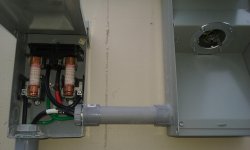
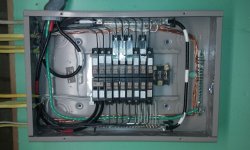
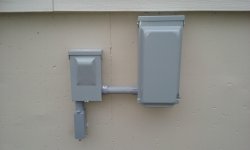
Below are pics inside of the finished install, as well as the pics outside where the generator hooks up. Apologize for the orientation of some of the pics (turn your head sideways?)
 

Attachments

  • 20170315_182259.jpg
    20170315_182259.jpg
    147.7 KB · Views: 47
  • 20170315_180826.jpg
    20170315_180826.jpg
    140.6 KB · Views: 50
  • 20170315_111629.jpg
    20170315_111629.jpg
    136.8 KB · Views: 52
  • 20170315_105937.jpg
    20170315_105937.jpg
    137.4 KB · Views: 51
  • 20170315_105850.jpg
    20170315_105850.jpg
    139.1 KB · Views: 50
  • 20170315_105839.jpg
    20170315_105839.jpg
    139.9 KB · Views: 53
  • 20170315_180855.jpg
    20170315_180855.jpg
    151 KB · Views: 39
OP
G

Gigfy

Well-known member
Joined
Jan 30, 2011
Messages
82
The transfer switch is rated for 100A, as is the sub-panel. However, the outside box to plug the generator is only rated for 50A.

I could have used a 100A box for the generator, but not only would that have been overkill, it would have cost a fortune for a 100A plug in. So I just used a simple 50A plug in (same plug commonly used to hook up RVs to a generator).

However, that left me with a sort of mismatch on the transfer switch. The main service side being fed with 100A, while the generator fed with 50A. My generator certainly wouldn't exceed 50A, but it's conceivable someone down the road could hook up a generator which would exceed the 50A rating of the plug, so I decided to put a fuse box on the generator side and fuse it to 50A. I don't know how others do it, but that's how I decided to do it.

Initially, I was going to custom build my own fuse box and include the 50A plug and 50A fuse block because I thought it would make a better looking install with just one box, but decided against it because it wouldn't have any UL listing. So I went with the two boxes on the outside (one fuse box and one inlet box).

One of the mistakes I made, was I used #4 copper cable to hook up the outside boxes (I used #2 copper for the connection of the main to the transfer switch to the sub panel.) I used #4 on the outside, even though #6 is all that's required. I used #4 because it was only a penny more per foot than the #6 at Home Depot. Both boxes on the outside are labeled for #4, so I thought I'd be OK.

On hindsight, I should have used the smaller #6, because it was really hard to work with the #4 in the conduit (1" PVC) and in the tight spaces in the boxes, even though I didn't exceed the labeled box fill, or the conduit fill.

I re-coded all the black wires on the right side with red tape in all the boxes. I learned that from someone on this forum (right for red). It helps a little tracking wires and helps keep things more consistent.

I really like the GE 50A box and plug. It's and "in use" weather proof box. I looked at other 50A inlet boxes, and I think GE makes one of the biggest ones. They use a decent quality Leviton plug too. Well worth the $80 from Home Depot.

I made a mistake of initially wiring the 50A fuse box by wiring the generator to the "load" side of the fuse box, instead of the "line" side. I've done so much wiring from the inside main panel and sub-panel, I unconsciously wired the fuse box, as if the transfer switch were feeding it, instead of the other way around. I can't think it would have made a practical difference, since the current will obviously flow either way, but I re-worked that wiring to make it right.

I had a bit of a problem drilling through the concrete. First I drilled a small pilot hole with a 1/4" bit through the concrete. Then used the big 1-1/2" bit and drilled halfway through from both sides, so I wouldn't blow out a big chunk of the wall. But the big bit wandered on me a little, so the holes didn't match up perfectly. I ended up having to heat bend the conduit going through the wall to make things look square and level.

I still have to add the sticker to the outside generator inlet box which tells the user to only use a generator with a floating neutral. I'll probably get a couple of those custom made from one of those ebay custom sticker vendors.

I still have a little general wiring to do on the house, but just about done. Have to install a few GFI outlets in the basement and things like that. My project ended up being much more extensive than I intended. It's almost been a whole house rewire (well, maybe half a house.) I've not done that much residential wiring before (mostly commercial wiring for myself).

I probably spent a couple grand on supplies to wire the house. My guess is it would have cost 10K, if I'd have hired an electrician. But I wouldn't have begrudged them their wages. It took me A LOT of hours to get all the work done.
 

wyliesdiesels

Well-known member
Joined
Aug 14, 2012
Messages
19,999
Location
Modesto, CA
Nice job.

Only thing about wire size is u couldve used #3 cu instead of #2cu for the main to transfer and transfer to sub. #3 is rated for 100a.

Wouldve saved a little in cost and a bit in labor since its a little easier to bend.
 
Last edited:
OP
G

Gigfy

Well-known member
Joined
Jan 30, 2011
Messages
82
Thanks Wylie.

I've noticed a lot of people have viewed this thread, so I thought I'd post the pics of the completed project, and mention my mistakes. Maybe it will help somebody.

Good point on the #3 copper. It's been so long, I can't remember why I used #2 cu on the sub instead of #3. Maybe that's all the big box store had available at the time?

One other mistake I made I wanted to mention is that I used some 3/16" tapcons to mount some of the hardware to the concrete and the tapcons broke off while screwing them in. I don't know if others have had this problem with the smaller diameter tapcons, but it's been an issue for me before. From now on I'm only using the bigger 1/4" tapcons.

I actually haven't purchased the Honda inverter generator yet. I recently sold my old portable generator, which is really made to run construction tools. I still plan to purchase the Honda EU3000is. I checked the amp load of the critical side of the sub, with a meter and it hardly pulls anything on the circuits. Motor startup is obviously more, but didn't look too bad with a slight bit of power management on the circuit breakers.

I plan use a custom cord which powers just one leg of the transfer switch from the generator. Unless there is something in the NEC book clearly prohibiting this?
 
To avoid these ads, REGISTER NOW!
Top Bottom