To avoid these ads, REGISTER NOW!

Mineral Wool blown in Insulation

Jakemedic

Well-known member
Joined
Jul 26, 2013
Messages
722
Location
Cornfields of SE Iowa
Howdy!
My local Menards has Mineral Wool insulation for sale cheap on closeout. My questions are is it better than fiberglass insulation for blown in insulation in the attic of my new shop. It is within 100 dollars between fiberglass, Cellulose and mineral wool. I would have to drive about 60 miles to obtain. Can I use standard blower to blow in mineral wool? bottom line, worth the extra 100.00?????
Thanks in advance for any assistance you may provide.

respectfully,
Jake
 
Last edited:
To avoid these ads, REGISTER NOW!

Toyomech

Well-known member
Joined
May 31, 2010
Messages
67
Location
Delaware
Basically same R value. Same installation techniques. Possibly slightly better sound properties. Not flammable. Wont itch like fiberglass but dust can still irritate.
 

240sxguy

Well-known member
Joined
Jan 6, 2009
Messages
1,158
Location
Madison, wi
I don't think it's worth the drive or extra money for the wool, I did cellulose in my old house and garage and it worked wonderfully. I'm definitely going that route again in this place.
 

matt_i

Well-known member
Joined
Mar 14, 2008
Messages
10,727
Location
SE Michigan
Thank you! It was originally marked 20 bucks a pack and down to 8.00. I was just curious if there was something magical about it.

Mineral wool R4.6 per inch blown cellulose R3.5 per inch. Maybe not magical but mathematical...

Over 10" of depth that adds up.

If I could find Roxul or its equivalent within $100 of cellulose I wouldn't be here typing......
 

mike93lx

ALLIANCE MEMBER
Joined
Dec 9, 2013
Messages
37,539
Location
Richmond, VA
I only have cellulose in my attic because it was free from a state program. I would never spend money to get cellulose when fiberglass is available.

If mineral wool was available for close to the same price, I would definitely take it over fiberglass. Sound dampening and fire control are the two main reasons, but it also is recycled.
 

Jlbc212

Well-known member
Joined
Dec 7, 2013
Messages
1,530
Location
Northeast MA
Having worked 37 years as a firefighter I saw too many fires involving cellulose insulation. It may be treated to make it somewhat fire resistant, but under the right circumstances it will smolder and burn. I would avoid it.
 

240sxguy

Well-known member
Joined
Jan 6, 2009
Messages
1,158
Location
Madison, wi
Mineral wool R4.6 per inch blown cellulose R3.5 per inch. Maybe not magical but mathematical...

Over 10" of depth that adds up.

If I could find Roxul or its equivalent within $100 of cellulose I wouldn't be here typing......

I wasn't aware of this, knowing that it may be cheaper to go that route.
 

Toyomech

Well-known member
Joined
May 31, 2010
Messages
67
Location
Delaware
I would verify that R value with product you are using. Some say 3.5 some say up to 4.1 but so does some fiberglass. 4.6 seems high for standard mineral wool.

Btw I think rockwool is a great product and we install it. I just think our customers would hold us to account if we called it nearly R-5 without the package saying so.
 

Angelfire

Well-known member
Joined
Mar 22, 2012
Messages
1,367
Location
New Mexico and Ireland
I installed ROXUL in my home addition as well as my shop. Very happy with it and won't consider fiberglass or cellulose in the future should the need arise. The fire resistance, water repellency, anti-rodent, R-factor, and for me, the batts snapped into place and won't "settle" all led to me choosing mineral wool.
Cheers
 

nadogail

Well-known member
Joined
Jan 23, 2009
Messages
31,957
Location
Coronado, CA
Having worked 37 years as a firefighter I saw too many fires involving cellulose insulation. It may be treated to make it somewhat fire resistant, but under the right circumstances it will smolder and burn. I would avoid it.

Not disputing the above, if the risk is acceptable and your budget is tight Cellulose Insulation may be acceptable for your needs.
 

jtprettyman

Well-known member
Joined
Feb 15, 2016
Messages
362
Location
Tennessee
Not blown in, but in the last house I built I used 2 1/2" thick rigid mineral wool board in ALL interior walls, and the ceiling / adjoining wall of the garage on the conditioned side of the FG batts. Loved the sound control - that place was an absolute vault, and the fire resistance was an added bonus.
 

tonyciambrone

Well-known member
Joined
Nov 4, 2015
Messages
1,152
Location
Northern Illinois
Here is the product. Looks like a good product. Like I said, have to drive 60 miles to get it.
https://www.menards.com/main/buildi...-insulation/782689/p-1543303636029-c-5777.htm

Nice find. I will be picking some up for my garage from the looks of it.

I have used the same insul-fill before. I chose it for Fire, water and rot resistance. Did not mind the extra cost since it was 20 bags total. For this price you'd be crazy to choose cellulose or fiberglass IMO. I rented the blower from Menards as well, and with two people it was very easy to accomplish.
 
To avoid these ads, REGISTER NOW!

Showkey

"MEMBER EMERITUS"
Joined
Aug 9, 2014
Messages
8,638
Location
Wausau WI
Having worked 37 years as a firefighter I saw too many fires involving cellulose insulation. It may be treated to make it somewhat fire resistant, but under the right circumstances it will smolder and burn. I would avoid it.

Not disputing the above, if the risk is acceptable and your budget is tight Cellulose Insulation may be acceptable for your needs.


Think its well worth disputing:

Cellulose Insulation has a Class 1 Fire rating. It is treated with fire retardants to meet all federal, state, and local fire safety requirements. Some manufacturers have even qualified two- and three-hour firewall designs using Cellulose Insulation.

Straight talk about building insulation and fire:
https://www.houleinsulation.com/fire.html

For foam crowd:
Like many materials found in a home or building, spray foam can ignite and burn if exposed to a sufficient heat source. Foam insulation should be considered combustible and handled accordingly.
 

mike93lx

ALLIANCE MEMBER
Joined
Dec 9, 2013
Messages
37,539
Location
Richmond, VA
The Insul/Fill bale covers 30 sq. ft at R19.
Cellulose bale covers 50 sq ft at R19. They are about the same price per bale.

Cellulose is cheaper, no one is disputing that. There should also be no debate that is is worse than both flown fiberglass and mineral wool. It's only good use is when cost is an issue
 

kinglake

Well-known member
Joined
Dec 12, 2011
Messages
96
Cellulose is cheaper, no one is disputing that. There should also be no debate that is is worse than both flown fiberglass and mineral wool. It's only good use is when cost is an issue

I'm curious why you think this? I can't find any research to support this. In fact, most says blown in cellulose is superior in just about every case.
 

mike93lx

ALLIANCE MEMBER
Joined
Dec 9, 2013
Messages
37,539
Location
Richmond, VA
I'm curious why you think this? I can't find any research to support this. In fact, most says blown in cellulose is superior in just about every case.

Cellulose turns to mush if it gets wet and can harbor mold.

With that said, it is more effective in very cold climates than fiberglass.

I only have it because it was free
 

kinglake

Well-known member
Joined
Dec 12, 2011
Messages
96
Cellulose turns to mush if it gets wet and can harbor mold.

With that said, it is more effective in very cold climates than fiberglass.

I only have it because it was free

Okay. Your above state made it sound like there was wide agreement that fiberglass was superior to cellulose when just about every single expert says the exact opposite. They of course both have their pros and cons.
 

FTG-05

Well-known member
Joined
Oct 11, 2012
Messages
1,536
Location
TN
I'm curious why you think this? I can't find any research to support this. In fact, most says blown in cellulose is superior in just about every case.

That's because cellulose is better. Let's count the ways:

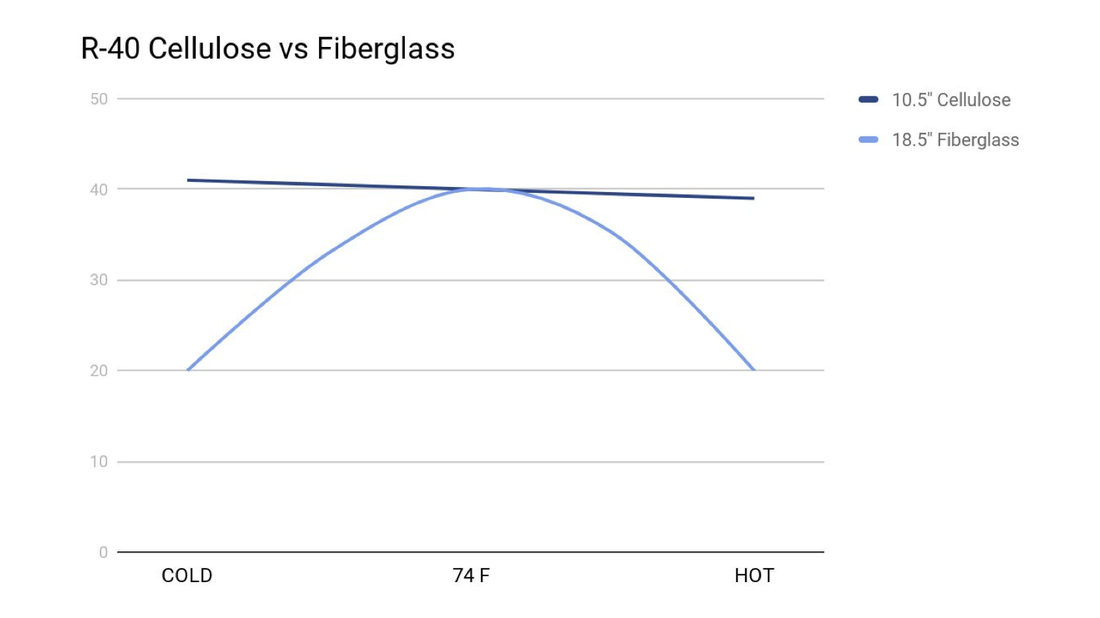
- Cellulose has a flat temp/performance curve. In other words, it's insulation performance remains the same over wide temp ranges, especially at extreme cold and hot temps. Fiberglas has an upside down U-shaped temp/perf curve. In other words, it's insulative performance drops off just when you need it the most.

- Cellulose won't burn, despite the firefighter's comment above. See videos below of melting a penny in your hand with cellulose and test houses burning down. Fiberglas doesn't burn but it melts - and that's ignoring the paper covering on one side - letting the fire right on through.

- Cellulose repels insects and vermin; fiberglas doesn't.

- Cellulose reduces air infiltration; spun fiberglas is used as an air filter. In fact, one way to find leaks in attics is to look for the dirty fiberglas insulation where the air has been blowing through.

- Cellulose has insulative value in and of itself. Fiberglas has none. All it does is provide a structure for still air, which provides the insulation. Compress the fiberglas - bye bye insulation value. And fiberglas won't spring back. Compress cellulose and it still provides insulation since it only derives some of it's performance from still air.

- Cellulose and noise: Advantage cellulose.

- Both cellulose and fiberglas will mold if wet - although cellulose is treated to prevent and/or reduce it. (Fix your roof leaks is the solution here - DUH).

- Fiberglas only positives are that it's cheap and light.

Spun fiberglas insulation is, IMO, one of the 20th century's greatest scams. Kudos to Dow Corning for taking a virtually useless material (for insulation) and turning it into a multi-billion $$$ business.

Videos:


kj_mustang

Well-known member
Joined
Feb 9, 2011
Messages
1,213
Location
Harrisonburg, VA
If cellulose turns to mush when wet, then why do insulation companies use wet dense pack cellulose. I used it in my new construction home 5 years ago. Once it is is dry, it is a pretty solid mass. It definitely is not going to settle. I have cut open the sheetrock to add a new wire run and getting a pull stick and cable through that stuff is not fun.
Image is from the web and not my house.
7f2a0bc3a49e669ae4bf49ec0177539e


http://www.mnshi.umn.edu/kb/scale/insulation_densepack.html
 

Jlbc212

Well-known member
Joined
Dec 7, 2013
Messages
1,530
Location
Northeast MA
Think its well worth disputing:

Cellulose Insulation has a Class 1 Fire rating. It is treated with fire retardants to meet all federal, state, and local fire safety requirements. Some manufacturers have even qualified two- and three-hour firewall designs using Cellulose Insulation.

Straight talk about building insulation and fire:
https://www.houleinsulation.com/fire.html

For foam crowd:
Like many materials found in a home or building, spray foam can ignite and burn if exposed to a sufficient heat source. Foam insulation should be considered combustible and handled accordingly.

I can only speak from my first hand experience. I worked 37 years as a firefighter in an old mill city with tenement housing. The three and four story wood, balloon frame structures were mostly built near the end of the 19th century and the beginning of the 20th. This was before the days of electrical wiring and long before anyone placed insulation in a home. With the energy crunch of the 1970's and beyond many of these buildings had cellulose insulation blown into the cockloft space (the 2 foot to 3 foot space between the upper floor ceiling and the flat roof). The cellulose insulation would get ignited by either overloaded or shorted electrical wiring, most often metallic sheathed cable with poor or no ground conductors. Initially the cellulose insulation will smolder, but I often witnessed the flames dancing off the top surface of the cellulose. The only sure way to extinguish it was to pull it out which meant pulling down the ceilings. If we didn't fully extinguish it we would be back to scene in a couple of hours for a rekindle. Just on my shift I had probably six of these fires every year for the extent of my career. When I first began my career the engine house I was assigned to covered the city's industrial park. There was a company there that was recycling and treating newsprint (cellulose) into insulation. One beautiful Sunday afternoon we responded there to smoke coming from a parked, 54 foot enclosed trailer. When we opened it we found it was packed with bundles of fire retardant treated cellulose insulation ready for shipment to retail stores. The insulation was smoldering. It was a long afternoon as we emptied out the trailer to extinguish the burning bundles.

It's difficult at best to refute a very lucrative business, besides the issue of a product being "eco-friendly."
 
Last edited:

50pascals

Well-known member
Joined
May 26, 2020
Messages
55
Location
Rochester, NY
Lots of comments here by people that have never looked at building assemblies with an Infrared camera. or used a blower door. I have used both, a lot.

My advice - If you want to buy insulation for thermal comfort reasons, and I'm sure you do, then use the insulation that works best in the situation.

The biggest source of heat gain in an attic in the summer is infra red energy radiated from the roof deck to the ceiling below. Fiberglass and rockwool block no IR. Cellulose blocks all of it.

The biggest heat loss in an attic in the winter (aside from air leaking right out) is interlstitial convection within the insulation. Fiberglass and rockwool both loose half their R-value in the winter. Cellulose loses almost none - it's too dense for air movement within the insulation itself.

True, cellulose can provide fuel to a fire in the right circumstances. But so do all of your belongings. And old cellulose (prior to the 50's or so?) had no fire retardants in it.
 
Last edited:
OP
J

Jakemedic

Well-known member
Joined
Jul 26, 2013
Messages
722
Location
Cornfields of SE Iowa
Lots of comments here by people that have never looked at building assemblies with an Infrared camera. or used a blower door. I have used both, a lot.

My advice - If you want to buy insulation for thermal comfort reasons, and I'm sure you do, then use the insulation that works best in the situation.

The biggest source of heat gain in an attic in the summer is infra red energy radiated from the roof deck to the ceiling below. Fiberglass and rockwool block no IR. Cellulose blocks all of it.

The biggest heat loss in an attic in the winter (aside from air leaking right out) is interlstitial convection within the insulation. Fiberglass and rockwool both loose half their R-value in the winter. Cellulose loses almost none - it's too dense for air movement within the insulation itself.

True, cellulose can provide fuel to a fire in the right circumstances. But so do all of your belongings. And old cellulose (prior to the 50's or so?) had no fire retardants in it.

Thank you for your opinion. I do very much appreciate it! Still haven't bought the insulation yet. It appears that everyone has an opinion about good/bad choices. Guess I have some research to do....... I want the best insulation for my dollar, and comfort.
 

tonyciambrone

Well-known member
Joined
Nov 4, 2015
Messages
1,152
Location
Northern Illinois
Fiberglass has an upside down U-shaped temp/perf curve. In other words, it's insulative performance drops off just when you need it the most.

I need some sort of link to this information...Everything I have ever seen shows fiberglass performs better at low temperatures..same with mineral wool type insulation.

Listen cellulose is frickin cheap and it works, no arguments from me there. Like I said earlier I just chose mineral wool for fire resistance, water, rot resistance. It'd be hard to argue anything performs better in those categories IMO
 

cleanspg

Well-known member
Joined
Nov 5, 2014
Messages
52
The biggest heat loss in an attic in the winter (aside from air leaking right out) is interlstitial convection within the insulation. Fiberglass and rockwool both loose half their R-value in the winter. Cellulose loses almost none - it's too dense for air movement within the insulation itself.

Isn't this only true for dense pack cellulose as done in a wall vs loose fill in an attic? Or if you pile it high enough is it still true?

I researched cellulose a bit when building my shop, but it dense packing seemed like a pain to diy so I dropped the idea. At the time I remember the only times/places where it was recommended for performance reasons were dense packed installations. Was always one of the "greenest" options and could be cost effective.

I would also be curious about blown in rockwool in a similar scenario. Rockwool batts are generally considered superior to fiberglass because they are much denser, but does the same hold true when blown in to an attic?
 

50pascals

Well-known member
Joined
May 26, 2020
Messages
55
Location
Rochester, NY
Isn't this only true for dense pack cellulose as done in a wall vs loose fill in an attic? Or if you pile it high enough is it still true?

I researched cellulose a bit when building my shop, but it dense packing seemed like a pain to diy so I dropped the idea. At the time I remember the only times/places where it was recommended for performance reasons were dense packed installations. Was always one of the "greenest" options and could be cost effective.

I would also be curious about blown in rockwool in a similar scenario. Rockwool batts are generally considered superior to fiberglass because they are much denser, but does the same hold true when blown in to an attic?

It is the same concept, only magnified.

You densepack walls because the convective forces are stronger. The stack effect can build over 8' (or so). And the convective drive is strong - cold on one side, warm on the other. Gravity works against the wall. So dense-packing is needed to effectively block those forces.

A blown attic is different, the insulation is only 12" or so deep, so the interlstitial convective forces are much lower than walls. And the effects of gravity are much lower because the temperature difference is horizontal, not vertical. So you don't need as much density to effectively block convective forces in a blown attic.

And one way to get better density in an attic, if you don't plan to blow a foot and a half of insulation is to leave the hose lay on the ceiling. The cellulose will "pack" a little as it piles up above the outlet of the hose.
 

pcmeiners

Well-known member
Joined
Aug 13, 2009
Messages
7,905
Location
In the only town in Pennsylvania, Bloomsburg.
"Cellulose turns to mush if it gets wet and can harbor mold."

Sorry but the celloulose I used has boric acid in it. It kills mold and does not burn. I blew in insulation in my parents house, they had a fire in the basement in 2006, balloon frame house. The entire basement ceiling was charcoal, so much so the beams and sub floor were replaced. The fire stopped where the cellulose started, the most the cellulose burned was a 1/4" at the basement level. Also Sandy wet everything, 36" up the walls on the first floor. Had mold on the basement beams/ first floor sheathing, no mold behind the sheetrock on the first floor as boric acid kills mold. Love the stuff, the only negatives are if loose cellulose get wet it is an issue in attics, and it needs to be blown in correctly (packed) . Fiberglass let air more around within itself, properly packed cellulose does not, in an attic it settles and packs itself.

In 1967 the heat bill for the house was $1300 for a season, a lot for then, equal to approx. $3600 in today's utility cost. The heat bill now, with NYC's insane utility costs is approx. $800; that is with packed walls (cellulose feed from top and bottom of each stud) and an r40-50 in the attic.
 
Last edited:

FTG-05

Well-known member
Joined
Oct 11, 2012
Messages
1,536
Location
TN
I need some sort of link to this information...Everything I have ever seen shows fiberglass performs better at low temperatures..same with mineral wool type insulation.

Listen cellulose is frickin cheap and it works, no arguments from me there. Like I said earlier I just chose mineral wool for fire resistance, water, rot resistance. It'd be hard to argue anything performs better in those categories IMO

A couple I found:

http://atticpros.com/

chart.jpg


https://highplainsinsulation.webstarts.com/about.html

Cellulose_vs_Fiberglass_Chart_358x444.jpg


https://www.weatherization.expert/spfandglass.html

cellulosevsfiberglass_orig.png
 

kai96

Member
Joined
Sep 6, 2020
Messages
12
Location
grand rapids
our house is fully insulated with cellulose.
It really shines at -20 below. the house is cozy warm. and the heat bills are below average in our neighborhood.
Some neighbors have fiberglass insulation. We can see the difference in winter when their roofs show through the snow. Our cellulose homes will have a foot of snow on the roof while the fiberglass homes will have large areas of no snow..
To me that is a more reliable evaluation than any chart or opinion.
 
To avoid these ads, REGISTER NOW!
Top Bottom