To avoid these ads, REGISTER NOW!

Mini shaper identification

tcl

New member
Joined
Oct 12, 2025
Messages
1
Hello all, new to the group.
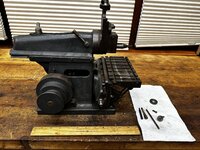
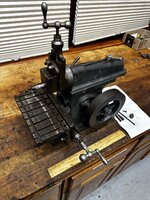
Can anyone help me identify this mini shaper that I have.
There are no markings on it and I’m not even sure I’ve got it together right since it came to me in pieces.
I believe I’m missing some pieces that would advance the cut after each stroke.
I also have no idea what kind of motor I would need to attach to make run (hp or rpm).
It seems to operate ok by hand and I’m hoping to make it operational again.
Any input is appreciated.
Thanks Tom
 

Attachments

  • IMG_0364.jpeg
    IMG_0364.jpeg
    1,002 KB · Views: 63
  • IMG_0363.jpeg
    IMG_0363.jpeg
    981.6 KB · Views: 64
  • IMG_0362.jpeg
    IMG_0362.jpeg
    1,021.2 KB · Views: 56
  • IMG_0361.jpeg
    IMG_0361.jpeg
    860.8 KB · Views: 50
  • IMG_0360.jpeg
    IMG_0360.jpeg
    1,021.5 KB · Views: 50
  • IMG_0359.jpeg
    IMG_0359.jpeg
    956.1 KB · Views: 48
To avoid these ads, REGISTER NOW!

Firebrick43

Well-known member
Joined
May 12, 2015
Messages
14,288
Location
West central Indiana
By the stampings on the dials and the table I would say its home made or shop made.

There used to be a book on it, gingery series or something like that but that is nicer than it. Did hemingway ever make a shaper kit?
 

paulsomlo

Well-known member
Joined
Jul 16, 2013
Messages
3,936
Location
Northern Colorado
By the stampings on the dials and the table I would say its home made or shop made.
I'm not sure I would agree - I think those stampings are somewhat typical of machinery made around the turn of the century.

The better places to post this inquiry are either the Antique Machinery subforum on PracticalMachinist.com or on Vintagemachinery.org.
 

Firebrick43

Well-known member
Joined
May 12, 2015
Messages
14,288
Location
West central Indiana
jqvosbk5.png

I have never seen numbers offset so poorly on a factory machine tool, even the old ones, like the 4 and 0 is in 40 for example.

I also haven't seen any shapers before the mid 1920's. Every thing before that I have seen was planers at the turn of the century and teens
 
Last edited:

RoninB4

Well-known member
Joined
Jul 22, 2020
Messages
3,641
Location
Under My House
-I can't identify it either. The location may offer a clue as England had a sizeable post WW2 cottage industry of small metal working shops and the machinery that was sold to them. It also could have been from kit form, castings that size weren't fun to make from scratch at home. It clearly can't take heavy cuts, not enough mass for peeling off great strips of metal. Is it still useful for broaching an internal keyway in a gear? I think it would be handy for small jobs. All other shapers I've seen are quite heavy for the size but this one, while limited, has a small footprint and probably a manageable weight. Table/stage seems a bit lightweight and missing any advancing mechanism but considering the machine mass I'd not consider that a show stopper either, will work fine for gear keyways and small dovetails where auto-advance isn't needed. For removing large amounts of metal (like plate thinning) this isn't the right machine anyway, a small milling machine would be faster/better suited. I don't use this word very often but it is a cute little ****** and worthy of restoration. I like it, congratulations.
 
  • Like
Reactions: tcl

Firebrick43

Well-known member
Joined
May 12, 2015
Messages
14,288
Location
West central Indiana
A 1/2 or 3/4 hp 1725rpm motor would work well for that. If I remember correctly the atlas 7B had a 1/2 hp.

You are going to have to either make a flat 3 stepped pulley for the motor if you want to mess with leather flat belting or buy two v belt stepped sheaves and swap the one on the shaper out and use an A sectioned or even better an AX section v belt.

It probably will need a jack shaft like the small atlas and ammco shapers had. I think it was a 2:1 reduction from the motor to it.
 
  • Like
Reactions: tcl
To avoid these ads, REGISTER NOW!

bmwrd0

Well-known member
Joined
Nov 7, 2010
Messages
5,532
Location
Beaver Fever Oregon
The castings look very professional to me, and the number stamping is consistent in dropping the zero, so I would say it is factory built.

Small shapers like that are often seen in England, so I would turn my search to that side of the pond. Here is a good resource: https://lathes.co.uk/
If you scroll down the page about 3/5s of the way, you will find the section on shapers. Tony is a trove of information, and if nothing comes up, I am sure he would love to see pictures of it.
 

Firebrick43

Well-known member
Joined
May 12, 2015
Messages
14,288
Location
West central Indiana
The castings look very professional to me, and the number stamping is consistent in dropping the zero, so I would say it is factory built.
Its easy to make a radial fixture to align the stamps, hobbyist do it all the time and the results are "consistent" for the most part except the hammer strikes themselves can be off due to lack of practice.

The issue is many stamps don't have the stamp centered on the shank. There fore when the shanks corner is placed in against the stamping fixture it maybe out of alignment with the previous number due to how the stamps are made.

A factory making 10's, 100's or even thousands of something is going to have two sides of the stamp ground the correct amount so they align to the other numbers. A one off part made by a hobbyist is not.

As far as castings, some of the kit manufactures such as Hemmingway and state college metal lathe accessories sold phenomenal quality castings.
 

bmwrd0

Well-known member
Joined
Nov 7, 2010
Messages
5,532
Location
Beaver Fever Oregon
The stampings are too consistent to go with that theory. A drop zero is not uncommon in printing from the early part of the 20th.

Sure, it could be a Hemingway kit type, but until I see one in that pattern I am sticking to it being factory.
 

Firebrick43

Well-known member
Joined
May 12, 2015
Messages
14,288
Location
West central Indiana
The stampings are too consistent to go with that theory.
Homemade graduated dials a lot better aligned compared and consistent to the shaper above. There are hundreds more examples with a quick google search of hobby machinist and practical machinist. If hobbyist can make it happen, a factory can
1760647821982.png
1760648169262.png
1760648635855.png

A drop zero is not uncommon in printing from the early part of the 20th.
What? linotype is not metal working stamps?
 
To avoid these ads, REGISTER NOW!
Top Bottom