To avoid these ads, REGISTER NOW!

MiniSplit Advice for multi room garage build

cccoltsicehockey

Well-known member
Joined
Apr 3, 2014
Messages
1,418
Location
Charlotte, NC
I had my first meeting with the AC installer my builder is using for my project after he had sometimes to review the plans. In the same time I have been reading a good bit through this section. Based on what I have read I feel like the suggestion I was giving might be extremely oversized for the application and thus might not function well.

For some background the strucutre has roughly 2285sqft to be heated and cooled. The two garage bays have walls that are 13ft and vaulted ceilings that are 22ft high at the collar ties. The one roof is a 12/12 the other is 14/12 so that the ridges met at the same point. The loft area will be heated/cooled to 72 year round. The rest of the space will likely be left at 56-78 range or whatever naturally occures in the middle based on season unless I am actively working in there. The building will be R19 walls, R38 roof, and R16 garage doors. We will be insulating all interior walls as well do to possibly having things cooled to different temps in different areas as well as for trying to keep the noise contained in the corner shop area. Working Garage Bay 2 will have 4 windows and the garage door. Storage Garage Bay 1 will have no windows, a person door and a garage door. I will also be doing an 84in ceiling fan in both garage bays to aid in air movement.

main-floor_8-16-2023-jpg.1942550


second-floor_8-16-2023-jpg.1942551


When I spoke with the contractor he said his calculations came out to needing 1.5ton units for each garage bay but he was concerned that might only be able to cool me down to 73-74 in the summer and that he suggested bumping up to a 2ton unit. He then suggested a second 2 head 2 ton unit that would cool the corner shop and the loft upstairs.

As mentioned from reading suggestions in this section 6tons for this amount of sqft seems like extreme overkill to the point it may not function properly? Am I reading things right or are these really closer to being correct.
 
To avoid these ads, REGISTER NOW!

fitter30

Well-known member
Joined
Jun 23, 2019
Messages
2,992
Location
Peace Valley,mo
What are going to be doing in this space. Mini's don't like dirty atmosphere they are hard to clean and filters are thin. If u look at the coils there enhance having little slits in them for the air to pass through. Look at a utube video on cleaning indoor unit.
 
OP
C

cccoltsicehockey

Well-known member
Joined
Apr 3, 2014
Messages
1,418
Location
Charlotte, NC
What are going to be doing in this space. Mini's don't like dirty atmosphere they are hard to clean and filters are thin. If u look at the coils there enhance having little slits in them for the air to pass through. Look at a utube video on cleaning indoor unit.
Loft - Basically man cave hangout area.
Shop - Wood shop mostly, maybe some minor metal stuff down the road. I plan to always turn the unit off each day before starting to work in ther so that it is not sucking up the dust out of the air. Hopefully, that and cleaning the filters more often will be enough to keep it happy.
Garage Bay 1 - Just car storage
Garage Bay 2 - Mechanic work, will have 2 post lift, doing plastic floor tiles so I can also wash and detail inside when it is colder out or raining.
 

chinboys

Well-known member
Joined
Jun 20, 2011
Messages
434
You really need to have a proper heat load calculation based on the insulation values, humidity levels and how much heated humidity air exchanges are happening per hour during the worst extreme head humidity loads.
Oversize the equipment means it doesn't run long enough to lower the humidity thus feeling cool and clamy. Undersize the equipment means potential equipment burnout from prolong cooling cycles where you don't get the cooling dehumidification effect.
The moisture mixed into the heat means the system will spend its power to rid the moisture first (latent heat) before lowering the air temperature of the environment (sensible heat).

I used a 4 ton LG unit that drives a 3/8 inch liquid 1 inch return to a 4 port manifold from which I configure ceiling cassettes or wall units off of (1/4 in liquid, 3/8 return. LG also makes outdoor units that drive 2 to 4 evaporators too from the compressor unit.
Adding a ceiling fan will also mKe you feel cooler without dropping the temperature further.

Lastly don't forget about the sun's energy adding infrared heat to your structure as well as the color of the walls and roofing.
 

theoldwizard1

Well-known member
Joined
Feb 22, 2011
Messages
43,246
Location
SE MI
I used a 4 ton LG unit that drives a 3/8 inch liquid 1 inch return to a 4 port manifold from which I configure ceiling cassettes or wall units off of (1/4 in liquid, 3/8 return. LG also makes outdoor units that drive 2 to 4 evaporators too from the compressor unit.
Adding a ceiling fan will also mKe you feel cooler without dropping the temperature further.
Large mini-splits typically are less efficient.

Long refrigerant runs and the use of manifolds also lowers efficiency.
 
OP
C

cccoltsicehockey

Well-known member
Joined
Apr 3, 2014
Messages
1,418
Location
Charlotte, NC
Properly insulated I find it hard to believe that 2-1/2 to 3 tons for lower level and 1 ton for the loft wouldn't be enough.

6 ton is nuts!
Glad I am not the only one that thought this was crazy.
You really need to have a proper heat load calculation based on the insulation values, humidity levels and how much heated humidity air exchanges are happening per hour during the worst extreme head humidity loads.
Oversize the equipment means it doesn't run long enough to lower the humidity thus feeling cool and clamy. Undersize the equipment means potential equipment burnout from prolong cooling cycles where you don't get the cooling dehumidification effect.
The moisture mixed into the heat means the system will spend its power to rid the moisture first (latent heat) before lowering the air temperature of the environment (sensible heat).

I used a 4 ton LG unit that drives a 3/8 inch liquid 1 inch return to a 4 port manifold from which I configure ceiling cassettes or wall units off of (1/4 in liquid, 3/8 return. LG also makes outdoor units that drive 2 to 4 evaporators too from the compressor unit.
Adding a ceiling fan will also mKe you feel cooler without dropping the temperature further.

Lastly don't forget about the sun's energy adding infrared heat to your structure as well as the color of the walls and roofing.
I definitely do not want to have humidity issues. I want to be done with the days of recharging cilica packets to help keep my tools from rusting in a humid souther garage.
Large mini-splits typically are less efficient.

Long refrigerant runs and the use of manifolds also lowers efficiency.
We scrapped the idea for an almost 100ft long line set because of potential efficency issues. I didn't want to see the outdoor unit but by moving it the lineset will be about 12-15ft and I will just build an enclosure around it.
 

danski0224

Well-known member
Joined
Jan 29, 2005
Messages
13,517
Location
Near Naperville, IL
We scrapped the idea for an almost 100ft long line set because of potential efficency issues.
Efficiency losses are in the manufacturer specs, although the length specified is normally not an issue. Vertical separation is another issue entirely.

You really need to have a load calculation performed, and not guess. Unfortunately, it seems that most HVAC contractors have no interest or skill to do a simple load calculation, much less get into duct design and equipment selection. There are independent companies that do this for a fee. Some municipalities near my location require all of this stuff as part of the permit process.

Just going off of the plans, finding the minimal funds to get the calculations done should not be an issue. That garage/shop is easily pushing a couple hundred thousand where I am.
 

Jackfre

Well-known member
Joined
Dec 26, 2010
Messages
4,412
Location
N CA
Multis are less efficient than singles. Consider your usage pattern/habits here and see if you can divide the building that way. “I’m going to use this space all the time/most/etc. The others less so.” Reason I say this is that you might want to have a single high efficiency unit in the primary space. Maybe 25 seer vs 16 or so for the triples. On my last home I did this. Rather than having the triple I put in a dual for the upstairs bedrooms and the high efficiency single downstairs. Given the use pattern it worked out well. Also, the cost of a dual and single was right in line with the cost of the triple. You then have much shorter line sets as well. If this is going to be a wood shop you are going to have to have dust collection or you will pack that mini. I just went with a Harvey G-700. Much quieter than my Cyclone.
 

stubbsrodandcustom

Well-known member
Joined
Aug 30, 2012
Messages
70
The ceiling is what is killing the needs for tonnage.

I am in Houston tx, I run a 18k btu for an oversized attached 2 car garage. 18'x23' with 8' ceiling. In the summer 100 degree and 100 humidity, I keep 75 degrees normally, but when I am doing heavy fab work or activities where I sweat more, I drop it to 67 and she holds it there quite well. 10" of blown in insulation in the attic, insulated doors, NO windows... Walls are not insulated but are brick with airspace then sheetrock.

So with that said.

My buddy has a 40x60 shop, with 2-24k btu mounted high up on his shop walls, He has a 14' eve height, and it struggles in the summer to keep below 80 degrees normally but it does it, his other thing is yes its insulated walls and ceiling but the 3 roll up doors are not insulated. This is a huge loss for sure. That is what kills his ability to cope but it keeps the humidity down and works great in the 90 degree temps, just the thermal load from the doors in 100 plus sun load is killer for sure.

So onto my suggestion for yours, it sounds like you have good insulation for sure. The cubic feet total of your shop and garages. I would actually suggest one of the 20 seer 48k multiple zone units. Or 1 main in the main workspace and a 2 head for the other areas. I think all in all this would keep your efficiency up and do more than needed during super hot summers. That's 4 tons you need combined, or you can do 18k for the workshop super high efficiency and like said above do lower efficiency for the garages to maintain temperatures.

Installation, it may be easier to do a 2 head for the workshop and the loft, the loft and workshop should be easy to keep controlled honestly. This would put 1 unit outside there, and then it may be worth putting 2 single 18k for each garage side. Keep the line sets short and mount the outside units to the wall, or on grade right below the drops for the lines. This would keep the install clean on the outside with not having to run long runs of line sets, thus improving efficiency.

Normally on residential construction 2100-2400 down south is 4 tons... = to 48k btu.

Here is a good website for helping others maybe figure this out.

https://hvacdirect.com/sizing-air-conditioner-and-heater.html

Cost for conditioning your space with mini splits should be cheaper for operating costs.

I am not a HVAC pro or anything but just a guy who has done a few mini splits and can only offer suggestions.
 
Last edited:

danski0224

Well-known member
Joined
Jan 29, 2005
Messages
13,517
Location
Near Naperville, IL
Glad I am not the only one that thought this was crazy.
Mini splits and inverter split systems are variable capacity. Some inverter split systems have a wider "turndown" range.

I can stick a 60k btu Bosch 18 SEER condenser on any copper or aluminum tube 24k btu evaporator, and it will work fine without any special wiring or communication features. Yes, you lose "efficiency", but it will work great for heating and cooling.

So, some of it still comes down to manufacture specifications.
 
Last edited:
OP
C

cccoltsicehockey

Well-known member
Joined
Apr 3, 2014
Messages
1,418
Location
Charlotte, NC
Efficiency losses are in the manufacturer specs, although the length specified is normally not an issue. Vertical separation is another issue entirely.

You really need to have a load calculation performed, and not guess. Unfortunately, it seems that most HVAC contractors have no interest or skill to do a simple load calculation, much less get into duct design and equipment selection. There are independent companies that do this for a fee. Some municipalities near my location require all of this stuff as part of the permit process.

Just going off of the plans, finding the minimal funds to get the calculations done should not be an issue. That garage/shop is easily pushing a couple hundred thousand where I am.
That makes sense. Your ballpark is correct. I didn't actually know there were independent companies that did that. I will take a look into that.

Multis are less efficient than singles. Consider your usage pattern/habits here and see if you can divide the building that way. “I’m going to use this space all the time/most/etc. The others less so.” Reason I say this is that you might want to have a single high efficiency unit in the primary space. Maybe 25 seer vs 16 or so for the triples. On my last home I did this. Rather than having the triple I put in a dual for the upstairs bedrooms and the high efficiency single downstairs. Given the use pattern it worked out well. Also, the cost of a dual and single was right in line with the cost of the triple. You then have much shorter line sets as well. If this is going to be a wood shop you are going to have to have dust collection or you will pack that mini. I just went with a Harvey G-700. Much quieter than my Cyclone.
The loft is the only area that will always be kept at a living temperature. The shop area is probably the next most likely as I will try and keep all metal and wood work in there unless working on an actual car frame that I can't take in there.

Garages will likely live at around 78 degrees short of me saying I am going in there to do actual work so it will be a lot more of rapid cool down in there but otherwise keep status quo and keep my tools dry.

The ceiling is what is killing the needs for tonnage.

I am in Houston tx, I run a 18k btu for an oversized attached 2 car garage. 18'x23' with 8' ceiling. In the summer 100 degree and 100 humidity, I keep 75 degrees normally, but when I am doing heavy fab work or activities where I sweat more, I drop it to 67 and she holds it there quite well. 10" of blown in insulation in the attic, insulated doors, NO windows... Walls are not insulated but are brick with airspace then sheetrock.

So with that said.

My buddy has a 40x60 shop, with 2-24k btu mounted high up on his shop walls, He has a 14' eve height, and it struggles in the summer to keep below 80 degrees normally but it does it, his other thing is yes its insulated walls and ceiling but the 3 roll up doors are not insulated. This is a huge loss for sure. That is what kills his ability to cope but it keeps the humidity down and works great in the 90 degree temps, just the thermal load from the doors in 100 plus sun load is killer for sure.

So onto my suggestion for yours, it sounds like you have good insulation for sure. The cubic feet total of your shop and garages. I would actually suggest one of the 20 seer 48k multiple zone units. Or 1 main in the main workspace and a 2 head for the other areas. I think all in all this would keep your efficiency up and do more than needed during super hot summers. That's 4 tons you need combined, or you can do 18k for the workshop super high efficiency and like said above do lower efficiency for the garages to maintain temperatures.

Normally on residential construction 2100-2400 down south is 4 tons... = to 48k btu.

Here is a good website for helping others maybe figure this out.

https://hvacdirect.com/sizing-air-conditioner-and-heater.html

Another point to ponder, multiple heads require cleaning, filter changes etc so its something to take into consideration. The larger single units have the btu but keeping the room constant temps will be an issue I think, granted you have fans to circulate and that will help out a **** load.

Pricepoint for Mini splits vs a cheaper full home hvac system with a mono duct at the ridgeline is almost equal in your needs I think. But the seer rating of the mini splits may be more beneficial than a big system running full tilt. Cost for conditioning your space with mini splits should be cheaper for operating costs.

I am not a HVAC pro or anything but just a guy who has done a few mini splits and can only offer suggestions.
I apprecieate your insite. The extremely high ceilings is defintiely the wild card although a proper calculation could definitely account for it. Your informaiton about comparable systems which high but not as high ceilings has me think maybe they are not as oversized as I think even if they are still oversized. Your estimate calculation is around where I was thinking with being at 4ton range though.

So single unit mini splits don't require cleaning or have filters? I think one of the reason a dual head unit was specified was the area it was cooling in the loft was only 330sqft and so almost all single units would likely be too large.

Mini splits and inverter split systems are variable capacity. Some inverter split systems have a wider "turndown" range.

I can stick a 60k btu Bosch 18 SEER condenser on a 24k btu evaporator, and it will work fine. Yes, you lose "efficiency", but it will work great for heating and cooling.

So, some of it still comes down to manufacture specifications.
Interesting I didn't know this. When you turn them down to they control the efficiency well still?
 

u3b3rg33k

Well-known member
Joined
Dec 18, 2017
Messages
4,048
"only" be able to cool it down to 73/74 and not 72? lol

it's a garage. so what.

IN GENERAL, it's pretty safe to oversize minisplits. they are variable capacity, so just check the spec sheet for turn down ratios. single head units have the best turndown, meaning they can go from rated performance down to a tiny fraction of it. e.g. a 24k BTU unit can drop down to 6kBTU (check your spec sheet for specifics).

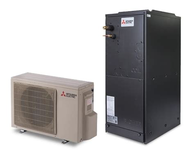
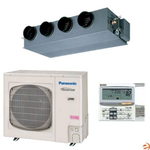
if you're going to be doing woodworking, I'd suggest you either get a standard inverter-split system, or a minisplit that can run a "traditional" fan coil box or "ducted unit", so you can put a proper 4" filter before the coil. general car/machine work shouldn't be an issue.
something like this:
1705421142780.png

or this:
1705421160951.png

a 4" or media filter instead of 1" cheapos will keep your coil nice and clean.
 
To avoid these ads, REGISTER NOW!

danski0224

Well-known member
Joined
Jan 29, 2005
Messages
13,517
Location
Near Naperville, IL
Interesting I didn't know this. When you turn them down to they control the efficiency well still?
The user doesn't do the "turndown".

The equipment "turns down" the compressor to reduce capacity. As far as I know, at least with respect to standard split systems with an inverter condenser section, Bosch is the only one that delivers full features with any other "foreign" equipment (non-Bosch evap coil, air handler/furnace) and does not require a communicating or special thermostat.

It can get complicated.

Your area/State may have incentives in place for air source heat pumps.
 

danski0224

Well-known member
Joined
Jan 29, 2005
Messages
13,517
Location
Near Naperville, IL
I didn't actually know there were independent companies that did that.
Search for "hvac load calculations". Sometimes, energy raters will do it. There are companies that do only this, and do not install HVAC stuff. Can be done entirely online. Send the print and window specs and $$, and get results.

Obviously do some research on the search results, check reviews, etc.

You can also buy a single use license for HVAC-Calc and try it yourself. It can do duct design, but that is not so quick for the inexperienced. No equipment selection.
 

stubbsrodandcustom

Well-known member
Joined
Aug 30, 2012
Messages
70
So single unit mini splits don't require cleaning or have filters? I think one of the reason a dual head unit was specified was the area it was cooling in the loft was only 330sqft and so almost all single units would likely be too large.

They still require cleaning and have filters. 330 sq ft is still something requiring some btu for sure, If you put an 18k for example, the workshop and loft with the 2 heads, one head would be in workshop and the other in loft, This would make both areas independent controlled heads but a single outside condenser unit. The loft shouldn't ever have to run hard being constant temp year round, the workshop may be a bit more on swings but the The other thing as both these areas are inside a conditioned space already so thermal load is very minimal. They should be stupid efficient honestly.

Other note, do not get anything with a heat strip unless you get freezing temps for a long time. Being a heat pump is generally standard on all these but you have to check the fine print sometimes.

if you're going to be doing woodworking, I'd suggest you either get a standard inverter-split system, or a minisplit that can run a "traditional" fan coil box or "ducted unit", so you can put a proper 4" filter before the coil. general car/machine work shouldn't be an issue.
something like this:
1705421142780.png

or this:
1705421160951.png

a 4" or media filter instead of 1" cheapos will keep your coil nice and clean.
This is a really good point for woodworking as dust can wreak hell on these filters and coils.
 

theoldwizard1

Well-known member
Joined
Feb 22, 2011
Messages
43,246
Location
SE MI
We scrapped the idea for an almost 100ft long line set because of potential efficency issues. I didn't want to see the outdoor unit but by moving it the lineset will be about 12-15ft and I will just build an enclosure around it.
Make sure there is plenty of air flow. The would be best if the entire enclosure could be moved for service.
 

danski0224

Well-known member
Joined
Jan 29, 2005
Messages
13,517
Location
Near Naperville, IL
do not get anything with a heat strip unless you get freezing temps for a long time.
Backup heat is important.

Generally speaking, air source heat pump performance drops as the outdoor temperature drops.

Without heat strips (or dual fuel), the heat pump must be capable of heating the space at the lowest anticipated temperature. While extreme in many places, the recent/current cold would be a problem for many air source heat pump systems without backup heat. If the heat pump is good until 5 degrees and it is 0 outside, that's a big deal, especially if the equipment shuts down or otherwise can't function.

Also, the backup heat and heat pump are not on at the same time, so the backup heat has to meet the demands at the lowest anticipated temperature.

Again, it really boils down to the equipment specs. And a load calculation- needed to figure out the thermal balance point. Economic balance point takes utility costs into consideration.

Only ground source heat pumps (commonly incorrectly referred to as geothermal) are pretty much immune to outside temperatures- as long as the loop doesn't freeze.

I have a dual fuel heating system, and had one way before it was "cool" or "trendy", at least in my area. I would have to get pretty creative (and expensive) to be able to heat with just the air source heat pump below my current 30 degree thermal balance point- but those options did not exist yet when the stuff was installed.
 

u3b3rg33k

Well-known member
Joined
Dec 18, 2017
Messages
4,048
The user doesn't do the "turndown".

The equipment "turns down" the compressor to reduce capacity. As far as I know, at least with respect to standard split systems with an inverter condenser section, Bosch is the only one that delivers full features with any other "foreign" equipment (non-Bosch evap coil, air handler/furnace) and does not require a communicating or special thermostat.

It can get complicated.

Your area/State may have incentives in place for air source heat pumps.
aside from Bosch, a lot of the inverter systems operate off suction saturation pressure/temperature as measured by the outdoor unit. we have a 5 ton Concord/Lynx which is a Lennox brand (their name is on a sticker inside the ODU), and the inverter board is silk screened with LG on it. it's basically a 5 ton minisplit in traditional american dress. non-communicating controls, no indoor sensors.
 

u3b3rg33k

Well-known member
Joined
Dec 18, 2017
Messages
4,048
inB4: unless you want to argue that the indoor coil is a remote sensing bulb!
 

danski0224

Well-known member
Joined
Jan 29, 2005
Messages
13,517
Location
Near Naperville, IL
aside from Bosch, a lot of the inverter systems operate off suction saturation pressure/temperature as measured by the outdoor unit. we have a 5 ton Concord/Lynx which is a Lennox brand (their name is on a sticker inside the ODU), and the inverter board is silk screened with LG on it. it's basically a 5 ton minisplit in traditional american dress. non-communicating controls, no indoor sensors.
Is that one variable in 1% increments over the operating range, or is there a limited amount of stages?
 
OP
C

cccoltsicehockey

Well-known member
Joined
Apr 3, 2014
Messages
1,418
Location
Charlotte, NC
"only" be able to cool it down to 73/74 and not 72? lol

it's a garage. so what.

IN GENERAL, it's pretty safe to oversize minisplits. they are variable capacity, so just check the spec sheet for turn down ratios. single head units have the best turndown, meaning they can go from rated performance down to a tiny fraction of it. e.g. a 24k BTU unit can drop down to 6kBTU (check your spec sheet for specifics).

if you're going to be doing woodworking, I'd suggest you either get a standard inverter-split system, or a minisplit that can run a "traditional" fan coil box or "ducted unit", so you can put a proper 4" filter before the coil. general car/machine work shouldn't be an issue.
something like this:
1705421142780.png

or this:
1705421160951.png

a 4" or media filter instead of 1" cheapos will keep your coil nice and clean.

It is a garage I get that. I will be finishing it in this case as if it is basically a house so I do want the ability to get it down to like 68-70 if I really want to.

Thank you for showing me this other unit. I did not even know about the top unit head design. I will ask the HVAC contractor about doing one of those. It would be fairly easy I think to put in the ceiling of the storage closet in the woodshop.
 

theoldwizard1

Well-known member
Joined
Feb 22, 2011
Messages
43,246
Location
SE MI
Backup heat is important.
ABSOLUTELY ! But "backup heat" is to prevent pipes from freezing when the power is out. Most furnaces/boiler that do NOT uses electricity as their heat source can run on a small portable generator. Not true with a heat pump.

Generally speaking, air source heat pump performance drops as the outdoor temperature drops.

Without heat strips (or dual fuel), the heat pump must be capable of heating the space at the lowest anticipated temperature. While extreme in many places, the recent/current cold would be a problem for many air source heat pump systems without backup heat. If the heat pump is good until 5 degrees and it is 0 outside, that's a big deal, especially if the equipment shuts down or otherwise can't function.
You are making a very broad statement !

Many (most?) modern heat pumps CAN produce adequate heat down to 0F or below. What you are talking about is an AUXILIARY heat source. Very different than a "backup", although some solution provide both (propane/natural gas/wood fireplace/stove).

Only ground source heat pumps (commonly incorrectly referred to as geothermal) are pretty much immune to outside temperatures- as long as the loop doesn't freeze.
Which is why I would ONLY install a ground source heat pump that uses wells, NOT loops buried underground (typically no additional ground space to add more loops). Also, why don't these systems have away of measuring the water temperature going out and the water temperature coming back in ?
 

danski0224

Well-known member
Joined
Jan 29, 2005
Messages
13,517
Location
Near Naperville, IL
ABSOLUTELY ! But "backup heat" is to prevent pipes from freezing when the power is out. Most furnaces/boiler that do NOT uses electricity as their heat source can run on a small portable generator. Not true with a heat pump.
I do know that a Bosch inverter heat pump CAN run off of a portable generator. Probably has to be around 10Kw, but it will start and run.
You are making a very broad statement !

Many (most?) modern heat pumps CAN produce adequate heat down to 0F or below.
Adequate heat for what?

If I need 36k btu to heat my house at a design temperature of 2 degrees F, the specs for a 36 k btu heat pump that I am looking right now will deliver 22k btu at 1300 CFM and an indoor temp setting of 70*F.

So, this equipment is already short by 14k btu. The temperature indoors is going to drop. I would need something like a 60k btu condenser mated to a 48k btu evaporator to deliver 35k btu of heat at 1580 CFM and 70*F indoor temperature.

So yes, the air source heat pump can function to 0*F or lower, but unless it is a fancy one, the delivered btu capacity drops as the outdoor temperature drops.

Again, one has to dive deep into manufacturer specs and equipment combinations to find something that works as expected or designed.
What you are talking about is an AUXILIARY heat source. Very different than a "backup", although some solution provide both (propane/natural gas/wood fireplace/stove).

The terms are used interchangeably, it seems. It is also called emergency heat.

If the selected heat pump combination won't deliver the required btu's at the outdoor winter design temperature, then some sort of additional heat is needed. I don't care what you call it, whether it is backup, aux or emergency.

The air source heat pump and aux heat typically do not operate at the same time, so the aux/backup needs to heat the structure by itself, or the user needs to know that maintaining 70*F indoors at -5 (or whatever) is not possible.

Yes, I have heard of some equipment being able to run in HP mode and engage strip heat. Until fairly recently, this has NOT been normal.
 
OP
C

cccoltsicehockey

Well-known member
Joined
Apr 3, 2014
Messages
1,418
Location
Charlotte, NC
Wanted to follow back up on this. So hopefully as to provide help to others.

At the suggestion of @danski0224 I contacted a local company that just does energy efficiency work and no actual AC work.

Theses were the numbers they came back with.

Entire Garage: 2.4 tons broken down as follows:

Garage 1: 0.9 ton

Garage 2: 0.8 ton

Shop/Loft: 0.7 ton

The reason for the garages being almost being 1 ton each is because of the 13ft high walls and 22ft high ceilings at peak. They also added a little extra load to the calculation to account for hot vehicles coming in and out of the garage.

They then left me with some information that I need to use to make my final decision.

They said if I want to make sure that the temperature basically doesn't change at all when pulling in hot cars to add another 1-1.5 to the entire system in the garage.

They also suggested with the way I plan to use all spaces with varying temperatures and the oversized nature of I try and account for hot cars being pulled in that I should go with all standalone units since they can turn down the most so as not short cycle as much as a multi head into that has to run at a minimum of 30-35% the total output.

Need to run the cost numbers now with my contractor but leaning towards 6k in the wood shop, 6k in the loft, 18k in each garage bay. The only possibility of change there is that I might do a 9k in the wood shop so that I can do one of the ducted systems at that is the smallest size it comes in.
 
To avoid these ads, REGISTER NOW!
Top Bottom