To avoid these ads, REGISTER NOW!

Minisplit: external lines or internal

JackOfDiamonds

Well-known member
Joined
Jul 31, 2020
Messages
706
Location
Idaho (USA)
I'm building an addition and will have a 2-head mini split. I can run the lines on the outside and use a cover like I did on my garage. But since I'm building new, I can run the lines inside the walls. Benefit of running inside is it looks better, and I don't need to buy a line cover. Benefit of running outside is it's probably easier.

If I run inside, what's the correct way to detail the exit of the lines from the building? I want it to look more deliberate than just a hole in the siding. It's a normal stick build with engineered wood siding.
 
Last edited:
To avoid these ads, REGISTER NOW!

Codyboy

Well-known member
Joined
Jan 31, 2019
Messages
1,703
Location
S.E. TEXAS
I installed a hood on mine. I think i got it at the AC supply but idk.
The original install from an AC company just had the lineset sticking out of the wall. Looked hideous but I didnt care about the looks and was more concerned with water getting in the hole and behind the wall.
I know some suppliers won't deal with the guy on the street but luckily I found a supplier that doesn't adhere to that bs.
You can always modify a dryer vent hood if you can't find an AC supplier to sell you the correct hood.
 

Attachments

  • Screenshot_20260228_172743_Gallery.jpg
    Screenshot_20260228_172743_Gallery.jpg
    1.2 MB · Views: 32

CTyankee

Well-known member
Joined
Jan 13, 2013
Messages
3,803
Location
CT
My experience has been easy installation is the main reason to punch the lines directly to the outside with new and more importantly..existing finished structures . Inside requires a few extra precautions, but usually allows for an exit point right at the rear or near of the external units so no special cosmetics would be needed besides a mounting block with proper flashing and sealing. YMMV.
 

mike93lx

ALLIANCE MEMBER
Joined
Dec 9, 2013
Messages
37,865
Location
Richmond, VA
There are some options here, including one for brick and stone applications

These look really good too.
 

pcmeiners

Well-known member
Joined
Aug 13, 2009
Messages
7,952
Location
In the only town in Pennsylvania, Bloomsburg.
If I run outside, what's the correct way to detail the exit of the lines from the building?
As to any Airex product ( used five of them) or any other line set enclosure make sure you get one large enough for the line set with insulation, the power line and control line as there are multiple sizes. With the Airex I had to go with the largest diameter.

Ran all mine within the wall. Much more work, line sets expand and contract which will make noise if not properly installed in wall cavities, I had to carefully bend the line sets so I purchased....


Also within wall cavities make sure the placement is protected from nail/screws, conform to building department specs.

As to the install, looks a hell of a lot better than crappy exterior wall installations.
 

fitter30

Well-known member
Joined
Jun 23, 2019
Messages
2,992
Location
Peace Valley,mo
2x4 wall would be tight to make 90° turn out of the wall without kinking the tubing. Might also read manufacturer warranty. Dealer might sell you equipment but might not have a warranty.
 

bx24

Member
Joined
Aug 3, 2025
Messages
6
I put my minsplit in my garage (one blower up and one down). Downstairs I put my minisplit lines in the 2x4 interior wall but studs not 16 on center; so bending was not an issue. I did have to bump out the section below the blower for the lines using 1" furring strips. Looks fine when done and left the sheetrock easy to remove incase down the road you have to have access.

But the nailer plates is key as noted above. I put 1/4" steel stock recessed in some wood (header) so no on can ever drill into the lines.

Hard to get insulation in there but R15 worked.

Outside is easier but I did not want the on the side of the garage.
 

pcmeiners

Well-known member
Joined
Aug 13, 2009
Messages
7,952
Location
In the only town in Pennsylvania, Bloomsburg.
2x4 wall would be tight to make 90° turn out of the wall without kinking the tubing.
Agree it is a bit tight. I install my first two splits using the stud cavities, I hand bent the linesets without any bending tools, slow and easy and patience is required. Actually if you place the hole through the wall towards the top of the outside unit you do not need a 90 degree bend, more like a 45 degree angle.

"But the nailer plates is key as noted above. I put 1/4" steel stock recessed in some wood (header) so no on can ever drill into the lines."

Same here I used 1/8"x3 by 6" steel plates from Ebay. At 1/8" cold rolled steel unless your shooting Hilti pins your not going through 1/8", screws will do nothing to the plate.
 
Last edited:

Steve W.

Well-known member
Joined
Mar 27, 2019
Messages
1,260
Location
Southwest oHIo
If I run outside, what's the correct way to detail the exit of the lines from the building? I want it to look more deliberate than just a hole in the siding. It's a normal stick build with engineered wood siding.
Lineset cover from Amazon.
IMG_6188[1].JPG

A little hard to see in the picture, but there is a curved hood at the top, which is right at the soffit.

Some Rustoleum "Sandstone" spray paint makes it blend in quite well. :cool:

.
 
OP
J

JackOfDiamonds

Well-known member
Joined
Jul 31, 2020
Messages
706
Location
Idaho (USA)
So far this seems to be how it stacks up:

  • building penetration and air sealing: no advantage one way or other. Either way, it's a hole in the house.
  • risk of accidentally punching lines when somebody hangs a picture inside: external wins
  • risk of noise from lines creaking in the wall: external wins
  • ease of changing or retrofit later: external wins
  • cost: about the same (cost of a line cover set, vs. cost of a flashing product)
  • ease of installation: external wins
  • risk of kinking lines: external wins
  • Insulation: external probably wins. You can maintain full-depth insulation in the wall cavity, no risk of line condensation in the wall, no risk of the drain line leaking inside the wall
  • Aesthetics: internal wins
So far I'm having a hard time signing myself for internal, when it's literally worse in every category except looks.
 

whateg01

Well-known member
Joined
Mar 13, 2006
Messages
11,461
Location
doo dah, kansas, usa
I'm getting ready to do this and have decided to run the lines down the inside of the wall, exposed. It makes it look a little ugly in the shop but I'll surface mounting all the wiring I'm adding anyway so not a big deal, imo. Looks better than having them on the exterior, imo.
 
To avoid these ads, REGISTER NOW!

dscheidt

Well-known member
Joined
Apr 26, 2017
Messages
2,909
So far this seems to be how it stacks up:

  • building penetration and air sealing: no advantage one way or other. Either way, it's a hole in the house.
  • risk of accidentally punching lines when somebody hangs a picture inside: external wins
  • risk of noise from lines creaking in the wall: external wins
  • ease of changing or retrofit later: external wins
  • cost: about the same (cost of a line cover set, vs. cost of a flashing product)
  • ease of installation: external wins
  • risk of kinking lines: external wins
  • Insulation: external probably wins. You can maintain full-depth insulation in the wall cavity, no risk of line condensation in the wall, no risk of the drain line leaking inside the wall
  • Aesthetics: internal wins
So far I'm having a hard time signing myself for internal, when it's literally worse in every category except looks.

Internal wins for wanting to put the inside unit somewhere that isn't an exterior wall.
 

Steve W.

Well-known member
Joined
Mar 27, 2019
Messages
1,260
Location
Southwest oHIo
So far I'm having a hard time signing myself for internal, when it's literally worse in every category except looks.
True, it might not be the best-looking thing on the outside of the building, but it's one of those things that is seen, easily identified, then accepted as "normal".

I'm getting ready to do this and have decided to run the lines down the inside of the wall, exposed. It makes it look a little ugly in the shop but I'll surface mounting all the wiring I'm adding anyway so not a big deal, imo. Looks better than having them on the exterior, imo.
It all comes down to what else is going on on your interior walls. If your walls are basically bare, having exposed wiring, air lines, refrigerant tubing, etc. is not much of an issue. For those of us that have other stuff mounted to the walls, it would all just be in the way.

Internal wins for wanting to put the inside unit somewhere that isn't an exterior wall.
My unit is mounted to the ceiling near a wall. My lines simply span the few inches between the unit and the wall, but they also go past the air line that is along the top edge of the wall. Having that gap also allows the lines to start the downward slope through the wall, so they exit below the soffit, as shown above.


Thisi
IMG_6049[1].JPG

This picture is obviously before the unit is firmly attached and the lines are not connected, but it shows spacing to the wall.

This one is after the install, but before the final detailing around the wall penetration.
IMG_7016[1].JPG

.
 
Last edited:

pcmeiners

Well-known member
Joined
Aug 13, 2009
Messages
7,952
Location
In the only town in Pennsylvania, Bloomsburg.
All good points JackofDiamonds....

"

  • risk of accidentally punching lines when somebody hangs a picture inside: external wins
Very unlikely your going to hit a line when the lines crossing a beam if covered by a steel plate 3x6" , and the linesets are 2" lower than the beam (2" face) after the plates, though it could happen.
  • risk of noise from lines creaking in the wall: external wins
If your aware of the possibility you can make sure the linesets have space to expand and are not rubbing against anything. Also I am sure there is a possibility of noise from surface mount linesets, possible even more due to the thin plastic covering, which only matters in the living space , not in a garage.
  • ease of changing or retrofit later: external wins
This is a good point, external definitely wins. As to this I purchase high quality linesets up to European standards, which were expensive but better quality than USA or third world sets.
  • cost: about the same (cost of a line cover set, vs. cost of a flashing product).
I see this a draw
  • ease of installation: external wins.
Definite exterior wins
  • risk of kinking lines: external wins
Without a good line set tubing bender a definite possibility.
  • Insulation: external probably wins. You can maintain full-depth insulation in the wall cavity, no risk of line condensation in the wall, no risk of the drain line leaking inside the wall
With insulated line sets I do no see condensation as an issue. Re-Insulating properly for an internal line set install takes time but not a big deal, replacing wall board and taping take a lot longer, no less you get sanding dust.
  • Aesthetics: internal wins"
Definitely. I have three of my split mounted internally on interior walls, two mounted on exterior walls (garage but internal cavity mounted inside). Was not about to mess up my internal walls with ugly plastic covers, especially in my living room which has recessed lower wall mounted splits. As was pointed out exterior wall mounting on the interior walls in a garage could add issues for mounting other objects on the walls, good point.
 
Last edited:

dcg9381

Well-known member
Joined
Jun 20, 2018
Messages
11,883
Location
Austin, TX
I'm building an addition and will have a 2-head mini split. I can run the lines on the outside and use a cover like I did on my garage. But since I'm building new, I can run the lines inside the walls. Benefit of running inside is it looks better, and I don't need to buy a line cover. Benefit of running outside is it's probably easier.
So I have a steel building with girts and my framing is "off" the girts. I literally ran a 3" electrical PVC sleeve for the coolant/control lines and a 3/4" line for a drain. No reason to do it outside if you have space for it inside and can insulate it.
 

Kapn

Well-known member
Joined
Jun 26, 2008
Messages
231
Location
Maryland
What about running inside 2x4 walls before spray foam insulation? Does that make sense over outside with covers?
 

thammel

Well-known member
Joined
Oct 3, 2005
Messages
2,245
Location
Maryland
I have 2x6 exterior walls. Ran my 2 mini-split set of lines in the walls...on top of the insulation. Very neat appearance outside.
 

Jgaz

Well-known member
Joined
Dec 16, 2016
Messages
1,704
Location
AZ
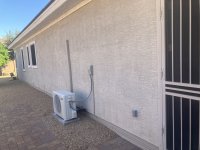
I ran mine on the outside with the lines in a mostly full length chase.
IMG_5551_Original.jpeg
 

Mikes61

Well-known member
Joined
Dec 25, 2023
Messages
238
I put a 3 ton minisplit in my garage while the 2 x 6 walls were still open inside. The coolant lines are ran inside the wall and the #8 wire is also ran inside the wall, with an AC disconnect being the only thing showing on the outside wall.

I had a leak on the 5/8” flare, inside the wall, prior to drywalling so I had to fix the flare and recharge the system. It made me think of what I would do if it leaked after the drywall and paint. Ive decided to leave that area bt those two studs open and put a metal cover over it and paint it to match the inside wall paint. I didn’t want to screw myself if I ever need to replace the system or have another leak.
 

ipgenie

Well-known member
Joined
Jan 29, 2020
Messages
562
Location
Idaho
When our office building was under construction, the mini split for the server room was installed with the line set in the walls. When we added a second split for redundancy, the lines ran exposed down the stairwell. Both have been just fine, but the lines et in the wall does look better. It's a block building so both lines just run through the wall to the exterior compressor.
 
To avoid these ads, REGISTER NOW!
Top Bottom