
You are using an out of date browser. It may not display this or other websites correctly.
You should upgrade or use an alternative browser.
You should upgrade or use an alternative browser.
Missing link in evolution found!
- Thread starter Ricky Joe
- Start date


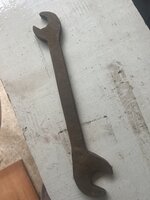

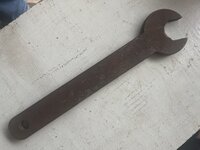
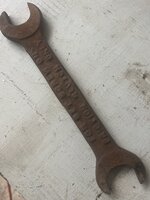

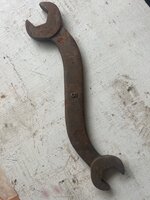
When “S” shaped wrenches ruled! One of these is stamped “N&W RY”, with the W an upside down M. Norfolk and Western Railway is very big in Roanoke, or it used to be, and higher education is still not a local strong point. These may all be railroad wrenches, for all I know. After all, I AMlocal!
Attachments





RTM
Well-known member
Weirdly, found them together. First digit might be an SA very specialized wrench, labeled “FOR SET SCREW ON FRICTION CLUTCH ONLY”, and “STREET STOKER 31073”. Obviously not suitable for any other application, and I’d hate to be the guy that tried. So, how do you stoke streets?

Street Stoker - wrenchwiki
Clement Street developed a stoker used to feed coal inro steam locomomotives.
wrenchwiki.com
Street Stokers
www.trainorders.com
Thanks. These are a bunch of wrenches I’ve had in the garage for years. They’ve really rusted and gone down, though surprisingly some look very good.Weirdly, found them together. First digit might be an S
Street Stoker - wrenchwiki
Clement Street developed a stoker used to feed coal inro steam locomomotives.wrenchwiki.com
Street Stokers
www.trainorders.com
Looks like VLCHEK. Fairly common, but unmarked so hard to hit a search on eBay.Obviously part of a set. Finally a manufacturer who mass produced! Sizes are 1”-7/8” and 3/4”-13/16”. If anyone has the rest of the set for trade, I’m interested!
The raised lettering is a clue that this one was likely cast rather than forged.A very specialized wrench, labeled “FOR SET SCREW ON FRICTION CLUTCH ONLY”, and “STREET STOKER 31073”. Obviously not suitable for any other application, and I’d hate to be the guy that tried. So, how do you stoke streets?
paulsomlo
Well-known member
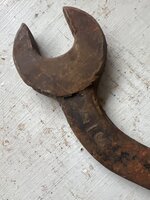
Probably used for the lug nuts on a chariot!I’ve been trying to find out what I have. In a box of mostly rusted wrenches, I found this, the possible evolutionary link between the two different styles of throat. It may date back to Roman era, judging from the numeral seven.
I have the same exact wrench. All joking aside, does anyone know what maker this is?I’ve been trying to find out what I have. In a box of mostly rusted wrenches, I found this, the possible evolutionary link between the two different styles of throat. It may date back to Roman era, judging from the numeral seven.
Mintgrun
Well-known member
Ricky Joe's been missing since January 11th.
I used to enjoy his contributions to the forum.
I used to enjoy his contributions to the forum.