To avoid these ads, REGISTER NOW!

Moisture/Humidity Issue

jkohnz

Member
Joined
Jul 2, 2020
Messages
24
Location
MO
Hi. I'm new, and this is my first post here. I'm hoping to get some definitive answers on what I need to do. I've been searching for info on Google, a lot of stuff comes up on this site and some others. But, I haven't found one in the same scenario/specs that I've got going on.

Here's the background:

  • 40x60x14 pole barn construction on raised pad, no flooding going on.
  • Building was completed in January 2020.
  • Located in MO.
  • Open ceiling/exposed trusses.
  • 4" concrete with vapor barrier underneath.
  • 6" open cell spray foam on the roof, 4" open cell on the walls. The builder sprayed it top to bottom, with no openings for ventilation.
  • 100amp service to the building.
  • 12'x12' 3 layer insulated overhead door, 3' walk in door, no windows.
  • No HVAC yet, but plan to this winter. Also planning to put in a giant ceiling fan for air flow.

****
EDIT: I should probably have mentioned that they put tyvek top to bottom on the outside of the building, metal over that, spray foam on the inside against the tyvek, so that if I have to replace a piece of metal it makes it easier.

Also, there are 2 6" round floor drains that basically drain out behind the building. So, it's not 100% air tight, but pretty darn close.
****

I go in it a few times a week, generally keep everything locked and closed up at all times. It is completely air-tight. You can't even see light around the garage door seals. It was 95 and sunny out the other day, and the inside only got up to 79. While out in the shop this past weekend, I noticed that my metal storage shelving that has particle board flats was completely covered with thick green mold. It was even starting to grow on the metal braces! This happened very quickly, as I didn't see it just a couple weeks ago. I've noticed, with the warm weather, the air seems musty/stale in there, which I'm sure is due to the lack of ventilation.

Since I'm restoring old vehicles, have $60K+ in tools, equipment, etc. stored in this, what options do I have to keep everything dry and not getting moldy again? Shelving flats I can replace with some 1/4" PT plywood or whatever. But, I don't want worse problems to come up.
 
Last edited:
To avoid these ads, REGISTER NOW!

On-Wheel

Well-known member
Joined
Oct 6, 2014
Messages
487
A commercial dehumidifier does like 18 gallons a day.Check for locally used units.There’s one by me for $550 with 2200 hours.I’ve seen them for 200.Rent one?A residential unit is 40-60 pints a day.

Get a few $10 temp/humidity gauges.How wet is it? Is the slab fresh?

A 1 ton/15k btu window ac unit might dry it out in a 2 days.Those will run on 110 20amp dedicated breaker.Thats the best bang for the buck that I can think of.

My 1100 sq’ went from 63% down to 41% today in 6 hours.Temp 84 to 73 in same time. Ironically it just shut off as I’m typing this.

All insulated and dry walled with 11’4” ceiling .

The good thing about an under sized unit is it will run longer to lower temp there for more time removing moisture.

Wipe down everything with water and small amount of bleach mixture to kill the funk.
 
Last edited:

karoc

Well-known member
Joined
Dec 19, 2017
Messages
1,987
Location
Hemphill Tx
Particle board is like a sponge,it really is. Get some decent decking plywood cut to size and paint both sides and edges will last you a long time.
 

glentre

Well-known member
Joined
May 21, 2016
Messages
909
Location
Gloucester, Virginia
First, welcome to this great forum.

This problem seems to happen to many of us with well insulated buildings if we're not careful and is usually caused by us opening our garage doors when the inside temperature is below the dew point of the outside air. On a hot and humid day, as soon as that outside air comes in contact with anything inside, condensation will form on every surface, even the floors. Don't ask me how I know! Spring and fall are the times this problem occurs the most when we get cool nights and hot/humid days.

In these instances, ceiling fans will help but dehumidifiers will do nothing to prevent flash condensation when you open your doors. The only way to prevent it is to raise the inside temperature above the dew point (temp at which the air cannot hold any more moisture and condensation occurs) of the incoming air when the doors are opened. I have a large ceiling fan and a wall mounted heat pump (picture construction trailers) which I turn on during these conditions and before I open the big doors. It is cheap to do since the outside temp is already warm and it only takes a few minutes to get the inside temp up so condensation will not happen. In your garage with no hvac and no fans, I guess the best you can do is to understand when this condition is likely to happen and be careful about opening your big doors until the inside temperature rises naturally during the day.

Glen
 
OP
J

jkohnz

Member
Joined
Jul 2, 2020
Messages
24
Location
MO
Get a few $10 temp/humidity gauges.How wet is it? Is the slab fresh?

A 1 ton/15k btu window ac unit might dry it out in a 2 days.Those will run on 110 20amp dedicated breaker.Thats the best bang for the buck that I can think of.

I might just pick up the humidity gauges. The slab was poured Christmas Eve 2019. We had a pretty mild winter.
 
OP
J

jkohnz

Member
Joined
Jul 2, 2020
Messages
24
Location
MO
Particle board is like a sponge,it really is. Get some decent decking plywood cut to size and paint both sides and edges will last you a long time.

Good idea. Thankfully it is only on these 2 shelving units, and not on any of my wooden work benches. I have several other shelving units I was going to put in, so I want to get this issue under control before doing so.

First, welcome to this great forum.

This problem seems to happen to many of us with well insulated buildings if we're not careful and is usually caused by us opening our garage doors when the inside temperature is below the dew point of the outside air. On a hot and humid day, as soon as that outside air comes in contact with anything inside, condensation will form on every surface, even the floors. Don't ask me how I know! Spring and fall are the times this problem occurs the most when we get cool nights and hot/humid days.

In these instances, ceiling fans will help but dehumidifiers will do nothing to prevent flash condensation when you open your doors. The only way to prevent it is to raise the inside temperature above the dew point (temp at which the air cannot hold any more moisture and condensation occurs) of the incoming air when the doors are opened. I have a large ceiling fan and a wall mounted heat pump (picture construction trailers) which I turn on during these conditions and before I open the big doors. It is cheap to do since the outside temp is already warm and it only takes a few minutes to get the inside temp up so condensation will not happen. In your garage with no hvac and no fans, I guess the best you can do is to understand when this condition is likely to happen and be careful about opening your big doors until the inside temperature rises naturally during the day.

Glen

I was wanting/hoping to avoid heating it up to match nearly 100 degree weather. Another thought I had was to get one of those industrial wall ventilation fans and set it up to come on maybe in the morning to equalize the humidity with the outside, but shut it off once it gets super hot out (or super cold). I don't open the big door a lot, usually just the walk in. But, when working on a car, or doing some welding, I open it up for the fumes. Maybe I should work on getting an exhaust vent set up so I can keep the door shut...
 

Jayhawk_Aviator

Well-known member
Joined
Jun 2, 2015
Messages
123
Jkonz. I’m in the Kansas City area and had very much the same issue. I would have mold on the wall, and at times moisture on the floor. Dehumidification is the answer. I have a mini split installed that I rarely used. I figured out it has a dehumidification mode. I run it round the clock in that mode and it totally does the trick. Before I started doing that I used a 70 pint u it from the house, and even that seeemed to work.
 

Showkey

"MEMBER EMERITUS"
Joined
Aug 9, 2014
Messages
8,638
Location
Wausau WI
Just to clear the air.......moving the air WILL NOT PREVENT MOLD........it will just spend the mold spores around. Moving the air will not change the moisture content ( relative humidity).

There several other posts on the topic of high humidity, musty smells, dripping ceiling , rust and mold. Many of the posts are in the heating AC section.

First: Measure the temperature and humidity levels inside the building. Suspect your humidity is upwards of 70%-80%. Bad things start at 70% mold and mildew will form on organic materials first like paper, rubber, dust, fabric etc......musty smell like grandma’s basement is common.

To control humidity you must control the temperature and air exchange rate. Air exchange rate also means insulation. After that your must condition the air. As mentioned Dehumidifier or AC in summer, heat in the winter.

Without of the insulation, temperature or air exchange rate Control the money Spent “conditioning” the air is wasted.

Opening the doors will only help on those Low humidity days.......not common in summer MO. Then at night the temperature changes the relative humidity sky rockets, dew point is reached and condensation is the next problem.

I run a dehumidifier in my shop all summer with goal of 50%.

B8A4EC0B-5D50-4C37-A0BC-5AC10E65718C.jpg
 
Last edited:

yeldogt

Well-known member
Joined
Jan 2, 2012
Messages
18,184
Moving air and raising the temp is not the answer .... you have humidity.

You may still have an excess of normal construction humidity -- all of the building materials are higher in humidity when new. This is why it's always best to get the AC working in new construction to dry out the building in the summer -- prior to interior work.

With a foamed building there is very little leaking -- so no air changes are happening. The humidity is trapped .... you need to condition the space. I have a Santa Fe compact humidifier in my studio. It's by a river and we get humidity -- the dehumidifier is able to keep it in check when the AC is not needed ... once the AC is working that eliminates the humidity. Those cheap big box type dehumidifiers with the small tanks don't work all that well in a big space and use a lot of power.

A mini split may solve all your problems ..... it really depends on how much humidity is around when you don't need AC. That's why I need the dehumidifier.

With a house and spray foam -- you need to ventilate. Bring in fresh air -- people breathing causes contaminates -- you bring in fresh to fix this. This is often not a problem with a shop and only one person -- the big door opening tales care of this quickly.

Also -- even in humid weather the opening of the door is not an issue .... it's not open long enough. You will be shocked when you finally get either AC or a dehumidifier in there -- the water it removes initially will be large.

A unit like the Santa Fe is designed to remove a lot of water ...much more than a small unit and will do it with less power. In my case a small ran for weeks and never got it down -- when I first connected the Santa Fe it ran for three days .. got the humidity down and controlled it.
 
Last edited:

nadogail

Well-known member
Joined
Jan 23, 2009
Messages
31,899
Location
Coronado, CA
Welcome to the forum.

I understand from my spouse who was born in MO, that it sits between two rivers and high humidity is to be expected.

Just as we have earthquakes here, you will see humidity and flooding there.
 

glentre

Well-known member
Joined
May 21, 2016
Messages
909
Location
Gloucester, Virginia
The OP asks what options he has to keep everything dry and not moldy again. Obviously, he had a moisture and condensation problem which allowed the mold to form. He has no HVAC or dehumidifier and will not be installing any until this winter. He wants a solution to the problem now so he does not get mold on his tools, equipment and shelving. This indicates he wants a solution so he can use his garage mold free until he gets his HVAC system installed which will resolve his humidity problem at that time. However, the system should be designed to introduce some ventilation air because his building is so tight. I feel his initial mold bloom came in the Spring when his inside temperature was chilly enough such that when he opened his garage door during a hot and humid day, everything in the garage was below the dew point of the outside air that was coming in through the open door and condensation formed followed by the mold. This happened to me and it happens quickly.
Now that we are in the depths of summer, I don't think he will see a repeat of the condensation problem because, without air conditioning, the inside temperature will not be cold enough to be below the dew point of the outside air. Therefore, he could do nothing at this time and continue to work in his garage with the doors open, although it might be uncomfortably hot and humid. But, there will be no condensation on interior surfaces which mold needs to form and survive so that problem has resolved itself with no other action required with regard to the mold. That is all he is asking..... how can he keep everything dry and not moldy again. If he is comfortable working with summer conditions inside his garage, he doesn't need to do anything to prevent another mold bloom.

Glen
 

yeldogt

Well-known member
Joined
Jan 2, 2012
Messages
18,184
The OP asks what options he has to keep everything dry and not moldy again. Obviously, he had a moisture and condensation problem which allowed the mold to form. He has no HVAC or dehumidifier and will not be installing any until this winter. He wants a solution to the problem now so he does not get mold on his tools, equipment and shelving. This indicates he wants a solution so he can use his garage mold free until he gets his HVAC system installed which will resolve his humidity problem at that time. However, the system should be designed to introduce some ventilation air because his building is so tight. I feel his initial mold bloom came in the Spring when his inside temperature was chilly enough such that when he opened his garage door during a hot and humid day, everything in the garage was below the dew point of the outside air that was coming in through the open door and condensation formed followed by the mold. This happened to me and it happens quickly.
Now that we are in the depths of summer, I don't think he will see a repeat of the condensation problem because, without air conditioning, the inside temperature will not be cold enough to be below the dew point of the outside air. Therefore, he could do nothing at this time and continue to work in his garage with the doors open, although it might be uncomfortably hot and humid. But, there will be no condensation on interior surfaces which mold needs to form and survive so that problem has resolved itself with no other action required with regard to the mold. That is all he is asking..... how can he keep everything dry and not moldy again. If he is comfortable working with summer conditions inside his garage, he doesn't need to do anything to prevent another mold bloom.

Glen

I wish what you were saying is true/correct ... but ... it's not.

While dew point is interesting -- overall humidity is the problem. If he happens to hit a very low humidity day ... open everything up and try and dry some of it out. It can take a year for a building to give up it's moisture -- Humidity can transfer through building materials to the inside forever .. that't why plastic VB is so dangerous in green grass climates.

I need humidity control .... With a spray foam building it's necessary in a green grass climate .... the good thing is it's easy to control and not costly.
 

Showkey

"MEMBER EMERITUS"
Joined
Aug 9, 2014
Messages
8,638
Location
Wausau WI
The OP asks what options he has to keep everything dry and not moldy again. Obviously, he had a moisture and condensation problem which allowed the mold to form. He has no HVAC or dehumidifier and will not be installing any until this winter. He wants a solution to the problem now so he does not get mold on his tools, equipment and shelving. This indicates he wants a solution so he can use his garage mold free until he gets his HVAC system installed which will resolve his humidity problem at that time. However, the system should be designed to introduce some ventilation air because his building is so tight. I feel his initial mold bloom came in the Spring when his inside temperature was chilly enough such that when he opened his garage door during a hot and humid day, everything in the garage was below the dew point of the outside air that was coming in through the open door and condensation formed followed by the mold. This happened to me and it happens quickly.
Now that we are in the depths of summer, I don't think he will see a repeat of the condensation problem because, without air conditioning, the inside temperature will not be cold enough to be below the dew point of the outside air. Therefore, he could do nothing at this time and continue to work in his garage with the doors open, although it might be uncomfortably hot and humid. But, there will be no condensation on interior surfaces which mold needs to form and survive so that problem has resolved itself with no other action required with regard to the mold. That is all he is asking..... how can he keep everything dry and not moldy again. If he is comfortable working with summer conditions inside his garage, he doesn't need to do anything to prevent another mold bloom.

Glen

As mentioned above in post 15 the building will not dry out. Especially in MO in the summer.

Dew point is only in play when condensation is occurring. OP may or may not have condensation issue. Mold and mildew only need high relative humidity.
Condensation issue usually occur with large temperature swings in a relative short period of time. Example in shop is cold shop Humid warm spring day .......shop floor and contents might immediately start sweating. Iced tea glass is another example of the dew point.

The building can still have very high humidity in summer and winter.
The humidity levels must be controlled.
Add heat in the building in the winter will usually dry the air.

My shop never had condensation.......but.......my leather welding gloves start to mold from 75% relative humid.

OP shop and my shop the relative humidity changes with the weather conditions outside. The dehumidifier will run more or less based on the need or Target humidity levels.

Here’s a day May 2 when if the doors were open the shop would dry out.....( these days and conditions don’t last)

DEF504C9-A05C-4401-963B-924B992AD475.jpg

Here’s day on Mar 12 where heat, sealed building with insulation made the inside warm and dry with no dehumidifier.

2B5329A8-1A7E-432B-9653-58AE1526A5F1.jpg
 
Last edited:

Balvar24

Well-known member
Joined
May 18, 2016
Messages
870
79F indoor on a 95C outdoor day?

Open cell insulation?

That's the problem.

Your relative humidity is probably head 100%. I bet the outdoor wet bulb is near 72F or higher? The air in the building is warming faster than the shelving and moisture condenses on the shelves.

What are you counting on as a vapor barrier in your walls?
 

Bighead38

Well-known member
Joined
Nov 11, 2012
Messages
5,612
Location
Rockland County NY
Just to clear the air.......moving the air WILL NOT PREVENT MOLD........it will just spend the mold spores around. Moving the air will not change the moisture content ( relative humidity).

There several other posts on the topic of high humidity, musty smells, dripping ceiling , rust and mold. Many of the posts are in the heating AC section.

First: Measure the temperature and humidity levels inside the building. Suspect your humidity is upwards of 70%-80%. Bad things start at 70% mold and mildew will form on organic materials first like paper, rubber, dust, fabric etc......musty smell like grandma’s basement is common.

To control humidity you must control the temperature and air exchange rate. Air exchange rate also means insulation. After that your must condition the air. As mentioned Dehumidifier or AC in summer, heat in the winter.

Without of the insulation, temperature or air exchange rate Control the money Spent “conditioning” the air is wasted.

Opening the doors will only help on those Low humidity days.......not common in summer MO. Then at night the temperature changes the relative humidity sky rockets, dew point is reached and condensation is the next problem.

I run a dehumidifier in my shop all summer with goal of 50%.

B8A4EC0B-5D50-4C37-A0BC-5AC10E65718C.jpg

Is that a standalone gauge? I really like that.
 

glentre

Well-known member
Joined
May 21, 2016
Messages
909
Location
Gloucester, Virginia
I suspect the majority of folks who have garages don't have them air conditioned. They work with open doors in the summer and don't have any mold problems even with high humidity conditions. Granted that high humidity alone can cause mold to form on some surfaces, especially organic materials like leather, cloth and paper items but this is not what the OP has described. He says that mold formed on his shelving and even on the metal bracing and that it happened very quickly. While I would like to hear from the OP on this point, I still think his mold bloom happened quickly when his chilly garage interior was flooded with high humidity warm outside air and flash condensation occurred likely sometime in the early spring. He is asking for options on what to do to prevent this from happening again and I am saying a repeat of that flash condensation in his garage is highly unlikely during the summer months because the inside temperatures and humidity will be close to the outside conditions and no condensation will happen. I do not disagree with those who advise the need for him to control humidity to prevent normal mold forming conditions but that is a different story from what he describes as a quick mold formation that resulted from condensation of water on his shelving and metal supports. High humidity is one thing. High humidity that condenses on cold surfaces below the dew point of the air surrounding them is entirely different.

Glen
 

SALIV8

Well-known member
Joined
Dec 11, 2008
Messages
2,114
Location
chicago and s/w michigan
Remove the mold, then open the doors a bit every day and setup some cheap box fans. See if that helps. If not, when you can, install a mini split on one or both ends.


Edit- do you have any windows on the shop? If so, leave those open and see if that helps.
 
To avoid these ads, REGISTER NOW!

On-Wheel

Well-known member
Joined
Oct 6, 2014
Messages
487
Is that a standalone gauge? I really like that.
The base plugs in for power.My base is in the house.Also has a battery operated temp humidity thing almost size of a tv remote I put in the garage.It might be WiFi and Bluetooth?
The base reads where it is plunged in at.
 

karoc

Well-known member
Joined
Dec 19, 2017
Messages
1,987
Location
Hemphill Tx
The thing that I don't understand is why spray foam companys want 100% seal meaning no ridge vents or soffit vents. I know that to get the full benefit of spray foam and what it provides it needs to be sealed. With the opening of bay door, which lets in different temps and humidity.That become trap in a cooler like shop with no excape,my point being a shop with no venting humidity becomes trap. I wonder if having some kind of venting would be better than no venting at all. Kinda like being in bathroom with gas,no venting it stinks with exhaust fan have air exchange. Asking cause I will be building in future. Dang when person has a pole barn which means its a large area you will have to have one heck of a dehumidifier.
 
OP
J

jkohnz

Member
Joined
Jul 2, 2020
Messages
24
Location
MO
I feel his initial mold bloom came in the Spring when his inside temperature was chilly enough such that when he opened his garage door during a hot and humid day, everything in the garage was below the dew point of the outside air that was coming in through the open door and condensation formed followed by the mold. This happened to me and it happens quickly.
Now that we are in the depths of summer, I don't think he will see a repeat of the condensation problem because, without air conditioning, the inside temperature will not be cold enough to be below the dew point of the outside air.

Glen

Thanks Glen. I appreciate the input. You are at least correct on that I did have a day where it was warm outside in the spring, and I had to open the big door. Everything got soaked with condensation that day. I just didn't realize it would cause the mold issue I'm seeing a few months later.

I think at this point I will get some humidity gauges to see just how humid it is in there. I could be totally off-base on this. It feels humid and smells musty, though.
 
OP
J

jkohnz

Member
Joined
Jul 2, 2020
Messages
24
Location
MO
79F indoor on a 95C outdoor day?

Open cell insulation?

That's the problem.

Your relative humidity is probably head 100%. I bet the outdoor wet bulb is near 72F or higher? The air in the building is warming faster than the shelving and moisture condenses on the shelves.

What are you counting on as a vapor barrier in your walls?

I should probably have mentioned that they put tyvek top to bottom on the outside of the building, metal over that, spray foam on the inside against the tyvek, so that if I have to replace a piece of metal it makes it easier.
 
OP
J

jkohnz

Member
Joined
Jul 2, 2020
Messages
24
Location
MO
The base plugs in for power.My base is in the house.Also has a battery operated temp humidity thing almost size of a tv remote I put in the garage.It might be WiFi and Bluetooth?
The base reads where it is plunged in at.

Got a brand/model on that?
 

glentre

Well-known member
Joined
May 21, 2016
Messages
909
Location
Gloucester, Virginia
Thanks Glen. I appreciate the input. You are at least correct on that I did have a day where it was warm outside in the spring, and I had to open the big door. Everything got soaked with condensation that day. I just didn't realize it would cause the mold issue I'm seeing a few months later.

I think at this point I will get some humidity gauges to see just how humid it is in there. I could be totally off-base on this. It feels humid and smells musty, though.

You would be wise to eliminate all the existing mold you can to help eliminate the musty smell and to prevent the mold from spreading. In the meantime, until you get your HVAC system installed, a large ceiling fan or some box fans will help keep the air circulating and allow fresh outside air to give you some ventilation and exchange of air.

Again, since you have such a well insulated and sealed garage, consider talking to your HVAC installer to ensure adequate ventilation of outside air is designed into the system. Understanding what happened with regard to the flash condensation, the same thing happening again in the fall months is a distinct possibility if you are not careful. Now, I agree with several others who posted about the need for ventilation and humidity control but that is a different situation from what you experienced.

Happy Fourth to all in celebrating everything that is great with this country of ours and recognizing there is still a need to constantly strive to make it better.

Glen
 

yeldogt

Well-known member
Joined
Jan 2, 2012
Messages
18,184
I have had many spray foamed buildings in my life and not one ever had this is problem from a single day opening doors. I have had the issue with new construction .. once a building is sealed.

As I said the OP needs to ventilate the building on a day where the humidity is low -- or condition it. It's a problem that is going to come back.


The need for fresh air is dependent on use -- many people in a small tight building or where producing contaminants .. yes.

This can be done with one of the better dehumidifiers -- you can pipe outside air to them and they will condition this air as the units internal fans runs. They make controllers and dampers for this/
 
Last edited:

yeldogt

Well-known member
Joined
Jan 2, 2012
Messages
18,184
I should probably have mentioned that they put tyvek top to bottom on the outside of the building, metal over that, spray foam on the inside against the tyvek, so that if I have to replace a piece of metal it makes it easier.


House wrap is not often understood -- same with vapor barriers.

It's generally understood that 5" of open foam is a full VB --- or enough of one to stop problems. what people don't understand is that heat is the force that moves water. this heat can be from outside (the sun) or inside (heater ..even people)

The OP has trapped moisture ... it can come from many sources. but the solution is the same. Even in very dry climates -- a house with many people will have humidity problems if tight and the ratio of people to available SF is high.
 

glentre

Well-known member
Joined
May 21, 2016
Messages
909
Location
Gloucester, Virginia
I have had many spray foamed buildings in my life and not one ever had this is problem from a single day opening doors. I have had the issue with new construction .. once a building is sealed.

As I said the OP needs to ventilate the building on a day where the humidity is low -- or condition it. It's a problem that is going to come back.


The need for fresh air is dependent on use -- many people in a small tight building or where producing contaminants .. yes.

This can be done with one of the better dehumidifiers -- you can pipe outside air to them and they will condition this air as the units internal fans runs. They make controllers and dampers for this/

The OP's originally described problem was flash condensation and it's not a problem that is going to come back unless his inside temperature is below the dew point of the air entering the garage. Certainly, he seems to have a trapped high humidity problem that will require dehumidification in the form of conditioned air or dehumidifiers in the long term but flash condensation during the summer will not occur. Come fall with chilly nights and hot/humid days and with doors open poses a high risk of the flash condensation happening again. But, it cannot happen unless the temperature inside his garage and of the objects in it are below the dew point of the surrounding air. Let's not mix up the phenomenon of flash condensation with problems resulting from high humidity but with no condensation on building surfaces.

Glen
 

Showkey

"MEMBER EMERITUS"
Joined
Aug 9, 2014
Messages
8,638
Location
Wausau WI
OP a just has to measure the indoor humidity levels over a period of time to confirm the situation.

With the OP stating 95* outside 79* inside temps......my bet is still 70% plus indoor humidity.
 

Bighead38

Well-known member
Joined
Nov 11, 2012
Messages
5,612
Location
Rockland County NY
The base plugs in for power.My base is in the house.Also has a battery operated temp humidity thing almost size of a tv remote I put in the garage.It might be WiFi and Bluetooth?
The base reads where it is plunged in at.

I meant stand alone that it wasn’t part of your central air system. What brand and model is it?
 
OP
J

jkohnz

Member
Joined
Jul 2, 2020
Messages
24
Location
MO
I ordered a cheap(er) humidity monitor for the shop, should be here tomorrow. I'll follow up with what it reads. It stores for 20 days, so that should give me a good idea.

On a positive note, I checked everything else in the shop, wood-wise, not a spec of mold anywhere else. So, it was just 2 shelving units that had MDF shelves, and a separate piece of MDF that was leaned up against one of the posts. Burned it all over the weekend in a massive burn pile I lit for the 4th. I do have some rust on my tools, though, to deal with.
 

Showkey

"MEMBER EMERITUS"
Joined
Aug 9, 2014
Messages
8,638
Location
Wausau WI
Here’s another interesting readings from the shop this morning:

EEB535B1-E3D6-479A-B0FB-CF13E07C0020.jpg

The shop is not air conditioned ( dehumidifier only) but never goes over 75* even with daytime outside temps in 90*.

My regular attached garage floor ( door open, cars coming and going) is sweating this week with 90* temps and very Outside humidity levels.......the slab temperature is about 60*.

The slab takes all summer to warm up and all winter to cool down. Live in completely wooded shaped area. Winter the water never freezes on the floor even with actual temperatures of -25*f. The attached garage is fully insulated but not heated or cooled.
 
OP
J

jkohnz

Member
Joined
Jul 2, 2020
Messages
24
Location
MO
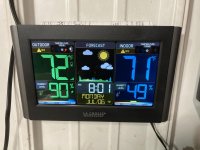
Using my cheapo humidity meter, it's showing 74% humidity and 82 degrees inside. Nothing sweating, like the floor, etc. Outside it's 93 and muggy.
 

Showkey

"MEMBER EMERITUS"
Joined
Aug 9, 2014
Messages
8,638
Location
Wausau WI
Using my cheapo humidity meter, it's showing 74% humidity and 82 degrees inside. Nothing sweating, like the floor, etc. Outside it's 93 and muggy.


There’s your problem .......prolonged above 65-70% humidity will produce the mold, mildew, funky smell Etc. ( it can be a slow process)

Sweating needs a temperature difference like the iced tea example. Where the cold area is below the dew point. With your inside temperature at 82* there is not likely to be a cold surface.

Plug in large big box 100 pint dehumidifier with a drain hose. 3-5 days the levels should trend to 50% setting the dehumidifier at 50%. Initially there will gallons of water “pulled from thin air”.
 
Last edited:
OP
J

jkohnz

Member
Joined
Jul 2, 2020
Messages
24
Location
MO
Plug in large big box 100 pint dehumidifier with a drain hose. 3-5 days the levels should trend to 50% setting the dehumidifier at 50%. Initially there will gallons of water “pulled from thin air”.

Would the dehumidifier work better than a mini split? I'm waiting on a friend to get back to me who owns an HVAC business on what it would cost to get set up with one of those (or maybe multiple needed?).
 
To avoid these ads, REGISTER NOW!
Top Bottom