To avoid these ads, REGISTER NOW!

Moisture in Air Lines

65Stang

Well-known member
Joined
Sep 25, 2008
Messages
240
Location
Washington State
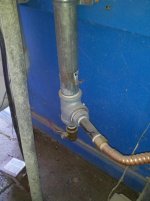
Got a problem. I have my 21 gallon compressor in a little storage box outside my shop. It is plumbed is via an air hose to a filter/collector. From there, it goes to a reel for the shop and also splits to black pipe piped to the garage for the reel there. I just set up my barrel blaster (awesome-ness), but I am getting a lot of moisture in the blaster gun. I have also noticed that I am getting moisture coming out of my air tools in the garage as well. There is moisture being collected in the filter/collector and I have emptied that. What might my issue be? This has been set up for quite a few years, and it seems that I have been getting more and more moisture in the lines as time passes. Drain the compressor maybe? More filters/collectors?

Below are picks of where the line comes in from the compressor and splits off.

View media item 17345
View media item 17346
 
To avoid these ads, REGISTER NOW!

BADSIX

Well-known member
Joined
Nov 30, 2010
Messages
895
Location
oregon coast
your compressor may need drained, when was the last time you drained it? allso you could put a tee were that 90 is just out of your filter and run a 6" ****** down with a drain valve to drain that pipe.
 
OP
6

65Stang

Well-known member
Joined
Sep 25, 2008
Messages
240
Location
Washington State
Uh, I'm supposed to drain the compressor!? :) Been a few years, been working outta state past three years.

Other than that, what else could be causing this moisture?
 
Last edited:

SGKent

Banned
Joined
Feb 12, 2010
Messages
1,959
Location
Citrus Heights CA
that little water separator is not going to stop all the moisture when you are beading. I ended up going to 30' of coiled hose to cool the flow so the moisture condenses out then two water separators and finally a paint style moisture trap to stop my moisture. The paint trap will saturate after a long while and I replace it with another and let that one dry out. Do drain the tank too.

something like this as the final trap

DisposableFilter.jpg
 

darkzero

Well-known member
Joined
Oct 20, 2011
Messages
3,327
Location
SoCal
Uh, I'm supposed to drain the compressor!? :) Been a few years, been working outta state past three years.
Other than that, what else could be causing this moisture?

Might want to just start with that & do it often. :)

Sounds like you haven't drained it in quite sometime & with only a 21 gallon tank it's no surprise if you haven't. The cause for excessive moisture or more than usual is high humidity or repeated cycles. If you find yourself having to run the compressor very often don't even waste your time on traps, filters, dryers, etc, you need a bigger compressor.
 

ng8264723

Well-known member
Joined
Aug 28, 2006
Messages
732
Location
Oakham MA
One of the best ways to get rid off moisture is with a cooling line. You basically use a copper line (awesome heat dissipitation) and run it as high as possible from the compressor. In my shop it runs up the 14 foot ceiling along the roof (therefore longer than staight up the wall). What occurs is the hot air cools as it moves upward and the water condenses out. It then falls back into the compressor. This simple piping arrangement is very effective. My shop has a 10 HP Saylor Beal with a 120 Gallon tank and one water separator. I NEVER EVER have water in my lines. My water separator is almost never full
 

OccupantRJ

Well-known member
Joined
May 15, 2009
Messages
11,132
Location
Eastern North Carolina
I have seen compressors that guys were not draining, and the tank would be almost full of water. They had me look at them usually because they were cycling very often. A 100 cfm compressor at work can output a gallon of water a day in certain times of the year. I bet your tank has a LOT of water in it.
 

e-tek

Well-known member
Joined
Dec 19, 2007
Messages
10,690
Location
Saskatoon, SK
I'd be curious how much water is in the tank.:eyecrazy:

No doubt!!!! I'd bet it's getting near HALF full of water! All your symptoms point to that. Optimally, tanks should be drained DAILY. At the very LEAST, once every few days of use. I get half a cup out for every day (6-8 hourS) of use. I wouldn't be surprised of you now have a TON of rust in that tank and that the drain plugs up when you drian it. If a LOT of water doesn't come out, better try and clean out the drain line.

Once you get that out of the way, you ALSO need a dryer when you run a sand blaster. The easiest/cheapest in my book is a dessicant dryer. You plumb it in-line just before the blaster. The dessicant pucks last a long time - mine go a couple years between changes, plus you can re-juvinate them in the microwave.

One other thing I noticed is your line from the compressor is more or less level to the ground. If you can, change it around so it runs from compressor UP to the first junction. That'll keep any water that's produced in the tank, in the tank.

May as well keep going here.....
You've got WAY too much hose for a blasting set up. Split your system into 2 parts from the compressor - one side to your hose and one side to your blaster. Keep the blaster side a short and "open" as possible. By open I mean use 3/4" plumbing with as few elbows as possible. If the system necks down anywhere, air will get restricted. You need VOLUME and pressure for a blaster.

Lastly (for me!), you need at least 18.5cfm/90psi for that blaster. I doubt your 21gal will do that. Most compressors used for a blaster are 80 gallon, 2-stage, 18cfm/90 or bigger. You'll know pretty quick - once you get all this sorted out. A small compressor becomes an exercise in frustration!
 
Last edited:

Al Bundy

Well-known member
Joined
Aug 1, 2011
Messages
2,026
Location
Upstate NY
I assume a compressor with only a 21 gallon tank doesn't have a very high output. I'm surprised you can actually run that blasting cabinet at all.

A section of pipe to cool the air is they way to go, though I would use black pipe rather than copper. The copper won't cool back down fast enough during heavy use. I built a small manifold that's approx. 25 feet of pipe. My water separator is attached at the other side of it. So far I get all the moisture out before it even gets to the separator. And that's with 6-7 hours of continuous use.
 
To avoid these ads, REGISTER NOW!

Falcon67

Well-known member
Joined
Jun 11, 2009
Messages
18,371
Location
Merkel, TX
You are working the compressor too hard. The more it runs, the more water you get. The more it runs, the hotter the air coming out of the pump. Hot air carries water. That air goes into the lines and does not necessarily drop out in the tank. It then condenses out in the lines and shows up at your tools. If you want to run that thing hard, then you need a BIG trap/filter at the compressor and possibly a cooling tower or condenser to cool the air coming out of the compressor. You can stop some of it at the tool with those little orange filters, but the lines are still full of condensing air. HAS to be stopped at the source. And yea - drain the compressor once in a while. I have painted car with a 25 gallon oilless - it is VERY HARD to keep the water under control. I can be done, but it's a job. Proper use of a blaster your size would require a two stage 80 gallon compressor.
 
Last edited:

MP&C

Well-known member
Joined
Oct 21, 2009
Messages
4,403
Location
Leonardtown, MD
The biggest advantage to a metal air line, be that copper or steel, is that it will help to condense any water vapor out of the compressed air. Most compressor manufacturers will recommend between 25 and 50' of such pipe prior to the water trap. Rubber hose does nothing to remove water vapor, so at the position your Husky water trap is located, there has been no condensing to speak of and the water vapor, as it is still a gas, goes right through and condenses further down the line, coming out the exhaust of your tools. As was said earlier, a 21 gallon compressor likely has little recovery time to shut off and cool down if you're running the sand blast cabinet, so the constant running you likely see only heats the air up more, for more water vapor introduced in the line.

To fix, you'll need a steel or copper air line installed to condense the vapor, or a refrigerant dryer or equivalent could take the place of all the condensing line, and with that sandblaster, it would help out tremendously to have a compressor better matched to the air consumption. Until this is done, you'll continue to have these issues. For the amount of water you're getting, those little orange screw on filters shown above would be like ******* in the wind, they may work for a little while, but if you're changing them out more than once a week, you have other issues to fix....
 
Last edited:

Duker

Well-known member
Joined
Sep 25, 2010
Messages
10,861
Location
Livingston, TX
As others have mentioned draining the tank on a regular basis is the first step in the solution. If your humidity level is above 70% on average (like it is here in Houston) you will need to have some other remedies to get moisture out of the system. There are quick and easy ways like a "drive shaft" which is nothing more than a large pipe ( we used to use real drive shafts ) where the inlet is at the bottom and the air exits the system at the top. As mentioned by other posters this creates a lot of metal surface to condense the water before it gets into the airline. This combined with a Trap run or condensing run which is nothing more than a series of pipe traversing back and forth to create more surface area will get rid of about 99% of the moisture at least it does in my system. The filter you already have then would be able to remove the remaining water. A "drive shaft" is a cheap and easy quick way to improve the system.
 

Attachments

  • Airline-1.jpg
    Airline-1.jpg
    141 KB · Views: 75

RRmech

Well-known member
Joined
Mar 25, 2009
Messages
1,084
Location
Santa Fe, NM
We had an air compressor in the basement of our RR repair barn, the size of a small school bus.
Water in our lines was a constant problem, as testimony to the MANY heated phone calls our Foreman and Supervisor rang to the Building Maint. Dept.!!??

Steve
 
OP
6

65Stang

Well-known member
Joined
Sep 25, 2008
Messages
240
Location
Washington State
Yeah, water in the tank. Still trying to get it out, clogged.


The blaster runs fine, but I can tell it would be more continuous and better with a larger compressor.
 
Last edited:
OP
6

65Stang

Well-known member
Joined
Sep 25, 2008
Messages
240
Location
Washington State
Only had about a half gallon water in the tank. Seems to be bringing in a lot less moisture now that I emptied it.

Will need to start looking at compressors, not what I really want right now, but woe is me. I think capacity is going to be more of an issue that moisture at this point. Craigslist, don't fail me now.
 
Last edited:
OP
6

65Stang

Well-known member
Joined
Sep 25, 2008
Messages
240
Location
Washington State
How about this for a compressor replacement. Still not quite a much CFM as is desired, but not sure if a 2 stage 80 gallon is in the budget/ballpark:


For sale BRAND NEW Air Compressor Ingersoll Rand 3 Hp Single Stage Cast Iron 60 Gal
Specs
(F)NPT Outlet (In.) 1/2
Amps AC 14.7
Free Air CFM @ 135 PSI 10.3
Free Air CFM @ 90 PSI 11.30
Free Air CFM @ Max. Pressure 10.3
Height (In.) 66
HP 3
Includes With Precision Bearing
Item Electric Air Compressor
Length (In.) 20
Max. Pressure (PSI) 135
Phase 1
Sub-Category Single-Stage Stationary
Tank (Gal.) 60
Tank Type Vertical
Voltage 230
Weight 295.00
Width (In.) 23
Description

Single-Stage Air Compressors

60-gal. vertical tank
Must be hardwired
 
Last edited:

akdiesel

Well-known member
Joined
Aug 8, 2008
Messages
2,617
Location
Wasilla, AK
You might be ok with the cfm of that compressor but it may be just below the recommended use of the blast cabinet. Your cabinet should have specs on the owners manual or the name plate tag on it.
A cheap addition to help remove air would be to get a small 5 gallon air tank and use as others have mentioned for dropping out moisture. It is simply another tank like your main tank only it has an additional Knock Out drum. enter the tank on the side and exit out the top to your main line. The use of a long run of the same size pipe to help remove water is not going to work well at all since it does not allow for a JT effect and the air in travel is in the same size pipe so it moves any moisture/particles down the line when in use.
Put a filter/water trap between the two tanks. This should be the least expensive way to remove most if not all of your moisture in your main lines.
 
OP
6

65Stang

Well-known member
Joined
Sep 25, 2008
Messages
240
Location
Washington State
Currently looking at a 60 gallon 15.5 cfm at 100 psi compressor. Will need to review best methods for reducing moisture. Compressor would be outside in small enclosure and I have the entire side of the shop (not visibible) to run lines along to remove moisture as an option.
 

pop pop

Well-known member
Joined
Apr 1, 2010
Messages
2,859
Location
Virginia
You'll never defeat water in the lines, but you can learn to live with it and do some things to help the situatioin.
All air contains water vapor. The amount depends on the humidity at the time. All that water vapor gets compressed with the air and it is still there after being compressed, although warm because of the compression. As the compressed air cools, it reaches saturation, or 100% humidity at that temperature. If it cools further, more water will condense out of the compressed air. So this is where the water comes from. It is a function of humidity and run time and compressed air temperature.

Drains and tanks collect the condensed water vapor, but the remaining compressed air is still saturated and will condense more water if it cools any more. This water vapor can only be removed by dessicants or refrigerated cooling (lower temp = condensing more water).

We are always using air that is very nearly saturated, unfortunately. When you let the compressed air escape, as in a blaster, the sudden drop in pressure causes a refrigeration affect, and the air is cooled and the water vapor condenses. For "dry" air, the compressed air needs to be cooled to a temperature lower than the "refrigeration" temperature found when it is allowed to expand - as in a tool, or blaster.
 

38Chevy454

Well-known member
Joined
Dec 26, 2006
Messages
4,036
Location
Cincinnati, OH
To get really dry air there are refrigerated driers that will condense out the moisture. Just like your A/C condenser makes water, the refrigerated drier does the same.

However I agree with the others that if you have more metal pipe with drops to collect the water most of your problems will go away. Having a larger compressor so it does not have to cycle so much will make work more tolerable as you don't have to wait for it to recharge pressure back up.
 
To avoid these ads, REGISTER NOW!
Top Bottom