To avoid these ads, REGISTER NOW!

Moisture Resistant Drywall Mud?

PoorUB

Well-known member
Joined
Mar 29, 2021
Messages
11,894
Location
Fargo, ND
I remodeled our bathroom a few years ago. A long the lower part of the bathtub where the drywall meets the tub the finish was looking poorly and today I dug into it. All the drywall mud was just powder under the paint. I suspect that a bit of water gets splashed over from the shower and slowly destroyed the drywall mud.
Are any of the drywall muds out there better in damp or wet areas? Are fast set mud better in the wet?
 
To avoid these ads, REGISTER NOW!

Renegade1LI

Well-known member
Joined
Mar 11, 2018
Messages
5,046
Location
long island ny
Always used cement board with thinset in the tub area then covered with redgard to just beyond the wet area. I wouldn't use dry wall compound in any wet areas. I'm assuming you're talking about within the tub area?
 

mike93lx

ALLIANCE MEMBER
Joined
Dec 9, 2013
Messages
38,398
Location
Richmond, VA
That is not a place I would use drywall. It really needs to be something water resistant, like kerdi board and tile, or cement board, redguard and tile
 
OP
P

PoorUB

Well-known member
Joined
Mar 29, 2021
Messages
11,894
Location
Fargo, ND
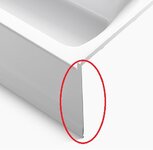
This isn't on the wall along the top of the tub, in the tub area. This is drywall the meets the "apron" on the outside of the tub. I believe over time there is just enough splash that runs out of the tub to soak up the drywall mud.
I used green board, that is not the issue. No matter what drywall you use you still need to mud it to the edge of the tub.

This edge in the circle.
 

Attachments

  • tub.jpg
    tub.jpg
    26.3 KB · Views: 24

rayra

Well-known member
Joined
Dec 1, 2014
Messages
4,724
Location
Escaped from Los Angeles
Need a better sealant / paint, after you replace that rotted drywall. And make sure the drywall isn't in contact with the flooring (to prevent wicking), behind the baseboard.
 

Renegade1LI

Well-known member
Joined
Mar 11, 2018
Messages
5,046
Location
long island ny
This isn't on the wall along the top of the tub, in the tub area. This is drywall the meets the "apron" on the outside of the tub. I believe over time there is just enough splash that runs out of the tub to soak up the drywall mud.
I used green board, that is not the issue. No matter what drywall you use you still need to mud it to the edge of the tub.

This edge in the circle.
Usually run the cement board beyond the apron to the next stud down to the floor just for that reason. I've seen many walls rot right at that area for the same reason. The cement board comes in 36" width so it's easy enough to extend past the tub, this places the transition to rock & spackle beyond the wet zone. When tiling same thing continue past the tub & to the floor, usually with a bull nose or border tile & you get a nice water tight seal.
 
OP
P

PoorUB

Well-known member
Joined
Mar 29, 2021
Messages
11,894
Location
Fargo, ND
Need a better sealant / paint, after you replace that rotted drywall. And make sure the drywall isn't in contact with the flooring (to prevent wicking), behind the baseboard.
The drywall is fine, the mud was shot.
 
OP
P

PoorUB

Well-known member
Joined
Mar 29, 2021
Messages
11,894
Location
Fargo, ND
Usually run the cement board beyond the apron to the next stud down to the floor just for that reason. I've seen many walls rot right at that area for the same reason. The cement board comes in 36" width so it's easy enough to extend past the tub, this places the transition to rock & spackle beyond the wet zone. When tiling same thing continue past the tub & to the floor, usually with a bull nose or border tile & you get a nice water tight seal.
The drywall is solid, it is green board, the mud is bad. How do you mud the cement board to the tub?
 
To avoid these ads, REGISTER NOW!

K'ledgeBldr

Well-known member
Joined
Aug 22, 2011
Messages
1,925
Location
Johns Creek, GA
“Hot mud”; or 5min/20min is definitely more resistant to water once dry. But, in your situation as you describe it, you need to mitigate the water getting to that area.

If a tub has been set correctly, the shelf perimeter should shed water back into the tub. If the water is from a showerhead, direct the spray away from that area. If you’re using a shower curtain, perhaps it’s not doing the job and needs replacement- maybe an enclosure. There are also those small diverter wings that attach to the tub and wall to prevent water from leaking down- fairwarning, they don’t last forever.

Other things that would help- PVA primer over the drywall mud, caulking where the drywall meets the tub, and a good two/three coats of paint. Sealing the drywall well will probably do more good than any mud.
 

Norcal

Well-known member
Joined
Mar 16, 2008
Messages
13,790
My bathtub shower area had FRP board as a shower surround, it stopped at the tub edge which led to a lot of problems with the drywall at the edge of it, the reason for FRP board is there is a window in the shower it made most other materials not suitable, a year ago it was gutted & tiled floor to ceiling, the bullnose tile went beyond the tub & there has been no further issues since, if I could get the photos off my iPhone photos would have been posted.
 
OP
P

PoorUB

Well-known member
Joined
Mar 29, 2021
Messages
11,894
Location
Fargo, ND
“Hot mud”; or 5min/20min is definitely more resistant to water once dry. But, in your situation as you describe it, you need to mitigate the water getting to that area.

If a tub has been set correctly, the shelf perimeter should shed water back into the tub. If the water is from a showerhead, direct the spray away from that area. If you’re using a shower curtain, perhaps it’s not doing the job and needs replacement- maybe an enclosure. There are also those small diverter wings that attach to the tub and wall to prevent water from leaking down- fairwarning, they don’t last forever.

Other things that would help- PVA primer over the drywall mud, caulking where the drywall meets the tub, and a good two/three coats of paint. Sealing the drywall well will probably do more good than any mud.
Thanks, but I know all of this, I just want a better quality mud.
 

Hank11

Well-known member
Joined
Aug 19, 2019
Messages
1,167
Location
Tennessee

rlitman

Well-known member
Joined
Oct 18, 2010
Messages
24,746
Location
Long Island
^^ and not a whole lot more resistant than regular drywall
Green board has a water repellent resin added to the paper, but is otherwise just gypsum plaster based drywall.
durabond or sheetrock hot mud is more resistant to water than regular premix.
Right. Pre-mix spackles are talc based. They turn back into powder as soon as they get wet, and count on being permeated by the paint to keep from disintegrating on their own in the air. Unprotected, it breaks up under water about as fast as toilet paper.

Hot mud is actually plaster based, which will hold up underwater for years in the right condition (not that it is recommended).
 

duneslider

Well-known member
Joined
Jan 20, 2013
Messages
2,297
Location
Riverton, Utah
There is a newer Alex Flex spackling mud that I have wondered if it is a little more water resistant. Might be worth a shot, I have been hearing it does have some flexible properties that are impressing people. I have no personal experience with it. I would assume if it has flex it has some polymers in it that would be resistant to water.
 

billspit

Well-known member
Joined
Aug 21, 2008
Messages
1,895
Location
SC
Over many years the seams on the drywall in my garage has almost all delaminated. I assume it is from humidity. Every once in a while, with particular weather conditions, we get dew forming inside the garage.
 
To avoid these ads, REGISTER NOW!
Top Bottom