To avoid these ads, REGISTER NOW!

Moisture/water between Tyvek and insulation

masher

Member
Joined
Aug 5, 2022
Messages
24
Location
SW Michigan
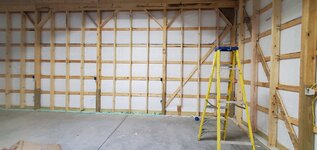
So I've been working on insulating my barn and got the ceiling all blown in and about half the walls the done. For the walls I ran 2x6's vertically at 24" OC as I'm putting drywall over it. I've got almost all of it insulated with R19 except for a 24' section of wall and I've got drywall over about half of it now. I had to pull some insulation back yesterday to build a frame around where the exhaust for the heater goes out the wall and it was pretty wet. Its steel sided with Tyvek behind the steel and the Tyvek is good and sealed. I thought maybe it was maybe because of the hot exhaust from the radiant tube heater going thru the cold steel where it really wasn't insulated yet. I'm in Michigan and its been going from 50 to 20 within a day or 2. Well I reached behind a few other bays of insulation that arent drywalled yet and some were damp and a little wet, others are fine. What's going on, is it because I don't20221203_184732.jpg20221211_174153.jpg20230218_155437.jpg have everything covered yet?
 
To avoid these ads, REGISTER NOW!

bluedog225

Well-known member
Joined
Jan 31, 2012
Messages
3,303
Location
Texas
I‘m guessing simple condensation. Tyvek will let the vapor pass to the drying side, eventually. Even double tyvek is permiable to water vapor per the manufacturer. Once it’s done, I’d hope that less warm, moist air will be able to get to the cold interior side of the steel.
 

lowerthanu

Member
Joined
Sep 22, 2012
Messages
21
Location
Hudson, WI
IMO you should have gone with unfaced insulation with thick plastic for a vapor barrier. That kraft face insulation claims a vapor barrier, but is obviously not anywhere near sealed so you are getting the warm air from the shop hitting the cold steel/tyvek and causing condensation and the moisture you are seeing. I am in WI with a similar climate to you and did it as described above and have zero issues.
 

jollygreengiant

Well-known member
Joined
Nov 10, 2013
Messages
2,368
Location
Ontario, Canada
IMO you should have gone with unfaced insulation with thick plastic for a vapor barrier. That kraft face insulation claims a vapor barrier, but is obviously not anywhere near sealed so you are getting the warm air from the shop hitting the cold steel/tyvek and causing condensation and the moisture you are seeing. I am in WI with a similar climate to you and did it as described above and have zero issues.

That would be my guess too, that you're getting warm air passing through and condensation forming on the colder tyvek. Like lowerthanu I'm not a fan of faced batts as you get a lot of leaks. You probably have quite a bit of air leaking between the batts and the uncovered vertical 2x6's that you can see in your pics.

The other way you could get water coming in would be a leak from the roof but that would be pretty easy to rule out.

ETA: What are the building codes like in your area for vapour barriers? Here I think you would still need a 3mil plastic vapour barrier on top of faced batts to get a good enough barrier.
 

pcmeiners

Well-known member
Joined
Aug 13, 2009
Messages
7,948
Location
In the only town in Pennsylvania, Bloomsburg.
For the amount of time it would take I would remove all the Sheetrock and get a vinyl vapor barrier, (thick stuff as it makes it easier to apply without unnecessary rips). I purchase some from Walmart (on line delivery) a while back. Make sure you tape seams and make outlets air tight.
 
OP
M

masher

Member
Joined
Aug 5, 2022
Messages
24
Location
SW Michigan
Not sure on the building codes. So the vinyl vapor barrier would go over the insualtion and then put the drywall on? In my other barn that I built about 20 years ago or so I used insulation from Menards that was actually wrapped in plastic all the way around making it much easier to deal with plus i bet it sealed better than the paper faced stuff. I couldn't find the plastic wrapped stuff anymore, the guy at Menards had never even heard of it. It was from the Johns Manville.
 

Bert_

Well-known member
Joined
Dec 24, 2016
Messages
9,766
Location
NW Iowa
The whole wall probably leaks a lot more air than you think. Warm air is condensing on the cold tin. Tyvek probably letting air by at the top and bottom. Interior vapor barrier has a hole in it everywhere you put an outlet box.
 

Tom Sestito

Well-known member
Joined
Dec 25, 2017
Messages
310
Location
Winnipeg, MB
Is it damp on the interior side of the tyvek or the exterior? Is there an airspace between the tyvek and the steel? Is the building conditioned yet (heat or cool?)

Educated guess here but sounds like you probably need to apply a vapour barrier to the interior side of the insulation. There are paint based vapour barriers available that you can apply over drywall. If you don't have an airspace between the steel and the tyvek you may have effectively turned the tyvek into a vapour barrier instead of an air barrier. It's hard to say without more detail, but the solution to that could be adding vapour barrier to the interior.
 

ShuhornGarage

Active member
Joined
Mar 22, 2016
Messages
41
I understand there may budget restraints but it not, have you considered spray foam? it's an awesome insulation, fills all the holes so there is little opportunity for air to move thru it & in Canada it is rated as a vapour barrier as well
 

firebirdparts

Well-known member
Joined
Jun 8, 2016
Messages
10,658
Location
Kingsport, TN
Warm air is not really relevant here. Warm air has the potential to be more moist and condense against a steel wall at night in the frozen north. But the moisture itself is the problem, not warmth. Where is the moisture coming from? Can you eliminate it?

I'm an engineer, but I don't know really all the sides to the debate about vapor barriers. In Michigan I would have said put a plastic sheet on the inside so that the air inside the wall is outside air. But somebody else may take another stance on that.
 

Augus7us

Well-known member
Joined
Jan 14, 2017
Messages
1,190
Location
Central Ohio
I feel you guys are over thinking this. He has a building that is partially insulated and heated. He turned the heater on and areas where the walls were bare allowed some warm air to touch the cold tin. Once all the insulation is up, the drywall is up and its finished, I doubt you'll have any issues. If it was that easy for warm air to infiltrate past drywall, kraft paper and insulation; most houses would be filled with mold and rotting away in my opinion.
 
To avoid these ads, REGISTER NOW!

billconner

Well-known member
Joined
Jul 20, 2021
Messages
6,971
Location
Thousand Islands NYS
I feel you guys are over thinking this. He has a building that is partially insulated and heated. He turned the heater on and areas where the walls were bare allowed some warm air to touch the cold tin. Once all the insulation is up, the drywall is up and its finished, I doubt you'll have any issues. If it was that easy for warm air to infiltrate past drywall, kraft paper and insulation; most houses would be filled with mold and rotting away in my opinion.
I thought he found condensation behind the insulated portions as well.

One thing worth considering is the extra moisture from construction like newer concrete, paint, and drywall mud. Maybe those aren't a factor here, but can be.

I'd sure look for paints that would provide a continuous vapor barrier rather than pull the drywall, but a good poly vinyl barrier would still be tops in my book. And I'd go at least 6 mil. Read the data sheets on paints claiming to be a vapor barrier. Shellac base would be my starting point, but generally 2 to 3 coats of alkyd base should do it as well.
 

pcmeiners

Well-known member
Joined
Aug 13, 2009
Messages
7,948
Location
In the only town in Pennsylvania, Bloomsburg.
The main issue with steel buildings, EVERY metal seam needs to be sealed before the insulation, then plastic before the Sheetrock ( unless your spray foaming). Your metal seams allow air flow, even if it is only between the metal seams; any air flow will bring in moisture. Without plastic and thorough sealing around electric boxes/pipes etc , your adding even more air flow to bring in even more moisture.
With plastic behind the sheetrock I would use Alkyd paint for priming, not because of water vapor through the wall but from condesation forming on painted surfaces due to moisture coming from the interior air, Latex can be the top coat. If latex primer is used paint can lift, especially around areas joint compound is used ( over time), basically latex ***** when moisture can travel through it .
 

jollygreengiant

Well-known member
Joined
Nov 10, 2013
Messages
2,368
Location
Ontario, Canada
I feel you guys are over thinking this. He has a building that is partially insulated and heated. He turned the heater on and areas where the walls were bare allowed some warm air to touch the cold tin. Once all the insulation is up, the drywall is up and its finished, I doubt you'll have any issues. If it was that easy for warm air to infiltrate past drywall, kraft paper and insulation; most houses would be filled with mold and rotting away in my opinion.

OP said he had condensation behind the areas that had already been insulated as well.

Older buildings didn't have many problems with moisture because they leaked air like a sieve. If water got into the wall it had no trouble drying out.
 

Bert_

Well-known member
Joined
Dec 24, 2016
Messages
9,766
Location
NW Iowa
I feel you guys are over thinking this. He has a building that is partially insulated and heated. He turned the heater on and areas where the walls were bare allowed some warm air to touch the cold tin. Once all the insulation is up, the drywall is up and its finished, I doubt you'll have any issues. If it was that easy for warm air to infiltrate past drywall, kraft paper and insulation; most houses would be filled with mold and rotting away in my opinion.
Lot of houses out there leak like a sieve (air leaks)
 

pcmeiners

Well-known member
Joined
Aug 13, 2009
Messages
7,948
Location
In the only town in Pennsylvania, Bloomsburg.
"Older buildings didn't have many problems with moisture because they leaked air like a sieve. If water got into the wall it had no trouble drying out."

True but they were not made of metal, facing the cold which could drop their temperature below the Dew point basically instantly. Second point, if old buildings had the same amount of material between the exterior surface and the inside surface, you would have more moisture issues.

" OP said he had condensation behind the areas that had already been insulated as well."

Fiberglass insulation allows air to flow around it, in it, and through it, if it did not our OP would not have a moisture issue, which does not happen with spray foam or well installed cellulose.
 

Smokeem

Well-known member
Joined
Jan 29, 2013
Messages
176
This is a typical problem with insulating metal buildings. If you notice all heavy steel metal building have insulation with a vinyl barrier that goes against the metal. Metal will sweat when there is a temperature difference between the inside and outside. Heating the building doesn't help at all. The other problem that might be happening is that without any type of wood substrate on the outside of the building, you are bringing the dew point into the fiberglass batt. In typical wood framed construction we only see this as an issue in cathedral ceilings that do not have an airspace. in those instances IRC does require a rigid insulation against the decking. Not saying that is the case here but could be.

About the vapor barrier. The IRC only requires a vapor barrier to be installed on the "warm in winter" side if the exterior cladding is not breathable. I would in my opinion consider that metal siding (guess a PBR style) to be breathable. I idea of the vapor barrier to to allow moisture from the inside of the building to pass through the gypsum and out to the exterior. Looking at the photos above it doesn't appear to show any logos on the moister barrier. Have they used an actual moister barrier of some other type of product? A true moisture barrier should allow moisture to pass from the unprinted side to printed side but not the other way around. Check into what product they have installed under the metal siding.
 

pcmeiners

Well-known member
Joined
Aug 13, 2009
Messages
7,948
Location
In the only town in Pennsylvania, Bloomsburg.
The main point of vinyl plastic is to stop air movement, within the wall structure, which in turn stops moisture migration. A breathable moisture barrier as in Tyvex is only efficient if there is a minimal air change within the wall envelope.
 

jollygreengiant

Well-known member
Joined
Nov 10, 2013
Messages
2,368
Location
Ontario, Canada
This is a typical problem with insulating metal buildings. If you notice all heavy steel metal building have insulation with a vinyl barrier that goes against the metal. Metal will sweat when there is a temperature difference between the inside and outside. Heating the building doesn't help at all. The other problem that might be happening is that without any type of wood substrate on the outside of the building, you are bringing the dew point into the fiberglass batt. In typical wood framed construction we only see this as an issue in cathedral ceilings that do not have an airspace.

The construction of cathedral ceilings is usually the same as typical wall assemblies so not sure what you mean here?

in those instances IRC does require a rigid insulation against the decking. Not saying that is the case here but could be.

About the vapor barrier. The IRC only requires a vapor barrier to be installed on the "warm in winter" side if the exterior cladding is not breathable.

Here we are required to use vapour barrier on the interior side regardless of exterior cladding. I am one climate zone further north of OP so I would think his requirements are similar. You have to get further south before you become more restricted on your vapour barrier options. Here the code specifies that we can use class 1,2, or 3 vapour barriers, although our local building officials won't pass anything that isn't a class 1 AKA 6 mil poly.

I would in my opinion consider that metal siding (guess a PBR style) to be breathable. I idea of the vapor barrier to to allow moisture from the inside of the building to pass through the gypsum and out to the exterior. Looking at the photos above it doesn't appear to show any logos on the moister barrier. Have they used an actual moister barrier of some other type of product? A true moisture barrier should allow moisture to pass from the unprinted side to printed side but not the other way around. Check into what product they have installed under the metal siding.

OP said in his original post that Tyvek is installed under the metal siding.

The main point of vinyl plastic is to stop air movement, within the wall structure, which in turn stops moisture migration. A breathable moisture barrier as in Tyvex is only efficient if there is a minimal air change within the wall envelope.

Tyvek itself is an approved air barrier when installed correctly, so as long as OP's builder installed it properly then the Tyvek will be stopping air from moving through the wall.

Vinyl plastic vapour barriers are designed to stop vapour from moving into the wall via diffusion. It can also function as an air barrier but the Tyvek and drywall will be doing 99% of the air movement control.
 

pcmeiners

Well-known member
Joined
Aug 13, 2009
Messages
7,948
Location
In the only town in Pennsylvania, Bloomsburg.
"Tyvek itself is an approved air barrier when installed correctly, so as long as OP's builder installed it properly then the Tyvek will be stopping air from moving through the wall."

Obviously the OP walls are not air tight, just as most installs involving Tyvex are not.
Secondly Tyvex allow vapor to move throught it, but not at a high rate, so moisture can build up in a wall cavity. Then, if the sheetrock side does not have a means of blocking vapor such as plastic, sealing paint and tight sealing of outlets, vapor will enter the cavity from the interior side; again if there is no means of sealing , air will move in the wall cavity be it from the exterior or interior. So in this case the OP need plastic just behind the Sheetrock, fully sealed unless he wants to remove everything down to the bare metal, and seal EVERY seam and opening on the metal wall air tight; even then without plastic you would still get some moisture entering the wall cavity from the interior.
 

Keithgclark

New member
Joined
Sep 18, 2021
Messages
2
The main issue with steel buildings, EVERY metal seam needs to be sealed before the insulation, then plastic before the Sheetrock ( unless your spray foaming). Your metal seams allow air flow, even if it is only between the metal seams; any air flow will bring in moisture. Without plastic and thorough sealing around electric boxes/pipes etc , your adding even more air flow to bring in even more moisture.
With plastic behind the sheetrock I would use Alkyd paint for priming, not because of water vapor through the wall but from condesation forming on painted surfaces due to moisture coming from the interior air, Latex can be the top coat. If latex primer is used paint can lift, especially around areas joint compound is used ( over time), basically latex ***** when moisture can travel through it .
Sealed up like this ? Thanks for the help in advance
 
To avoid these ads, REGISTER NOW!
Top Bottom