To avoid these ads, REGISTER NOW!

Monolithic Slab Cracking Help!

Benni40

New member
Joined
Jul 15, 2020
Messages
2
Location
MI
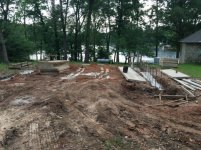
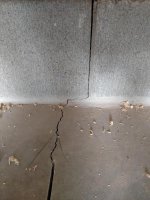
Hi Everyone: I have been using Garage Journal as a reference for my garage build and now I need user's opinions on my slab that was poured for my garage about 6 weeks ago. My slab is a 20' x 28' monolithic style that was poured over I'm guessing 8" to 12" of compacted sand depending on the location because my property do have quite a slope. The contractor did not use any rebar or wire which is one of this problems I could have going forward. It was saw cut into 4 sections, the east/west or 28' section is split down the middle and I think is cracked all the down to the bottom and is staring to really spread apart. Example the north/west section at the saw cut is around a 1/8", but the other cut has already expanded to 1/4". I have not put any thing in the garage yet that is heavy like a car because I'm still working on electrical and insulation. My general contractor talked to a couple of cement contractors and they both said that the crack won't spread any further apart because everything has now settled. I live in Michigan and I believe this the crack is going to get larger and the sections are going to shift. I'm looking for any opinions on this, I have attached some pictures of the crack on the inside and outside of my garage, plus pictures of the slope. Thank you so much for any direction! Brent
 

Attachments
  • crete2.jpg
    crete2.jpg
    112.6 KB · Views: 335
  • crete1.jpg
    crete1.jpg
    147.3 KB · Views: 329
  • crete4.jpg
    crete4.jpg
    50.2 KB · Views: 302
  • slope1.jpg
    slope1.jpg
    147.6 KB · Views: 305
  • slope2.jpg
    slope2.jpg
    149.4 KB · Views: 296
Last edited:
To avoid these ads, REGISTER NOW!

K'ledgeBldr

Well-known member
Joined
Aug 22, 2011
Messages
1,925
Location
Johns Creek, GA
I'm sure this will be a problem...

The contractor did not use any rebar or wire which is one of this problems I could have going forward.

Cutting control joints is a good way to control cracking of concrete- as the ol' saying goes; there are two kinds of concrete, cracked concrete, and concrete that will crack.

The question is how did this not get rebar? Other than there was no building permit(?)
 

Bigblockyeti

Banned
Joined
Feb 1, 2018
Messages
2,550
Location
Upstate, SC
No rebar or steel mesh would concern me to the point I wouldn't have allowed it to be poured. That the crack has broken the mortar joint on the stem wall is more concerning. They've stated that it's settled but have they offered any proof or guarantee as to what will be done when (not if) it settles further. It looks like it was inadequately compacted and probably in too thick of lifts when the site was prepped. It sounds like the GC is blowing smoke the and concrete contractor f'd up.
 
Last edited:

Walter_TA

Well-known member
Joined
Mar 11, 2017
Messages
191
Looks like they added to much water. This does not look like bad base under the concrete. Did you keep the top wet for the first week? Do you have a vapor barrier underneath? If it has sat for 6 weeks then most of the water that was in there has come out. I would bet that it has settled. It will still shrink some but not much. Most of that happens when the concrete is curing and has not yet gained strength. It will crack as the water evaporates and the concrete shrinks. Remember there is one way to fix concrete. JACK HAMMER.
 
Last edited:

Lucky Llama

Well-known member
Joined
Aug 1, 2018
Messages
53
Location
Pass Christian
It's to late to do much about it now. I wouldn't stress too much about it. It does appear that too much water was added during the pour. If it does become a bigger problem, you can pour a 3 1/2 inch slab over the top. This is not a perfect solution, but short of ripping it out is probably about as good as its going to get.
 

matt_i

Well-known member
Joined
Mar 14, 2008
Messages
10,722
Location
SE Michigan
Agreed. At this stage of the build nobody is going to do anything other than talk about it.

Steel reinforcement is always recommended if you ask me.

You could pursue a Bureau of Licensing and Regulation formal complaint but its only likely to gain traction if a code violation is in play and the slab cracking isn't one imo.
 

ford33

Well-known member
Joined
Feb 26, 2011
Messages
2,118
Location
Chicago, IL. USA
Search for and read the Concrete Underground posting for how to lay a slab. It will give you some clue's to why this is happening and what to expect in the future.

If you have read posts on GJ, you should have known whether your base is "I'm guessing sand" and how soon to cut the control joints and whether rebar is necessary and what it does.

Personally, I don't believe you can do much about this now. It doesn't look bad to me. Without the rebar, the cracked slab pieces will move independently up and down and across but it is too late to prevent that now. Enjoy the new garage and focus on doing what you enjoy. You have a nice garage which is better than most other people.
 

thayer

Member
Joined
Jul 17, 2020
Messages
9
Location
Portola Valley, CA
Hi - 20 year licensed architect here.

You've got a couple of significant issues:

1. Slab cracking: I'd recommend a construction joint every 5'-0" to 8'-0" and an expansion joint every 20'-0". In your case, it would be nice if you had an expansion joint dividing your slab into (2) 14'-0" x 20'-0" sections with an expansion joint, and then cut (3) construction joints in each of those slabs. You don't have this and, therefore, your slab will continue to crack over the years.

2. Structural deflection: A foundation slab of any size requires steel reinforcement. Concrete is great in compression and terrible in tension, and the steel is the opposite, so they work well as a system. Your slab is essentially a beam that spans from footing to footing - therefore the top of the slab is always in compression and the bottom is always in tension. Without steel reinforcement, your slab will crack through instead of at the surface. You will be adding a number of heavy tools to the garage which will exacerbate it.

3. Settling: Assuming your contractor did put rebar in your footings (something like (4) #5 bars horizontally and (2) #5 bars vertically every 4'-0" or so) your shop will continue to settle for many, many years. If there is no rebar in your footings it will eventually settle outside of what is reasonable.

4. Water Intrusion: A slab poured on grade is particularly susceptible to water intrusion. That is why the standard is to lay down at least 6" of compacted 3/4" gravel over the top of a compacted dirt earth, and to top that off with a vapor barrier typically 6mil thickness. The gravel doesn't allow the water to make it up to the slab, and the vapor barrier keeps water vapor out. Without these items you will have water intrusion at best, and a heaved slab due to water expansion during the freeze seasons.

A number of these issues are contemplated by the national building codes. I don't know your jurisdiction but virtually all town and city codes reference national codes.

I'd hire a 3rd party civil engineer and have them inspect and prepare a report. Use that report to guide your actions. I think you've got some significant issues to deal with.

Good luck.

Evan Thayer
 

walrus

Well-known member
Joined
Nov 12, 2008
Messages
11,673
Location
Maine
No rebar or wire is a huge mistake, especially when placed on lousy fill.
 

nadogail

Well-known member
Joined
Jan 23, 2009
Messages
31,904
Location
Coronado, CA
Too all of you who have made this thread your first post on this board, WELCOME ABOARD.

The original poster, Benni40, has in my opinion a real can of worms. It will be interesting to see if his General Contractor supports him. IMHO, the General Contractor is responsible for supervising and inspecting the work of the Sub Contractors.

That this pour passed inspection makes me wonder about the competence of everyone involved.

Were all the contractors licensed? Were the appropriate permits pulled? Who signed off on the inspections?

Please keep us informed.
 
To avoid these ads, REGISTER NOW!

Kaizen

Well-known member
Joined
Jan 9, 2015
Messages
6,938
Location
New England
Op clarify. They did put double layer of rebar around the thickened edge right??

For a comparison my Alaskan slab took three winters to crack. And it’s just a hairline at the sawn joints. I also have fiber mesh only in the field. No steel except the edge.


Sent from my iPhone using Tapatalk
 

matt_i

Well-known member
Joined
Mar 14, 2008
Messages
10,722
Location
SE Michigan
Were all the contractors licensed? Were the appropriate permits pulled? Who signed off on the inspections?

I also find it strange as all of these are paperwork processes which have nothing to do with the concrete.

A GC has to be licensed in MI. I used to have one except it expired when I moved out of state for some years. One need not even lift nor own a tool to get one, simply pass a test in Lansing, some of which deals with basic building requirements and others which deal with laws and process. The license enables one to pull building permits to build jobs for other customers.

Typical inspections are footing/foundation to make sure that the building location matches the plat (site plan) before any concrete is poured. They also eyeball the depth as a glance towards being frost-protected.

The inspectors sign off on inspections. They don't appear at concrete pre-pours either.

There's an organized dispute and arbitration process thru the Bureau of Licensing and Regulation. But it centers on code violations, not cosmetic issues. Its my opinion that if the cracking continues to increase in size to affect the structure and its ability to be weather-tight then there's a potential claim for building on uncompacted fill.
 

kaymccampbell

Well-known member
Joined
Feb 27, 2015
Messages
29,417
Location
Upstate New York
Nice. Looks like you had the same thieving **** contractor I did. Mine stole the moisture barrier and rebar the morning of the pour, because I couldn't be there that day. Don't sweat the cracks. Do worry if things start moving up and down in relation to each other. Mine hasn't moved since it cracked 35 years ago.
 

brownbagg

Well-known member
Joined
Mar 20, 2006
Messages
5,208
rebar not a problem, rebat only needed for load factor, wire kinda holds it after the crack, the issue is that first picture, Thats a settlement crack and the fact you poured it wet. a typical slab on a compacted slab, with no rebar or wire would just have a hair line surface crack about every ten feet square

that first picture is not a hairline, its opening up
 

Showkey

"MEMBER EMERITUS"
Joined
Aug 9, 2014
Messages
8,638
Location
Wausau WI
Only in the GJ can someone look at a picture and conclude too much water !

This has come up a 100 times....... ....Concrete Is guaranteed to gray and cracked !

Think all agree rebar or wire mesh is important, preferred and often critical. It has to be in the spec, just like the strength of the concrete (3600, 5000, 6000 psi, fiber , bag mix).

Did the original plans, submitted approved permitted plans and or contract to build call for rebar ? If not and there no violations approved documents........then your purchased a sub standard product ( or normal product) by design with little recourse.......as they built what all parties approved to the build contract and permit.

On the up side all concrete cracks .......mentioned here and prior post.

Same for compacted base, base materials, 25 or 40 year shingles, ice and water shield, tar paper or synthetic paper or 5 outletS and one light Vs the better alternatives.
 
Last edited:

ConCretin

Well-known member
Joined
Jan 20, 2011
Messages
3,378
Location
Central Maine
Firstly that looks like a lot more than 8-12” of compacted sand. I wouldn’t have used sand for a structural fill in the first place due to compaction and subsidence concerns. Looking at the base of the slope, I don’t see any evidence that topsoil and organics were removed, which makes me wonder if they were removed under the rest of the fill. And finally, I’d like to have seen a wider pad with more gradual slopes.

With regard to the cracks. Control joints are designed to induce shrinkage cracks where you can’t see them rather than letting random cracks occur where you can. With that said, your cracks are larger than I’d expect. Maybe the concrete is shrinking excessively or maybe the base is settling.

The lack of rebar isn’t helping the situation either. Rebar doesn’t make a slab stronger but it does hold it together when it cracks. I always recommend rebar for a mono-slab due to the increased chance of movement. If your base is failing rebar wouldn’t save it but it might hold things together if minor settlement occurs.

I hate to say it but you may have a long term issue here. I’d consider hiring a geo-technical firm to evaluate the structural fill under your garage. If you still owe your contractor any money, I’d hang onto it until you do. I hope I’m wrong. Good luck.
 

My Old Tools

Well-known member
Joined
Jun 4, 2014
Messages
5,424
Location
Hamrick Lake, TX
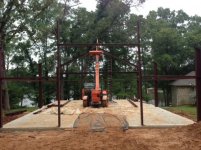
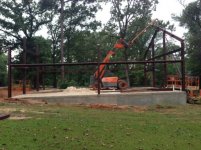
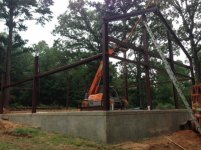
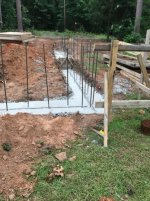
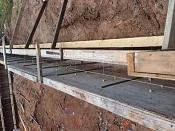
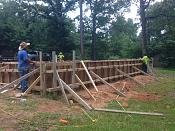
This slab has been down for over 3 years now. Almost 4 feet of fall front to back. Poured in Texas in August. Lots of steel, no cuts or joints, no cracks. It can be done. Yes, it is heavily loaded. The real trick is all the footings (beams) were dug to undisturbed soil. The interior backfill was done correctly. It took 2 pours for the footings and a 3rd for the floor.
 

Attachments

  • shop slab3.jpg
    shop slab3.jpg
    61.5 KB · Views: 89
  • shop slab2.jpg
    shop slab2.jpg
    62.8 KB · Views: 85
  • shop slab.jpg
    shop slab.jpg
    59.7 KB · Views: 86
Last edited:

Bigblockyeti

Banned
Joined
Feb 1, 2018
Messages
2,550
Location
Upstate, SC
^ How deep, long and wide is it? I poured my 16' x 22' x 5-5.5" two months ago with plenty of rebar, steel mesh and fiber. The thickened perimeter edge is 16" wide and an additional 4-5" deeper. The earth beneath was undisturbed but I spent plenty of time with a plate compactor on it anyway and compacted the gravel too. I was going to cut reliefs but cautiously opted against it and it still looks good so far.
 

My Old Tools

Well-known member
Joined
Jun 4, 2014
Messages
5,424
Location
Hamrick Lake, TX
Mine is 30x40. Footings were dug 24 inches below grade, 16" wide. These pics were the first pour. Then forms for the second pour stem walls.
 

Attachments

  • shop slab4.jpg
    shop slab4.jpg
    93.7 KB · Views: 58
  • shop slab5.jpg
    shop slab5.jpg
    91.3 KB · Views: 59
  • shop slab6.jpg
    shop slab6.jpg
    7.7 KB · Views: 155
  • shop slab7.jpg
    shop slab7.jpg
    7.9 KB · Views: 159
Last edited:
OP
B

Benni40

New member
Joined
Jul 15, 2020
Messages
2
Location
MI
First off, thank you everyone who replied to my post. I have learned more about concrete that I ever wanted to know because of the issue I'm dealing with and should have not let him pour without rebar/wire. Where I'm at in Michigan, a detached structure of 600 ft. or less are not required to have frost protection, vapor barrier, or any form of rebar/wire. Some of the questions that where asked I would like to answer now. Building permits and inspections everything was pulled and passed. The top layer of soil was removed before the sand was brought in. The floor was not kept wet for the first week. I think the logical thing here to do is bring in a third party engineer to look at it and write a report. Thank you again and hopefully this all works out. I'm trying to stay positive.
 
To avoid these ads, REGISTER NOW!
Top Bottom