OP
moparfreak
Well-known member
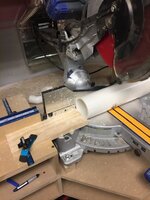
Next step was to "plumb" in a 1-1/4" PVC fitting.

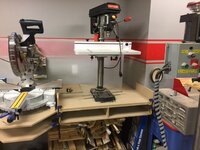
Fortunately when the saw is tipped back over into place, you can't see the amateur duct tape job. Risers made to provide enough clearance. I'll run the pipe out to the back and take a 90 degree up and join into the DC hood.

Next, with the saw in approximate position, is to start to build a dust hood around it. I wanted to find some sort of sheet material that was easy to work with, yet had some strength / rigidity also. I was looking at sheet metal / HVAC panning but that stuff gets dented / crinkles pretty easily. Also looked at Lexan, which is a bit pricey. I finally settled on using the plastic cover diffuser panels for commercial lighting systems. They are only $5-6 a piece, 2'x4' so large enough, 1/8" thick so some strength there, and very flexible. This allows me to get a nice sweeping curve on the back of the DC hood.
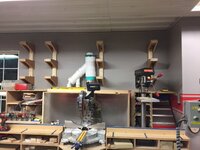
Still sort of in layout mode, but I fastened two of them to the wall to form the two sides of the hood, and meeting in the back of the saw.

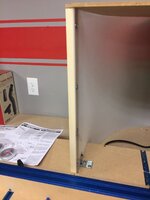
Here's a view closer in on one side of the hood. Ultimately I'll use some L-bkts to fasten to the table, and caulk / tape seams between panels. The curve is determined by the sweep of the back of the saw so that I can still hit the miter and bevel angles w/o obstruction by the hood.

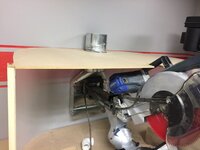
Then for the main actual dust collection through the hood, I've pulled some parts from the HVAC aisle, using a 6" boot connected to a register adapter. Once I actually have a working cyclone dust collector capable of pulling through such a large opening, I can mess around with blocking off some of the inlet to get best flow through it. The idea here is to pick up the fine airborne dust that kicks up around the saw that really gets in my lungs and eyes. I think this will do the job.

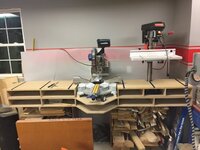
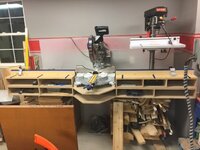
Next step is to fasten the boot to the wall, and start laying out the support tables to the RH and LH sides of the saw, along with the fences. Then once that's in place I can trim the hood panels to just the right position & shape. I don't think I want the hood coming all the way out to the fence, but maybe close behind it. The other tricky part is the fact that I want to fit my benchtop drill press on the RH side of the fence. So, a lot more to do....
Fortunately when the saw is tipped back over into place, you can't see the amateur duct tape job. Risers made to provide enough clearance. I'll run the pipe out to the back and take a 90 degree up and join into the DC hood.
Next, with the saw in approximate position, is to start to build a dust hood around it. I wanted to find some sort of sheet material that was easy to work with, yet had some strength / rigidity also. I was looking at sheet metal / HVAC panning but that stuff gets dented / crinkles pretty easily. Also looked at Lexan, which is a bit pricey. I finally settled on using the plastic cover diffuser panels for commercial lighting systems. They are only $5-6 a piece, 2'x4' so large enough, 1/8" thick so some strength there, and very flexible. This allows me to get a nice sweeping curve on the back of the DC hood.
Still sort of in layout mode, but I fastened two of them to the wall to form the two sides of the hood, and meeting in the back of the saw.
Here's a view closer in on one side of the hood. Ultimately I'll use some L-bkts to fasten to the table, and caulk / tape seams between panels. The curve is determined by the sweep of the back of the saw so that I can still hit the miter and bevel angles w/o obstruction by the hood.
Then for the main actual dust collection through the hood, I've pulled some parts from the HVAC aisle, using a 6" boot connected to a register adapter. Once I actually have a working cyclone dust collector capable of pulling through such a large opening, I can mess around with blocking off some of the inlet to get best flow through it. The idea here is to pick up the fine airborne dust that kicks up around the saw that really gets in my lungs and eyes. I think this will do the job.
Next step is to fasten the boot to the wall, and start laying out the support tables to the RH and LH sides of the saw, along with the fences. Then once that's in place I can trim the hood panels to just the right position & shape. I don't think I want the hood coming all the way out to the fence, but maybe close behind it. The other tricky part is the fact that I want to fit my benchtop drill press on the RH side of the fence. So, a lot more to do....