To avoid these ads, REGISTER NOW!

More VFD Questions

Bib Overalls

Well-known member
Joined
Dec 4, 2006
Messages
3,318
Location
Jonesboro, Arkansas
I have access to a 220V 3hp rated single phase VFD. Input is standard 220V
(2 conductors w/ground) and output is 220 3 phase (3 conductors w/ground).

I want to use this VFD on my 3hp ACRA mill. Currently the motor is hooked up to a rotary converter. The reason I want to change out is because I am tired of changing the belts when I need to change speeds.

The ACRA mill is currently being feed through a rotary switch mounted to the machine. The switch has high and low settings and forward/reverse. A total of four speeds; a high and low forward and reverse.

First question: Should I run my three phase power supply through the stock rotary switch.

Second question. The mill has a sheave pulley on the motor and the spindle.
How should I set up the belts; slowest at the spindle, one to one at the spindle, or fastest at she spindle? Slow will have the most torque, one to one will show an accurate RPM reading on the VFD, and fastest will increase the motor speed and possibly push the RPMs up to a more powerful setting.

Any and all help appreciate.

Steve
 
To avoid these ads, REGISTER NOW!

laser3kw

Well-known member
Joined
Nov 17, 2012
Messages
7,276
Location
northen IL
First question: Should I run my three phase power supply through the stock rotary switch.
no - never. In order t switch forward to reverse, wire the "terminal strip" for those functions per manufacture direction. Those connections are generally labeled "S1, S2" etc
Very easy to do, you can even use the stock drum switch wired to these connections.
Second question. The mill has a sheave pulley on the motor and the spindle.
How should I set up the belts; slowest at the spindle, one to one at the spindle, or fastest at she spindle?

Suggest setting the spindle speed via belt so your most used speed(s) are around the vfd 60 hz output. The vfd is good about making more torque as the frequency (hz) goes down but makes less torque above 60 hz.
Fortunately, high spindle speed generally are in light cutting applications so it isn't as big an issue.
Others will warn, prolong slow frequency may cause excessive motor temp.
I wouldn't worry about the display matching the actual rpm. Most people get use to adjusting by feel.
 
Last edited:

larry_g

Well-known member
Joined
Apr 28, 2007
Messages
16,885
Location
oregon
Your still going to be adjusting belts. Where you set the belt is determined what you are doing. Heavy cuts in steel or small cuts in Al. The Vfd will give you a range but I would suggest that unless you know better what your motor can handle then I'd suggest that you set the Vfd limits to ~ 30hz min and 80hz max. and as said above stay near 60hz as best you can.

A Vfd rated motor can better handle the lower frequency's but you must confirm the quality and ratings of your motor to understand it's limits.

lg
no neat sig line
 

ddawg16

Well-known member
Joined
Jul 11, 2008
Messages
21,005
Location
S. California
Definitely cant use any kind of switch between motor and VFD.

You could kill the VFD if you do so.

It's perfectly fine to have a disconnect between the VFD and motor.

Bib....as mentioned, do the motor control via the terminal strip. Be aware those are going to be dry contacts....in other words, do NOT connect to ac. Use the common and +v on the terminal strip. Yell if you have questions.

You should have several options (programming can be tough sometimes). You can use digital inputs to select the speed and direction, or you can do everything from the keypad.

On the start/stop, there are 3 methods.
1. From the keypad
2. Momentary start with a stop button (breaks the ckt)....usually used with an E-Stop button (highly suggested)
3. On/Off switch (on is a maintained contact)
 

alfredeneuman

Well-known member
Joined
Mar 3, 2011
Messages
4,580
Location
Fullerton, CA
It's perfectly fine to have a disconnect between the VFD and motor.

Any switch between the VFD and the motor will gradually do damage to the output transistors of the VFD while it is running.
VFDs should have disconnect mounted ahead of them.

(The only switch between the motor and the VFD should be E-Stops)
 

Falcon67

Well-known member
Joined
Jun 11, 2009
Messages
18,371
Location
Merkel, TX
Your still going to be adjusting belts. Where you set the belt is determined what you are doing. Heavy cuts in steel or small cuts in Al. The Vfd will give you a range but I would suggest that unless you know better what your motor can handle then I'd suggest that you set the Vfd limits to ~ 30hz min and 80hz max. and as said above stay near 60hz as best you can.

A Vfd rated motor can better handle the lower frequency's but you must confirm the quality and ratings of your motor to understand it's limits.

lg
no neat sig line

Quoted for truth. I found with my 1 HP mill that anything outside of 20 cycles either side of 60 hz didn't really agree with the motor. Mine has a gear case and I still change speeds. Also as above - VFD direct to motor, you have to re-wire all controls to the VFD control outputs and likely program said outputs to perform as expected. And the shutoff is behind the VFD, on the incoming power feed.

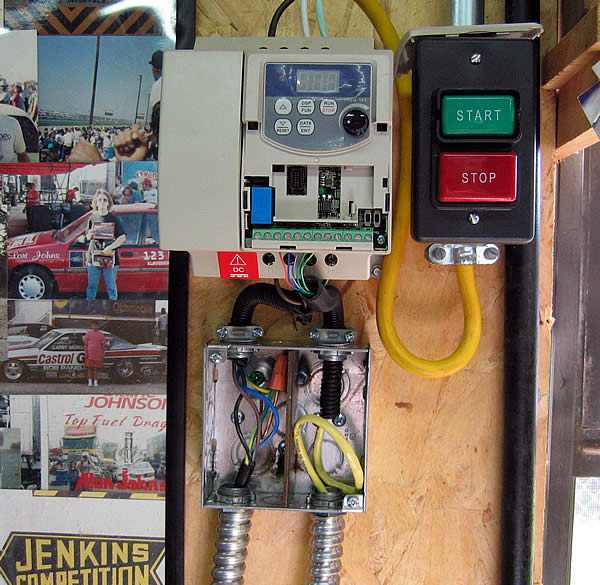
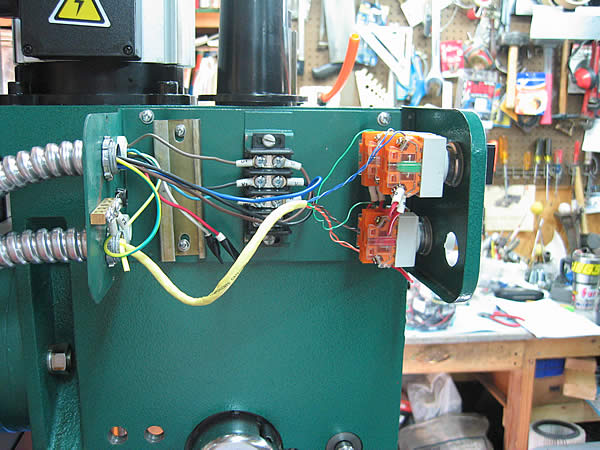
I don't have a before picture of the control box on my mill, but it was gutted for use with the VFD. Terminal strip homes motor power feed firing.

G0519_wiring.jpg


Control/motor drive wiring with lockout
G0519_VFD.jpg
 

ddawg16

Well-known member
Joined
Jul 11, 2008
Messages
21,005
Location
S. California
Any switch between the VFD and the motor will gradually do damage to the output transistors of the VFD while it is running.
VFDs should have disconnect mounted ahead of them.

(The only switch between the motor and the VFD should be E-Stops)

One does not flip the switch while it's running....it's a disconnect....you switch if off to work on the motor.....you don't use it to turn the motor on and off.
 

Norcal

Well-known member
Joined
Mar 16, 2008
Messages
13,759
When I see a VFD installed without a proper enclosure and exposed wiring it reminds me of when someone hooks up a receptacle and mounts it to the wall by driving a couple of nails into the yoke to fasten it. The exposed VFD mounting is pretty common in DIY installs.
 

Bert_

Well-known member
Joined
Dec 24, 2016
Messages
9,735
Location
NW Iowa
When I see a VFD installed without a proper enclosure and exposed wiring it reminds me of when someone hooks up a receptacle and mounts it to the wall by driving a couple of nails into the yoke to fasten it. The exposed VFD mounting is pretty common in DIY installs.

Glad someone else notices it. If you mount it in a fairly clean environment you can get away with using a nema 1 kit, most VFD's have one available.
 

Stuart in MN

Well-known member
Joined
Sep 8, 2005
Messages
23,125
Location
Minneapolis
One does not flip the switch while it's running....it's a disconnect....you switch if off to work on the motor.....you don't use it to turn the motor on and off.

I agree that having a switch on the load side won't damage the drive if it's not used with power on - the question is whether you can prevent that from never happening. For example, someone else who is not familiar with the setup may use it inadvertently.

Bottom line is there's no reason to have the drum switch located there. Instead, it can be wired up to to the forward/reverse inputs to the drive.
 

rsanter

Well-known member
Joined
Dec 22, 2007
Messages
18,517
Location
visalia ca
You can leave the original switch for the mill in place. I have mine still there and the VFD runs through it to the motor. With that said the switch is always in the on position.
You need to do the start, stop, and reverse with the VFD.

What Sheve should you use?
Well that depends. I still move my belt to the range I will be using if I need to. So put it on the sheve for the size cutter and type of material you machine the most. Adjust from there

Should you use the rotary phase converter?
Well you better check with the manufacturer, the mill is 3hp and the VFD is 3hp. So that one may not work for you. When you take single 220 in and put 3ph out you need to derate the VFD. Check with the manufacturer about the rating and also ask if it’s ok to run it on a RPC
 

matt_i

Well-known member
Joined
Mar 14, 2008
Messages
10,728
Location
SE Michigan
Imo, don't use RPC input power. Its extremely "dirty" power that an electric motor can shrug off. Just feed your VFD clean utility single phase power and let it do the rest. A manual knee mill has more horsepower than the structure can handle.

Along those lines, my advice is to set for 500 rpms via belt and use your VFD from there, in order to do the least amount of belt changes. If you get into large cutters use the back-gear on the milling head which will require reverse rotation, so make sure you get a pushbutton setup which has two possible selections or rewire a drum switch to connect the low voltage power to the correct input and program the VFD's input as a direction-reference by selecting the correct parameters. Must read the manual a couple times and things will start making sense.
 

laser3kw

Well-known member
Joined
Nov 17, 2012
Messages
7,276
Location
northen IL
One does not flip the switch while it's running....it's a disconnect....you switch if off to work on the motor.....you don't use it to turn the motor on and off.

Understood.
There are situations where a "disconnect" is appropriate between the vfd out put and the motor.
In reference to the OP and others, the general thrust of the question is if they can use the stock drum switch to provide the forward / reverse by interrupting the leads and swapping two lines (phases). And, some do actually try to use a disconnect to cut power to the motor instead of powering off the vfd. These situations are what we are trying to warn against.
If you have a need to have a disconnect ( energy shut off not within 50 ft of motor for instance). I would op for a disconnect with an auxiliary early break contact that goes back to the terminal strip to shut down the vfd (base block or e-stop control). That way the vfd is not outputting when the other line contact to the motor breaks.
 
Last edited:

ddawg16

Well-known member
Joined
Jul 11, 2008
Messages
21,005
Location
S. California
Understood.
There are situations where a "disconnect" is appropriate between the vfd out put and the motor.
In reference to the OP and others, the general thrust of the question is if they can use the stock drum switch to provide the forward / reverse by interrupting the leads and swapping two lines (phases). And, some do actually try to use a disconnect to cut power to the motor instead of powering off the vfd. These situations are what we are trying to warn against.
If you have a need to have a disconnect ( energy shut off not within 50 ft of motor for instance). I would op for a disconnect with an auxiliary early break contact that goes back to the terminal strip to shut down the vfd (base block or e-stop control). That way the vfd is not outputting when the other line contact to the motor breaks.

I agree.....

And as I noted above....adding an E-Stop button is a very good idea.....it's faster to hit it than flipping the disconnect.
 

Bert_

Well-known member
Joined
Dec 24, 2016
Messages
9,735
Location
NW Iowa
I'm curious, what would those situations be?

The only time you can put a disconnect before the VFD is if the motor is close by. I've wired plenty of VFD's where the motor is 100+ feet away. Your required to have a disconnect within 50' and in sight of the motor.
 
To avoid these ads, REGISTER NOW!

laser3kw

Well-known member
Joined
Nov 17, 2012
Messages
7,276
Location
northen IL
I'm curious, what would those situations be?

some code may require, in industrial situations, that when the energy shut off is not within 50 ft of motor. This is to assure that power does not reach the motor during maintenance or non-operating service.
quote from another source:
Section 430.102 provides the requirements for locating the motor disconnecting means and a clear understanding of this information is imperative in understanding the reason for the change. An individual disconnecting means must be installed for each motor controller so power can be disconnected from the controller. This disconnecting means must be located in sight from the motor controller location.

The term “in sight from” is defined in Article 100 as follows: “Where this Code specifies that one equipment shall be “in sight from” another equipment, the specified equipment is to be visible and not more than 15 m (50 ft) distant from the other.”
Most of the GJ applications would not need it.

PS - I was typing while Bert was posting! lol
 
Last edited:

ddawg16

Well-known member
Joined
Jul 11, 2008
Messages
21,005
Location
S. California
I personally would want a disconnect AT or NEAR the motor....in the event I needed to do anything....like move the belt from one pulley to another....or look at the wiring.

You only have to get bit once.....
 

Stuart in MN

Well-known member
Joined
Sep 8, 2005
Messages
23,125
Location
Minneapolis
There's an exception in NEC 430.102 where the disconnecting means for the motor doesn't have to be in site of the motor, if it introduces increased hazards to property. There's an associated FPN note that includes motors associated with adjustable speed drives in this exception. I'm a registered electrical engineer, and use this exception all the time on commercial projects without any issues.
 

ddawg16

Well-known member
Joined
Jul 11, 2008
Messages
21,005
Location
S. California
There's an exception in NEC 430.102 where the disconnecting means for the motor doesn't have to be in site of the motor, if it introduces increased hazards to property. There's an associated FPN note that includes motors associated with adjustable speed drives in this exception. I'm a registered electrical engineer, and use this exception all the time on commercial projects without any issues.

I can think of many examples where that would be true.....

At the end of the day....I side on safety...."lock out...tag out"
 

laser3kw

Well-known member
Joined
Nov 17, 2012
Messages
7,276
Location
northen IL
There's an exception in NEC 430.102 where the disconnecting means for the motor doesn't have to be in site of the motor, if it introduces increased hazards to property. There's an associated FPN note that includes motors associated with adjustable speed drives in this exception. I'm a registered electrical engineer, and use this exception all the time on commercial projects without any issues.

the lines are starting to blur a little here. Yes, there are exceptions, but the discussion here on GJ is primarily residential. I framed my earlier answer with "industrial" and Stuart pointed out "commercial".
So. if you need to do this, consult the applicable codes for you installation.
 

Stuart in MN

Well-known member
Joined
Sep 8, 2005
Messages
23,125
Location
Minneapolis
the lines are starting to blur a little here. Yes, there are exceptions, but the discussion here on GJ is primarily residential. I framed my earlier answer with "industrial" and Stuart pointed out "commercial".


I mentioned commercial projects only because that's what I work on, but the exception cited in the code doesn't have any verbiage to say it applies only to commercial or industrial, or to say that a residential application would be different.


In any case, this started out as a discussion about using a VFD on a mill, and it's highly unlikely the drive would be installed anywhere but right next to or right on the mill itself.


I still say that wiring the mill's existing rotary switch to the VFD's control inputs for forward and reverse (and many VFDs have programmable inputs, so you could also have connections for preset high and low speed settings) would be a better way to go. It will allow the switch to provide the functions for how it was originally intended, and it eliminates the potential of damaging the VFD by inadvertently running it with an open output.


Or, that switch could be wired on the input side of the VFD to act as a local disconnect.
 

manwithtools

ALLIANCE MEMBER
Joined
Aug 24, 2015
Messages
13,908
Location
Lebanon, TN
I still say that wiring the mill's existing rotary switch to the VFD's control inputs for forward and reverse (and many VFDs have programmable inputs, so you could also have connections for preset high and low speed settings) would be a better way to go. It will allow the switch to provide the functions for how it was originally intended, and it eliminates the potential of damaging the VFD by inadvertently running it with an open output.

This is excellent advise, and it's extra true if the machine has been used by the owner for a while in the original configuration. Muscle memory takes over and you instinctively use the drum switch to stop or reverse the motor, not a good thing if it's wired to the output of the VFD.

Wire the drum switch to the control inputs on the drive, it's just the right way to do it.
 

laser3kw

Well-known member
Joined
Nov 17, 2012
Messages
7,276
Location
northen IL
for further reading:
GJ VFD thread
there is a great deal of similar projects that have all the kinks worked out.
It'll keep you busy for the weekend :thumbup:

I mentioned commercial projects only because that's what I work on, but the exception cited in the code doesn't have any verbiage to say it applies only to commercial or industrial, or to say that a residential application would be different.

“Exception: The disconnecting means shall not be
required to be in sight from the motor and the driven
machinery location under either condition (1) or (2) below,
provided the disconnecting means required in accordance
with 430.102(A) is individually capable of being locked in
the open position. The provision for locking or adding a
lock to the disconnecting means shall be permanently
installed on or at the switch or circuit breaker used as the
disconnecting means.
(1) Where such a location of the disconnecting means is
impracticable or introduces additional or increased
hazards to persons or property.
(2) In industrial installations, with written safety
procedures, where conditions of maintenance and
supervision ensure that only qualified persons will service
the equipment.
FPN No. 1: Some examples of increased or additional
hazards include, but are not limited to: motors rated
in excess of 100 Hp, multi-motor equipment,
submersible motors, motors associated with variable
frequency drives and motors located in hazardous
(classified) locations.”
:dunno:
semantics? depends how the source is quoted
 
Last edited:

Stuart in MN

Well-known member
Joined
Sep 8, 2005
Messages
23,125
Location
Minneapolis
semantics? depends how the source is quoted

It says, "The disconnecting means shall not be required to be in sight from the motor and the driven machinery location under either condition (1) or (2) below"

The word 'or' is the key here...condition (1) is the part I referenced, which doesn't say anything about industrial installations.
 

Stuart in MN

Well-known member
Joined
Sep 8, 2005
Messages
23,125
Location
Minneapolis
Not trying to be a smartass here but where would condition 1 come into play in a residential setting?

Putting a disconnect on the downstream side of the VFD could potentially damage it, if someone were to open the disconnect while the VFD is running. So, condition 1 applies.

(1) Where such a location of the disconnecting means is impracticable or introduces additional or increased hazards to persons or property.
 
Last edited:

Stuart in MN

Well-known member
Joined
Sep 8, 2005
Messages
23,125
Location
Minneapolis
VFDs is the one directly applicable to this thread. Could also apply to well pumps and septic pumps.

Yup, well pumps that are submersible and septic pumps (which by nature are in a hazardous location) are mentioned in the FPN note above.
 

laser3kw

Well-known member
Joined
Nov 17, 2012
Messages
7,276
Location
northen IL
It says, "The disconnecting means shall not be required to be in sight from the motor and the driven machinery location under either condition (1) or (2) below"

The word 'or' is the key here...condition (1) is the part I referenced, which doesn't say anything about industrial installations.

I was addressing the assertion:

I mentioned commercial projects only because that's what I work on, but the exception cited in the code doesn't have any verbiage to say it applies only to commercial or industrial, or to say that a residential application would be different.

(2) In industrial installations,.....

Putting the wrong type of disconnect on the downstream side of the VFD could potentially damage it, if someone were to open the disconnect while the VFD is running.

fixed it for you
 
Last edited:

Stuart in MN

Well-known member
Joined
Sep 8, 2005
Messages
23,125
Location
Minneapolis
I was addressing the assertion:

I was referring to exception 1, not exception 2. I'm sorry if that wasn't clear.

fixed it for you

You don't want to operate a VFD with open output, so any disconnect could damage it. You don't have to 'fix' anything for me.

And, I'm done...my intent was never to turn this into an argument.
 

laser3kw

Well-known member
Joined
Nov 17, 2012
Messages
7,276
Location
northen IL
You don't want to operate a VFD with open output, so any disconnect could damage it. .

no argument here. If you go back to post #15, I mentioned the type of disconnect that is used to prevent "running the VFD with open output".
The industry has addressed this with disconnects that have an auxiliary early break contacts that are connected to the terminal strip to put the VFD into a base block mode (term may differ per manufacture) preventing the vfd from outputting while the disconnect is "off". The disconnect switch, when turned from "on" to "off", breaks the aux contact first before the line contacts break. The vfd stops outputting as soon as the aux contact opens and before the switch continues to open the line contacts to the motor.
Searches will show several, here is one that could be used:

vfd disconnect with aux contact link
 
Last edited:

Falcon67

Well-known member
Joined
Jun 11, 2009
Messages
18,371
Location
Merkel, TX
I agree.....

And as I noted above....adding an E-Stop button is a very good idea.....it's faster to hit it than flipping the disconnect.

E-stop on my VFD is a programmed input. You can set the amount of spin down time - my spindle stops in under .5 seconds.
 
To avoid these ads, REGISTER NOW!
Top Bottom