To avoid these ads, REGISTER NOW!

Mortar Needed for Block on Foundation?

SliderJack

Well-known member
Joined
Aug 17, 2015
Messages
62
Location
TN
I'm starting to lay block on top of the poured foundation. I'm going to need 5 courses on one side, 4 on the other since the foundation is stepped. My lot is a little unlevel. Left back will need 4 courses to be above grade, right front is low and will get 5 courses and only one course will be below grade. Using 8x12 block for a brick veneer ledge and 8x8 after.

What type of motor should I be using? Asked pro desk at Lowes and have a pallet of Quickrete Mortar Mix (Type-N) sitting in my garage. But now I'm concerned I should have Quickrete Mortar (Type-S)

http://www.lowes.com/pd_10391-286-110260___?productId=3006083&pl=1&Ntt=type-n

vs.

http://www.lowes.com/pd_234136-286-113658___?productId=3026898&pl=1&Ntt=type-s#img

I think I know the answer, but thought I'd ask anyway. :) Especially since I looked and found this: http://www.quikrete.com/PDFs/MortarSelectorGuide.pdf and called Quickrete.

I guess I wanted confirmation that I would need the same strength mortar used in a basement wall as I do for the garage wall.

Thanks.
 
To avoid these ads, REGISTER NOW!
OP
S

SliderJack

Well-known member
Joined
Aug 17, 2015
Messages
62
Location
TN
I bought a 1/2" cement bit, plan to drill into footings 1" or so, and put single rebar and fill, corner blocks only. Do you think sufficient? Thanks.
 

Leaflessshadetree

Well-known member
Joined
Aug 1, 2013
Messages
7,147
Location
Don't ask.
I'd drill the holes 6" deep, also would consider using epoxy in the holes. I'd also mix my own mortar, partially due to cost and partially because some Quick-crete products seem a little light on ingredients.
 

chops101

Well-known member
Joined
Jul 15, 2013
Messages
554
Location
S. FL
Type N is interior, and weaker.
Type S is exterior and would work fine
Type M has the strongest compression strength, a little grainer.
I just mixed 14 bags Type M last weekend for a block project.

Don't forget the ladder mesh every other course.
 

Jackfre

Well-known member
Joined
Dec 26, 2010
Messages
4,407
Location
N CA
I always used the 3-1-1, sand, cement and lime. Wire every other course and yes, for structural purposes you should be 6" and epoxied to the foundation, so you will need a large bit, say 3/4" for #4 bar.
 

pcmeiners

Well-known member
Joined
Aug 13, 2009
Messages
7,861
Location
In the only town in Pennsylvania, Bloomsburg.
"I'd also mix my own mortar, partially due to cost and partially because some Quick-crete products seem a little light on ingredients."
Same feeling, sometimes I use ready mix but add mortar/portland.

Sliderjack, personally I would exchange the mortar. I would definitely back fill the blocks and add at least a horizontal rebar run

"plan to drill into footings 1" "? I would do vertical rebar every 2 to 3 blocks, drilled at least 2" into slab
 

matt_i

Well-known member
Joined
Mar 14, 2008
Messages
10,725
Location
SE Michigan
Would have saved a couple of steps to pour the vertical bars into the footer just as its finished but still wet. Even if they are too tall one can always cut them off quickly with a angle grinder and cutoff wheel. Thats hindsight and won't do much good now. I would move towards drilling 5/8" holes @ 6" deep and then use an "epoxy mixer gun" type-thing for #4 vertical bars.

The biggest thing I find taking a lot of time in concrete work is adding reinforcing steel. Its time consuming to cut, measure, and wire, adds some material expense and is generally hard work. That said, I think it also makes a big difference in the quality of the investment in concrete for not much more material cost. So, if you are doing this yourself, I'd personally spend the extra time to figure out how to add vertical and horizontal bars, then lock the block courses together with concrete filling the center sections.
 
To avoid these ads, REGISTER NOW!
OP
S

SliderJack

Well-known member
Joined
Aug 17, 2015
Messages
62
Location
TN
They're coming to pick up and drop-off the right mortar tomorrow. Thanks for confirming.

Wire mesh every-other course? I remember reading about that but didn't think it was necessary and don't see it being used around here. Under what circumstances is that suggested/required?

So change 1" to 6", 1/2" to 5/8". I'm going to need a bigger boat! :)
 

chops101

Well-known member
Joined
Jul 15, 2013
Messages
554
Location
S. FL
Horizontal reinforcement wire is required for my latitude every other course for just about everything. It's cheap enough ($2.50/10') .
If you're filling rebar cells you might as well do this too...Your call.
 

pcmeiners

Well-known member
Joined
Aug 13, 2009
Messages
7,861
Location
In the only town in Pennsylvania, Bloomsburg.
Wire mesh every-other course? sounds OK to me
Did my front basement 8 years back, used rebar, every other coarse, wire is fine, back filled..no cracks.

holes...deeper the better 6" is great.

Anchoring cement is pretty amazing, cheap, used to set/level 5 story building steel with it.

I like to keep the block damp if possible. Like to add milk to the mix (acrylic additive).

Now that WE all added to you work load, good luck.
 

Finky198

Well-known member
Joined
Feb 25, 2014
Messages
2,120
Location
North East
Get your self type m mix it with water if u want you can add acrylic to help adhesion, But it's not necessary add enough water to start you can the add a little toward the end to tamp it up if need be 3 times max. don't mix to much at a time

The other option is 2x 3/4Full 5 gallon buckets of sand to a half a 80 bag of Portland and 1/3 to 1/2 a bucket of water mix in mixer or mortor pan

Ripped bags are often sold for less at Lowe's and Home Depot
 
Last edited:
OP
S

SliderJack

Well-known member
Joined
Aug 17, 2015
Messages
62
Location
TN
Getting the right mortar was a good move ,and the rerod, but don,t forget to use brick ties for your veneer wall!

Yeah, thanks. I actually saw some pics of ladder mesh between blocks that extended out for brick veneer. That looked interesting.

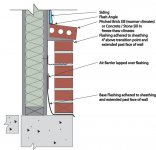
What I don't see used around here are weep holes in the brick veneer. Is that something not used in certain climates? I had planned to add flashing near the bottom between the sheathing and into the bricks. And weep holes with fabric behind. Do people worry the weep holes give a place for termites to come in.
 

Attachments

  • brickwainscot.jpg
    brickwainscot.jpg
    46.2 KB · Views: 26

The Wart

Member
Joined
May 18, 2015
Messages
13
Location
Maryland
I'm assuming by foundation you mean footers
Type s is fine for CMU below grade. The type is actually ok for CMU above grade but it is generally easier to just stick with s. Type m or a straight sand-Portland mix are unnecessary, and possibly detrimental. In general mortar should never be harder than the masonry unit it is being applied to. Also, the lime is what gives you the workability of the mortar, without it the cure time will be too rapid.
Rebar, my engineer normally specs #4 @ 24oc or #5 @ 32oc when the wall is unsupported, i.e. Whenever there is fill on only one side. Either way 6" drilled into the footer is fine. Also, you don't need to run them all the way up. They can be run into just the first course of block and then a vertical dropped into the core prior to filling it. The overlap of the two pieces of rebar in the grout provides the connection. It is also much easier to lay block without having to thread onto a vertical bar.
Wire mesh at least every other course.
Generally CMU below grade should be filled to protect from trapped water and freeze damage but that is obviously climate dependent.
The brick detail you attached is good and you absolutely should use weep holes, an air gap, and base flashing. Make sure the mortar dropping off the back of the brick doesn't plug your weeps.
Good luck and have fun
 
To avoid these ads, REGISTER NOW!
Top Bottom